Best Anchor Stocks has a partnership with Fiscal.ai (the research platform I personally use), through which you can enjoy a 15% discount on any plan. Use this link to claim yours! You’ll find KPIs, Copilot (a ChatGPT focused on finance) and the best UX:

You can read this article (almost) entirely for free. If you like what you read, consider becoming a paid member to get access to…
All in-depth reports (16 companies profiled thus far, and growing)
Earnings follow-ups
Other investment related content
A community of like-minded investors
Complete access to my portfolio and transactions
Occasional webinars
You’ll also get access to the 30+ page detailed report on the robotics industry.
The in-depth reports of Stevanato and Deere are also free to read to gauge the quality of the research. Other in-depth reports have been written about…
Deere (DE)
FRP Holdings (FRPH)
Five Below (FIVE)
Diageo (DEO)
Hermès (HESAY)
Atlas Copco (ATCO.B)
Stevanato (STVN)
Keysight (KEYS)
Zoetis (ZTS)
Judges Scientific (JDG.L)
Medpace (MEDP)
Trupanion (TRUP)
AAON (AAON)
BBB Foods (TBBB)
Eurofins (EPA.ERF)
Sabre (SABR)
Rosebank Industries (ROSE.L)
Undisclosed position
Undisclosed position

It was yet another interesting week in the market with “heat” appearing in the AI trade. I discuss what led to it and what lessons it can teach investors (myself included).
Without further ado, let’s get on with it.
Articles of the week
I published two articles this week. The first one was part 2 of my Rollins (ROL) vs Verisure (VSURE) series.
Rollins (ROL), Verisure (VSURE), and the cost of standing still (Part 2, Verisure)

This is the second part of my mini-series on Rollins (ROL) vs. Verisure (VSURE). I published the first part last week, where I discussed Rollins’ current situation, why I believe its business model is more fragile than many believe it is, and shared at what price I would consider starting a position. I’d recommend reading that part first as many of the comparisons below will build on it.
I go over Verisure and explain why I believe it’s a better business than it seems at first glance. I also explain how it compares to Rollins side by side; they are actually pretty similar businesses but at the same time very different (strange, I know, but I explain why in the articles). You can read part 1 here.
Rollins (ROL), Verisure (VSURE), and the cost of standing still (Part 1, Rollins)

Pest control and home alarms don’t sound like the most exciting industries in the world, but they share some interesting characteristics that any investor would appreciate. These characteristics make both companies very similar but very different at the same time.
The second article of the week was my ASML earnings digest.
My 2028 numbers

ASML reported, to nobody’s surprise, yet another strong quarter. Net sales came in at €11.7 billion (towards the high end of management’s guidance) and gross margin landed at 57.5%, well above the gu…
The company reported pretty good earnings. I go over those in detail and update my 2028 estimates with the new information management gave. I also triangulated what orders/backlog might look like through the first 3 quarters of the year even though we got no official reporting. You can find this in the X post below:


Without further ado, let’s see what the markets did this week.
Market Overview
It was a pretty negative week for financial markets. The S&P 500 (SPY) and the Nasdaq (QQQ) both fell pretty significantly, especially the latter:
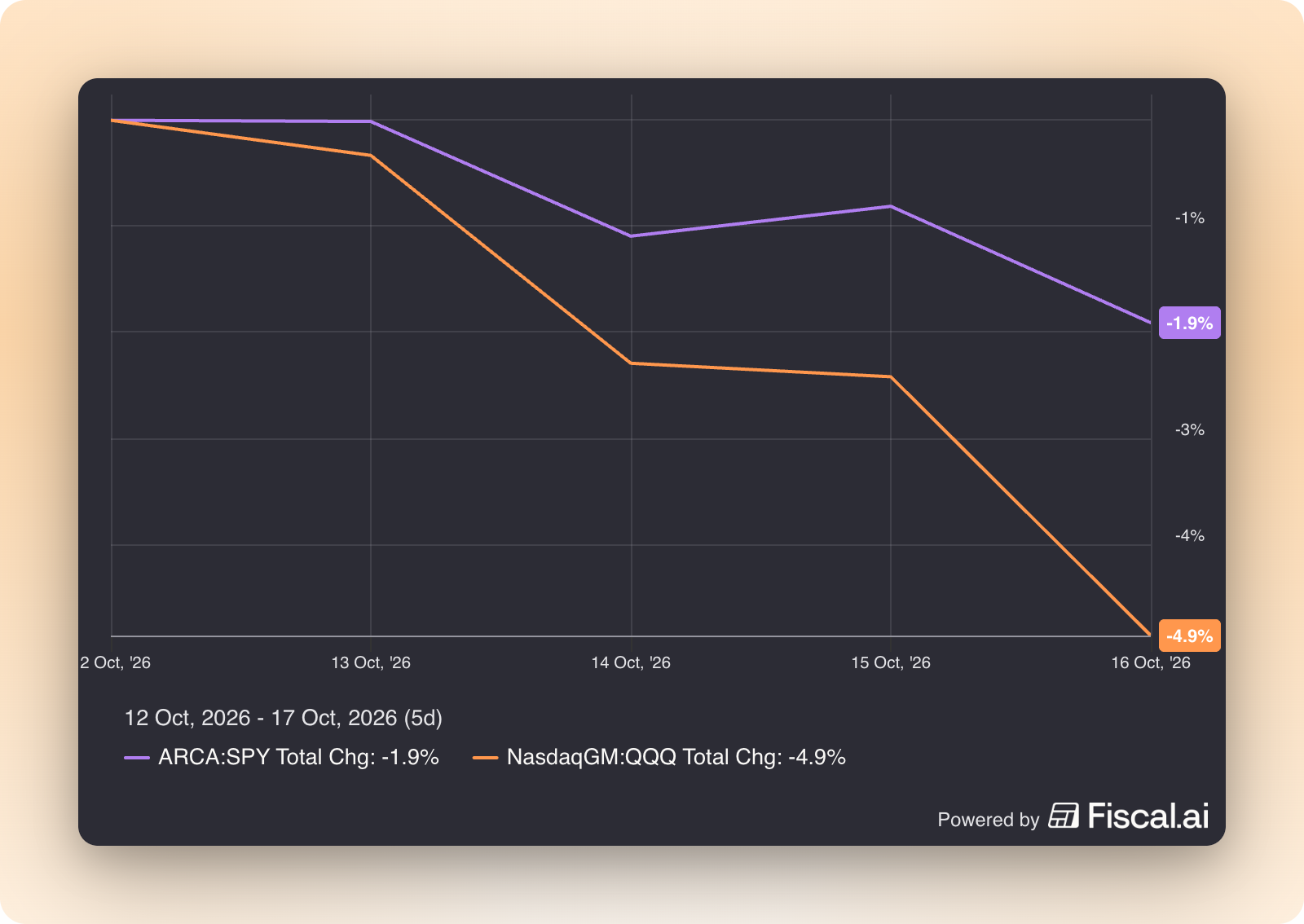
The drop was much more pronounced in the Nasdaq because of its heavier exposure to the AI trade, and there were several culprits…
Hotter-than-expected inflation data revived fears of rate hikes
Financing costs for AI infrastructure kept rising with CoreWeave’s bonds now yielding over 15%. Remember that in a previous NOTW, I discussed how it was “strange” to see rates going up with the AI trade staying strong because much of the infrastructure needs to be financed with debt (and the cost of debt was rising). Now, this CAN happen if returns still stay above the cost of capital and if much of the debt is issued by investment grade players (i.e., the hyperscalers). I don’t know if this is the case for neoclouds.
The most relevant news, though, was that Anthropic gave investors its first real look at the numbers ahead of its IPO (an IPO which is now rumoured to be delayed due to AI safety concerns). Q3 revenue came in at $16.8 billion, up roughly 45% quarter-over-quarter, and the company claimed it was already profitable on an adjusted basis (adjusted doing the heavy lifting here). Impressive at first glance, but not by the standard the market had priced in. The reality is that growth is slowing and the IPO valuation being discussed reportedly dropped from $2 trillion to $1.5 trillion. When expectations are sky-high, “great” can still disappoint. A tale as old as time in financial markets. Stocks that had run up considerably YTD sold off hard even though the magnitude of these drops is never as visible in the indices as it is under the hood. The unwind, however, has been severe enough to put some very large funds under pressure.
Rumors circulated this week that the VARA AI fund had blown up. This has not been confirmed (a person familiar with the fund said it’s “doing fine”), but the story is fascinating regardless. At the end of June, VARA reported $26.4 billion in AUM (assets under management) just 16 months after launching (the kind of things you don’t see at market lows tbf), run by a team of around 9-20 people. The fund lost 44% in July alone on this portfolio…
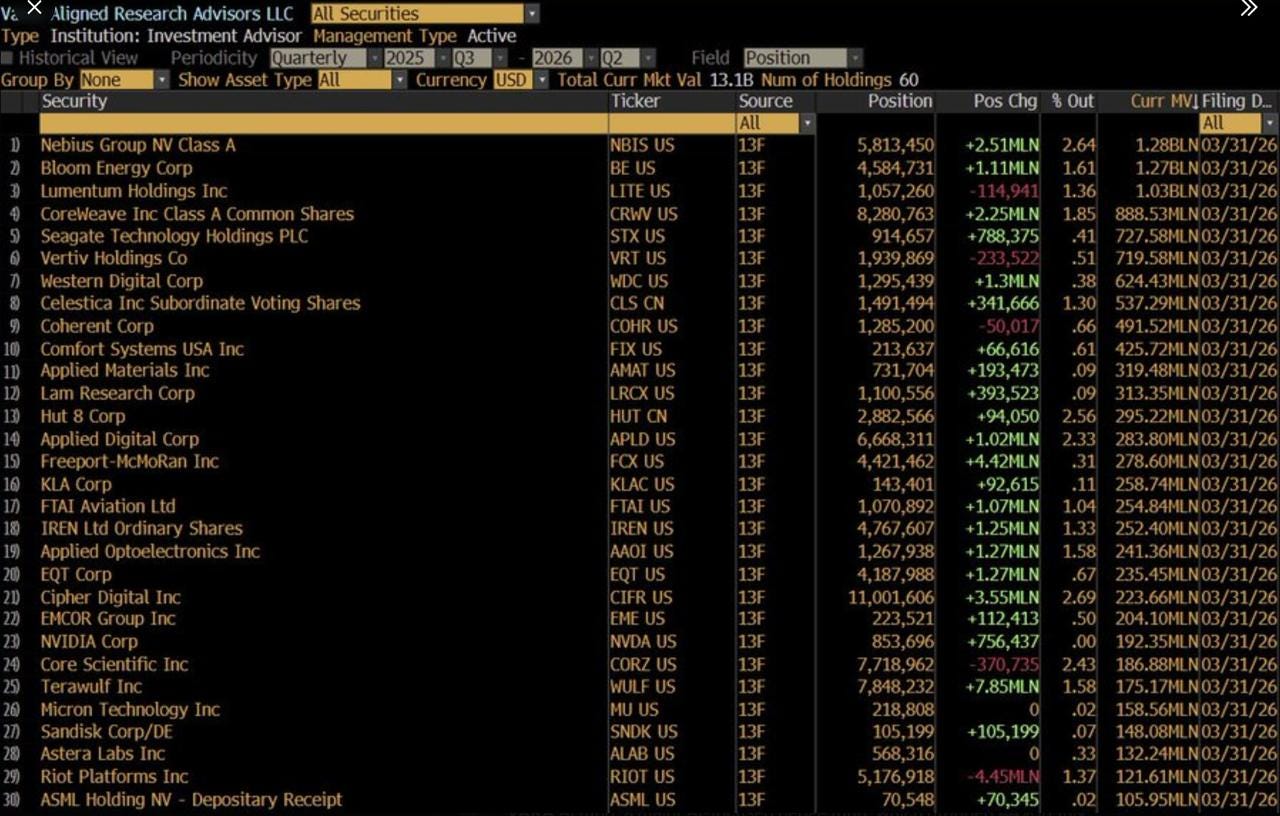
The above brings several lessons in diversification. Even though the portfolio held 60+ companies, it was all exposed to the same factor. And leverage always makes things more interesting. The fund’s latest filing shows around $9 billion in regulatory AUM, while the 13F reports roughly $40 billion in notional positions (largely through call options on Google, Amazon, and Nvidia). That’s 4x+ exposure to a single theme. This is something that a lot of people heavily exposed to the AI theme will learn eventually: diversification by name count means nothing if every position is the same bet.
Whether or not VARA has actually blown up, there’s an important lesson here about Wall Street. Even after July’s loss, the fund was still up 65% for the year, so the early LPs did fine. The ones getting hurt are the ones who arrived after the triple-digit returns, which is precisely when the AUM ballooned. The managers, meanwhile, are already rich. Why, because they get paid based on the size of the pot, and the pot was the biggest right before the drawdown. Where am I going with all of this? The richest people in this industry are not necessarily those who add the most value but those who were in the right place at the right time. In asset management, it’s enough to win big once because incentives are terribly misaligned with LPs and sustained value creation (especially during “mania” periods), but it is what it is.
This isn’t the first time we’ve seen this movie this year. In July, Leopold Aschenbrenner’s Situational Awareness lost 67% in a single month, ran into margin calls with leverage of nearly 4x, and had to forcefully sell its entire public stock portfolio to Citadel. The fund was still up 80% for the year afterward and kept its private holdings. Some people are now calling Leopold “unlucky”:


Running a concentrated, single-theme book at nearly 4x leverage and getting margin-called when the theme turns is not bad luck. It’s the predictable outcome of the bet and those who are making it probably know it! I don’t doubt that Leopold is incredibly talented (who am I to say otherwise), and to his credit, he told investors he’d removed all leverage. But the system rewarded the approach handsomely right up until it didn’t, and capital rushed in at the top. One shouldn’t feel too much pity for these types of managers. They are very rich, and the people who lost money were sophisticated investors who should have known what they were investing in.
Does all of this mean the AI trade is over? I have absolutely no clue. Anthropic’s numbers suggest demand for AI is very real, especially since Anthropic is now the only player in the AI-trade. This said, this week was a reminder that the businesses themselves can keep performing while the leveraged bets on them get wiped out (it’s always been this way!). Interestingly, money rotated into defensive sectors like healthcare and staples (my portfolio was green with markets significantly red), and if the AI trade does eventually go under, we’ll find out, as Buffett put it, who’s been swimming naked. That’s precisely why I do have exposure to the AI trade but have not gone crazy over it (surviving is objective number 1).
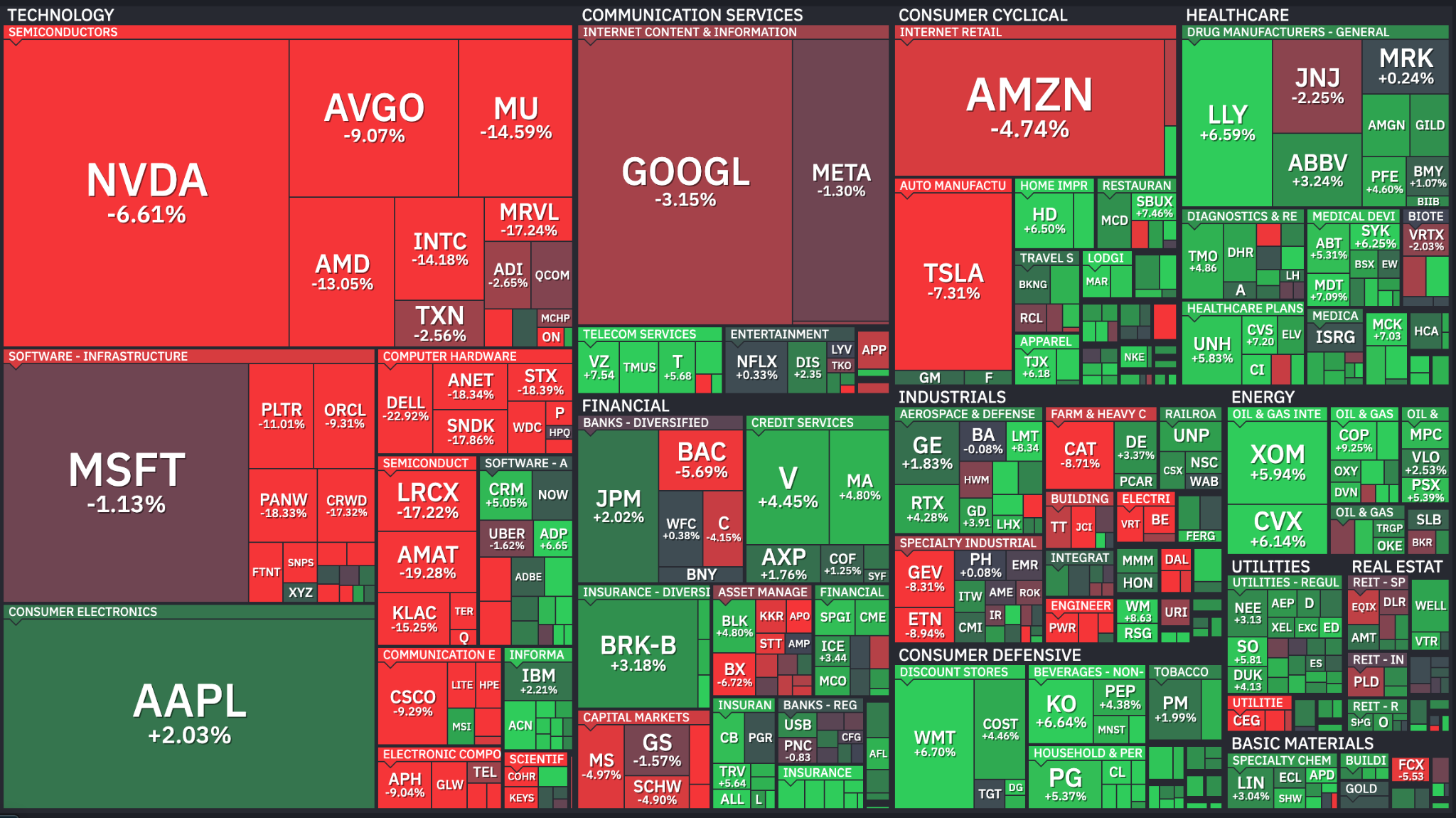
The industry map was very red in tech and green pretty much everywhere else:
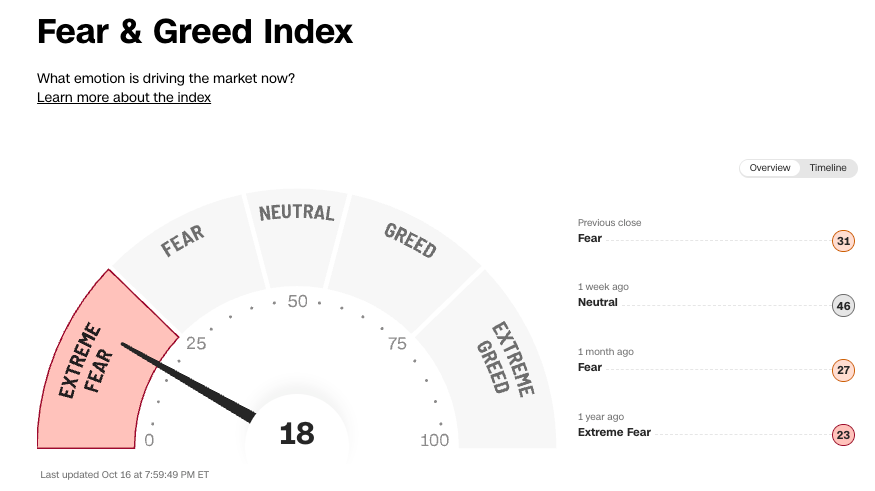
The fear and greed index dropped significantly and entered extreme fear territory:
Company-specific news