This is the second part of my mini-series on Rollins (ROL) vs. Verisure (VSURE). I published the first part last week, where I discussed Rollins’ current situation, why I believe its business model is more fragile than many believe it is, and shared at what price I would consider starting a position. I’d recommend reading that part first as many of the comparisons below will build on it.
Rollins (ROL), Verisure (VSURE), and the cost of standing still (Part 1)

Pest control and home alarms don’t sound like the most exciting industries in the world, but they share some interesting characteristics that any investor would appreciate. These characteristics make both companies very similar but very different at the same time.
In this article I’ll provide some thoughts on Verisure, the “unknown compounder”.
Verisure is an interesting business because it doesn’t get the same attention as Rollins does despite arguably enjoying somewhat more interesting characteristics. This (not a lot of attention + attractive unit economics) tends to be an interesting set-up, especially since we can compare the current Verisure to what the company might look like in 5 years (i.e., we somewhat have an idea of what the market might be willing to pay for the company in 5 years).
While Rollins doesn’t tell you what it costs to “stand still,” Verisure does provide all the information necessary. In the remainder of this article I’ll go through Verisure’s unit economics, what each customer is really worth, the risks that come with its model, its valuation, and how it stacks up against Rollins head to head.
What Verisure does
Verisure is the European leader in monitored alarms. The company operates in 17 countries across Europe and Latin America, and ended Q2 2026 with 6.38 million subscribers (+9.4% YoY) paying an average of €48.2 per month (i.e., monthly ARPU). Revenue was €3.75 billion in 2025 (+9.9% YoY) with annualized recurring revenue now standing at €3.6 billion.
Let’s dig a bit deeper into what the company actually does. In a nutshell, the company sells professionally installed and monitored alarms to homes (82% of customers) and small businesses (18%), mostly in Southern Europe: Iberia, Italy and France alone are around 63% of revenue. Verisure typically receives two payments from its customers:
A one-time upfront installation fee to cover the hardware
A recurring monthly subscription that covers 24/7 monitoring from Verisure’s own monitoring centers, verification of each alarm (photo, video or audio), response (calling the police or sending a guard), maintenance and customer care.
Management summarizes what Verisure offers in four words: deter, detect, verify and intervene. The key point here is that, despite subsidizing hardware, Verisure is a service business, not a hardware business. This makes it more comparable to Rollins without being identical. The way I like to see this is that around 90% of revenue is recurring, with the hardware acting like the entry ticket to the subscription. The company is the undisputed leader in 13 of its 17 countries, with its portfolio being more than five times larger than the second player across its footprint. This seems somewhat relevant in an industry characterized by scale economies.
One thing that stands out from the outset is how management “discloses” the business. While Rollins bundles both activities (the acquisition machine + the recurring business), Verisure choose to split itself into the two halves of the “machine”:
Portfolio Services (i.e., the existing customer base): ~87% of revenue, with a 73.7% adjusted EBITDA margin in 2025 (74.1% in Q2 2026). This is the company’s cash cow and the asset that likely drives most of the current valuation. Unlike Rollins’ relatively high churn, Verisure reports a churn rate that ranges between 6%-8%.
Customer Acquisition (i.e., the acquisition machine): this segment is loss-making by design (−€723 million of adjusted EBITDA in 2025) because installation fees are kept low and most of the cost of winning a customer is paid upfront. This segment’s goal is to bring customers into “portfolio services” where the company can “milk” them for an average of 13-15 years.
Adjacencies: smaller products sold outside the core alarm, ~3% of revenue and not really relevant for today’s discussion.
Management is ultimately telling investors how much the portfolio earns, how much it spends to grow it, and how much it spends just to replace the customers who leave. This means we can actually answer the “two questions that matter” which if you recall are...
How many customers leave each year?
How much does it cost to replace them?
CPA vs RMC, the two key variables
The entire Verisure business model comes down to two numbers, with the good news being that management is pretty conservative in how it calculates both:
CPA (cost per acquisition): what Verisure spends, net of installation fees, to put one new alarm on a wall. It includes sales, marketing, the hardware and the installation. It’s basically an “all-in” metric that shows how much the company spends on acquiring a new customer
RMC (recurring monthly cost): measures what it costs to serve that customer each month (monitoring, guards, maintenance, customer service). ARPU minus RMC results in EPC (Earnings Per Customer), the monthly adjusted EBITDA per customer.
RMC is not as conservative as it should probably be. RMC is an operating cost, so it doesn’t include maintenance Capex. Replacing equipment at existing customers (including the ongoing 2G/3G upgrades) is reported separately as Portfolio Services Capex, below EBITDA. This means the ~74% Portfolio Services margin overstates what the base really earns on a steady state. Deducting roughly €2.7 per customer per month of portfolio Capex (2025) from an EPC of €35.7 (Q2 2026) leaves an “all-in” portfolio margin of roughly 68% of ARPU. It’s also true that this number is somewhat depressed by the 2G/3G upgrades, which should fade after 2030, but the conclusion stands: Verisure owns a very profitable base business that continues to enjoy positive margin incrementals.
By dividing CPA by a year of EPC we get to what management calls the Acquisition Multiple, which is equivalent to the payback period in years. Acquisition multiples have historically ranged between 3.6x-3.8x meaning that Verisure takes around 4 years to pay back its CPA:
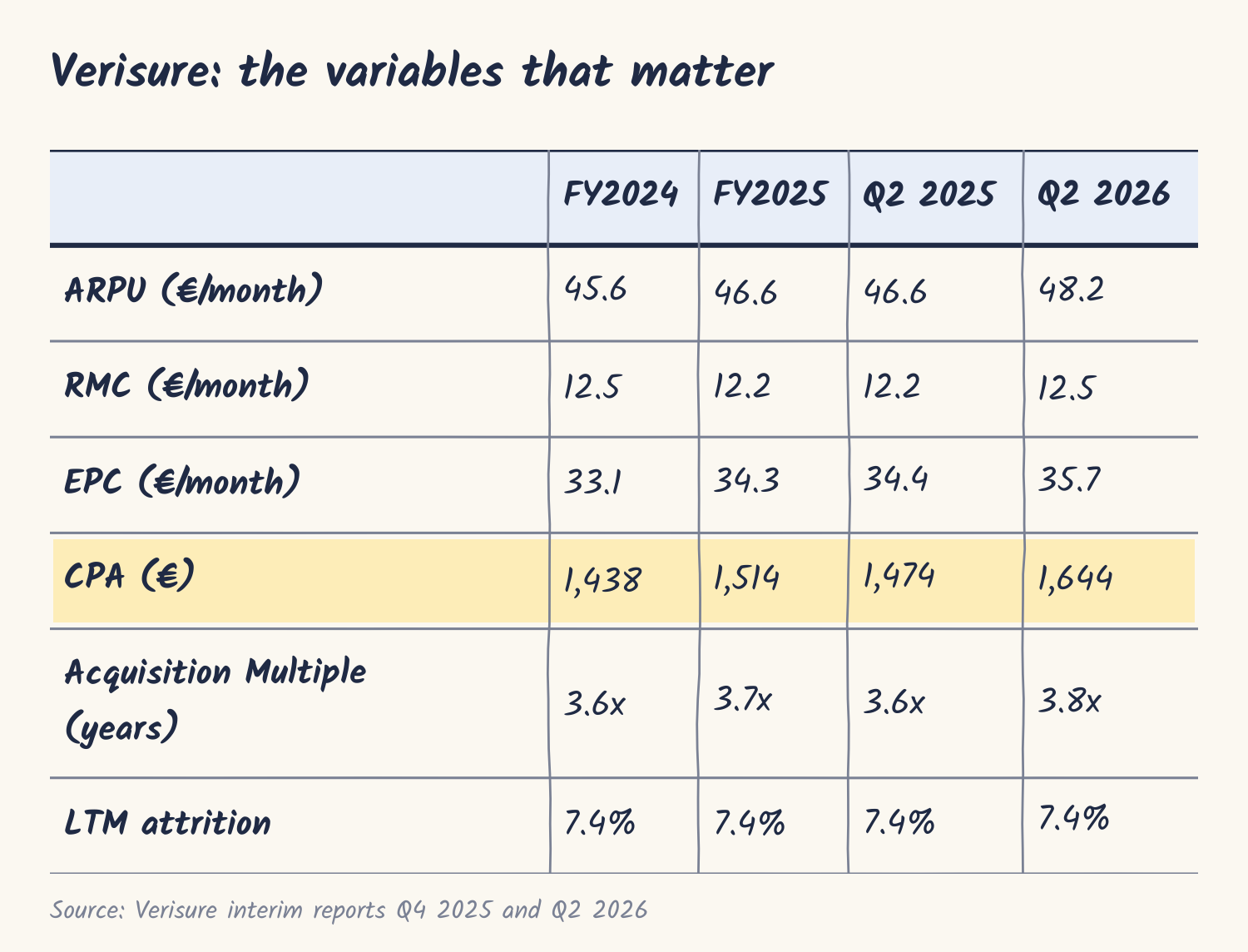
The nice thing about the business comes after those 3.8 years. Customers tend to stay on average 13-15 years with the company, so Verisure ultimately earns 9-11 years of EPC as “pure” profit. This customer longevity results in pretty appealing returns.
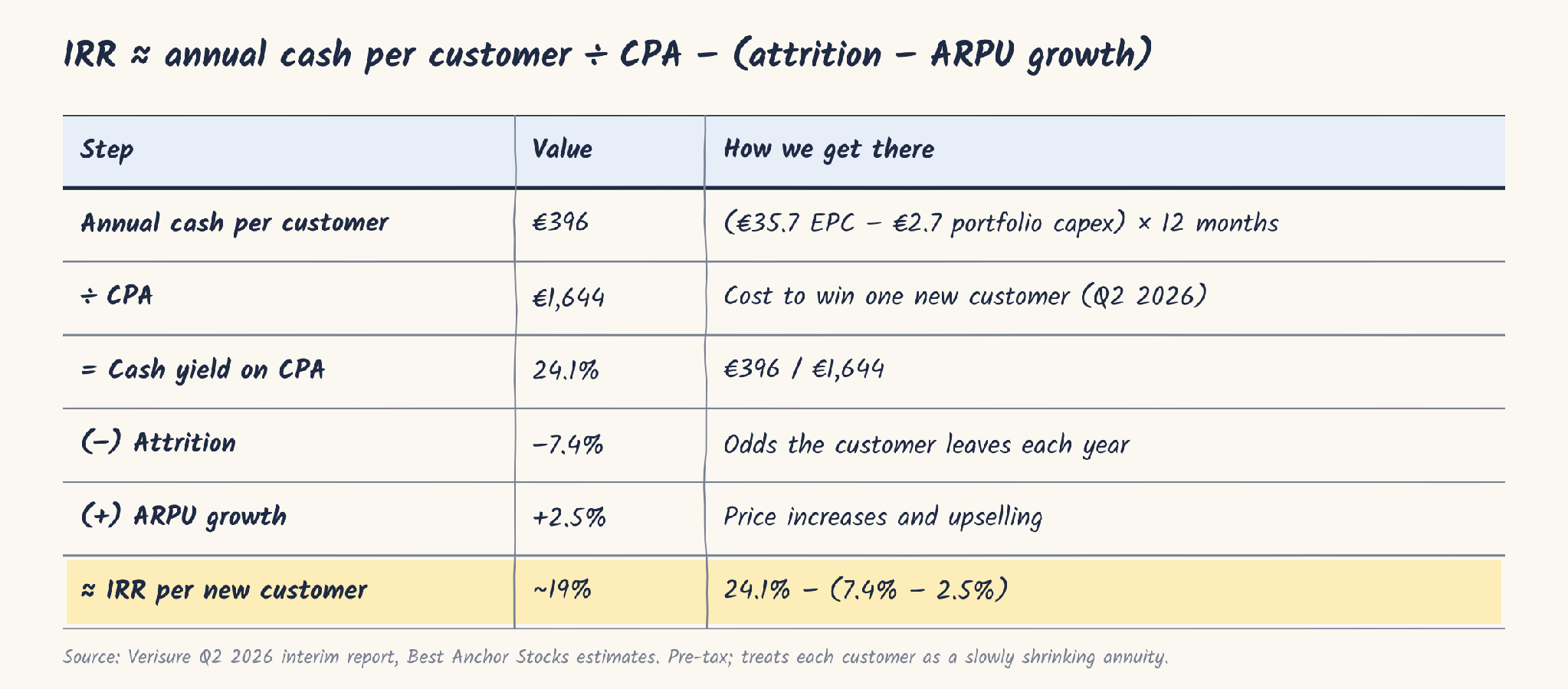
As you might have already imagined, the variable that makes everything “click” and that makes this business different to Rollins is churn. With 7.4% disclosed attrition, management estimates the average customer stays around 15 years. They claim this translates into a ~20% IRR on each new acquired customer, a claim that we can actually verify. Think of each new customer as a stream of cash pulled in two directions:
The cash per customer grows every year thanks to price increases and upselling (~2.5% ARPU growth over time)
On the other hand, the odds that the customer is still around shrink every year because of attrition (7.4%).
If we net both out, the cash a cohort of customers generates shrinks by roughly 5% per year. This means that a simple model that treats each customer as a slowly shrinking annuity should help us understand whether management’s returns claim makes sense. Using Q2 2026 EPC (€35.7) minus ~€2.7/month of portfolio capex (2025, including 2G/3G upgrades), each customer generates roughly €396 a year. Against a €1,644 CPA, 7.4% attrition and 2.5% ARPU growth, that’s a ~19% pre-tax IRR, right in line with management’s claim:
The problem is that EPC and CPA are moving variables, so we must stress-test the IRR to understand how sensitive it is to these variables:
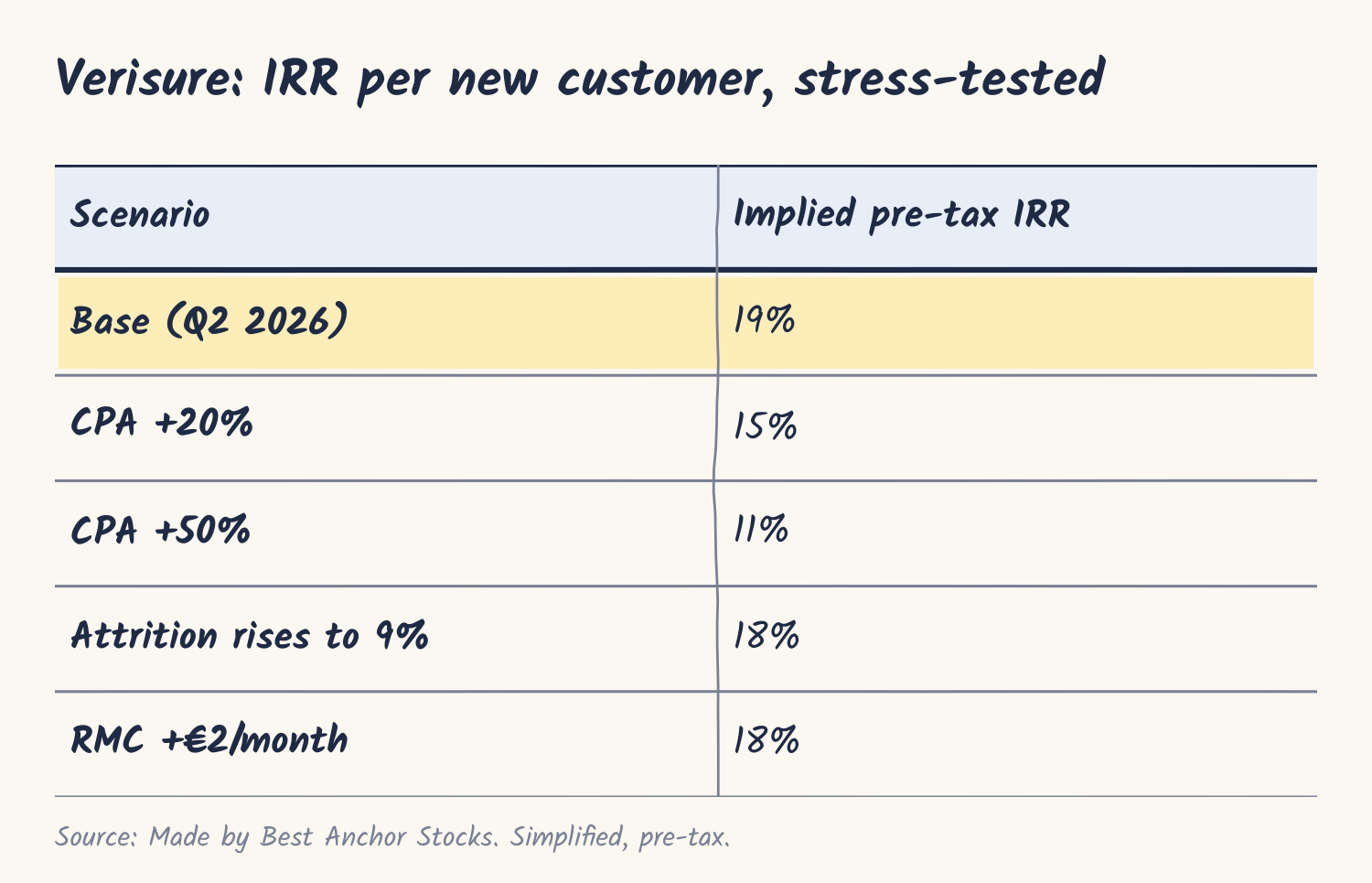
The good news is that CPA would need to rise more than 60% (to ~€2,650) before a new customer stops clearing a 10% hurdle rate. This is ultimately the cushion that Verisure has at its disposal thanks to its customer longevity (15 years). The case for Rollins is markedly different. With its much higher churn, a similar rise in acquisition costs would hurt the unit economics a lot more because the pest control giant spends considerably more on replacing churn than Verisure does.
All this said, the CPA trend is worth watching as the Acquisition Multiple has drifted from 3.6x to 3.8x. It does seem like a slow squeeze on a very profitable investment and not a threat to the model per se, but CPA seems to be rising for everyone due to AI-driven search. Recall that, in part 1, I explained why AI-led search seems less of a risk to Verisure:
When someone asks a search engine or a chatbot “who should I call about ants in my kitchen?”, the answer is increasingly a short list of names with an explanation rather than a list of blue links with Orkin as the top result (this was the “Google Search” era). For Rollins, that list will often include local operators with good reviews competing on equal footing with Orkin. Pest control is a local, fairly standardized service, and Rollins competes against a huge tail of small companies. An AI answer that compares options, prices and reviews in one place flattens the brand advantage Orkin has historically bought through advertising.
I believe (even though I don’t have proof) that Verisure is in a significantly different position. A monitored alarm with guard response isn’t something a local handyman can offer because it requires 24/7 monitoring centers, licensing (in Spain and France, for example, a connection to the police), a field network and scale. In most of Verisure’s markets there are only a handful of credible alternatives, and Verisure is usually the leader. It’s also a considered, high-trust purchase where brand matters more and where Verisure relies heavily on its own sales force and telesales rather than on winning a single search query. The bottom line is that an AI assistant asked for “the best home alarm in Spain” is far more likely to name Verisure than an assistant asked for “pest control near me” is to name Orkin.
The interesting tug-of-war between CPA and EPC
What makes these two variables interesting is their interplay: CPA is growing faster than EPC. In Q2 2026 CPA rose 9.8% at constant currency (6.7% excluding the Spanish rebrand), while EPC rose ~4%. Management blamed media inflation and lower operating leverage on fixed sales costs (branches, sales salaries) but it should nevertheless sound familiar because it’s the same digital-lead inflation that hit Rollins. The key difference lies in what happens to Verisure’s base.
Verisure’s RMC has been remarkably stable over decades. It was roughly at the same level it is today in 2004 (wow) which means that, in inflation-adjusted terms, RMC has come down very significantly over time.
Management guides for roughly 1% annual cost-out over the long term through scale, its “Fit for Growth” program, and several AI initiatives. There was a small uptick in Q2 (+1.2%) but it needs context; it came from integrating ADT Mexico. Excluding Mexico, RMC fell YoY, again. So while acquiring customers is definitely getting more expensive for Verisure, serving its installed base is getting cheaper in real terms.
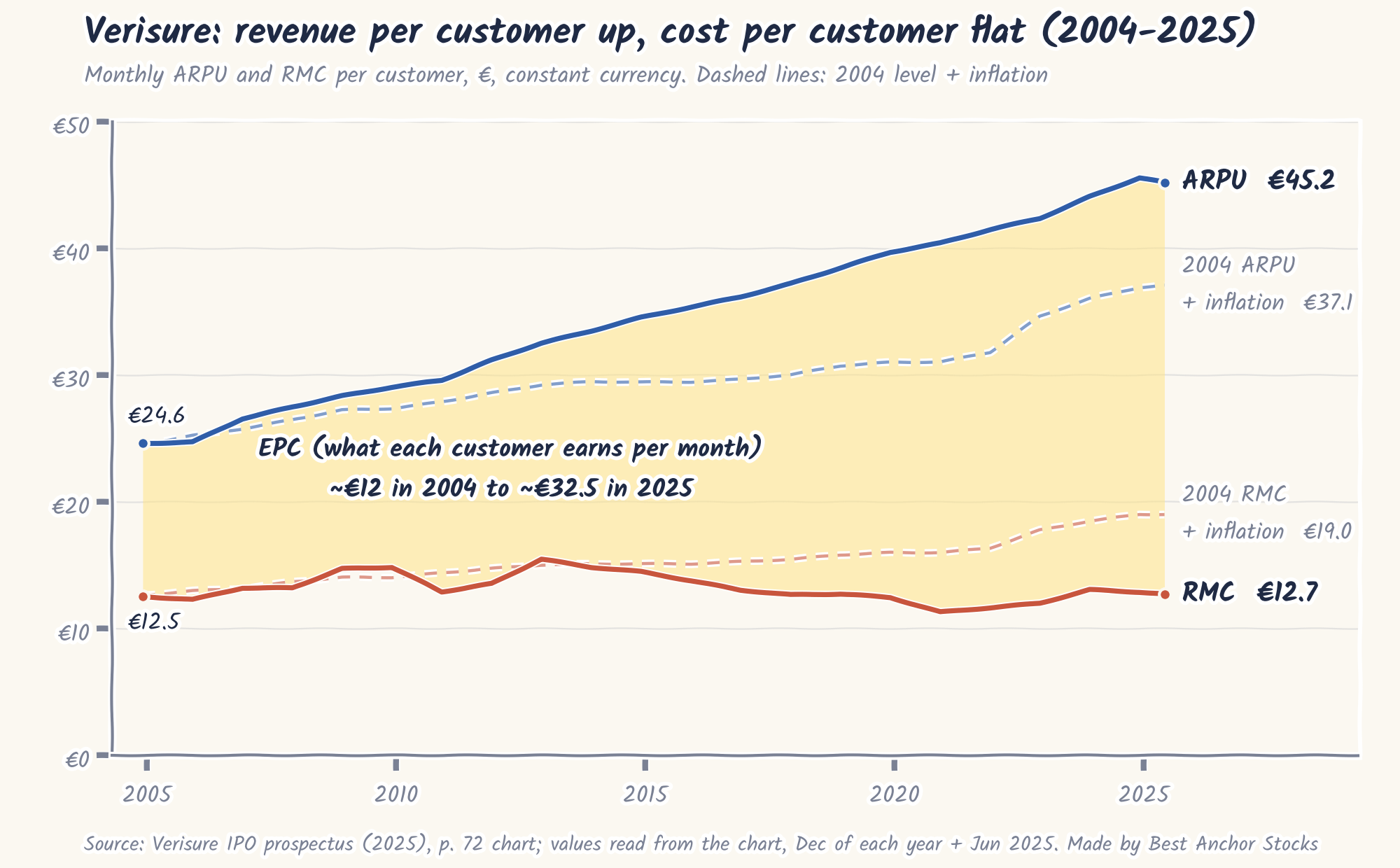
ARPU has kept rising 2-3% per year, which one could consider in line or slightly below inflation. For any other business this would be not great, but for Verisure that 2-3% can be considered a REAL price increase (due to RMC remaining flat) and therefore pretty profitable. What does this mean in layman terms? That Verisure’s base of customers is becoming more profitable over time even as the cost to acquire new customers rises. This is relevant because each new customer is acquired at the portfolio services margin, meaning that the company can somewhat protect itself from a rising CPA using its RMC leverage.
The capital intensity problem
One question should’ve crossed your mind by now...
If the unit economics are this good, why isn’t Verisure already a “cash machine”?
The answer lies in the capital intensity of the business model; Verisure needs to eat a lot of capital up front to grow organically. Group Capex was 26.2% of revenue in 2025 (29.8% in 2022), and that’s only the part that gets capitalized. If we add what Verisure expenses through the income statement, the company spent €1.69 billion gross (€1.32 billion net of installation fees) acquiring customers in 2025. That’s 35% of revenue, net, spent on the sales engine.
The beauty of Verisure’s disclosure (which is something one doesn’t get with Rollins) is that it splits the spend into two buckets:
Replacing customers who left (analogous to Maintenance Capex)
Growing the base (Growth Capex)
Here’s how cash flow should be interpreted:
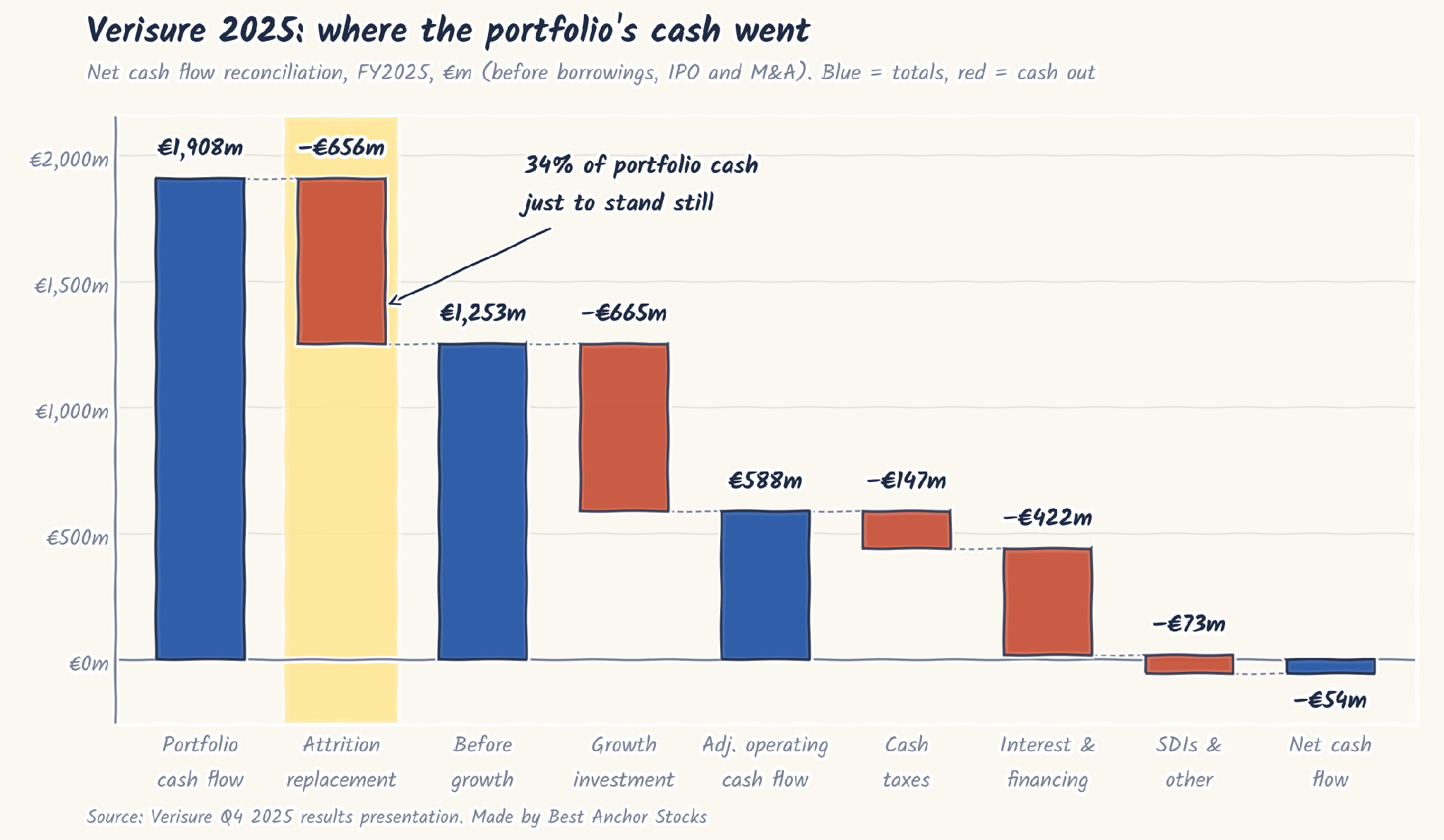
A few things should stand out:
€656 million went to attrition replacement. We can simply triangulate this figure by multiplying cancellations times CPA. That’s 34% of the cash the portfolio generated before customer acquisition, or 17.5% of revenue. This is Verisure’s true maintenance Capex, and it’s exactly the number Rollins doesn’t disclose outright, something we don’t really need to know that it’s proportionally higher.
Another €665 million was pure growth investment. Verisure could, in theory, turn this off and milk its customer base. The interpretation is that, if the company had chosen not to grow organically, pre-growth cash generation over the last twelve months would’ve been ~€1.4 billion. In FY 2025, pre-growth operating cash generation was just under €1.3 billion.
The portfolio is outgrowing its own appetite for growth (good news). The Portfolio Reinvestment Rate (acquisition spend divided by portfolio cash flow) went from 72% in 2019 to 61% in 2024, 59.6% in 2025 and 57.3% in Q2 2026. The bigger the base gets, the more cash is left over after funding growth even when facing CPA increases. What does this ultimately mean? That the CPA/RMC dynamics we discussed above seem favorable to Verisure.
Management has been quite vocal about the reinvestment rate as a cash flow lever. The CFO called the portfolio reinvestment rate “an important metric for us“ because...
“As our portfolio grows in profitability and cash generation, a progressively smaller proportion of portfolio cash flow is reinvested into new customer acquisition”.
He laid this out in a recent call (Q4 2025):
“The cash generated from our portfolio is growing faster than the cash deployed to acquire new customers, this is particularly pronounced in more scaled markets, and we see this trend continuing in the future”.
It’s one of the three “structural improvements“ (together with working capital and financing costs) behind the guidance to be free cash flow positive in 2026. In the Q2 2026 call, the CEO also commented that the improvements should also fund “additional shareholder returns beyond 2026“. The inflection is becoming increasingly apparent in the numbers:
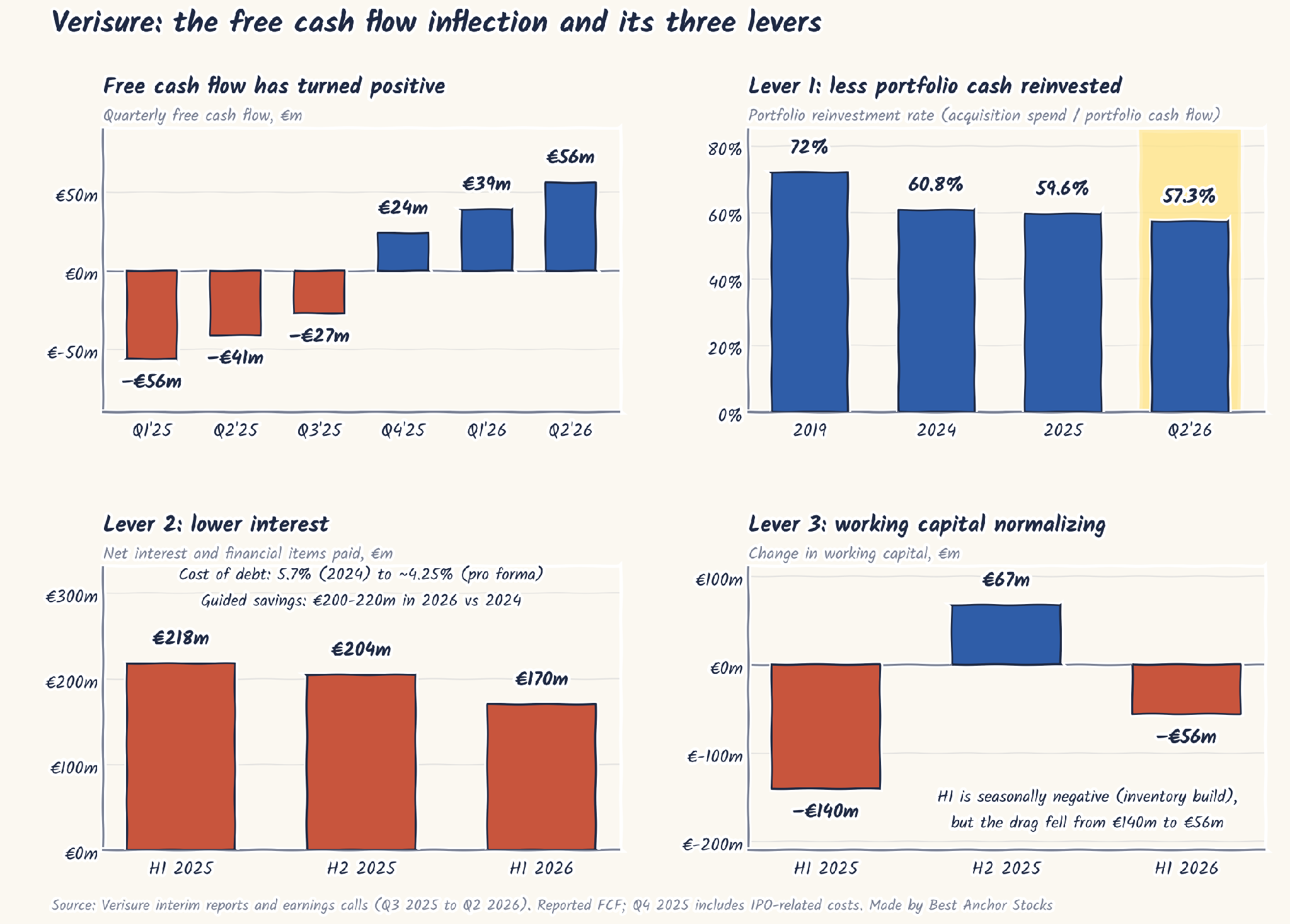
Besides for the interest rate, we don’t really have much guidance on how these will move, but the trend seems pretty obvious. So much so that management has hinted at increasing capital returns to shareholders, both through dividends (first discussed in the Q2 2026 call) and maybe buybacks (still TBD):
We see clear scope for additional shareholder returns beyond 2026 as free cash flow continues to accelerate. We’re coming through the 2G/3G upgrade program, the Spain rebrand, and continued reduction in the portfolio reinvestment rate. Once leverage settles at our medium-term target of 2.5x, we see a clear pathway to return further capital.
This leads to what I believe should become the central “dilemma” for anyone looking at Verisure (it is for me at least): it is an incredibly cash generative business if it stops growing, but it’s very unlikely to stop growing anytime soon. If management keeps reinvesting ~€650-700 million a year to grow the base, the cash generation capacity of thus business never really shows up in shareholders’ pockets. If it stops reinvesting, the cash shows up but growth disappears.
So at first glance it feels like you can only have one of the two and you really don’t know what will make the market/investors happy. What a long-term investor should want is pretty obvious...If Verisure is able to continue earning a 19% pre-tax IRR on its customer acquisition activities, you’d want the management team to reinvest as much as possible. Why? Because it’s tax efficient and it’s a pretty decent return! Simultaneously, you’ll likely not want to enter the continuous loop of never seeing the company’s real cash generative capacity. Recall that a business that grows 10% per year, returns no cash to shareholders, and goes bust in year 10 is worth...zero. I don’t think the “dilemma” between growth and cash generation is unique to Verisure (every company has it), but it does seem a tad more pronounced due to its business model.
The good news for Verisure’s shareholders is that the company is gradually proving that you don’t need to choose one or the other, you can maybe have both! Free Cash Flow is inflecting as the portfolio scales, so Verisure is increasingly reinvesting aggressively while it generates incrementally more cash.
For now, investors have to trust the reinvestment. The value creation shows up in a bigger and more profitable portfolio rather than in reported free cash flow, and a sponsor-controlled company has every incentive to keep pushing for growth. The growth runway remains long, with penetration of monitored alarms in Europe remaining still at only around 5% of homes (evidently the TAM is not 100% of homes and I’ll discuss this in more detail later).
In my humble opinion, this interplay between reinvestment and cash flow is a feature rather than a bug, but only as long as the IRR on new customers stays well above the cost of capital. The day CPA inflation erodes that spread, the right answer flips from “grow” to “harvest”, and one would expect management to be disciplined enough to make that call.
A unique set of risks
I think that, as a recent IPO, dividing the company’s risks between those specific to the stock and those specific to the business makes sense. Let’s get the “stock risk” out of the way first.
The sponsor overhang
Verisure is still controlled by its pre-IPO owners. The company listed on 8 October 2025 at €13.25 per share, but only around 26% of the company was sold in the IPO. As of 31 December 2025, the largest shareholders were:
Hellman & Friedman: 43.7%
Eiffel Investment (linked to Singapore’s GIC): 16.0%
Alba (Corporación Financiera Alba): 6.3%
Securholds: 5.4%. This is the vehicle of Luis Gil, a long-time Verisure executive and current board member. It bought about €185 million of shares in the IPO at €13.25, and the lock-up specifically allowed it to pledge its shares as collateral for the debt used to finance that purchase. This is a stake worth watching with the stock around 40% below the IPO price: share-backed loans usually come with loan-to-value covenants, so a further drop could force a sale regardless of what the fundamentals say.
Management and former employees: about 3% (the CEO alone holds about 1%)
The above simply shows that roughly 70% of the shares are held by investors who will, sooner or later, want to sell (or at least have the option to). At today’s share price, H&F’s stake alone is worth around €3.7 billion, close to half of Verisure’s market cap. The lock-up calendar looks like this:
180 days for the large shareholders (H&F, Eiffel, Alba, Securholds): expired in early April 2026, so they can already sell. It’s a “known issue” by now.
365 days for board members and senior management: expires right about now (October 2026), with other management shares released in phases over the following 3-12 months.
Orderly marketing agreement until October 2027 (extendable in six-month increments up to October 2029): sales by existing investors need H&F’s consent and are typically coordinated through block trades.
The practical implication is that supply is likely to come in chunks through block trades, which are usually priced at a discount and might weigh on the share price for a while. Until H&F (and probably Eiffel) are meaningfully out, the stock is likely to trade with a cloud over it. This doesn’t (or shouldn’t) make it uninvestable (does anyone here remember what happened once TBBB’s lock-up expired?), and there are two mitigating factors. First, H&F chose not to sell in the IPO (most of the deal was a primary raise used to pay down debt). This means that, if they weren’t in a rush to sell at €13, they may not be in a rush to sell at €8. Second, every sale increases the free float, which over time improves liquidity and index eligibility. This is a risk to the timing and the share price, not to the business, and from a long-term investor’s POV it may well be the reason the stock is cheap in the first place.
Rollins has a version of the same problem. The Rollins family group still controls about 38% of the shares, and it has started to sell: LOR (the family vehicle) sold 20 million shares at $57.50 in November 2025 (Rollins bought back $200 million of them which in hindsight doesn’t seem ideal), after a first secondary in 2023. That sale came with a 365-day lock-up that expires in November 2026. The difference is one of scale: Rollins has a much larger free float to absorb sales, while at Verisure most of the company could still change hands.
The economics: front-loaded costs, back-loaded returns
The second risk is somewhat built into the company’s operating model. Verisure pays about €1,650 upfront for every new customer and needs almost four years of EBITDA to get its investment back. The real money is made through customer longevity, as these tend to stay 15 years on average. This means that the cost is front-loaded and the payback is back-loaded, which ultimately means that anything that shortens customer life hits value that has already been paid for.
That said, I’d make a couple of caveats:
The model is fairly robust when looked at per customer. Because the payback (3.8 years) is so short compared with the customer life (15 years), the IRR doesn’t collapse if attrition rises. Attrition going from 7.4% to 9% only takes the IRR from 19% to about 18%. This makes CPA the much more relevant variable. The real damage comes from customers who leave before the four-year payback, which is why minimum contract periods (12-36 months in many markets) and the upfront fee matter.
The real impact comes at the group level. Every extra point of attrition on a 6.4 million customer base means about 64,000 more cancellations, and replacing them at today’s CPA costs roughly €105 million more per year just to stand still. In the table below you can see how this impacts “no-growth owner earnings” (i.e., the cash Verisure would generate in a steady state):
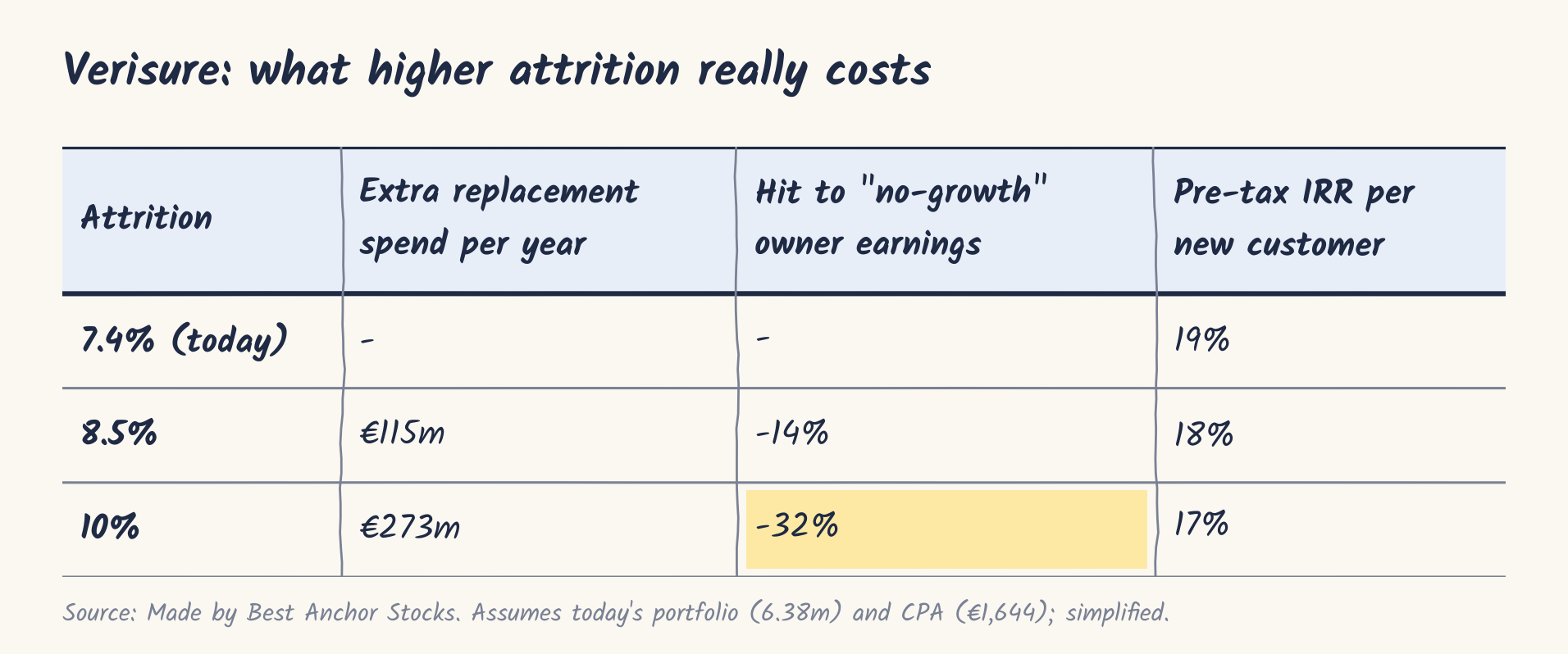
In short, a jump in attrition wouldn’t destroy the unit economics, but combined with the company’s leverage it could wipe out a third of the cash flow available to shareholders, and that’s before any CPA inflation. In all fairness, attrition has been quite stable throughout Verisure’s history, but some things that could trigger it are a deep recession (management points to Spain’s resilience during the financial crisis, but the base is now much more international), cheaper DIY alternatives (cameras like Ring, or Verisure’s own Arlo), or service quality slipping as the company pushes for margin. The mitigant is that Verisure could cut its €665 million of growth investment quickly to protect cash, a lever Rollins doesn’t really have without shrinking.
TAM and what ADT tells us about mature state economics
Before I hinted at what Verisure should look like when it matures: the no-growth owner earnings. The interesting thing is that we have a pretty good example on the other side of the Atlantic to really understand whether our approximation is directionally correct. ADT is the largest monitored security company in the US, has almost exactly the same number of customers as Verisure (~6.1 million vs ~6.3 million), but their financial statements and KPIs look like night and day:
ADT’s revenue grew ~2% in the last year and its monitoring revenue (the equivalent of Verisure’s portfolio) barely grew 1.4% in 2025. The subscriber base is actually shrinking (6.1 million vs 6.4 million a year ago, partly due to a divestiture). Four potential reasons explain this growth trajectory:
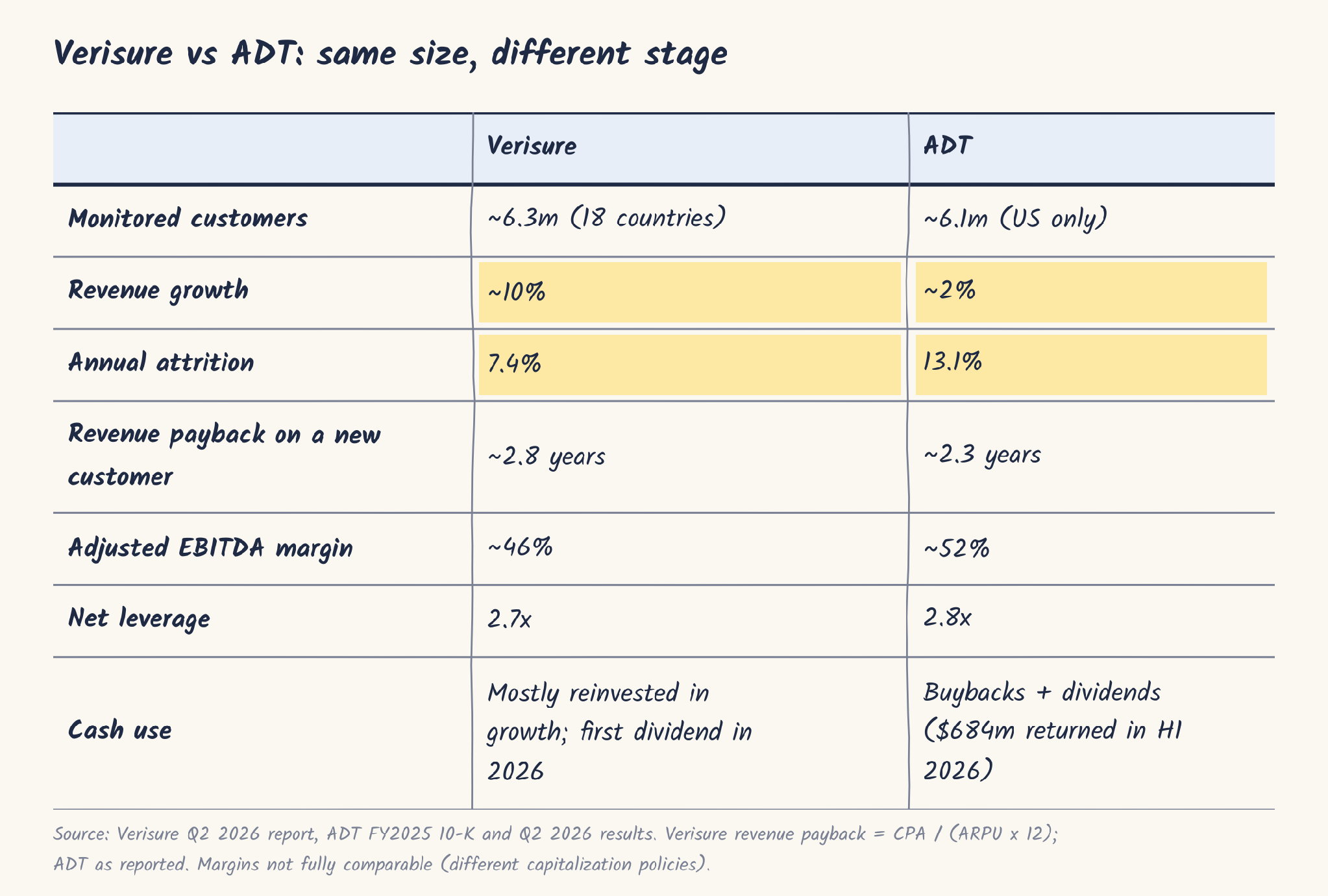
Churn eats almost all the growth. ADT loses 13.1% of its revenue base every year, almost double that of Verisure. It added ~190,000 customers in Q2 2026 (~760,000 annualized), while 13% attrition on 6.1 million customers means roughly 800,000 cancellations every year. In layman terms, ADT is running on the same treadmill as Rollins: most of what it spends on sales just replaces customers who left. Relocations (Americans move much more than Europeans), non-payment and price-driven cancellations are likely the main culprits.
A mature and crowded market. Monitored alarm penetration in the US is around 23% according to Verisure’s own estimates (vs ~5% of homes in its European footprint), and ADT competes with pro-installed alternatives (SimpliSafe, Xfinity, Vivint, Brinks) as well as DIY players like Ring (Amazon), SimpliSafe, Arlo or Wyze.
You might wonder why the penetration gap is so large between the US and Europe. There are a couple of reasons I can think of, but interestingly crime isn’t one of them. According to Verisure, many of its European markets actually have higher burglary rates than the US.
The gap comes down mostly to structural reasons. First, housing type. Most Americans live in detached houses with many entry points, while around half of Europeans live in flats (even more in Spain or Italy), which feel safer and have historically been harder to address. Second, insurance: US insurers commonly offer premium discounts for monitored alarms. Third, price and history: the US market developed decades earlier, with a huge dealer network and cheaper monitoring plans, which turned alarms into a mass-market product. Lastly, police rules: several European countries require alarms to be verified before police are dispatched, which raises the cost of the service and limits low-cost offers.
Expensive growth channels. A good chunk of ADT’s additions came from dealers, affiliates and bulk purchases of customer accounts, which are more expensive and less sticky. Management is now actively pulling back from these channels.
A cash cow mindset. ADT returned $684 million to shareholders in the first half of 2026 alone (buybacks and dividends, including buying part of Apollo’s stake as it exited). The business is run for cash rather than for growth, which is rational when the returns on growth are lower.
The most telling data point is that ADT has launched “ADT Blue”, a cheaper DIY product line sold on Amazon, to compete for “value-conscious” customers it had never targeted before. Even the US leader has had to go down-market to defend itself against Ring! Its medium-term targets (1 million more subscribers by 2030, attrition down to 11%) show that the strategy is now to stop the bleeding rather than to grow aggressively. Everything that I’ve discussed here about ADT is important to keep in mind for later when we take a look at the valuation.
Other competitors
Beyond DIY (Ring), Verisure competes with two main groups. The first is other professionally-monitored players, a fragmented category with more than 70 providers across its footprint (Sector Alarm, Movistar Prosegur Alarmas, EPS Homiris, Nexecur, IMA Protect and Orange Maison Protégée in Europe, ADT and Prosegur in Latin America), many of them affiliated with banks or telcos. The numbers seem to clearly favor Verisure against these players: management estimates it held around 37% of the installed base of professionally-monitored systems across its footprint at the end of 2024 (up from 28% in 2019), and across its top 10 countries it’s on average 2.7x larger than its nearest competitor. Despite these being company estimates, the direction seems obvious and scale seems to be reinforcing: the leader can outspend everyone else on marketing and innovation while spreading monitoring centers, guards and IT over a much larger base (hence the falling RMC discussed earlier).
The second is telcos, banks and insurers, which already have a relationship with the customer and could bundle security into it at a lower monthly price (Telefónica and Orange have re-entered the category in recent years in Spain and France). Verisure has turned part of this threat into a new sales channel: its partnership with BPCE (one of the largest French banking groups) has scaled nationally, and in April 2026 it launched a partnership with MasOrange in Spain. Management says customers coming through these alliances come in at Verisure pricing, with attrition in line with or better than the group’s (they are pre-qualified and often bundled with a mortgage or an insurance policy).
So Verisure doesn’t face a “long tail” of local competitors the way Rollins does, and its main competitors in each market are few and smaller. One would think that entry barriers to alarms is higher than it is to pest control, and while this is true, it also comes with a greater deal of technological disruption risk.
The DIY risk
The most relevant thing that comes with the ADT analogue is that it shows what happens when a market matures and cheap DIY alternatives become good enough: the low end of the market moves to DIY, the cost to win a professionally monitored customer goes up and growth stalls. The 7.4% vs 13.1% churn gap suggests that Europe is structurally different, but the question is whether the same could happen to Verisure as its markets mature.
In Europe, DIY is, imho, the most interesting competitive threat Verisure faces. Cheap connected cameras, video doorbells and self-installed kits (Ring, Google Nest and a growing list of Chinese manufacturers) let people monitor their home from their phone for a fraction of the price and without a contract. Verisure itself flags in its prospectus that a shift in consumer preferences towards self-monitoring could lead to pricing pressure, higher attrition and a higher CPA, and that big tech (Amazon, Google, Apple) could decide to push further into the category.
There are a few reasons why I believe this threat is real but manageable:
It’s a different product. A camera tells you something happened; Verisure’s offering is built to deter, verify and send someone (a guard or the police). The customer who wants the latter is unlikely to settle for a notification on his phone at 3 a.m. although I must say that ADT proves that DIY disruption should 100% be taken seriously.
Regulation works in Verisure’s favor. In many of its markets, alarm hardware must be certified, installation must be done by a certified professional and maintenance is mandatory. On top of that, in France the police only respond to alarms that have been professionally verified, and in Spain they require video, audio or personal verification (otherwise they only respond after three alarms in 30 minutes). A self-monitored kit simply doesn’t get you the response that you are looking for.
Verisure owns a DIY brand itself. if part of the market moves to self-monitoring, Verisure participates through Arlo, even though it would most likely be at worse economics. The fact that management acquired Arlo is likely a confirmation that the DIY risk is real.
Where I think DIY should be a real concern is at the low end of the market. The price-sensitive customer who might have bought a cheap monitored alarm may now just buy a couple of cameras and, while this is unlikely to show up in the existing base; it would show up as a slowly rising CPA (more effort to convince each customer) and fewer gross additions in Verisure’s more mature markets.
Is penetration perennially low?
Verisure’s bull case relies on the fact that only ~5% of European homes have a monitored alarm, vs ~23% in the US. But a low penetration rate is not the same thing as a large addressable market even if management makes it seem this way. There are a few things that make me somewhat skeptical of the “untapped market” narrative:
The category itself isn’t growing that fast. According to Verisure’s own estimates, the installed base of monitored alarms in Europe grew at around 4-6% per year between 2019 and 2024. Verisure has grown faster mainly because it captured around two-thirds of the category’s growth, i.e. by taking share. In Spain, its most mature market, it already holds 63% of the installed base, so share gains can’t continue forever and the underlying industry is not in hyper-growth mode.
There may be cultural and economic reasons behind the low penetration. A ~€48/month subscription is a significant expense for many European households, homeownership patterns differ (more apartments, which have historically been harder to address) and the perceived need for security varies a lot by country. Penetration has indeed been rising for decades, but it has done so slowly.
Is the company’s expansion outside of the core a tell? If the opportunity in core markets were truly unlimited, why buy ADT Mexico (from Johnson Controls, not from ADT Inc.) (~125,000 customers) and expand in Latin America? Even though this is a fair concern, Latin America does make sense in its own merits. Penetration is even lower than in Europe and safety concerns are higher, which led to category growth of ~11% per year between 2019 and 2024. With ADT Mexico, Verisure bought an immediate #1 position for €207.5 million. This gave management 125,000 customers and resulted in a CPA of €1,660 which is right in line with what they spend organically. This is definitely not the case for Rollins, which tends to pay considerably more for customers acquired inorganically.
The realistic scenario probably lands somewhere in between a mature state “local” business and a fast-growing international business. Verisure’s European business probably converges slowly towards a more mature profile (lower growth, more cash returned), while Latin America, new product categories (LockGuard, Guardian, Seniors) and pricing keep total growth going for a while. The good news is that even the “mature” end-state, as ADT shows, is a ~50% EBITDA margin business that returns a lot of cash. The bad news is that the market won’t pay a compounder multiple for it, so the key question for the investment case is how long Verisure can keep growing at ~10% before it starts to look like ADT. Let’s address this.
Is Verisure a buy after its 40% drop?
Verisure listed at €13.25 per share in October 2025 and has had a rough first year as a publicly traded company. The stock trades at around €8.20, near its all-time low, which puts the market cap at ~€8.4 billion and the enterprise value at ~€13.3 billion (with €4.9 billion of net debt).