


Pest control and home alarms don’t sound like the most exciting industries in the world, but they share some interesting characteristics that any investor would appreciate. These characteristics make both companies very similar but very different at the same time.
It’s highly likely that you have come across the kinds of products Rollins and Verisure sell. The similarities between both businesses begin in the nature of the product/service they provide: pest control and alarms are considered critical expenses for homeowners because they make up a low portion of a total household’s budget but help protect a valuable asset. These characteristics translate into somewhat steady demand and relatively low churn (”relatively” is doing the heavy lifting here). Even though these businesses are unlikely to meet many investors’ description of a subscription-like business, I must say they look a lot like one.
Rollins and Verisure are characterized by a similar compounding machine/business model that can be subdivided into two “engines”:
A base of customers who pay regularly
A sales engine that has to keep refilling that base as customers leave
The core concept is identical across both businesses but the interplay between the variables that matter varies markedly and dramatically changes the unit economics. This is why I believe that putting both side by side is a very interesting exercise.
Yet another thing that’s markedly different is the valuation of both businesses. Comparing earnings-based valuation multiples makes little sense here because both companies expense things differently, so I’ll have to graphically plot their EV/sales multiples. Even after its recent drop, Rollins trades at a 15-20% premium to Verisure both on an EV/sales and EV/(EBITDA-Capex) multiple basis. The premium was as large as 50%+ earlier during the year, but Rollins has derated to a greater extent than Verisure. This multiple compression has been likely driven by a similar concern which I’ll discuss in more depth later:
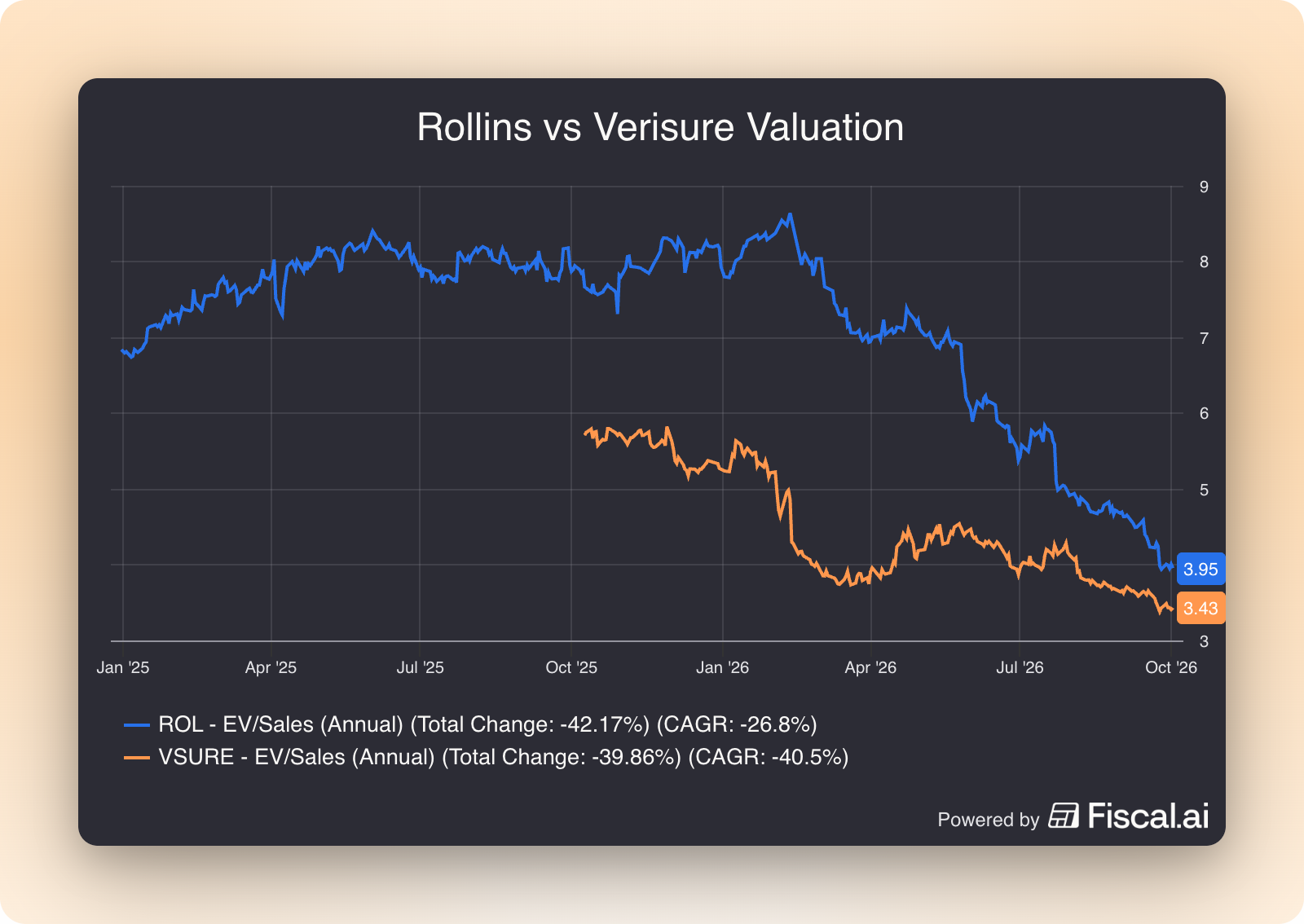
The interesting question here is whether Rollins’ valuation premium justified. Investors must try to answer two questions before aiming to answer this:
How much does it cost to win a customer?
How long does that customer stay?
Arriving at the answer to this question is not as straightforward as it seems. Both Rollins and Verisure have a “good” and a “bad” side just like all businesses do, and it should be up to investors to judge whether their “good” and “bad” justify the valuation premium/discount. The first thing that stands out is that one of these companies is willing to help you answer the questions above, whereas the other does not.
Rollins has undoubtedly been one of the great compounders of the last few decades, but the stock is down almost 50% over the last twelve months. The reason (imho) lies in a cost that most investors never look at: what does it cost Rollins to stand still? Verisure, which listed in Stockholm in October 2025, is the opposite case. It looks capital-intensive and leveraged at first glance, but it discloses its customer economics in so much detail that you can actually do the math and understand what you are paying for.
Today’s article focuses on Rollins, the known compounder. In part 2 of this mini-series I’ll go over Verisure, the unknown and new (to financial markets that is) compounder.
Rollins (ROL): outlining the unquestionable
Rollins is the largest pest control company in the US. Orkin is its flagship brand, but the company can really be considered a house/portfolio of brands (HomeTeam, Fox, Saela, Northwest and dozens of local names) serving more than two million residential and commercial customers. With 75% of revenue being “recurring” services spread across millions of customers, I believe one is not making a mistake by treating Rollins as a subscription-like business. This in and of itself doesn’t make a business great, though.
The company’s track record speaks for itself. Rollins grew its revenue from $1.57 billion in 2016 to $3.76 billion in 2025, a ~10% total revenue growth CAGR that was tilted to the organic side (organic growth CAGR was above 7% between 2022 and 2025). Acquisitions filled the delta and have consistently added around 2-3% of growth per year (has been higher lately). Rollins takes advantage of the fragmentation and local dynamics of the pest control industry when it comes to M&A, something that’s not as large as a growth lever for Verisure.
No matter how skeptical one wants to be, there’s plenty to like here. I believe that the “good” of this business has been widely discussed by many, so I’ll make a quick summary of what I believe to be the “good” and will jump right into what I believe many are missing.
Let’s start with the good:
Good growth and resilient demand. The company has managed to grow at a double digit clip for many years while enjoying HSD organic growth. The demand for its services also seems very resilient (both in the residential and commercial side) through “tough” economic periods, so the company has not only been a good grower, but also a consistent one.
The Rollins family is still involved with the business, although management is currently “professionalized” and the family has began periodically selling shares. These sales are not bad per se, but they can potentially create a supply overhang on the stock (this is a much more relevant topic for Verisure).
Route density as the moat. Pest control is a local business with every extra customer on an existing route being almost pure margin. The rationale is that the truck, the technician and the branch are fixed costs so, in theory, the bigger you are in a given zip code, the harder you are to beat on cost. While this is true, I believe people have mixed up these dynamics with operating leverage. I believe Rollins has less operating leverage than many appreciate, and I’ll explain why later.
A fragmented industry. The fact that the industry is made up of thousands of mom-and-pops (more than 30,000 according to Rollins’ CEO) means there’s a long M&A runway for a consolidator like Rollins. In 2025 alone Rollins closed Saela plus 26 other deals.
It looks very capital-light (”looks” is doing the heavy lifting here). Rollins generated $650 million of free cash flow in 2025 on $855 million of adjusted EBITDA (22.7% margin). Reported Capex was roughly $28 million, less than 1% of revenue. At first glance it looks like this business doesn’t need capital to grow, but one would be very wrong in assuming this is true.
A conservative balance sheet. Leverage stands at ~1x EBITDA, which seems pretty low for such a recurring business. While I don’t expect Rollins to “lever up” significantly, I believe the low leverage does increase the runway to return capital to shareholders.
This is exactly the type of business I like at first glance, but the problem is that I don’t necessarily agree with several of the above, at least not to the extent many people do. This (imho) makes Rollins a worse business than many believe it is.
What’s not to like?... A couple of things
Even though one is constantly bombarded on social media about how cheap Rollins is after the recent fall, the reality is that it might well still be expensive. The halo effect dominates financial markets: when a stock is doing well, everything from the management team to the moat seems perfect. On the flipside, when the stock is doing poorly, everything seems to be going terrible. Aristotle used to say that “virtue lies in the middle” and I believe this is largely applicable to investing. The only caveat is that “stock price bias” is real and therefore we might be more inclined to think negatively about a stock when price is heading south. With the goal of being transparent, I will tell you that this might well be the case here! Still, I do think the business model is more fragile than many people think it is.
Let’s start with the most obvious concern, albeit not the most worrying.
Capital-light… or simply expensed?
Rollins barely capitalizes the cost of winning a customer. Apart from a small amount of sales commissions ($34 million amortized in 2025), digital leads, advertising, sales salaries and door-to-door reps all run directly through the income statement. Selling and marketing alone was $485 million in 2025, 12.9% of revenue. Even though expending everything directly through the income statement is conservative accounting (i.e., good), it does imply that the sub-1% Capex figure hides the real reinvestment needs of the business. The most relevant implication, though, is that a big chunk of what’s spent/reinvested isn’t spent on growth but rather on replacing existing customers.
The way to think about this is that, if Rollins stopped its sales and marketing activities tomorrow, the customer base would start shrinking immediately at a pretty concerning clip. The money spent to keep the business flat should economically be considered maintenance capex, but for Rollins it just happens to sit in Opex. This said, the real “worrying” part lies in churn and the cost to replace the existing base.
Churn and the rising cost to replace customers
Rollins doesn’t report a retention rate in its filings. Management repeats every quarter that retention is “strong” and “stable” but they indirectly provide a number to triangulate churn. At the May 2026 Investor Day, the CFO said the following:
“The average customer life in our residential business is four to five years and commercial customers stay 10 years or more”.
A four-to-five-year customer life implies residential churn of roughly 20-25% per year. Combining both residential and commercial results in a blended churn rate of around 15%-20%. This churn rate stands out (as high, that is) and management acknowledges the concern:
“We just lose way too many customers every year, and we’re making investments in that as well.”
Ken Krause, Rollins’ CFO, during the Q1 2026 earnings call
Residential pest control is a business where customers move, switch to DIY or simply cancel after a quiet season, so churn is structurally much higher than Rollins’ historical track record would suggest. I must say that it caught me by surprise when looking at the business. The key question is not whether churn is high, though (we know it is), but the key question is rather...
Why does this matter so much?
Because the business model is quite sensitive/exposed to it. The short summary is that, the higher the churn, the more of your sales effort goes into running to stand still. One could consider these investments “unproductive” in the sense that they are not made to grow and I’d say few shareholders would want to see a good chunk of money being reinvested into maintenance. Let’s do some simple math. Say Rollins wants to grow its business by 5% per year and currently experiences 15% churn. The company would have to grow 20%, with 75% of this growth being just “maintenance” growth:
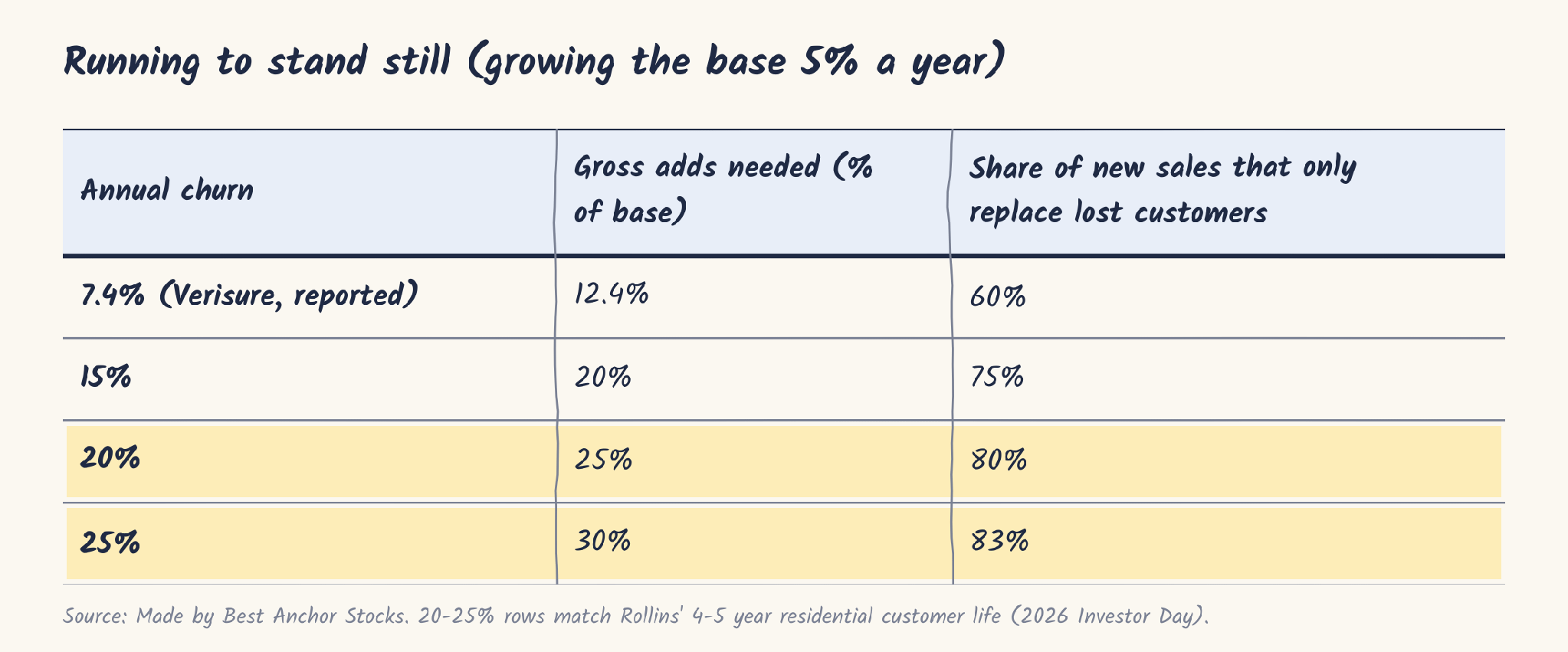
The simple way to interpret this is that, with a residential churn of 20-25%, four out of every five residential customers Rollins acquires simply refill the base. This means that growth is very dependent on the acquisition engine running at full speed all the time, and the cost of that engine becomes the key variable of the whole investment case.
Rollins doesn’t disclose a CAC (customer acquisition cost), but we can more or less approximate it with the information we are given. The company spent around $2.07 per $1 dollar of organic growth in FY 2025. This cost has been steadily rising and marked a new high in H1 2026: $2.37:
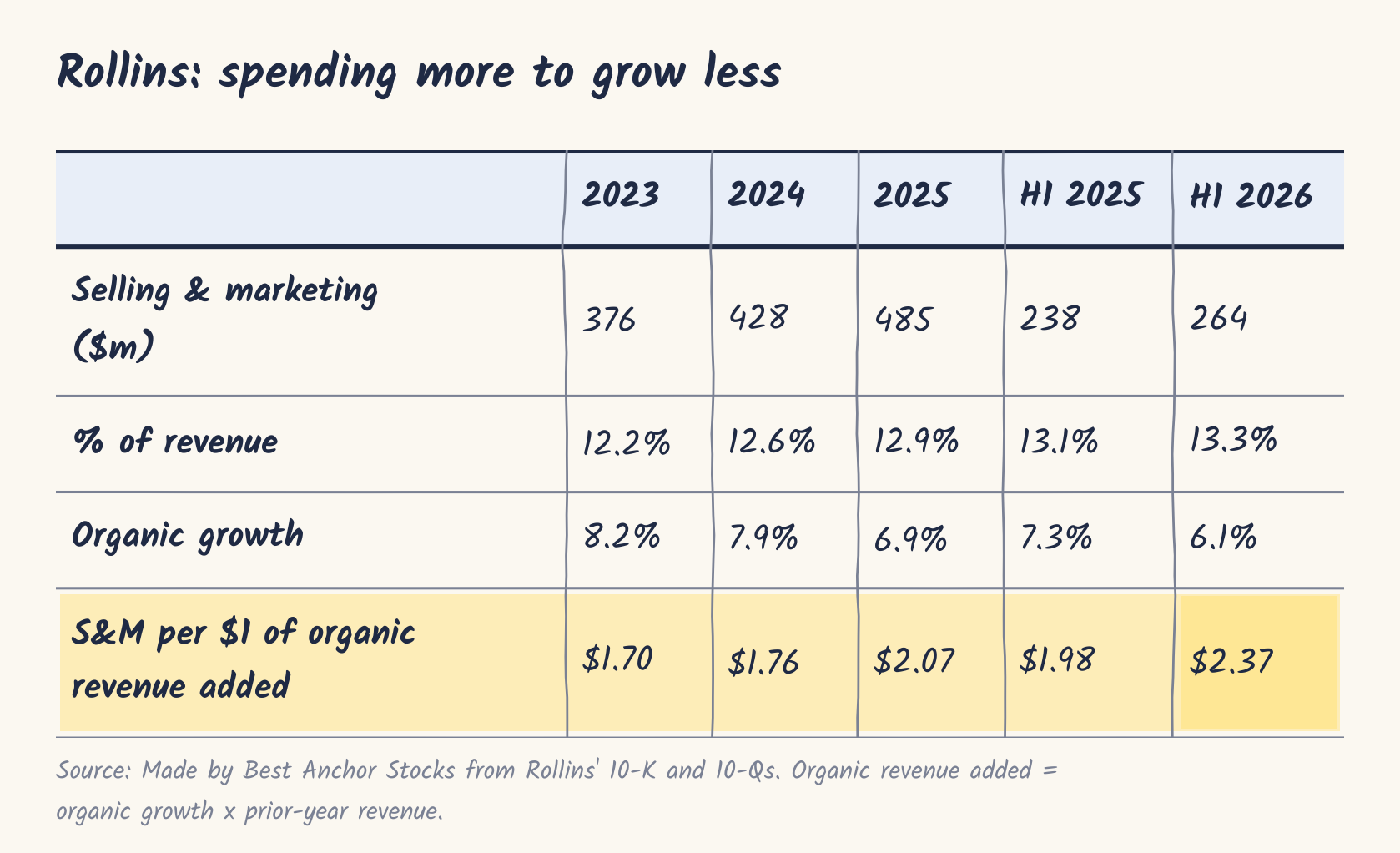
The bottom line here is that Rollins is spending more and more to grow less and less. Selling and marketing grew 13-14% per year in 2024 and 2025 while organic growth decelerated, and the result is that the cost per dollar of organic revenue is up about 20% in two years. This dynamic is especially dangerous when one considers that a good chunk of said investments are “unproductive” in the sense that they simply refill the base. So, not only does Rollins need to spend a good chunk of S&M in standing still, but standing still is becoming more expensive! This is not the best news when thinking about incremental returns.
Management itself said at the Investor Day that it has increased selling and marketing by 200 basis points of revenue over the last few years, paid for by cutting G&A. G&A leverage is a valid source of funds...but it eventually faces a limit. Rollins is not the only company disclosing higher media costs by the way, but this trend matters deeply for Rollins due to its relatively high churn.
All of the above has become evident in Rollins’ EBITA incrementals, which have disappointed even the pessimistic...
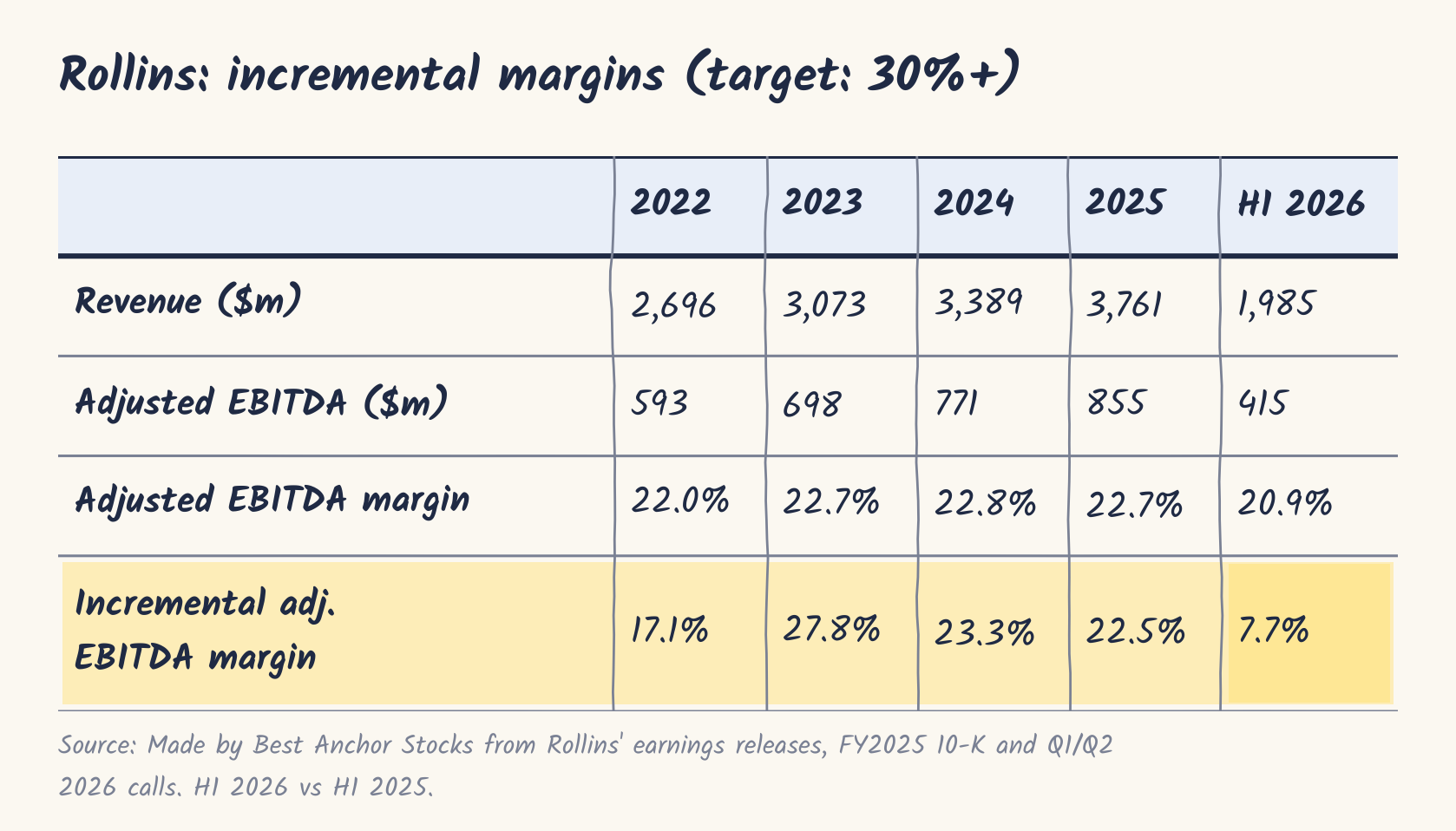
...but the higher CAC is not the only reason behind this trend. I also believe that Rollins’ model is less scalable than what many people believe it is.
There’s operating leverage in route density, but it’s not unlimited
The route density advantage is real and I’m not going to be the one to negate it, but it doesn’t mean that the business model is very scalable. The rationale is that a technician can only do so many stops in a day and a truck only carries one technician. This means that, once a route is full, the next customer doesn’t come for free: it requires another technician, another truck and, eventually, another branch. So, ultimately, the cost base looks fixed while you fill a route, but over any meaningful period it becomes a step-variable, growing more or less in line with the number of customers you serve.
The numbers seem to back this up. Between 2023 and 2025 Rollins’ revenue grew 22%, yet gross margin only went from 52.2% to 52.8%, and employee costs in cost of services stayed flat at 31.0% of revenue in both 2024 and 2025. Operating margin barely moved (19.0% in 2023, 19.3% in 2025). The problem is that the reverse happens when volumes disappoint; the business suffers operating deleverage. In Q2 2026 “service salary de-leverage” was one of the main reasons gross margin fell 100 basis points. This doesn’t seem like the ideal asymmetry.
If every new route needs a new technician, keeping technicians becomes just as important as keeping customers (not really, but you get it, it’s important). Employee expenses in cost of services were $1.17 billion in 2025 (31% of revenue), and Rollins has around 22,000 employees. The problem is that it loses a significant chunk of its employees early on (retention in year 1 is estimated at 50%). In management’s own words...
“We lose way too many technicians in the first year”
The good news is that those who make it past year one tend to stay 10, 15 or 20+ years. At the 2026 Investor Day, the company put a “price” on these dynamics...
Rollins spends roughly $15,000 to onboard each new teammate, money that is lost when they leave within the year.
Retaining just 1,000 more teammates would save almost $15 million, and fixing technician turnover is worth $15-20 million a year, or 30-40 basis points of margin.
First-year retention improved 8% in 2025 and nearly 18% since 2023, so progress is being made, but from a low base.
So labor is not only step-variable, it’s also leaky: to add one technician to a route, Rollins often has to hire more than one. In the pest business, employee churn feeds customer churn because it’s a relationship business, but the opposite could be said as well: employee retention feeds customer retention. Rollins itself links the two: talent retention “enables a better customer experience and improved customer retention”. But hold on, there’s news also on this front.
The FTC (Federal Trade Commission) added yet another “headwind” in 2026. In May 2026 Rollins agreed to an FTC consent order after the agency alleged that it required nearly all of its roughly 18,000 US workers (including technicians, sales staff and customer service reps) to sign non-competes barring them from working in pest control within a 75-mile radius for two years. Under the order, Rollins can only use non-competes for senior executives with equity, must rescind existing ones for everyone else, and its customer non-solicitation clauses have been narrowed, with compliance reporting for 10 years.
Management calls the FTC concern “totally overblown” and says the order won’t have a material impact. The CFO argued that first-year leavers quit because “this is a really tough job”, but that they typically don’t do so to start a competitor. That’s probably true for the first-year problem, but there’s a flipside: a tenured technician who knows the customers on his route can now more easily move to a competitor (or start his own business, which is how much of this fragmented industry was born) and take some of those relationships with them. With less legal protection, Rollins has to retain both technicians and customers through pay and culture, which means another cost line that is unlikely to go down. Yikes.
The next article will show why Verisure is very different in this regard. Once an alarm is installed, serving one more customer mostly means a bit more capacity at a monitoring center that is already running 24/7, plus guard response and maintenance only when something happens. This is the reason why Verisure’s recurring monthly cost per customer (RMC) is going down over time (€12.5 in 2024, €12.2 in 2025) while its Portfolio Services margin expands (72.7% in 2024, 73.7% in 2025, 74.1% in Q2 2026). Adding a customer to Verisure’s base adds revenue at around 74% margin, whereas adding one to a Rollins route adds revenue at roughly the same margin the company already earns. The heavy cost at Verisure is upfront (the CPA), but serving the customer once they’re in is a very scalable business. Even though this last part seems unimportant, it’s actually pretty relevant and likely the key difference between both businesses.
The model shows cracks in FY 2026
All of what I’ve discussed above is exactly where/how things went wrong this year for Rollins (so yes, I’m looking at it in hindsight obviously). Rollins grew organically 5.7% in Q2 2026, with residential organic growth shy of 4%. Management cut full-year organic growth guidance from 7-8% to “at least 6%” and incremental margins to “at least 10%”, a far cry from the 30%+ medium-term target presented at the May Investor Day. Adjusted EBITDA grew just 2.2% and the margin dropped from 23.1% to 21.9%. No bueno.
More than the numbers per se, the explanation was what was most telling. Retention and pricing were fine, but what worsened was the acquisition funnel. Orkin, which relies on search, digital media and inbound calls, saw leads dry up. And when asked whether spending more would have helped, CEO Jerry Gahlhoff answered:
“Even if you wanted to increase your spend, didn’t move volume… it would move it incrementally because maybe I’m taking a little bit from a competitor, it perhaps wouldn’t have been worth the investment that we made in it.”
In other words, the marginal cost of acquiring a customer through digital channels went up considerably, so much so that it wasn’t worth paying for! Management had already flagged in February that they are “constantly fighting increases” in the cost of generating digital leads and, in fairness, they are not the only company to flag this. AI-driven search might drive costs up, and I believe this is more of a problem for Rollins than for Verisure. Let me explain why.
When someone asks a search engine or a chatbot “who should I call about ants in my kitchen?“, the answer is increasingly a short list of names with an explanation rather than a list of blue links with Orkin as the top result (this was the “Google Search” era). For Rollins, that list will often include local operators with good reviews competing on equal footing with Orkin. Pest control is a local, fairly standardized service, and Rollins competes against a huge tail of small companies. An AI answer that compares options, prices and reviews in one place flattens the brand advantage Orkin has historically bought through advertising. Management is aware of this and they discussed it at the recent investor day, claiming that Orkin ranks first in AI visibility among pest control brands, and admitted AI “may put pressure on total lead quantity”. The encouraging news is that while leads are drying up, the quality of the leads seems to be improving (still TBD).
I believe (even though I don’t have proof) that Verisure is in a significantly different position. A monitored alarm with guard response isn’t something a local handyman can offer because it requires 24/7 monitoring centers, licensing (in Spain and France, for example, a connection to the police), a field network and scale. In most of Verisure’s markets there are only a handful of credible alternatives, and Verisure is usually the leader. It’s also a considered, high-trust purchase where brand matters more and where Verisure relies heavily on its own sales force and telesales rather than on winning a single search query. The bottom line is that an AI assistant asked for “the best home alarm in Spain” is far more likely to name Verisure than an assistant asked for “pest control near me” is to name Orkin. This hasn’t stopped Verisure from derating, though!
Verisure isn’t immune to Rollins’ concerns (it has also flagged digital media inflation), but the key difference lies in churn: with ~7% churn instead of 20-25%, Verisure simply needs to win far fewer customers each year to stand still. This means that any increase in the cost of a lead hurts it much less especially as its base becomes more profitable over time.
Let me be clear...it’s not the end of the world for Rollins
Rollins’ answer and counter-argument is to lean on the brands that are not dependent on digital leads. Fox (acquired 2023) and Saela (acquired in 2025) are growing double digits organically thanks to their door-to-door sales forces, and HomeTeam sells prevention through home builders. Management called these customers “nice sticky customers” that build efficient routes and their argument is that they help diversify the customer acquisition routes.
Door to door comes with several advantages. For starters, management claims that retention data on door-to-door is 1-2% better than customers from its other channels. This doesn’t mean that door-to-door is free. Rollins paid a somewhat hefty multiple for both Fox and Saela (Saela alone cost $207 million), and the model relies on large seasonal sales forces. So another relevant question comes to the mix...
Is the average cost to acquire a customer going up as the mix shifts toward door-to-door?
Rollins doesn’t disclose this, but the rising selling and marketing cost per dollar of organic revenue we saw earlier might be a hint.
The margin “problem”
Because Rollins’ acquisition costs are fully expensed and it spends a considerable chunk on onboarding new customers, any further increase of its CAC hits margins one-for-one and pretty quickly. Here’s a sensitivity on the 2025 adjusted EBITDA margin of 22.7%, depending on how much of selling and marketing is really about winning new customers:
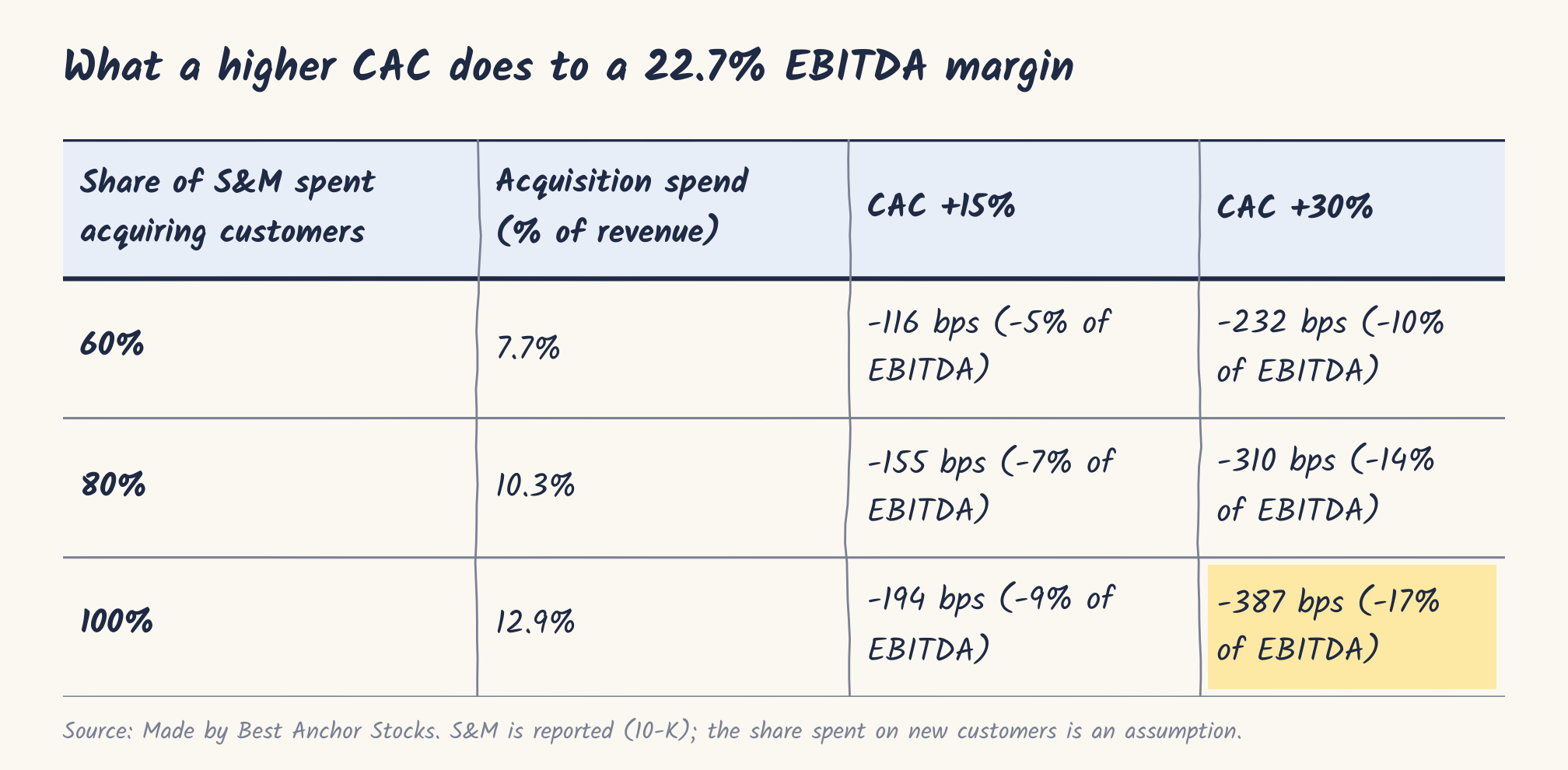
A 30% increase in CAC would wipe out several years of the margin expansion that management is promising (incremental margins of 30%+ over time). And the worst part is that you wouldn’t see it coming in the reported numbers until it was already there. While I am definitely not denying that Rollins is a good business (I actually believe it is), I believe that its business model is more fragile than many people think it is. It’s a subscription-like business, yes, but the company’s churn makes the customer acquisition engine pretty relevant for the thesis.
At what price is Rollins a buy?
Something that’s pretty evident is that the market has already punished the stock (shoot first, ask questions later). Rollins trades at around $30 per share, down roughly 48% over the last twelve months and more than 50% from highs:
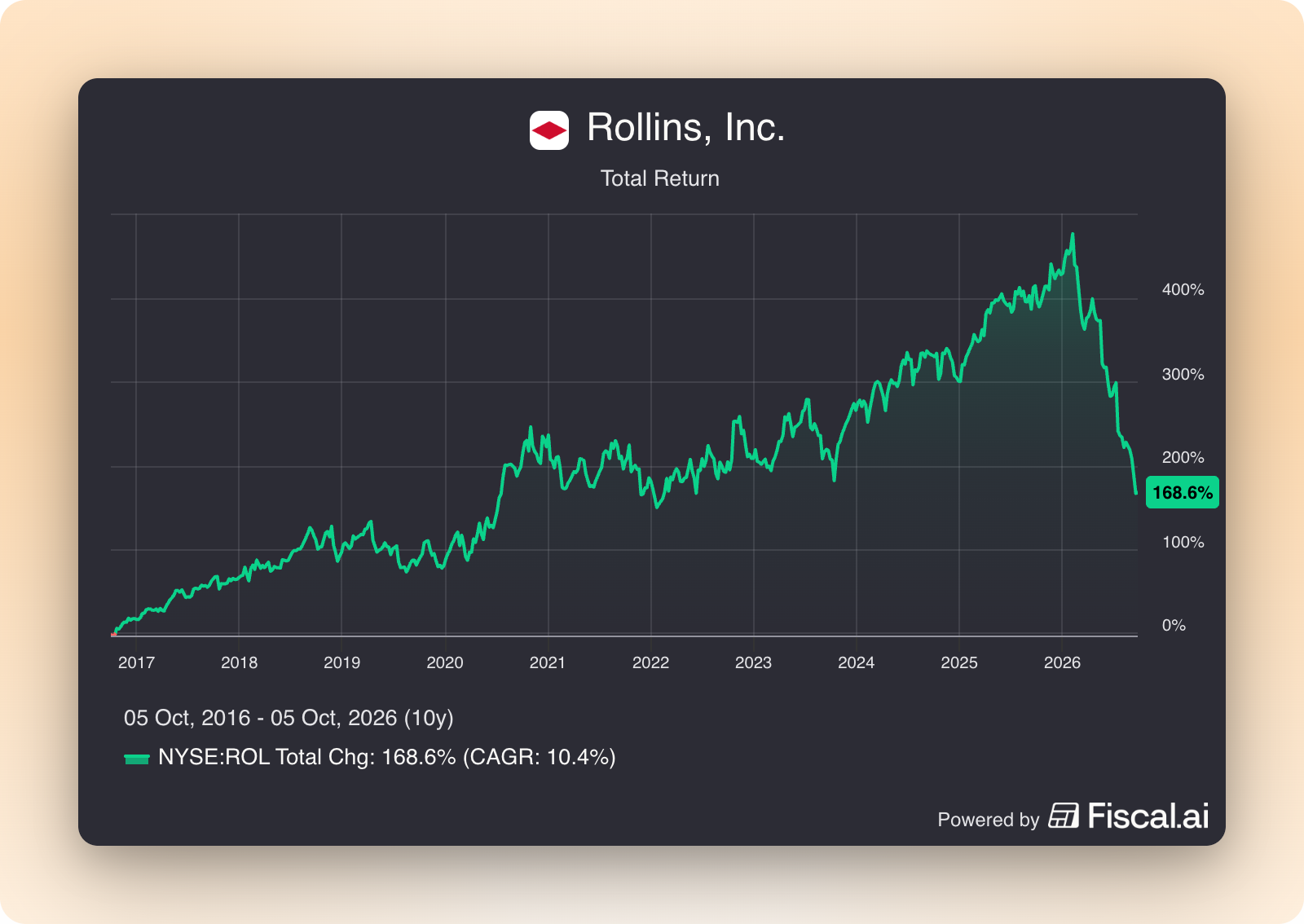
This is a big drawdown for a business that most investors considered untouchable, but nothing unheard of in today’s “compounder” land where a lot of real (and perceived) high quality companies have suffered considerable drawdowns. While many of these companies were undeniably trading at pretty hefty valuations, it’s fair to think that (for some) the market might have overshot to the downside. Is this the case for Rollins?