


ASML reported, to nobody’s surprise, yet another strong quarter. Net sales came in at €11.7 billion (towards the high end of management’s guidance) and gross margin landed at 57.5%, well above the guide. This is a situation that we’ve seen quite a few times over the past few quarters and one that’s not unusual in a supply-constrained environment: sales surprising to the upside driven by IBM (Installed Based Management sales), which in turn flows through higher-than-expected profitability.
IBM is the fastest way available for customers to expand capacity and therefore it shouldn’t be a surprise to see IBM sales grow fast throughout supply crunches. This is good news for ASML and its shareholders because IBM sales allow ASML to profit from an upcycle relatively fast despite being a long lead-time business. IBM came in at €3.3 billion (€400 million above guidance) and management attributed a good chunk of the gross margin beat to it (no surprises here).
Increased volume is also helping ASML achieve considerable operating leverage. Operating margin reached 44.4% this quarter (up from 37.1% in Q2) and roughly half of the 730 bps gain came from Opex (not COGS), and nearly all of it from R&D...Sales grew 25% QoQ while R&D actually fell (from €1.28 billion to €1.17 billion), taking R&D from 13.7% to 10.1% of sales:
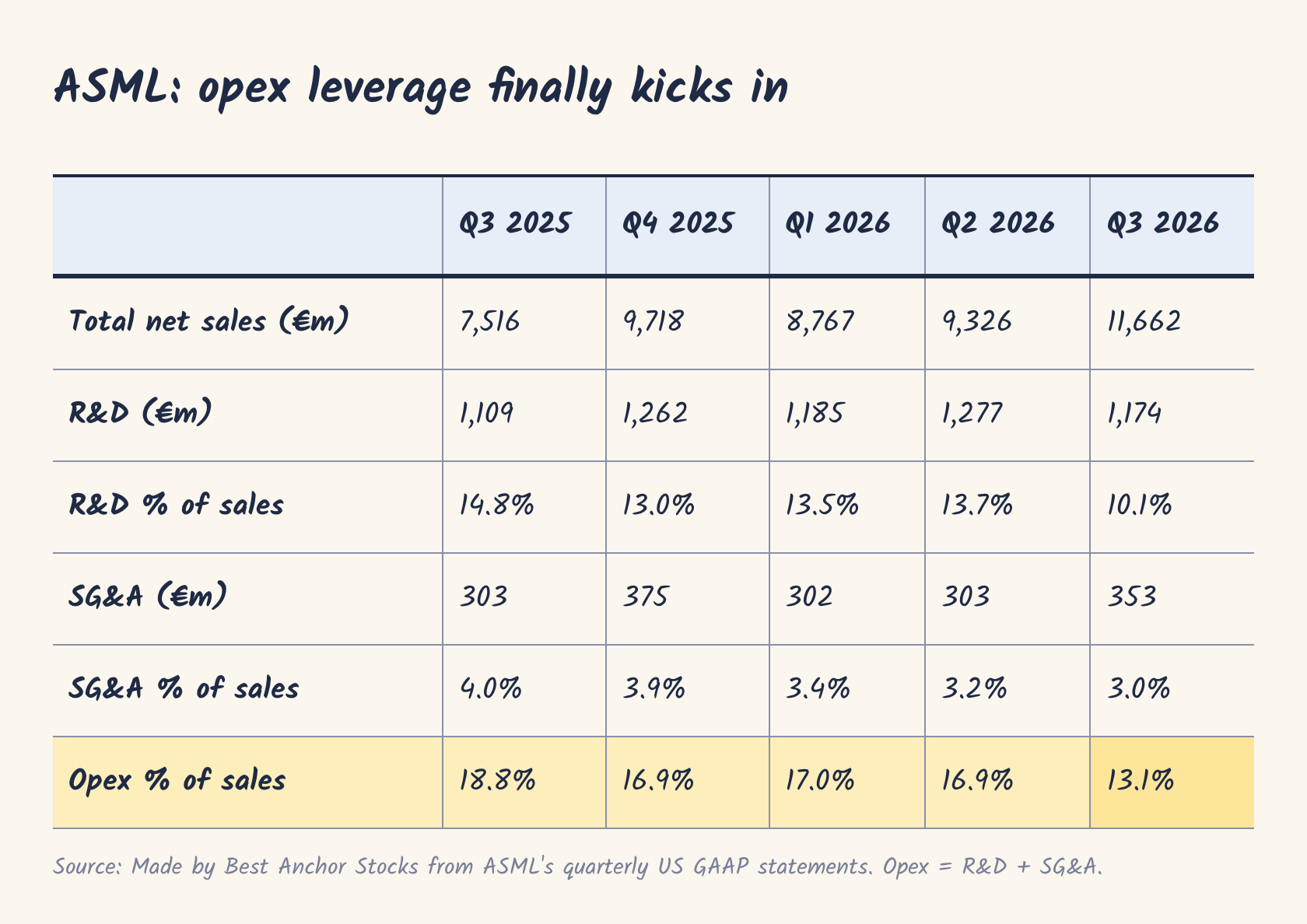
Even though this low figure has only presented itself in Q3 2026 and therefore shouldn’t be considered a trend, it’s something that shouldn’t surprise us because ASML is in the early stages of monetizing last decade’s R&D. The company has been investing heavily into its EUV program over the past decade and EUV is expected to ramp up considerably over the next couple of years. The way to think about this is that ASML has been running an R&D program over the last decade that it expects to monetize now.
This doesn’t mean that R&D will not go up anymore in our lifetimes. We should also be mindful about new R&D cycles like hyper-NA EUV, even though system commonality might help keep R&D proportionally low. I believe the “common platform” will be quite a big deal in terms of R&D and COGS leverage:
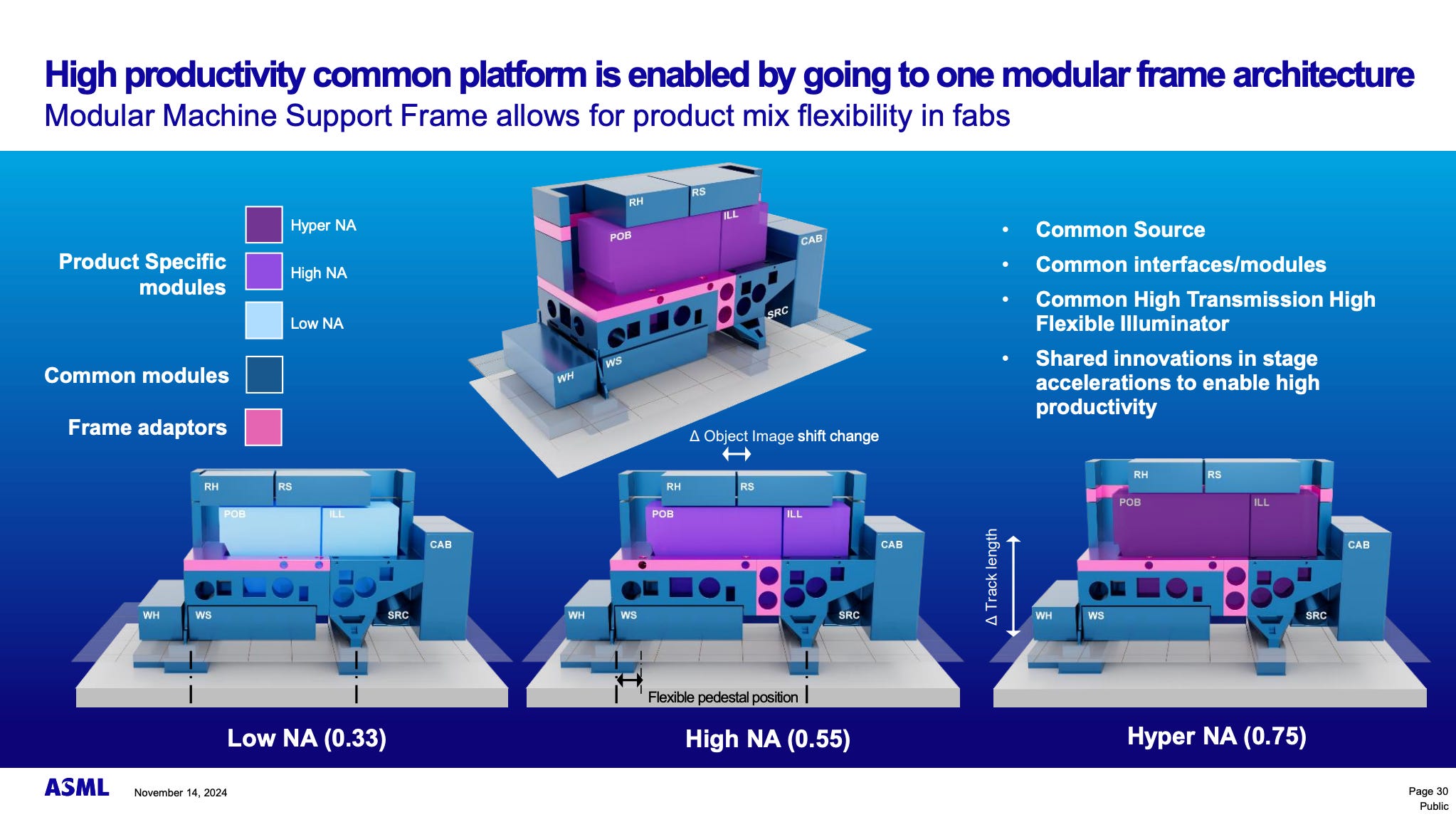
In short, ASML’s Opex could be considered somewhat of a fixed cost, meaning that sales increases typically fall to the bottom line at very nice incrementals.
I’ve also seen some people quote ASML’s strong EPS beat, but it needs context. Net income of €5.0 billion includes a one-off gain from Mistral AI...
Included in there €500 million for the revaluation of the first tranche that we bought from Mistral AI.
Stripping this revaluation gain out, net income would’ve been around €4.45 billion and basic EPS around €11.60 rather than the reported €12.95. It’s an outstanding quarter nevertheless and even though the fact that the EPS figure (and therefore the P/E) are misleading seems so obvious, we shouldn’t underestimate many people’s ability to fixate on a P/E multiple or a headline beat!

ASML’s China business: warranted skepticism?
I was quite surprised to see a lot of people point out the China/DUV outperformance in Q3 (as a bad thing, that is). China went from 14% of net system sales in Q2 to 23% in Q3, and ArFi (immersion DUV) units jumped from 23 to 40:
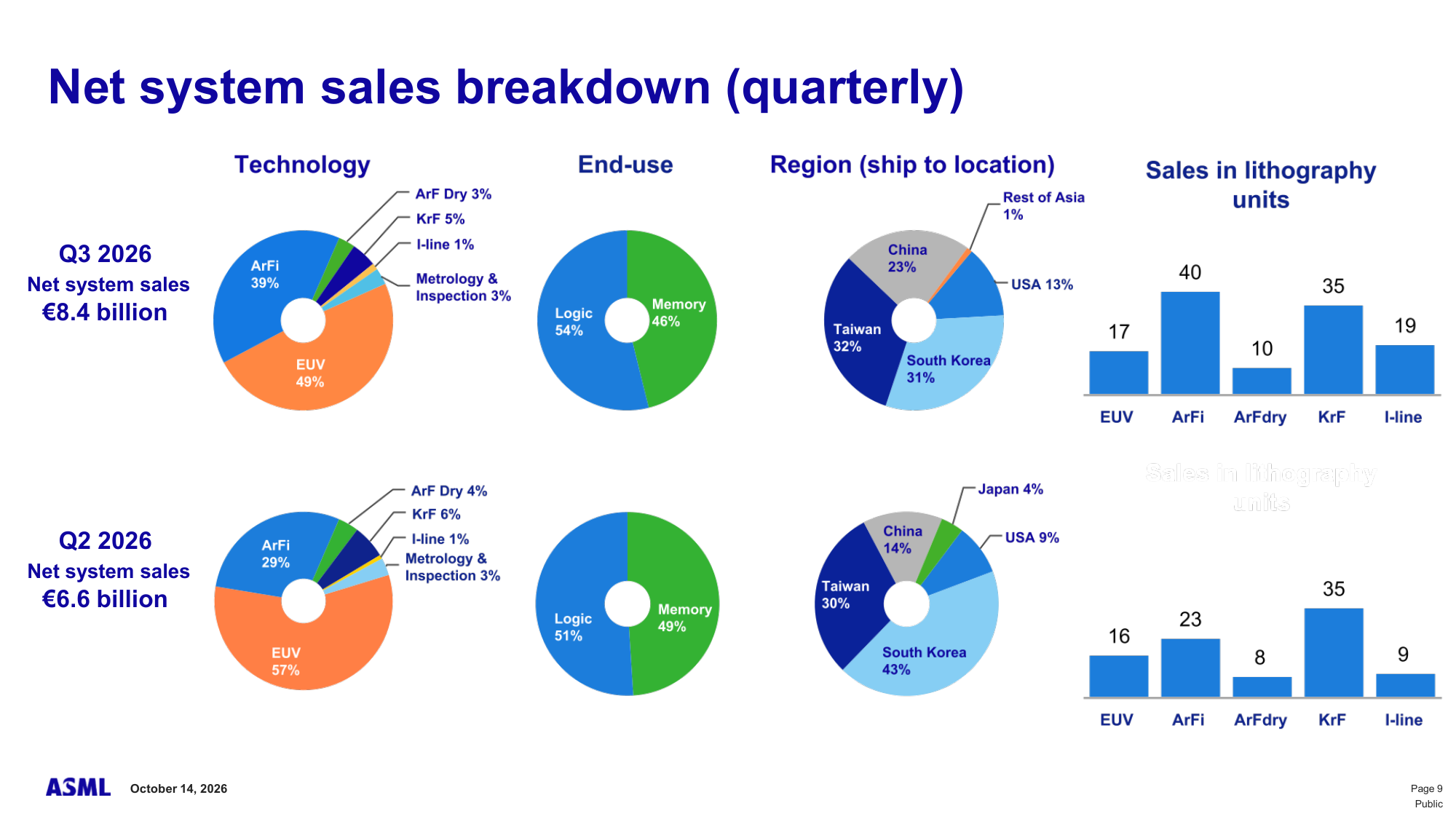
Source: ASML Investor Presentation
I believe many are extrapolating these numbers to a new change in trend, but the reality seems very different. China accounted for roughly €4.0 billion of the €21.2 billion of net system sales YTD, which is about 19% of total sales. In other words, China is tracking right where management expected it to be, around 20% of total system sales in 2026. As EUV ramps up over the coming years, China as a percentage of total sales should moderate further going forward (it’s just a matter of mix).
I can totally understand why the market is worried about China, though. Let’s talk a bit about the MATCH Act. The MATCH Act is a new bill with bipartisan support that promises to make ASML’s shipments (and servicing) to China even more restrictive than it currently is. As one could’ve correctly imagined, The Netherlands is not precisely happy about it...
Dutch Foreign Trade Minister Sjoerd Sjoerdsma called the US MATCH Act coercive in June, while claiming that the Netherlands would favor “highly targeted proportionate measures“ of its own (i.e., they want independence to set restrictions, good luck with that). The MATCH Act wants to ban ASML from selling DUV machines to China and from servicing its installed base there. This would be a big step up from today’s restrictions. EUV has always been restricted in China, and since 2023-2024 only the most advanced immersion DUV tools (NXT:2000i and above, plus the NXT:1970i/1980i) need export licenses, so ASML can still sell mid-range immersion and dry DUV to China and service most of the installed base. The MATCH Act would extend the ban to virtually all DUV plus servicing which would be a double hit to ASML’s China business.
The good news is that the potential impact of this risk should diminish as EUV ramps up and the reality is that we still don’t know whether the MATCH Act will pass and under what conditions. So, I do believe that it’s rational for the market to be worried about ASML’s China exposure, but at the same time I find “interesting” how this was much more of a risk when the stock was trading at 52 week lows rather than near 52 week highs when in fact the potential impact of the risk got worse! Something something, price drives sentiment.
+30% and +30% is not enough
“Capacity” was once again the star word of ASML’s earnings release. Management laid out a plan in Q2 that called to raise unit output by 30% in 2027 and (aspirationally) by another 30% in 2028. Management shared in Q3 that this plan will probably not be enough to satisfy demand:
It’s becoming very clear that 30% in 2027, 30% in 2028 will not allow us to meet our customer demand. So we have to do more and we are looking basically at ways, especially in 2028 and beyond, to further extend our capacity.
(This +30% and +30%, by the way, refers to both low-NA EUV and DUV immersion capacity.)
Due to ASML’s complex supply chain and its long lead times, 2027 unit capacity looks locked at +30%, while it does seem possible to expand capacity beyond +30% in 2028. This doesn’t mean that there’s no upside to 2027 numbers, but if there’s any, it’ll likely come from the other two capacity levers at ASML’s disposal:
IBM/upgrades: customers get fast incremental capacity within their existing footprint, and ASML is “very aggressively“ developing more upgrades. This is pretty profitable revenue, so a 2027 beat driven by IBM would once again fall through to the bottom line at pretty nice incremental margins
Productivity of new systems: the NXE:3800F (260 wph vs 230 wph today) arrives in 2027 “in small quantities”, with the real impact in 2028 and beyond. Critical immersion tools shipped in 2027 will also be upgraded to 330 wph. The bottom line is that, not only is ASML going to ship more units, but these are going to be more productive
There was a tone change this quarter as well in terms of the visibility of demand. Management shared that customers are telling them that they don’t expect their supply to meet their demand “at least until 2028.” I’m not sure what industry expectations were with regards to a potential supply/demand imbalance extending beyond 2028, but this doesn’t seem great for the “bottleneck thesis” that many have been pitching for the AI industry (i.e., “supply constrained beyond 2030“). It’s consistent with what I wrote in Q2, though:
ASML and TSMC are likely not going to be bottlenecks for as long as many expected. [...] It might happen, but some of the historically considered bottlenecks are bringing significant capacity online before 2030 and likely faster than many expected (humans always find a way to bypass bottlenecks).
Now, the real question is whether the bottleneck will be solved through a cooling demand or through a heating supply. I believe this matters because both situations end up in widely different economics for the supply chain. ASML believes it will be the latter (supply has to catch up because “demand visibility is getting stronger”):
A lot of our discussions with our customers now are shifting in fact beyond 2027. A lot of order intake for 2028. But also some strong interest to already place orders for 2029 and sometimes even 2030.
Even though I believe this commentary is great and that it’s better to hear it than not to hear it (duh), I also believe that “demand visibility” has to be contextualized here. Industry participants talk about visibility of demand as if it were a given, but the reality is that future compute demand is all but a given and depends to a great extent on things outside of their control.
You can have your arguments in favor or against future compute demand being incrementally much higher in 2030 and also about where that value ends up accruing, but it seems obvious that orders being signed for 2029 and 2030 might evaporate if demand “falters” (although there’s no way of knowing the terms they were signed on). What seems pretty obvious right now is that the supply chain remains confident in the durability of the AI demand wave; whether that remains true in 2029 and 2030 when these orders are due is still TBD. I’m less worried about 2028 orders because they are pretty close and prepayments are likely being made, but thinking out to 2029 and 2030 seems like a bit of a stretch.
Another “problem” we have here is that we are currently getting only qualitative comments from ASML. We’ll get the backlog figure next quarter and then we’ll be able to really see how this positive sentiment is translating into the company’s order book. The good news for ASML is that its demand sources are now much more fragmented than they once were (Intel, memory...), BUT they are all dependent on the same AI growth thesis so really the demand source currently remains concentrated.
High-NA and metrology also show green shoots
The quarter brought a lot of news in terms of high-NA EUV, not all released in the quarter’s press release per se:
TSMC asked ASML to lead a consortium to bring 12-inch reticles (photomasks) to the industry sometime in the first half of the next decade (with all major customers joining). TSMC also confirmed it will introduce High-NA in HVM around 2030, which seemed a done deal considering that the investment in the 12-inch reticle is being made because they expect high-NA to run at scale
Samsung will start using High-NA in HVM in 2028
Intel is already running High-NA in HVM and is increasing the number of layers
It seems like the fears about high-NA adoption were greatly overblown (who knew?).
Metrology is also shaping up to become a source of upside as ASML continues to vertically integrate around its holistic lithography strategy. Management shared the following:
We have a huge momentum on metrology. We have seen a major, major growth.
The new YieldStar 550B (overlay metrology) is ready for the 14 angstrom logic node and 1D DRAM and brings a 60% productivity improvement. Metrology & inspection was a €825 million business in 2025 (+28% YoY), so it’s still small in the grand scheme of things, but it’s growing fast as customers need more and more metrology to get performance out of advanced nodes.
In overlay metrology the main competitor is KLA (with its Archer platform) but ASML’s edge is “holistic lithography”: YieldStar data feeds directly into the scanner to correct overlay in real time, something a standalone metrology vendor can’t replicate to perfection.
Revisiting my 2028 exercise
Management upped the 2026 sales guide midpoint from €44 billion to €44.5 billion. This implies a 36% YoY increase which, according to management, is “largely driven by EUV.“ (the YoY increase, not the raised guide). The breakdown they gave for 2026 is:
EUV: growing over 45% YoY
Non-EUV (DUV + metrology & inspection): growing around 20% YoY
Installed Base Management: growing around 50% YoY
This means that ASML is going to beat (almost certainly) the low end of its 2030 guide (€44 billion) in 2026.
In last quarter’s article, I shared an exercise in which I estimated that ASML could land around €70 billion in revenue in 2028 (there was a mistake in my numbers so I corrected that), 17% ahead of the high end of its 2030 guide, two years in advance. I recommend going back to that article to understand how the exercise was built because I’m going to revisit it below with the new information. The new info is the following:
ASML is working towards a 2028 capacity increase of more than +30%. I’ll use +35% and +40% scenarios although I’ll anchor in the low end because it’s an aspiration and will be challenging to achieve. This translates into 115-119 low-NA EUV systems (vs my Q2 estimate of 110) and 228-237 immersion DUV systems (vs 220). Note that management specifically claimed that there’s upside to 2028 capacity but not for 2027. As 2027 will most likely continue to be a constrained supply environment, I modeled their comments through higher IBM sales.
IBM is (not surprisingly) running much hotter than I modeled (€12.2 billion in 2026 vs my €11 billion estimate) and we might get a further boost in 2027 if unit volume is not enough to satisfy demand (see comment above). I’ll use 25% growth in 2027 (vs 20% I used in my Q2 exercise) and +20% in 2028.
Pricing conversations are done and the full effect lands in 2028. Last quarter I used a 15% blended ASP increase, which solely reflected the more productive mix (management expected the mix to add ~15% of capacity on top of the +30% in units) and ASML pricing to value (i.e., it simply assumed that ASML charged the same for every increased unit of productivity). Outright price increases should come on top of that, so I’ll use a 20% blended increase for low-NA EUV (15% capacity increase + 5% pricing). I also added a 10% blended ASP increase to immersion DUV (some reports point to this being the ASP increase that ASML is already implementing on some customers, but we don’t have official confirmation from the company). For High-NA EUV I keep the same 15% ASP uplift I applied in Q2 as I doubt the company will raise prices outright so early in its adoption curve.
Metrology is seeing “major, major growth“ although I’ll be conservative and will not update my numbers here
Everything else stays exactly as it was in Q2. I’ll keep dry DUV flat at €2.5 billion and metrology & inspection at €1.5 billion for conservativeness sake. Below you can find the three scenarios:
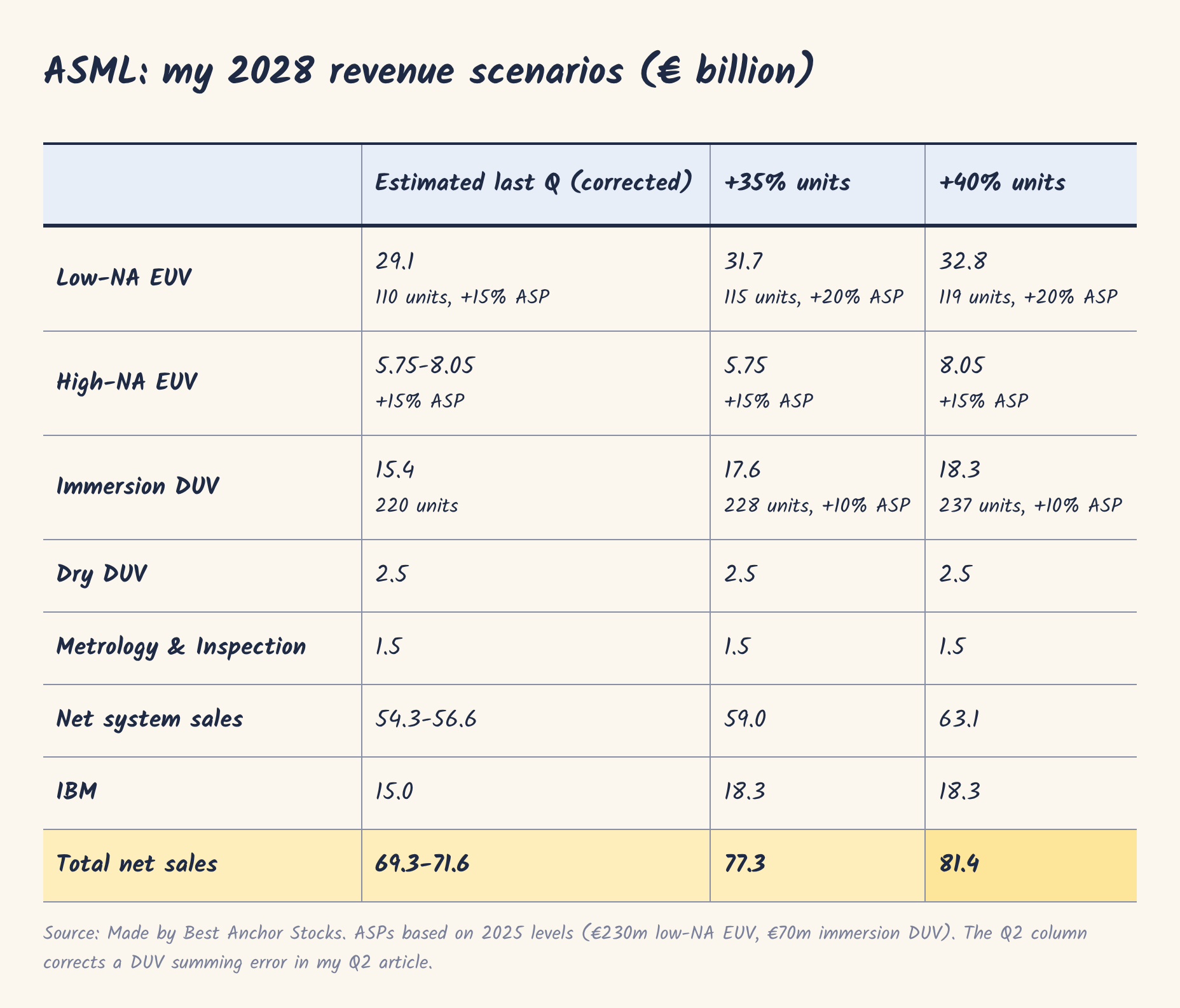
This gets ASML to €77-81 billion in revenue in 2028, 29-36% above the high end of the current 2030 guide (€60 billion, which likely gets raised in the next Capital Markets Day) and 17-23% ahead of 2028 consensus revenue of €66 billion (which in fairness has not been updated with the new info). Compared to my corrected 2028 estimate shared in Q2, the changes break down as follows:
IBM: +€3.3 billion, together with low-NA EUV the largest driver (higher 2026 base and faster 2027 growth)
Low-NA EUV: +€2.6-3.7 billion, split roughly evenly between more units and the outright price increases
Immersion DUV: +€2.2-2.8 billion from more units and the 10% ASP increase
High-NA EUV: unchanged at €5.75-8.05 billion, with the same 15% ASP uplift as in Q2
In terms of margins, I anchored on 60% gross margins last quarter. ASML is guiding for 56% this year (57.5% in Q3) before any of the price increases show up, and outright price increases should fall almost entirely to the gross margin line, so 60% now looks conservative but I’ll leave it as is.
Management guided for €6 billion in R&D and €1.7 billion in SG&A in their 2030 scenarios and I’ll keep these as is as well. Operating income at 60% gross margins and under this scenario would be somewhere between €38.7 billion and €41.2 billion.
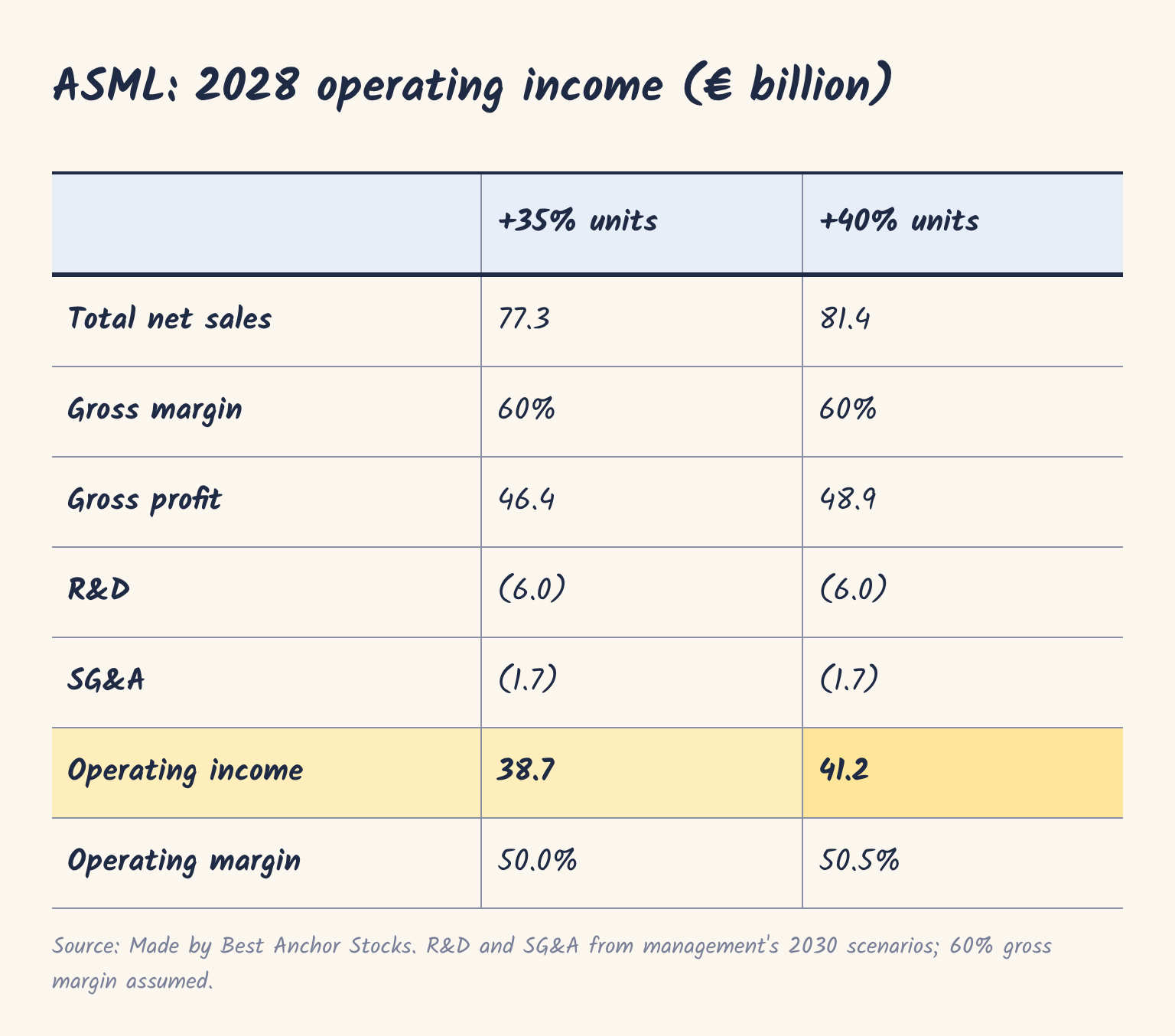
With the stock at around €1,530 (~€590 billion market cap and ~€580 billion EV considering ~€10 billion in net cash), ASML is trading at around 14-15x its potential 2028 EBIT (60% gross margin case), compared to 18x with my Q2 assumptions. Valuing the business at 25x EBIT at the end of 2028, the potential IRR would be around 26-30%; at 20x it compresses to 14-17% (not considering dividends and buybacks, which should add 1-2%). This seems like a pretty appealing return, but there are certain caveats...
I do think that ASML is a fairly high visibility company over the next few years due to its long lead times, but if there’s one thing that I’m sure about is that the numbers above are most likely going to be wrong in some way
The increase “beyond +30%” in capacity in 2028 is something that’s under analysis, but ASML might not be able to conduct the capacity increase as they like. This means that the numbers I estimated in Q2 might be a better reflection of what ASML might achieve, although these should also not be considered a given. We must also be aware that if they can’t satisfy demand through increased units, we might see upside in IBM sales which is also good for ASML
AI demand can falter along the way and orders might get pushed out or outright cancelled
Semicap investors should not forget about cyclicality. ASML is undoubtedly a cyclical business and I believe it will remain so over the long term. The only difference today is that we seem to be living in an unprecedented supply crunch across the industry, but historically these have ended in “unprecedented” supply gluts. I highly doubt we’ll live in an imbalance forever and the market seems to be increasingly skeptical about what demand might look like post-2028. We’ll see.
Anyways, I do believe that ASML seems to offer a pretty appealing return despite the stock having run up significantly. The facts have changed and the order books are starting to get filled, proving ASML with good visibility for the next 2 years. I remain more skeptical on the 2029 and 2030 numbers and they are more important than they look because those years will most likely inform the exit multiple.
I will continue to hold my position.
Have a great day,
Leandro
great analysis and a super quarter! I've sold my position this year as my IRRs estimations weren't great. now I'me getting the feeling that it was the wrong decision. who could have thought that great companies surprise to the upside? (specially with cyclical tailwinds)