You can read part of this article in PDF format here.
Best Anchor Stocks has a partnership with Fiscal.ai (the research platform I personally use), through which you can enjoy a 15% discount on any plan. Use this link to claim yours! You’ll find KPIs, Copilot (a ChatGPT focused on finance) and the best UX:
Indices continue to “bleed” as the AI-trade loses steam. Is this a sign that AI is over? Not necessarily, and I explain why in the brief market commentary where I also share a golf analogy. There was also some pretty interesting news about several portfolio companies (spoiler: quite a bit of insider buying).
Without further ado, let’s get on with it.
Articles of the week
I published two articles this week. The first one was Danaher’s Q3 earnings digest which I decided to title “Danaher’s Robotics Era” as the conversation around AI was what I enjoyed the most.
Danaher’s robotics era

Most articles will come with a PDF in case that it is your preferred reading method. You can read the PDF of this earnings review here.
I also share my thoughts on new management and, although it’s still early days…I did not get particularly excited.
The second article of the week was the eighth edition of On The Radar.

I bring three interesting and non-related businesses that I am currently looking at (TBD where my research will take me on these).
Without further ado, let’s see what the markets did this week.
Market Overview
The market was hectic this week (not that it’s not always this way!), with both indices suffering losses:
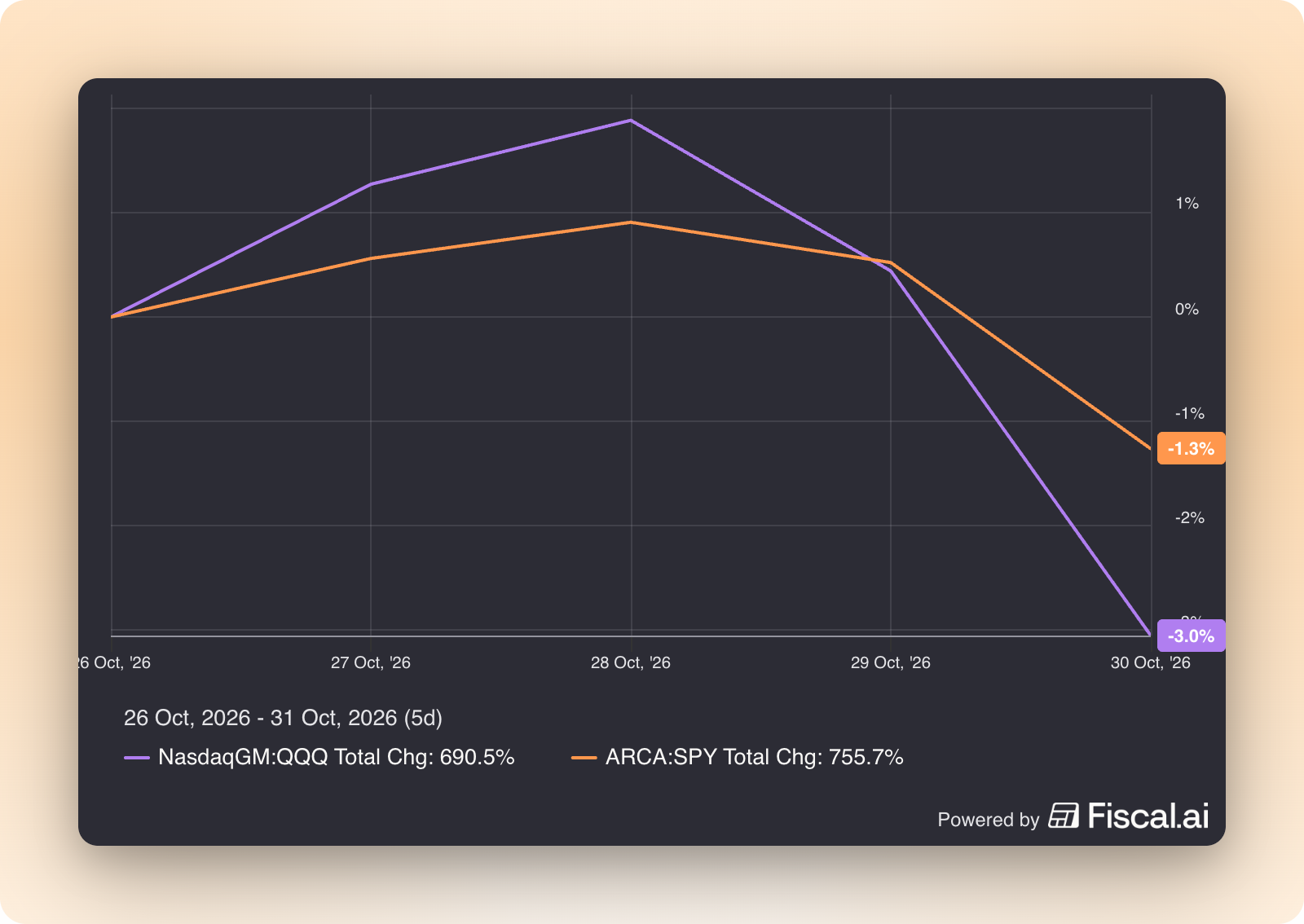
As has been the case for a couple of weeks, the drop was significantly more pronounced in the Nasdaq than in the S&P 500 due to its more significant AI exposure. The AI trade seems to be showing some cracks as the market might be interpreting that Capex is losing steam. In a (potential) world where less AI Capex is required (still TBD), one should be inclined to think that the relative winners will be the same companies that have been winning over the past couple of decades: the hyperscalers. These companies can ultimately pull back Capex investments (they are still not signalling they will do btw) and start generating significant amounts of Free Cash Flow as they grow into their existing capacity.
Nowhere is this more visible than at Amazon. The company spent $77.3 billion on capex this quarter (almost $20 billion more than analysts expected) and is now running at negative $42.4 billion of trailing free cash flow. Despite this, management is sticking to its $220 billion plan for 2026 and believes that 2027 Capex will be “significantly above” the 2026 level. Is this the overinvestment everyone fears, or is it the setup for the FCF unlock I described above? I’ll dig into it when I discuss Amazon next week but the answer seems to be conditional on AI demand.
If AI demand cools off and we have proof that hyperscalers have overinvested, investors will most likely face a couple of years of overcapacity. This overcapacity will most likely be “ugly” due to two reasons. First, higher amortization and, secondly, likely lower price per GW (i.e., lower margins and returns). The “good” news (if there’s any) is that you know that they’ll make it through the other side. This is reminiscent (to an extent) to Amazon’s overinvestment in retail with the non-minor difference being the scale of the expected investment.
On the other hand, numerous businesses across the AI-trade are terminal zeroes or significantly impaired assets if demand cools off and Capex is scaled back. I believe that stock prices are starting to anticipate something that is yet not palpable: a slowdown of demand and eagerness to spend on capacity. This said, we should not forget that markets are forward-looking (or that’s what they say) and that they tend to shoot before asking questions.
The latter is becoming pretty evident in the current earnings season. Drops of 20%+ seem to have become the norm, but one mustn’t forget that eventually the impact these events have on long-term performance is minor. Many of my big winners were down 10-20% on any single day, which didn’t stop them from eventually pursuing ATHs again. Whenever you think that any single-day drop means something, don’t forget that the majority of daily volume in the market is algorithmic trading. Now, this said, it would also be a mistake to think that the market is always wrong. When a stock is down significantly, there’s almost always a reason. The thing we need to try to understand is whether that reason is temporary or structural.
Evidently the money that’s coming out of the AI trade went somewhere, and here comes one of the words of the year: rotation. A while ago I was speaking to a friend and told him that the current market can be explained with a golfing analogy. Some days, your putter works but your driver doesn’t. Other days, your driver works but your putter doesn’t. What’s the end result? You end up shooting an average score regardless of what was or wasn’t working. The current market is a bit similar in the sense that sometimes it is the AI trade that works, others it is the defensives that people rotate into that work, but the end result is that the S&P 500 has been flat since June. As an investor you can either:
Play the rotation game back and forth
Be aware that it happens, that you can’t anticipate it (there are many intelligent people trying to anticipate it) and build a portfolio you are comfortable with that’s based on your main advantage: duration
This is a personal choice, but I have always felt that I’m not great at rotating in and out of positions so I’ve chosen to do the second. The problem with the first is that it implies overconcentration in any single factor, which can come back to bite you faster than you’d expect. We’ve seen this on X this week. A lot of people were losing their minds over a 1% drop in the S&P 500, which is likely a sign that they had become overexposed to a single factor. I am not saying this is inherently bad (it isn’t), but one must evidently know the game they are playing. Volatility is NOT a risk in and of itself, but it can indeed lead to emotions and over-trading, both of which can punish long-term returns.
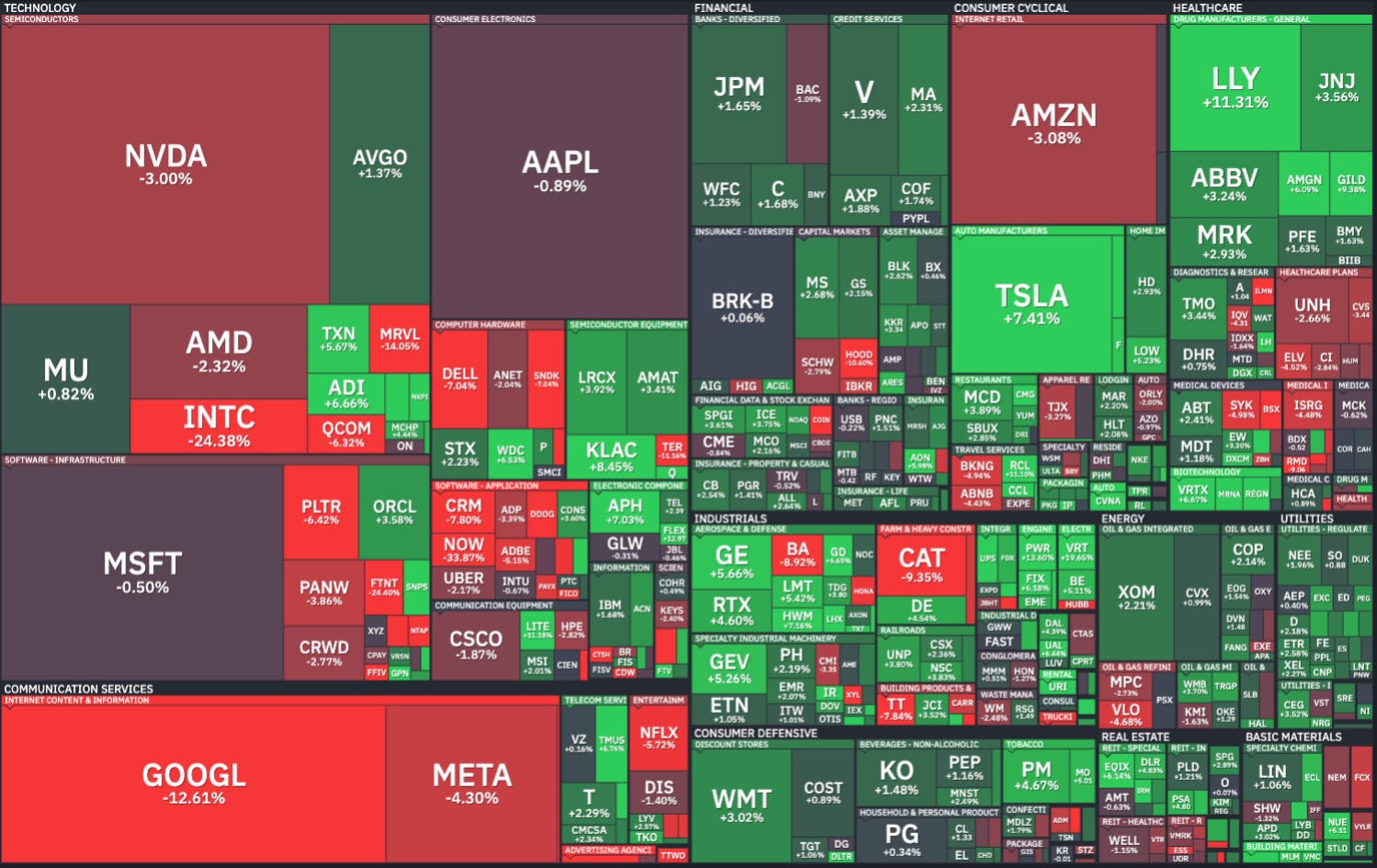
One would’ve thought that the industry map would not look great, and this was the case in tech, whereas it was green pretty much everywhere else:
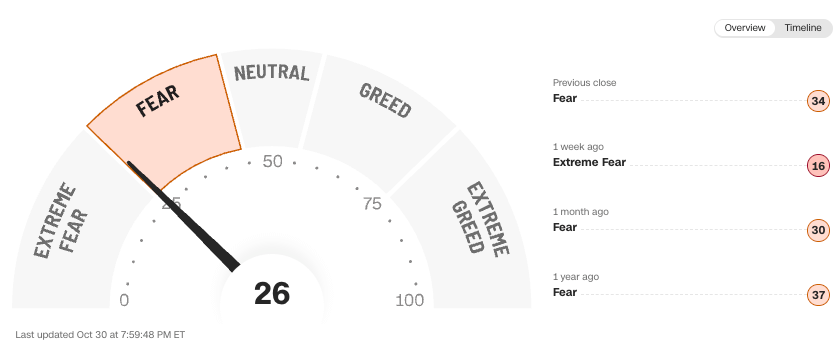
The fear and greed index interestingly improved despite what markets did this week: