


Most articles will come with a PDF in case that it is your preferred reading method. You can read the PDF of this earnings review here.
Danaher reported Q3 earnings last week but the numbers were the least interesting part of the release. Q3 was Julie Sawyer Montgomery’s first earnings call as CEO (with Matt Gugino also debuting as CFO), so I (and probably many investors) was expecting a quarter in which the new management team would set the tone for what’s to come. Would expectations get a reset? Would we get a new strategy? We got a mix.
The quarter itself was okay. Danaher delivered a beat on the top and bottom lines, raised its EPS range for the year, and management alluded to an acceleration on a “questionable” metric. After having enjoyed respiratory tailwinds and not stripping these out from core growth, management started reporting core growth ex-respiratory once tailwinds turned into headwinds. You know how this works: tails I win, heads, you lose!
I’ll go over three things in this article:
A quick summary of the numbers (and a couple of things worth considering)
Why I found the call to be a good chunk of corporate BS and why the new CEO didn’t excite me one bit
Danaher and AI (the core of the article): what management had to say about AI, the autonomous lab, and the NVIDIA partnership
Without further ado, let’s jump right into the numbers.
Danaher’s Q3
Q3 was a decent quarter by all means (or at least what Danaher investors can consider “decent” after reset expectations). Danaher met top-line estimates, reported double-digit adjusted EPS growth (not all growth was organic), and strong cash generation:
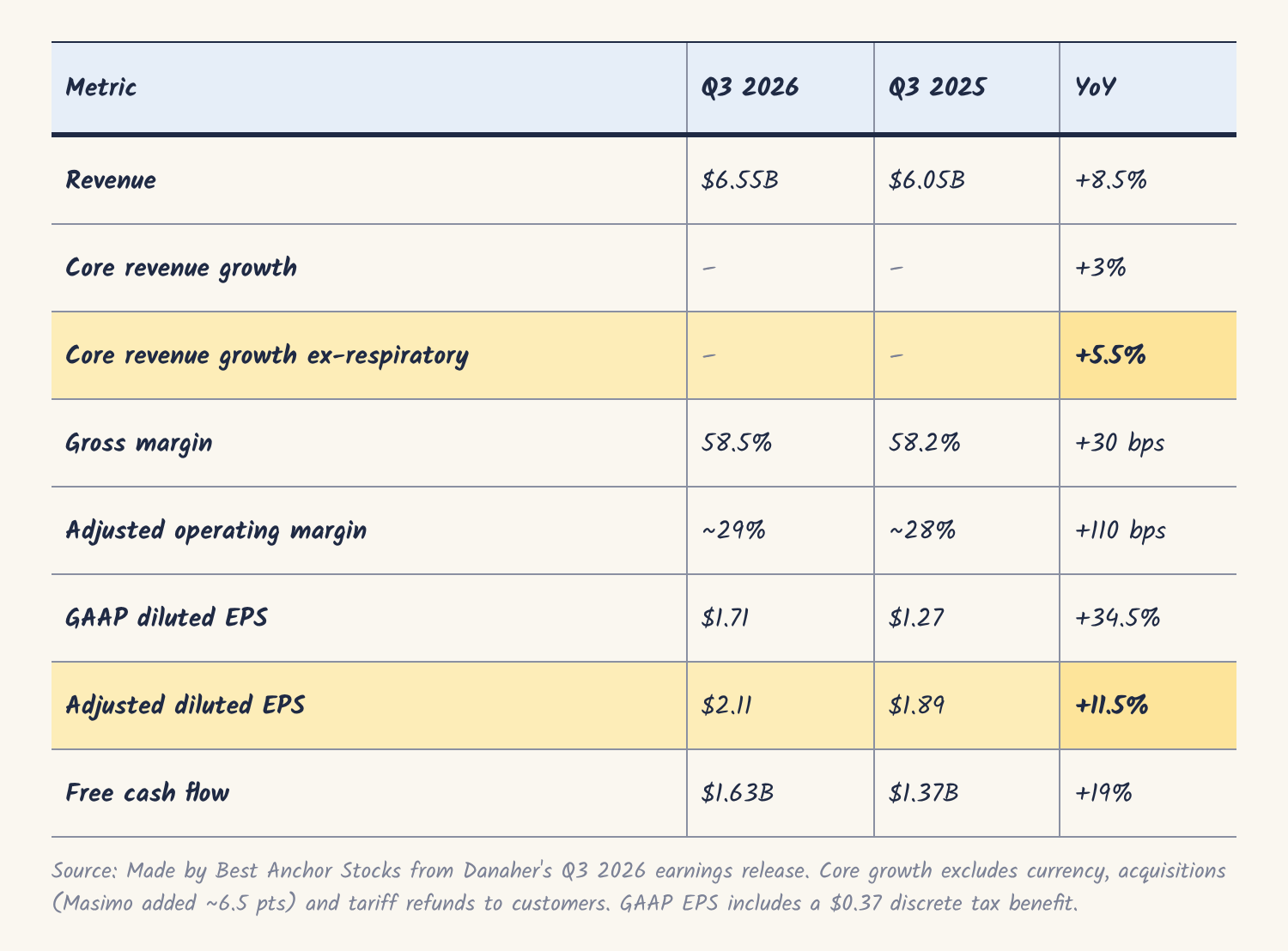
Danaher hadn’t reported such strong revenue growth (+8.5% YoY) since 2021, but around 650 bps of this growth came from Masimo, which closed in Q2.
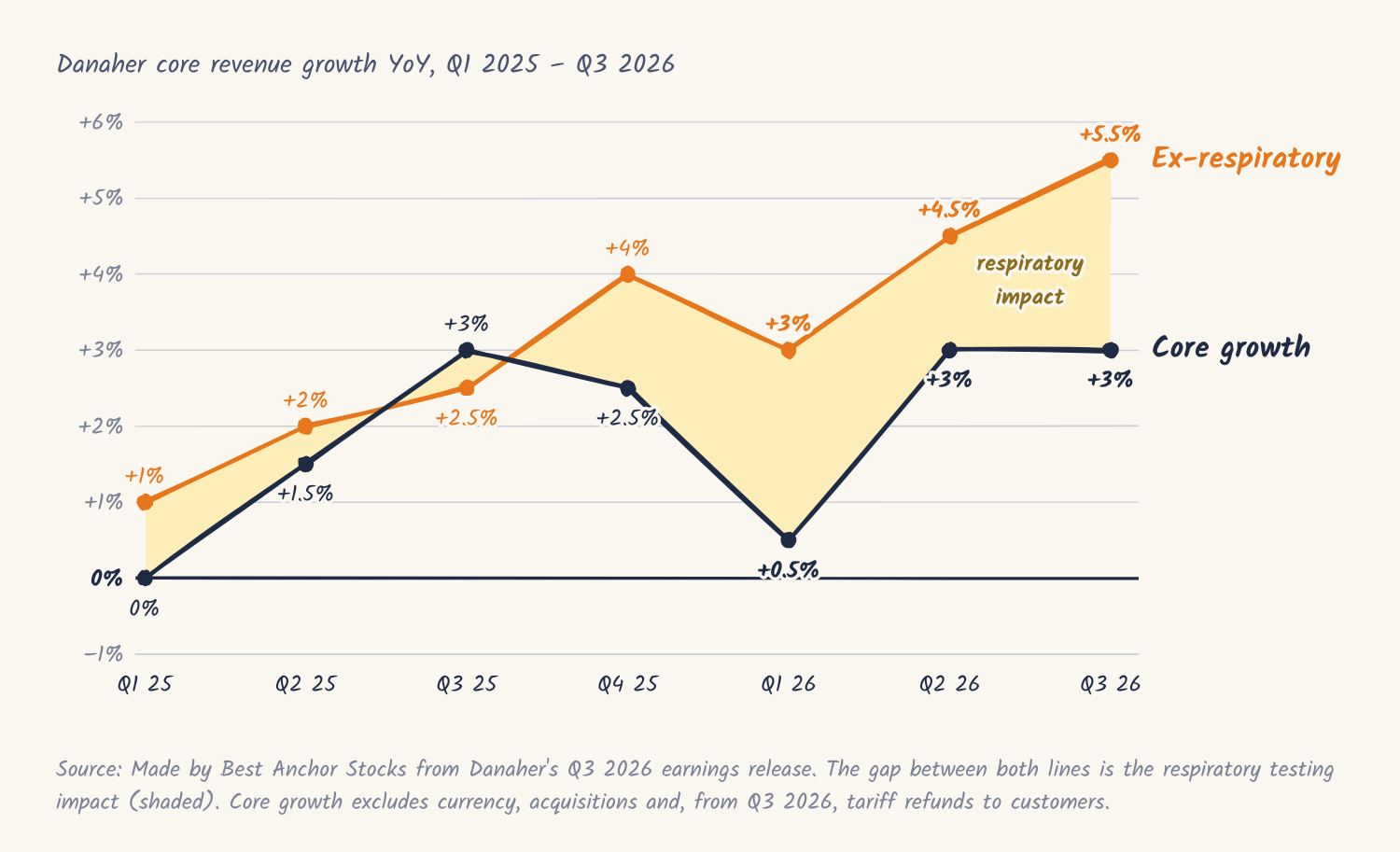
Core revenue (i.e., organic) grew 3%, with respiratory once again acting as a ~250 bps headwind. The “good” news (if you love adjusted metrics, that is) was that core revenue growth ex-respiratory came in at 5.5% YoY. This ultimately means that this metric has accelerated for three consecutive quarters:
The other good news was that core growth was relatively broad-based across segments:
Biotechnology (core +5%): bioprocessing grew towards the upper end of MSD, slightly ahead of management’s expectations. Consumables revenue grew MSD while equipment revenue grew only LSD. Good news could be found in orders (again). Bioprocessing orders grew mid-teens (led by upstream consumables and resins), with equipment orders continuing to grow at a “strong double-digit range“ year-to-date.
Life Sciences (core +4.5%): Q3 was the third quarter in a row in which Life Sciences beat management’s internal expectations. Who would’ve said this a year ago? Probably not many.
Diagnostics (core +0.5%, +7% ex-respiratory): respiratory was a 650 bps headwind (around $350 million vs around $500 million last year). Cepheid’s non-respiratory business grew LDD and Beckman Coulter Diagnostics delivered its best quarter in more than two years.
Masimo continued tracking ahead of expectations, delivering HSD growth in its first full quarter within Danaher and tracking similarly YTD (you can read my Masimo article here).
Management proved to be relatively optimistic about the state of their end markets...
Underlying demand across large pharma and biopharma remained robust. Biotech activity continued to strengthen. While academic demand remained below historic levels, demand improved sequentially.
...which is a positive read-through for some portfolio companies like Judges Scientific (JDG.L) that have been punished by weak AcaGov (academic and government) demand.
The guide and the 2027 “starting point”
Management raised the FY 2026 adjusted EPS guide to $8.57-$8.62 (from $8.45-$8.60), mostly to reflect the Q3 earnings beat. Danaher guided for core growth ex-respiratory of 4%-5% (4.5% midpoint) in Q4. This would be a 100 bps deceleration compared to Q3 but it’s also true they are coming against tougher comps (4% in Q4 2025 vs 2.5% in Q3 2025). On a two-year stack basis, the Q4 guide implies 8%-9% growth, roughly in line with (or slightly better than) the 8% delivered in Q3.
They also trimmed their respiratory forecast yet again: they now expect ~$1.5 billion this year (around $100 million less than before and down from ~$1.9 billion in 2025).
The most relevant comment, however, was the “first look“ into FY 2027:
As we look to 2027, we think that 4%-5% core revenue growth, excluding respiratory revenue, is the right starting point as we sit today.
My first look into their first look is...”yikes.” I honestly didn’t expect that a new CEO/CFO combo would come up with an optimistic outlook in their first call, but this begs the question:
Why say anything at all if you’re going to go through the planning process in Q4 and provide formal guidance in January?
Tycho Peterson (Jefferies analyst) summarized pretty well what many investors were probably thinking...
Matt, I want to stress test the assumptions you put out for next year, the 4%-5%. I have a lot of people asking why you are not accelerating here. Appreciate your comments on bioproduction a minute ago.
You had the order resin delays, obviously, in biotech, that should come through. You do not have the China VBP headwind. You have recovering biotech, academic picking up a bit. So, why on earth would ex-respiratory be the same?
I think you kind of alluded to the fact you just want to see how 4Q shapes up, and 4%-5% is maybe a 4%, but maybe get us comfortable there is something that you are not baking in that is getting worse.
The answer was pretty much “that’s what we’ve been growing at, and we want to go through the planning process.” So, again, why make and apparent sandbag when there’s no need to? No idea!
Management expects respiratory to land at ~$1.5 billion again in 2027, so (assuming an “average” flu season) core growth and core growth ex-respiratory should pretty much be the same number next year. On the one hand, this means the debate about the ex-respiratory metric goes away. On the other hand, it means that 4%-5% is the total core growth starting point for a company whose long-term ambition is HSD core growth (i.e., not great). It’s true that once Masimo comes into core growth then Danaher’s core growth should naturally accelerate, but let’s do some quick math to understand where next year could land.
Masimo generated $1.52 billion in revenue in FY 2025, so if it grows HSD (say 8%) in both 2026 and 2027, it would generate around $1.64 billion in 2026 and $1.78 billion in 2027. Since the deal closed in June 2026, Danaher will have only consolidated around $0.93 billion of Masimo revenue this year (roughly $90 million in Q2, $390 million in Q3, and $440 million in Q4), which means Masimo should add around $850 million in incremental revenue in 2027.
Doing the same exercise for StatLab ($250 million in FY 2025, closed in early Q4) adds another $220 million or so. On an estimated FY 2026 revenue base of around $26.3 billion, M&A should contribute roughly 4 points of growth in 2027. Adding this to the 4%-5% core growth starting point, Danaher’s FX-neutral total revenue growth would land somewhere around 8%-9% next year.
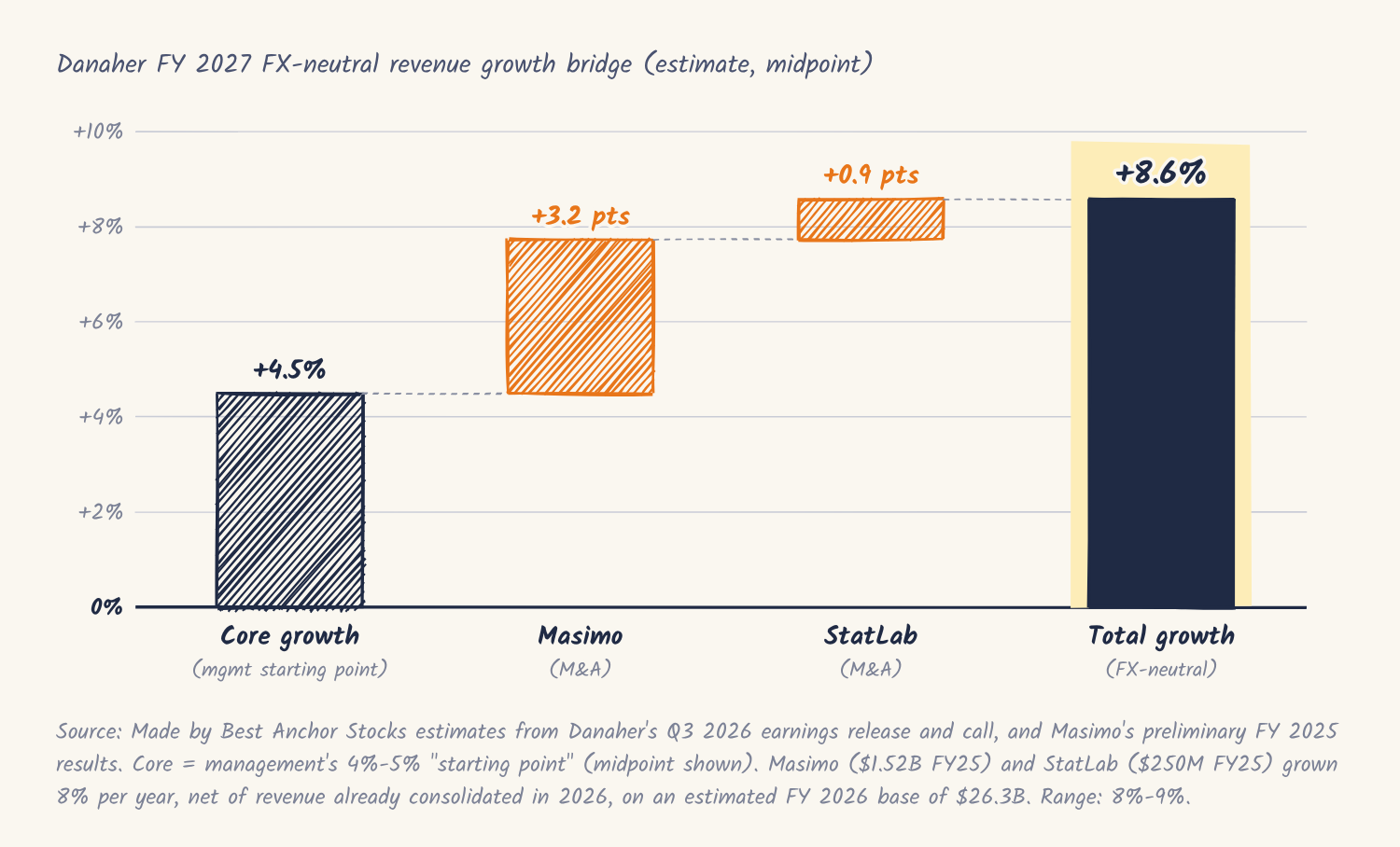
(Note these are my own estimates there might be a small overlap (around 25 bps) if management’s 4%-5% starting point already includes Masimo’s organic growth after it anniversaries in mid-2027.)
Not terrible on the surface, but organic growth has disappointed for a pretty long while and shows no sign of ticking up. This would be Danaher’s fourth year well below its HSD “aspiration” (some would call this aspiration a “dream” by now).
A lot of corporate BS in the call
To jump straight to the point...I thought a good chunk of the call was corporate BS, and the new CEO didn’t excite me at all, neither in the prepared remarks nor in the Q&A which seemed yet another prepared remark.
A good example of this was capital allocation. When asked about M&A priorities, the new CEO answered the following:
M&A remains our bias for capital allocation as we think it is the best way to compound returns over the long term, and we are going to continue to look for strategically compounding M&A.
“Strategically compounding M&A” came up several times during the call and I honestly still don’t know what it means but sounds like ROIC is going to be low because “strategic assets” rarely come cheap.
The main problem with this is that this is likely not what investors wanted to hear after several years of disappointing growth. Danaher’s core growth was -1.5% in 2024, +2% in 2025, and is now expected to land at ~2.5% in 2026. What investors (speaking for myself here) want is self-criticism and a concrete plan on how growth is going to accelerate towards the company’s ambition.
To be fair, there was a small dose of the former, but this is ultimately criticism on what Rainer Blair did, so it’s “easy” criticism:
At the same time, growth over the past several years has not consistently reflected the full potential of our portfolio.
She also acknowledged that...
That will take time, and we know credibility will be earned through results.
I think the intentions are the right ones, but the “how” was nowhere to be found. When analysts asked management what metrics investors should use to track progress over the next 12-18 months, the answer was “unambiguous share gain is our report card.“ Great corporate BS, but there were no targets, no timelines, and nothing we can hold management accountable for next year. I’ll give them that it’s still early and they might be becoming comfortable with the business.
Anyways, the call kicked off with a long preamble by Julie with a good chunk of corporate BS in which the main highlight was that she wants to pursue more horizontal integration across the OpCos (operating companies):
Our customers don’t think about their challenges through the lens of our organizational structure. They have a problem to solve, and they want the best partnership and solutions we can bring them.
She claimed that this approach has already generated “several hundred millions of dollars of opportunity in a short time“ in Diagnostics, and she even said she’s willing to double pay sales incentives to make it work:
Frankly, the opportunity is clear enough here that I am happy to double pay on incentives because as you are using the power of Danaher to increase our share of wallet with customers, there is significant win-win opportunities there to go after.
This makes sense on paper (customers buy across “3, s6, 12 operating companies“), and it’s likely the most tangible change she’s bringing to the table. This said, Danaher’s decentralized OpCo model has historically been one of its strengths, so it will most likely be a balancing act.
There was, however, a strong proof point of this strategy being put to work: the AI lab.
AI, the autonomous lab, and NVIDIA
AI was, by far, the most interesting topic of the call, the only one where management gave us something concrete, and likely the one that made Danaher’s stock rise the day of the release.
Before going into the details, it’s worth understanding how management frames the opportunity. AI matters to Danaher in two ways:
Externally: AI is changing how customers do science (and drug discovery in particular), creating demand for new products and workflows. This is something I discussed in an article I published a while ago and is the reason why I like the healthcare exposure
Internally: AI as a productivity tool layered on top of DBS (Danaher Business System)
Analysts asked Julie about AI’s implications for Danaher, and her answer was probably the only thing that was not corporate BS in the call. Her argument is that Danaher’s breadth becomes even more valuable in an AI world:
So we have all five pieces of the equation needed. We have the instruments. Think about Molecular Devices, SCIEX, Leica Micro. We have the consumables, IDT, Abcam. We have the automation, Beck LS, our Automata partnership. We have the software in Genedata and IDBS. Lastly, we have the scale that makes us a priority for the frontier labs.
I could buy this argument. The thought process here is that if AI-driven science requires connecting the “brain” (models) with the “hands” (instruments, consumables, and automation that actually run experiments), then a company that sells all of these pieces and can make them talk to each other should be in a privileged position. Very few players have this breadth and AI makes the “connected Danaher” strategy discussed above much more tangible.
The autonomous lab
The first proof point is Danaher’s first AI-powered autonomous lab. Julie framed it in a way that should feel reminiscent of my Robotics Report:
The simplest way to think about this is that we are working to connect AI to the physical experiment. Lots of organizations can ask AI what their next experiment should be. Our autonomous lab has AI design the experiment, and then our technology makes the reagents and tests those reagents, and then the results feed the next experiment. This creates a full design, make, test closed loop, which is leading to 8x faster discovery of reagents and a 10x productivity enhancement.
There are two things I find interesting here. The first one is that the lab brings together six different OpCos, which makes it the most tangible example of the “connected Danaher” strategy. The second one is that the lab is being used internally first (to discover reagents at Abcam), with the idea of later making it available to third parties:
We want to demonstrate that we can do it in Danaher and then work with our customers.
The “10x higher volume” claim is the part that matters most from our POV, but it’s worth being precise about what it means, though. The “volume” refers to the lab’s output (validated reagents produced at Abcam), not to what customers consume, and management also framed it as a “10x productivity enhancement.”
More output per unit of input could cut both ways for Danaher’s razor-blade model. On the one hand, if customers adopt autonomous labs and run many more experiments, they should consume more reagents and consumables. On the other hand, a smarter closed loop could reach the right answer with fewer failed experiments, which would mean fewer consumables per discovery. My guess is that the first effect wins (cheaper experiments usually lead to more experiments...Jevons Paradox anyone?), but we’ll have to wait and see.
But what are “reagents”? In Abcam’s case these are mostly research antibodies and assay kits (i.e., the tools scientists use to detect and measure a biological target in their experiments). They sit at the very start of the drug development chain (discovery), well before manufacturing (Cytiva) comes into play. Developing a reliable antibody is slow trial and error, and AI-driven discovery needs exactly this kind of high-quality wet-lab data. If Danaher can produce it faster than anyone else, it strengthens Abcam and supposedly positions Danaher as the go-to partner for AI-native drug developers.
And in comes Nvidia
About a week before earnings, Danaher announced its collaboration with NVIDIA. The goal of the collaboration is to basically make the autonomous lab possible...
The goal is to combine our instruments, automation, and software with NVIDIA’s AI and advanced computing technologies. This means more intelligent instruments and automated lab workflows via edge computing, and it means exploring AI models and digital twins to simulate and optimize experiments before running them.
...but not only that. It involves:
Running NVIDIA DGX Spark hardware at the edge (i.e., next to the instruments) so that data can be processed where it’s generated
Using NVIDIA RAPIDS libraries to speed up data processing
Evaluating foundation models like NVIDIA BioNeMo for real-time analysis
Exploring NVIDIA Cosmos world models and Omniverse digital twins to simulate instrument behavior and lab conditions
The lab is a Danaher-run showcase at Abcam, whereas the NVIDIA partnership is about embedding AI into Danaher’s instruments themselves (so they can process data and adapt experiments in real time) and building digital twins to simulate experiments before running them. In theory, this could extend across the instrument portfolio and into customers’ labs, not just Danaher’s own. Management framed both as part of the same “autonomous science” vision, but for now the NVIDIA work is a pilot on a limited set of instruments.
Now, it’s important to keep expectations in check (Danaher investors know this by now). The initial pilot covers a limited set of instruments (not the whole portfolio), no financial terms were disclosed, and customers will be free to choose their own AI models and data standards (i.e., they won’t be locked into NVIDIA’s stack). This last point is relevant because Danaher seems to be positioning itself as an open, “plug-and-play” hardware layer rather than trying to build a walled garden. Julie also mentioned that Danaher is working with Anthropic on standards to make instruments easier to connect to AI agents and to other instruments:
This is about making our instruments easier to connect to other agents and other instruments. So we think that’s an important part of utilizing the value of our breadth.
The common thread is interoperability. If Danaher’s instruments become the easiest ones to plug into AI workflows, then customers would have a reason to standardize their processes on Danaher.
This seems like something encouraging but also something that will take a bit of time to materialize in the numbers. Management was honest with it at least:
While it is not material today, we have started to see a modest benefit to our orders and revenue. Frankly, it is at the forefront of every customer conversation I have in Life Sciences.
The early demand is showing up in automation at Beckman Coulter Life Sciences, which saw “increased demand for AI-enabled solutions and services“ during the quarter. Management also mentioned that they’re approaching the new “tech bios” (AI-native drug development companies) as a connected Danaher from the start, and that they like the traction they’re seeing.
I’ll admit that this was the part of the call that I enjoyed the most (or maybe the only one haha). Unlike the strategic priorities that sound like corporate BS, the AI strategy does seem tangible. I do believe Danaher is one of the best-positioned companies in the industry to benefit from AI-driven science (the downstream healthcare industry seems like a good place to be), but TBD when we’ll see this in the numbers.
Final thoughts
Danaher’s Q3 can be summarized in one short sentence:
Good execution, an uninspiring outlook, and an interesting AI story.
Nothing in this quarter changes my view of Danaher as a defensible, high-quality business, but Julie did not give me a reason to get more excited about it either.
Have a great day,
Leandro
Reporting core growth ex-respiratory at 5.5% while respiratory was still a roughly 250 bps headwind makes the headline 3% organic number look weaker than the underlying trend. Also worth noting that about 650 bps of the 8.5% revenue growth came from Masimo, so the organic picture is much closer to the 3% core figure.