


This article is available in PDF format. You can access it here.
Welcome to the eighth issue of “On The Radar”,
If you want to know what this series is all about, I recommend reading the first issue. Let me save you the click with a short summary: the goal is to share interesting companies that I’ve looked at but have not researched in-depth yet (at least not to the extent that allows me to gain sufficient conviction). Therefore, the “On The Radar” series should be understood as a well-curated list of companies that fit my investment philosophy and that might (in the future) make it into the portfolio. For you, it might be a great source of ideas!
Out of the 22 companies that have been profiled thus far in the series, two have made it into the portfolio, and both have generated substantial alpha compared to the S&P 500. The 22 “On The Radar” companies have on average returned 10% and have provided a mid-single digit alpha compared to the main US indices since the series was launched.
Today’s issue brings yet another three companies (one for free and the remaining reserved for paid subscribers) that I’ve been looking into or that I plan to look into in the coming weeks/months:
A global leader in in-store technology whose stock has almost halved despite record results (there’s a reason, of course)
A serial acquirer’s new roll-up trading below every price at which it has raised equity since 2025 to get the flywheel going
A picks and shovels play in one of the fastest-growing areas of oncology
Note that all of these businesses get included in the “On The Radar” tab of the Portfolio Management Tool with their respective price evolution since the issue.
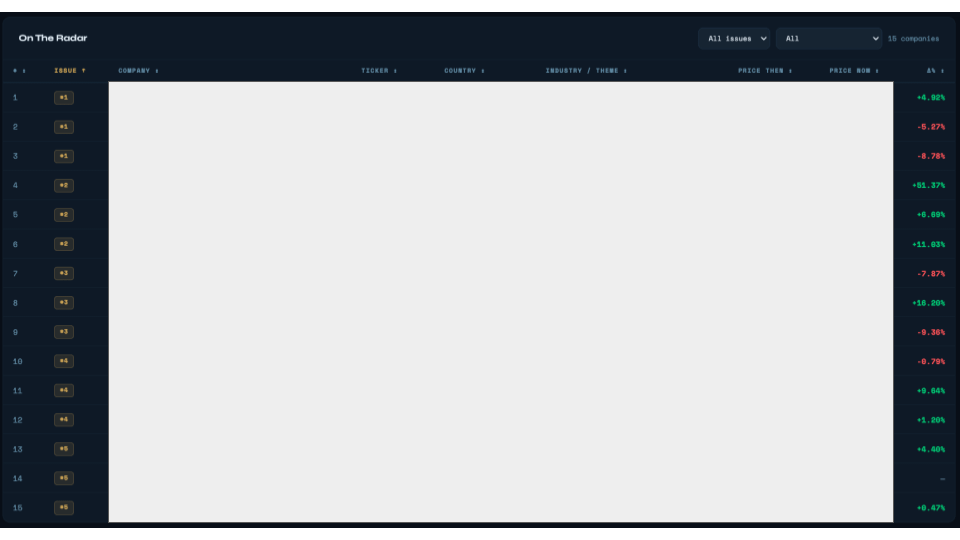
As this is the eighth issue, free subscribers have had access to 8 companies (one for free per issue) whereas paid subscribers have had access to 25.
So, without further ado, let’s jump into the first company.
Vusion (EPA:VU)
Brief description of the business
Vusion (formerly known as “SES-imagotag“) is the global leader in electronic shelf labels (ESLs). You’ve most likely come across an ESL because they increasingly are replacing paper labels in stores:
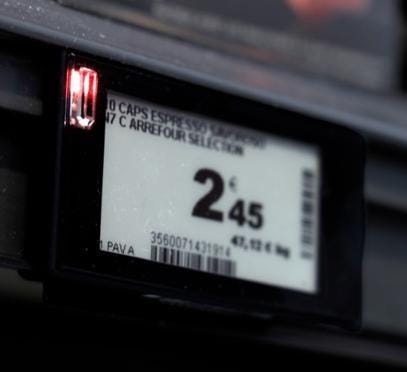
Source: Vusion H1 2026 results presentation
The ESL is only Vusion’s entry point into the store, which is what potentially makes this business interesting. Vusion’s pitch is that it sells an IoT platform made up of labels, smart rails and AI shelf cameras, all connected to VusionCloud. This platform now runs circa 52,000 stores and 522 million connected devices, up 2.4x in a year.
On top of this platform sits what management calls VAS (value-added services), made up of software, cloud subscriptions, computer vision (Captana, ~200,000 shelf cameras) and retail media (through a recent acquisition). VAS revenue was €125M in H1 2026 (+39% YoY), of which €61M can be considered recurring (+73% YoY).
Despite the significant growth of VAS revenue, Vusion’s business model is still mostly project-based and hardware focused. The sales motion ultimately works as follows:
A retailer signs a rollout
Vusion installs labels across its stores over one to three years. Manufacturing is outsourced to BOE, the Chinese display giant that also owns ~24% of Vusion, plus a Jabil base in Vietnam for the US.
Vusion expands its relationship over time through VAS, taking advantage of its installed base.
The contract that has defined Vusion’s fate over the past couple of years has been Walmart in the US, signed in 2023. Walmart received 1.76M warrants, exercisable as its spending with Vusion went from $700M to $3B. Even though this ramp up has benefitted Vusion enormously (not only its numbers but also its credibility as an IoT supplier), the reality is that it can backfire through weaker 2027 (and beyond) numbers. I’ll briefly touch on this topic later.
Why it caught my attention
Vusion came up in one of my automated screens because the numbers and the share price seemed to be telling opposite stories. Despite Vusion’s strong growth track record (20%+ CAGR over the last 15 years as per management) continuing in FY 2026 and margins expanding considerably, the stock is down almost 50% from its highs:
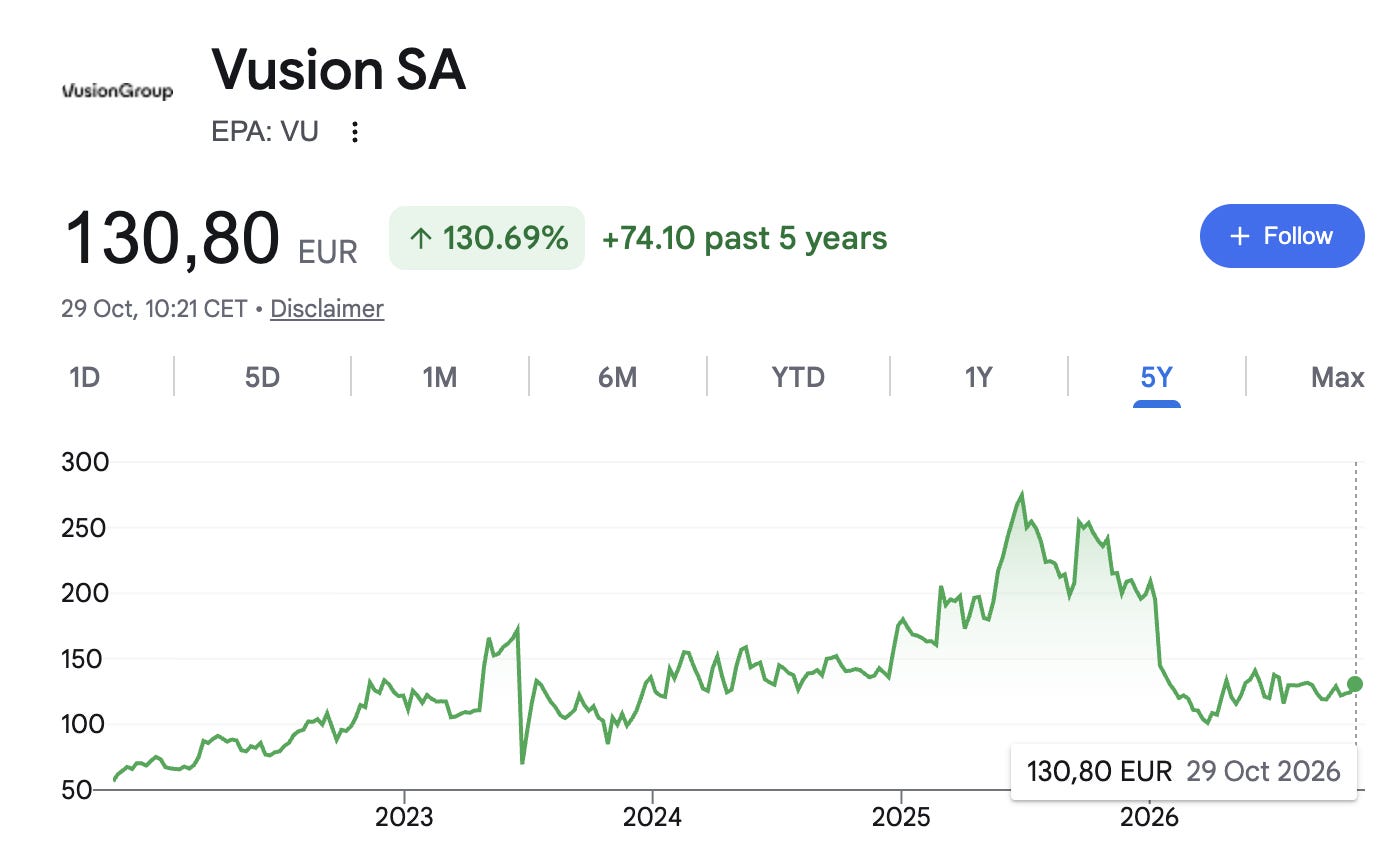
This apparent discrepancy led me to dig deeper, and I ultimately found out that what the market seems to be pricing in is the end of the Walmart rollout. Initially expected to run into 2028-2029, management confirmed that the EdgeSense deployment at Walmart will be largely completed by the end of 2026. This pull forward likely created the rise to ATHs in 2025 and posterior drop as the rollout was deemed to be less sustainable (so much for forward-looking markets!).
Seeing that the valuation has derated due to a potential 2027 revenue cliff is something that I actually view positively, not only because it creates a duration opportunity but also because it demonstrates that Walmart saw value in Vusion’s offering.
Let’s imagine that 2027 is indeed a revenue cliff post-Walmart rollout (even though Vision’s pipeline seems to be filling the void quite nicely)...does a weak 2027 mean the business is worth 50% less? Likely not, which also doesn’t mean that the stock is currently cheap!
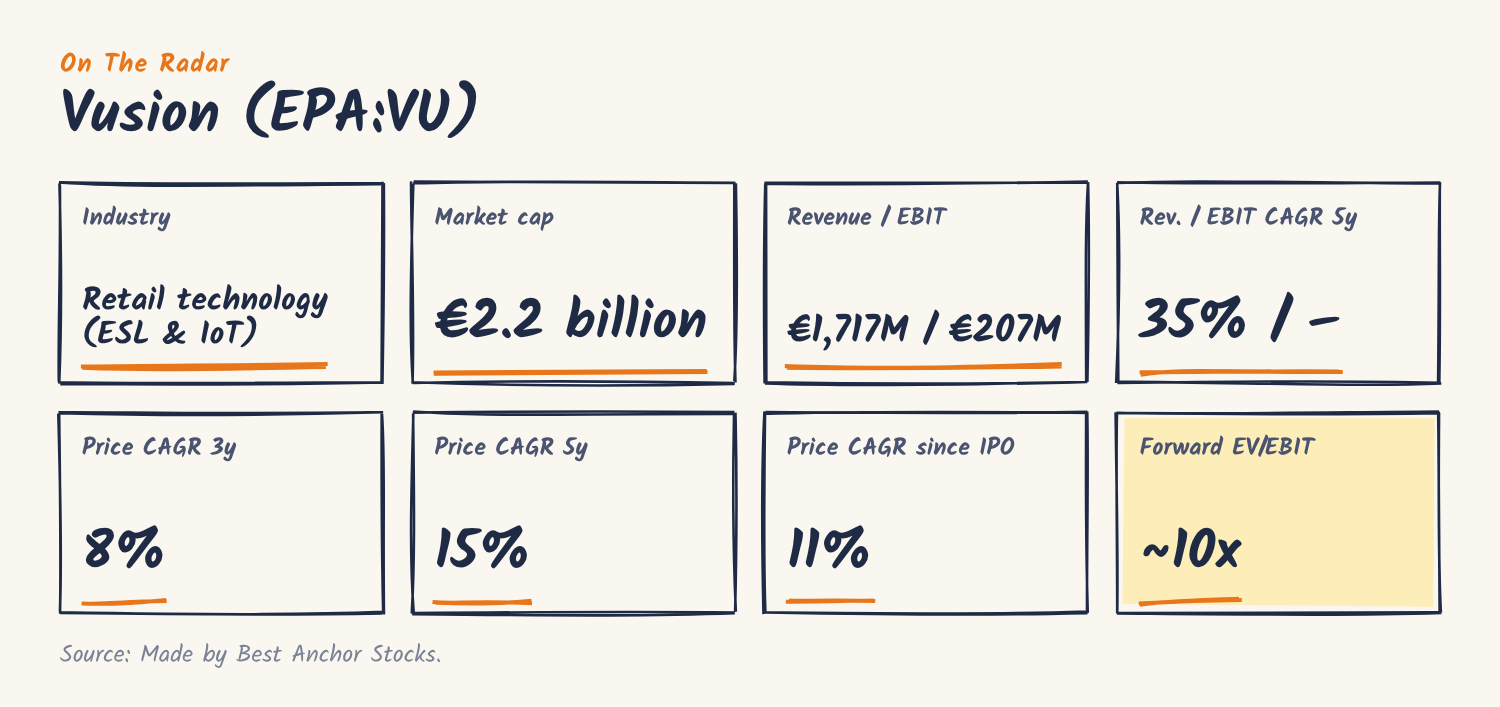
Vusion does seem optically cheap, though. At ~€1.9B of enterprise value, the stock trades at roughly 9x LTM adjusted EBIT (evidently EBIT is influenced by the Walmart US rollout). My research into Vusion is ultimately a quest to answer the following question:
Is 2027 a cliff, or just a pause before the next leg of growth?
Note that it might not even be a cliff in the sense that growth goes negative (which the multiple does seem to imply), but rather a revenue growth deceleration which honestly seems like a given at this point.
What I like
There are many things I like about Vusion, in no particular order...
Clear market leadership. The company has a scale that is twice that of any competitor (the main ones being Hanshow, SoluM and Pricer), and its VAS revenue is several times their combined non-ESL revenue. This is important because scale seems to be a significant competitive advantage in its transition towards a razor-blade business model.
The mix shift will most likely improve the quality of the business. VAS should reach ~€400M pro forma revenue in 2026 (including the In-Store Media acquisition), four times the levels of 2022, and management targets VAS at close to 30% of revenue in 2027. VAS carries a much higher variable cost margin than ESL, which is already beginning to become visible in margins (and it’s also more recurring).
The penetration runway is long. Management estimates ESL penetration at around 20% of the market and much lower for computer vision and retail media. Walmart makes up a significant chunk of the market and Vusion has a head start relationship with the company, with future Walmart rollouts expected in Canada and Mexico.
Capital-light manufacturing. Group-financed Capex is ~3.6% of sales as large rollouts are typically co-funded by customers (e.g., Walmart). This creates a “capital light” business mode, but also comes with large cash flow swings.
Balance sheet and capital allocation. The company enjoys net cash of €197M even after the Walmart down-payment reversals and has a long-tenured CEO at the helm.
Optionality in vision AI and retail media. This is already starting to become apparent in VAS, but it’s the next big wave of in-store technology. The fifth generation of its computer vision technology is set to scale in 2027 and AI is only as useful as the data one has (i.e., Vusion’s scale seems non-trivial).
So, all in all, seems like a pretty decent business trading for a low-double digit EBIT multiple.
What gives me pause
Even though the stock does seem cheap, the ~50% drawdown has happened for a reason:
Customer concentration and the 2027 cliff. Walmart has driven most of the US growth (Americas/APAC +39% in H1 vs EMEA +6%). Replacing this contract requires a big step-up in orders in H2 which management still seems confident about. It does seem that the pipeline is filling up nicely, but the timing/magnitude are the two unknowns.
Dependence on BOE, which is both the main manufacturer and the largest shareholder, with two board seats.
The ESL itself is hardware. Chinese competitors compete hard on price, and the ESL can become a commodity if the platform doesn’t keep ahead.
What I am watching
The main thing I’m trying to do here is answer two questions:
Is the 2027 cliff real? It seems to be discounted in the stock price
What’s the opportunity ahead post-2027? Is the market large enough to continue growing for many years?
Let’s jump to the second company, honestly the one I like the most thus far.