


You can read this article for free, but a paid subscription gives you access to…
All in-depth reports (16 companies profiled thus far, and growing)
Earnings follow-ups
Other investment related content
A community of like-minded investors
Complete access to my portfolio and transactions
Occasional webinars
You’ll also get access to the 30+ page detailed report on the robotics industry.
The in-depth reports of Stevanato and Deere are also free to read to gauge the quality of the research.
Consider becoming a paid or free subscriber today:
On February 10th, I closed my Amazon Q4 earnings digest with the following quote:
I am considering increasing my exposure to Big Tech, and I’ll keep you posted.
I have not kept you posted because I ultimately did not do much about it, but maybe I should’ve taken my own advice. With the exception of Meta, the remaining hyperscalers have performed better than the S&P 500 since that article was published:
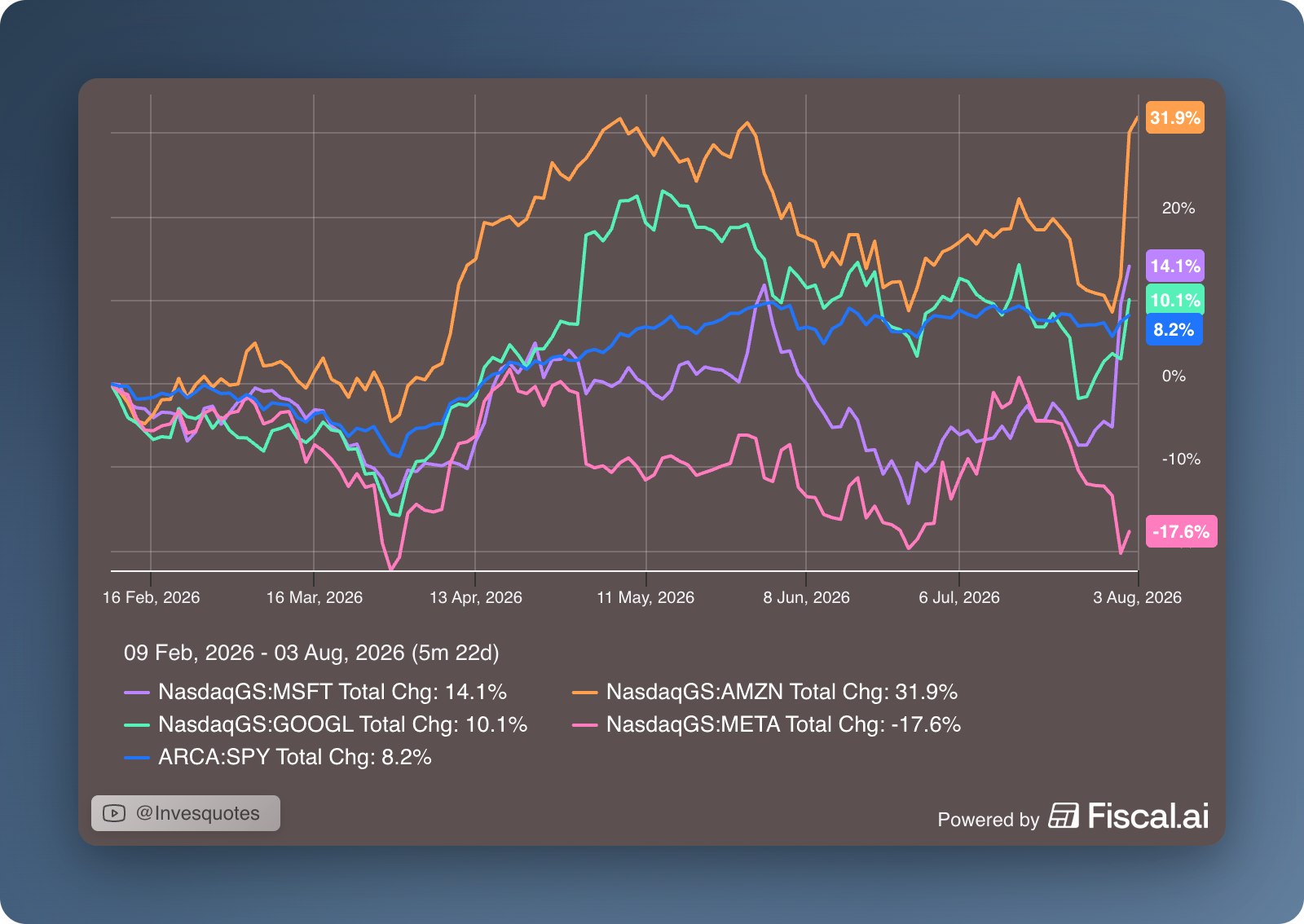
To add insult to injury, the best performer by a considerable margin has been Amazon, a company that I already owned (I profiled Amazon at $90 on November 2022).
Now, all the hyperscalers continue to face today a similar debate than they faced back then, although time is slowly but steadily reassuring investors on the path forward. Investors (or “the market”) remain skeptical on whether the ROIC (Return on Invested Capital) on the massive Capex investments these companies are undertaking will be worth it. The most interesting thing of all is that, simultaneously, this same market seems not afraid to bid up the entire data center supply chain (the so-called “bottlenecks”)! My hunch is that both things (poor hyperscaler ROIC and booming supply chain business) can’t be true simultaneously. One would think that, if ROIC is going to be subpar for the hyperscalers, they would eventually scale down capex and starve the whole supply chain.
It seems like Q2 earnings might have marked the inflection to the ROIC dilemma. Or better said: the stock reactions we have seen post-Q2 earnings might have shifted the narrative (always remember that stock prices drive the narratives, not the other way around).
Amazon reported very good earnings last week and, importantly, provided some context around ROIC. Let’s first take a look at the summary table:
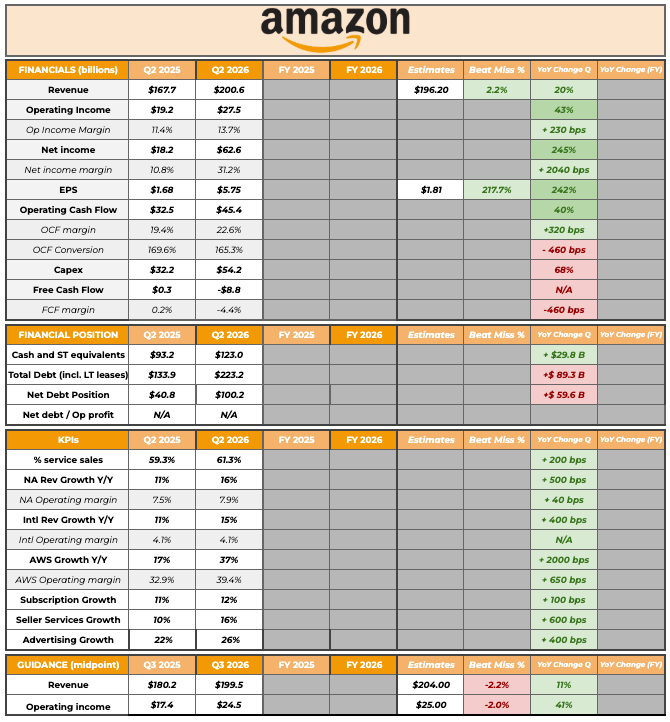
Both revenue and operating profit were up substantially, but we need some context with which we can also contextualize the Q3 guide. Prime Day fell in Q3 last year (2025), but in Q2 this year (2026). This resulted in easy comps in Q2, but in tough comps in Q3 (with management guiding to a 400 bps headwind to Q3 from this Prime Day shift). The bottom line is that Amazon’s “normalized” top line growth is somewhere between the reported Q2 growth rate (+20% YoY) and the guided Q3 growth rate (9%-12%). The fact that Amazon is growing mid-teens at a +$700 billion revenue run rate is utterly impressive. Just in case you were wondering, growing 15% YoY on a $700 billion revenue run rate means adding $105 billion in revenue per year. I don’t think there are many companies in the world that generate $105 billion and there aren’t any that add this as incremental revenue!
The star in terms of growth was the usual suspect: AWS. The segment enjoyed its fifth consecutive quarter of acceleration and grew +37% YoY…
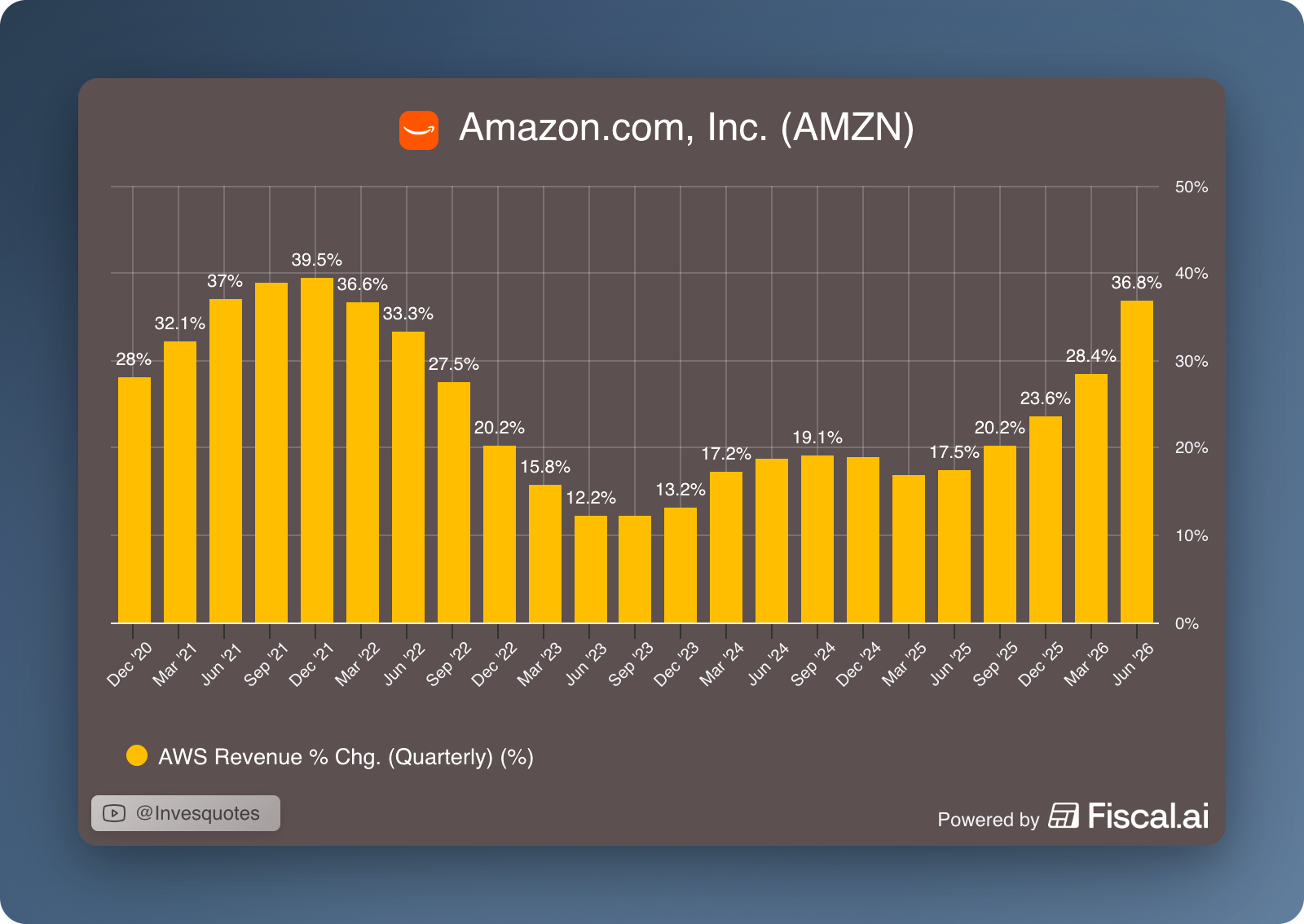
…which was literally its fastest growth rate since Q1 2022, with the non-minor difference that TTM AWS revenue is now more than double of what it was back then! Amazon has always prided itself on investing in capital intensive industries with “unlimited” runways ahead, and AWS seems to fit that profile to perfection.
The best thing about all of this is that the leading indicators do not portray that things are about to slow down: Amazon reported a $496 billion backlog, growing triple digits (read that again). I would, however, be careful with the interpretation of these metrics. Management can include pretty much anything in the backlog, which doesn’t mean that the likelihood of that backlog converting to revenue is high or that it’ll convert to revenue anytime soon. Management did, however, make some interesting comments around capacity, of which I would highlight two:
Capacity for 2027 is pretty much sold out and they are already selling significant amounts of 2028 capacity
They remain on track to double power capacity from 2025 to 2027
This last point is interesting because if we assume that the price per GW sold remained constant, the above implies that AWS revenue doubles from the 2025 base ($129 billion), potentially supporting $258 billion in revenue by 2027 (currently TTM revenue is $169 billion). This is evidently an oversimplification and there are many variables that can make the relationship between GW added and revenue move up/down. For example, Amazon might be selling more GWs of power, but if the price of every GW sold decreases as capacity in the industry comes online, then GWs sold will not translate 1:1 into revenue. There are plenty of things to consider when thinking about the price per GW sold. One of the most important ones is industry structure: will this capacity be sold primarily to the two large labs (Anthropic and OpenAI) or will the customer base be much less concentrated? Andy Jassy believes that it’ll be the latter because the era of open-source models is upon us:
As we’ve been saying for 18 months now, technically competent companies are going to build their own foundational models. Not the really big frontier models, but smaller models that leverage their proprietary data.
A scenario like this would be ideal for the hyperscalers because it would significantly reduce the purchasing power of the large compute buyers and should result (all else equal) into a higher price per GW sold. Something that’s becoming strikingly clear is that there are few stakeholders in the AI-trade besides Anthropic and OpenAI who don’t want to see open-source models succeed.
There are other variables at play in terms of price per GW besides industry structure. For example, the cost per token is coming down fast, but the industry remains in a supply-demand imbalance and power is the constraint. This means that, currently, this “scarcity” premium might be helping hyperscalers counter the cost per token “headwinds” (you could also consider this a tailwind when thinking about Jevon’s Paradox). I am not trying to tell you what you should think, just laying out the variables that matter.
If we assume that the price per GW sold stays constant and Amazon sells all of its capacity in 2027 (this is pretty much a given), then that would mean that AWS revenue CAGRs at a 40% clip between 2025 and 2027. While this looks hefty considering what we know already (LTM AWS revenue growth rate is currently 28%), the leading indicators and the fact that a lot of Capex still has to come online surely makes it seem like a possibility. At a 35% EBIT margin, this would result in $90 billion of AWS EBIT in 2027, or what’s the same, that Amazon (in its entirety) is currently trading at a 33x 2027 AWS multiple. Even though I don’t think that the conversion from GW to revenue will be 1:1, management was not shy to claim that AWS could become a $1 trillion revenue run rate business at some point, so the opportunity ahead seems pretty large.
What makes this more so impressive is that this growth is not coming in the way of margin expansion. AWS margins expanded considerably in Q2 and are already at all-time highs despite the Capex “inefficiencies:”
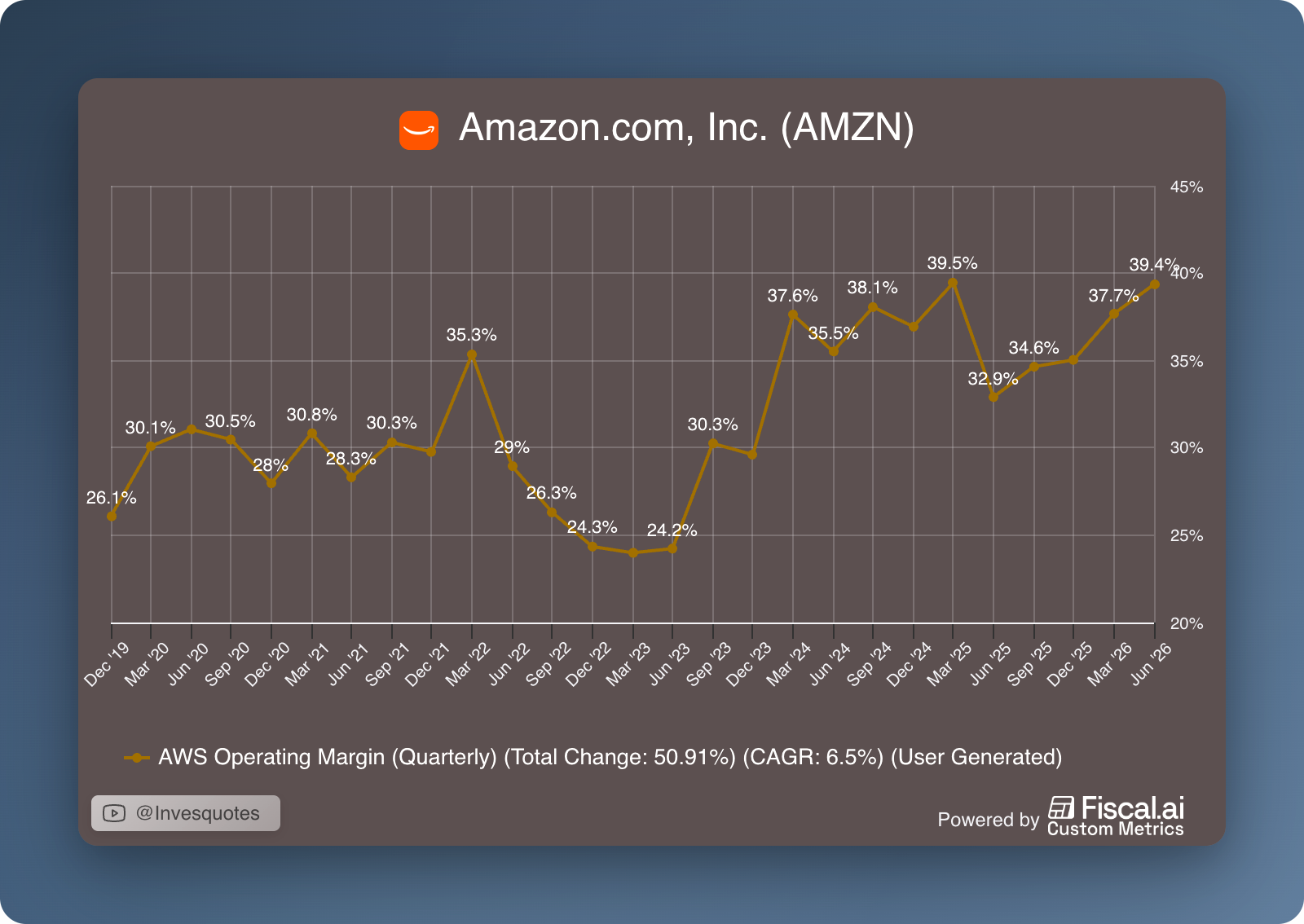
This, imho, portrays two things:
Amazon is selling its capacity at a very attractive price point. Management even claimed that margins on AWS’ AI business might be a tad higher than those of the core business
The capacity is getting used as soon as it comes online (sort of confirmed by management even for 2027)
Margins are a good segue into the topic du jour: ROIC. There are a lot of things to discuss here, but probably the first thing should be management’s context around the ROIC of AWS Capex. They claimed that, in the early stages, a bunk of Capex goes into start-up costs, which we could basically consider the shell of the data center. Building this takes 2-3 years before it can be filled with chips/networking equipment, and as revenue in this business is generated when the chips/racks are in place, this ultimately means Amazon faces a good chunk of unproductive Capex during the early stages of the buildout. This matters dearly for the ROIC debate because Amazon is managing to put up these growth rates and margin expansion while a good chunk of its capacity remains “un-utilized.” Management believes the useful life of these shells is more than 30 years.
Now, the other side of the coin can be found in the chips and networking equipment. This is what ultimately generates the revenue and can only be installed once the shell (and all the relevant permits) are in place. Management believes that…
The useful life of this equipment is 5-6 years. I would say that judging on what GPU rent costs have done over time, there’s a case to be made for longer useful lives, BUT we have also been in a supply/demand imbalance which should lend itself to larger useful lives
They take 2-3 years to break-even on this investment, meaning that there are 2-3 years of pure profit making
For servers and networking equipment, on average, it takes a little less than 3 years to break even on that investment. The servers currently have a useful life of at least five to six years. That means we’re driving significant free cash flow on the servers and networking equipment in the 2 to 3 years after we break even.
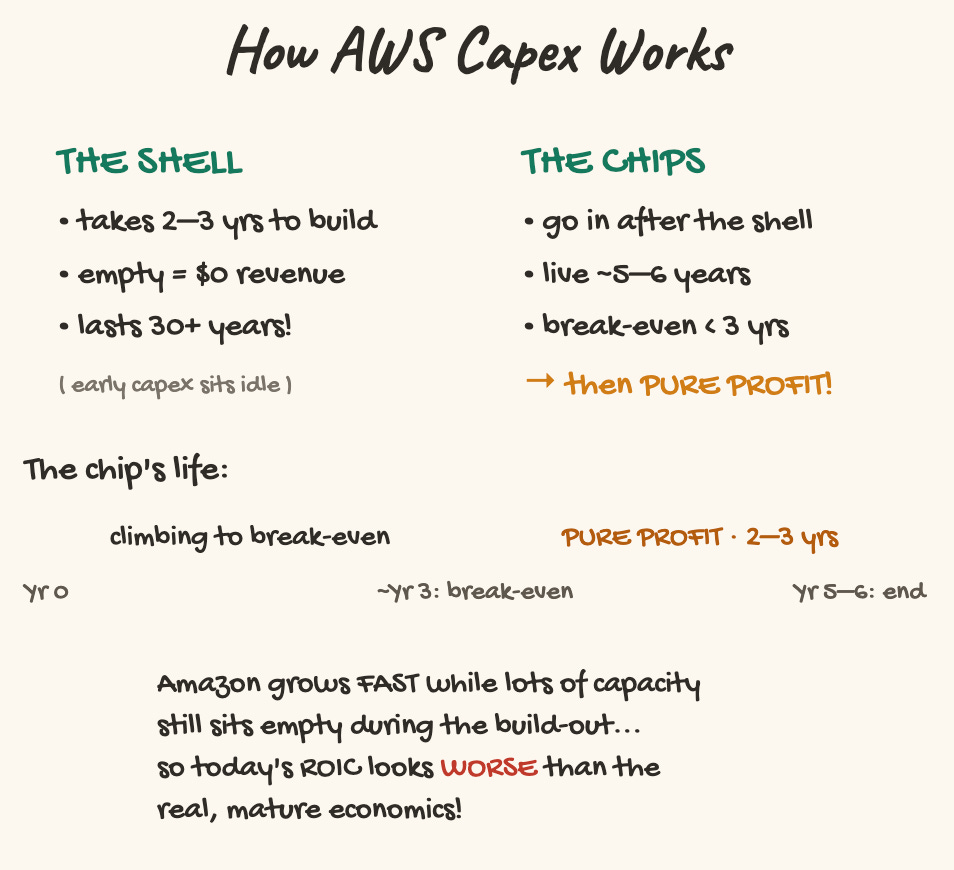
Andy Jassy also claimed that chips and networking equipment have a considerably shorter lead time than the shells, meaning that Amazon already has significant visibility when ordering these. Considering this is the most expensive part of the buildout, it should calm investors’ overcapacity fears as the overbuilding risk is reduced with visibility.
With this data we can somewhat approximate the cash IRR ex-shell of Amazon’s investments (which should trend towards the “all-inclusive” IRR as the shells get toward the end of their useful lives). We get to somewhere around a 20%-45% cash IRR on these investments BUT there are two things worth considering:
There is currently a supply/demand imbalance which most likely overstates steady-state IRRs (i.e., hyperscalers are unlikely going to be able to charge the same once capacity and demand balance out)
The number above doesn’t include the initial shell buildout, which honestly becomes non-relevant when thinking about future chip generations (as they will be built into the same shells that have already been paid off)
What we ultimately get from the above is a very relevant insight: not only are the returns on these investments pretty appealing, but Capex can also be scaled back according to demand because the lead times of “what matters” (chips and networking equipment) are pretty short. Cash IRR should continue to improve as capacity comes online:
We’ll spend a lot of Capex and encounter free cash flow headwinds until these data centers come online, can be monetized, and we get a few years into these servers being utilized.
Another thing worth thinking about here is the implications of the above for the supply chain. I mean, the hyperscalers are spending hundreds of billions in Capex, but a good chunk of this is going into the shells and not the chips per se. Despite not being able to spend most of the Capex on chips, the chip companies (mainly Nvidia and custom silicon) are seeing their fundamentals improve at unprecedented rates. This (imho) means there’s still a significant runway for chips, and even for Amazon’s! Andy Jassy mentioned that Amazon’s chips business is already at a $25 billion run rate growing triple digits and didn’t rule out (as discussed last quarter) selling these to third parties (i.e., to instances outside of AWS).
Even though they’ve not been the most loved by the market, the best positioned companies in all this debate seem to be the hyperscalers. If demand eventually falters, they can stop spending on chips and probably will not take long to digest the “overcapacity.” In this scenario, they would most likely generate significant amounts of cash that they could use to repurchase shares at (maybe) depressed valuations.
The scenario is strikingly different for the supply chain, which would see their revenue and profit contract significantly if hyperscalers were to cut capex. Interestingly enough, the market has decided to buy the latter, and sell the former!
Amazon “other” businesses
Despite AWS making the headlines and maybe singlehandedly carrying Amazon’s valuation at this point, there’s much more to Amazon’s business. Amazon might be the hyperscaler with the most optionality. Retail and ads (both can’t be understood independently) continued growing at a very decent clip.
The two things I would highlight about the retail business would be that Amazon continues to “put up a fight” against lower cost players like Temu…
We also expanded ultra-low price selection on Amazon Haul in the US by nearly 20x since launch and now have over 6 million items priced under $10.
…and continues to significantly expand its perishable business, with perishable customers up 50% YTD! Management also said some words about Supply Chain Services claiming that they had already won several large customers. While this is great and it makes all the sense in the world for Amazon to sell its supply chain as a service, let’s not forget that Buy With Prime was the company’s first stint at something similar and we have not gotten many relevant updates on the topic.
And then we have Amazon Leo. Amazon already has close to 400 satellites in orbit, which management deems enough to to begin internet service. Let’s not forget that, unlike other LEO providers, Amazon does seem to have a competitive advantage here. With enterprise and government customers they have the link to AWS, and with individuals they have the Prime membership (maybe LEO becomes just an additional offering in the Prime membership, who knows):
We already have meaningful revenue commitments from enterprises and government customers, and we have more than 20 partners who will extend the reach of our network across the globe.
So, all in all, even though what’s booming right now in the business is AWS, the reality is that Amazon still continues to grow strong (and profitably) its retail business and there are additional businesses coming into the fold.
I would say that this was one of the cleanest quarters for Amazon in a while. You might have noticed that I have not spoken about Capex. Amazon raised its capex guide to $220 billion (+10% QoQ), driven primarily by higher input costs like memory. I believe this means that the Capex upward revisions have maybe gotten to an “end”, which is honestly not the best news for a supply chain in which the valuations of some companies relied on an ever-expanding Capex figure from the hyperscalers (time will tell).
Have a great day,
Leandro
Nice recap. This is not an easy business to analyze!
Thanks Leandro. Have you started to update your DCF model for your thoughts on capex stabilizing/tapering in the out years? I think we're all trying to figure out when it's likely that AMZN reverts to positive FCF.