Eurofins (EPA:ERF) is a company I profiled in May this year (+35% since), you can read my in-depth report on the company below:

Eurofins reported its Q3 and 9M revenue update today. European businesses are not legally required to report earnings every three months (the requirement is semi-annual) so they either (1) don’t report a single thing in Q1 and Q3, or (2) release a short revenue update. Eurofins falls in this second group.
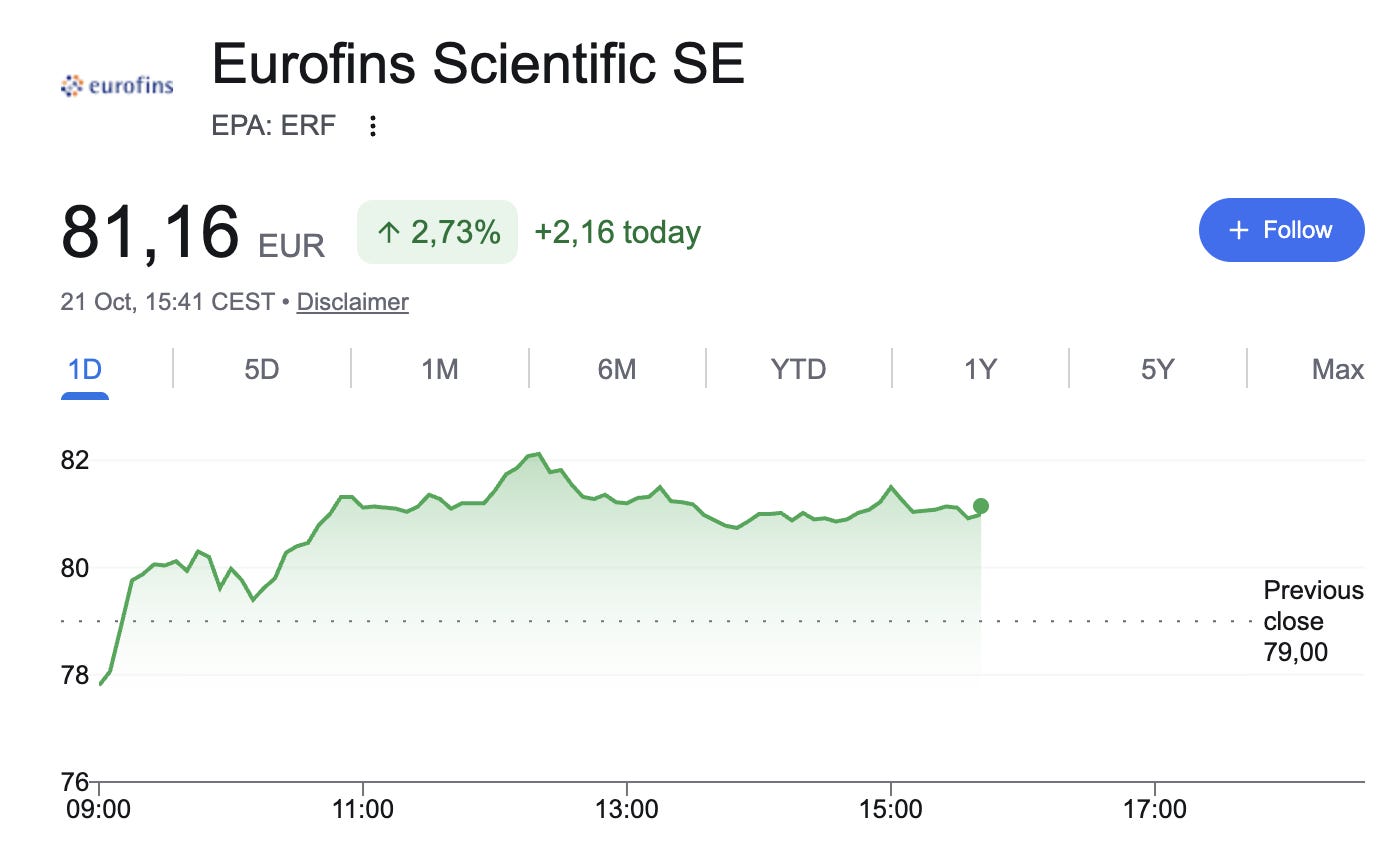
The quarter was not incredible, but probably not too far from what the market expected. The earnings call was pretty encouraging (you’ll learn below why) which is likely part of the reason why the stock reacted positively despite having run up significantly over the past couple of months:
Note that here I’ll focus on the quarter (not the 9 months) in this article, as I published an H1 2026 article not long ago which you can below:
Food for the bulls, food for the bears

(Eurofins is a company I profiled in May 2026. You can find the in-depth report here.)
Let’s jump right in.
The numbers
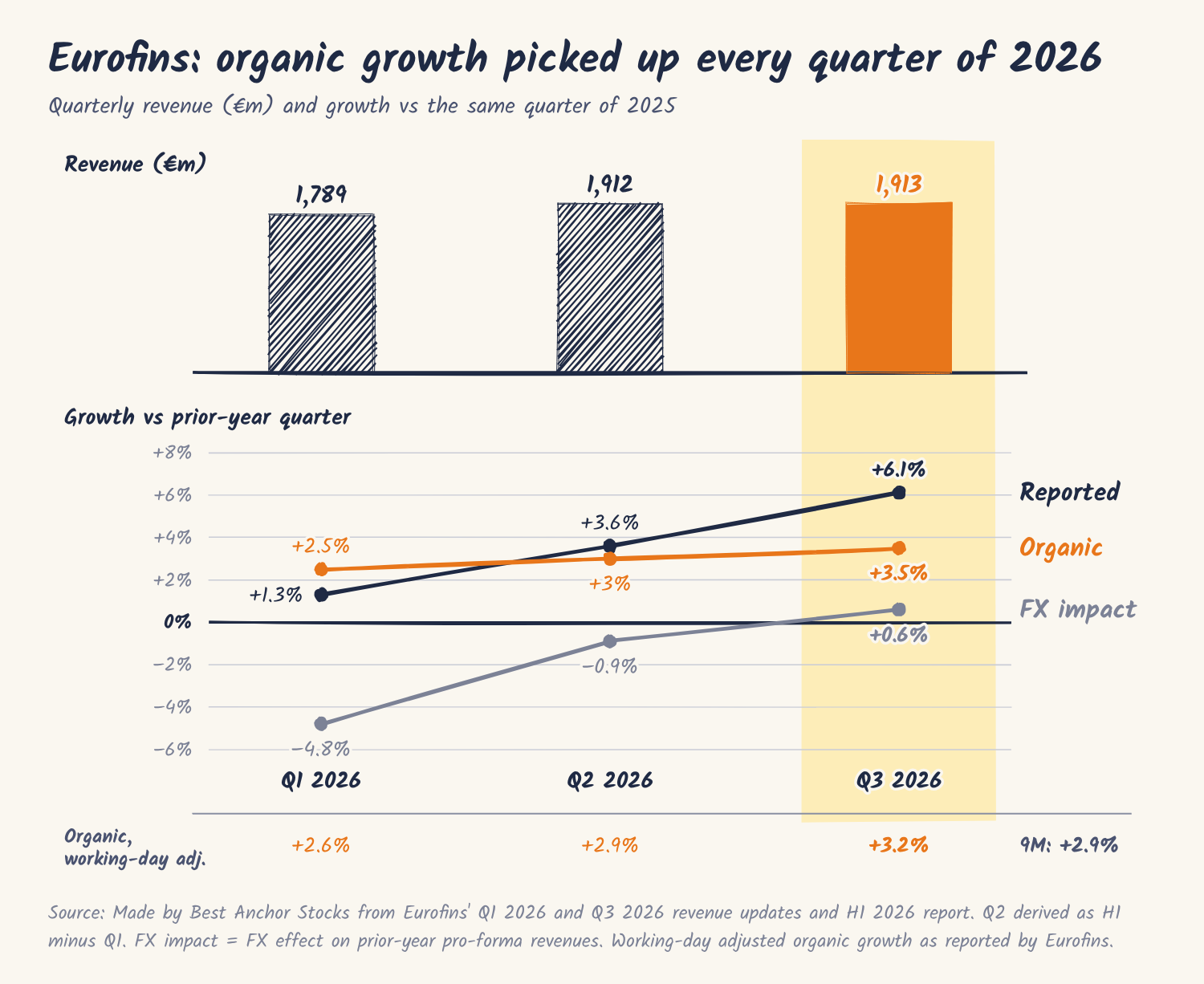
The numeric highlight (in my view) was that growth continued accelerating (reported numbers were aided by an FX tailwind), but maybe not at the pace many expected. The company grew Q3 2026 revenue 6.1% to €1,913m (right around the market’s expectations), with organic growth accelerating to 3.5%.
Q3 was the third straight quarter in which organic growth picked up by half a point: 2.5% in Q1, 3.0% in Q2, 3.5% in Q3.
Even though the organic growth acceleration is welcome, it fell short of what the company required to achieve to meet its FY 2026 objective of MSD (mid-single-digit) organic growth. I believe this “guidance downgrade” is something that many people assumed back when Eurofins reported H1 2026 earnings. This is what I wrote in my H1 2026 update:
So, all in all, not a great start to the year from an organic growth POV, something I believe only increases the pressure on management’s credibility. Even though Gilles said this…
It is obvious that to hit mid-single-digit organic growth for this year, we need to have a significant pick-up in H2. We believe we’ll have a pickup in H2. We still think MSD is achievable.
…I highly doubt the market/investors are buying it at this point. After having grown considerably slower than MSD in H1, Eurofins needs its organic growth to pick up quite considerably in H2 to meet this year’s objective. It’s definitely possible, but the company is coming up against tougher comps and “when” those contracts ultimately make it into revenue is not 100% under management’s control.
So, in my opinion, what occurred in Q3 served simply to confirm what most analysts had already anticipated and honestly to confirm something that seemed inevitable.
Just to put some numbers on this...Q4 organic growth would have to reach roughly 6.9% to hit 4% organic growth for FY 2026, 10.7% to hit 5% and 14.6% to hit 6%. Even the bottom of the range means doubling Q3’s 3.5% organic growth rate in a single quarter. This ultimately means that the guidance cut was a question of when, not if. These are my own estimates and, even though projecting organic growth is tough, it should be enough to demonstrate that the company needed a significant acceleration in H2 that the market did not really buy into.
The “good” news
There were a couple of pieces of “good” news on the growth front which I’d summarize as follows:
Management claimed that FY 2027 organic growth should return to MSD. I don’t know if this will happen, but the organic growth trend is encouraging and so were management’s comments (more on them below)
Gilles framed the 2027 objective as follows:
I think we just stated the obvious, and our growth has been a bit lower than what we thought would be possible this year. I think there will be gradual improvements, but not necessarily on all fronts at the same time. I mean, mid-single digit for most people is 4 to 6%, I believe. And so we might be slightly below 6.5% next year.
Inorganic growth is tracking ahead of management’s expectations, meaning that the combination of “organic + inorganic” growth might well end up in the same place despite organic falling short of their expectations
Biopharma seems to have considerably accelerated in Q3, albeit not even management knows whether the acceleration is sustainable.
A non-trivial portion of the organic growth headwind is self-inflicted and temporary. Eurofins is still rolling out its proprietary LIMS (laboratory information management system) across its network. Management claims this has been disrupting the labs and costing them growth but that, once the deployment is complete, that drag should fade and teams can refocus on winning new clients.
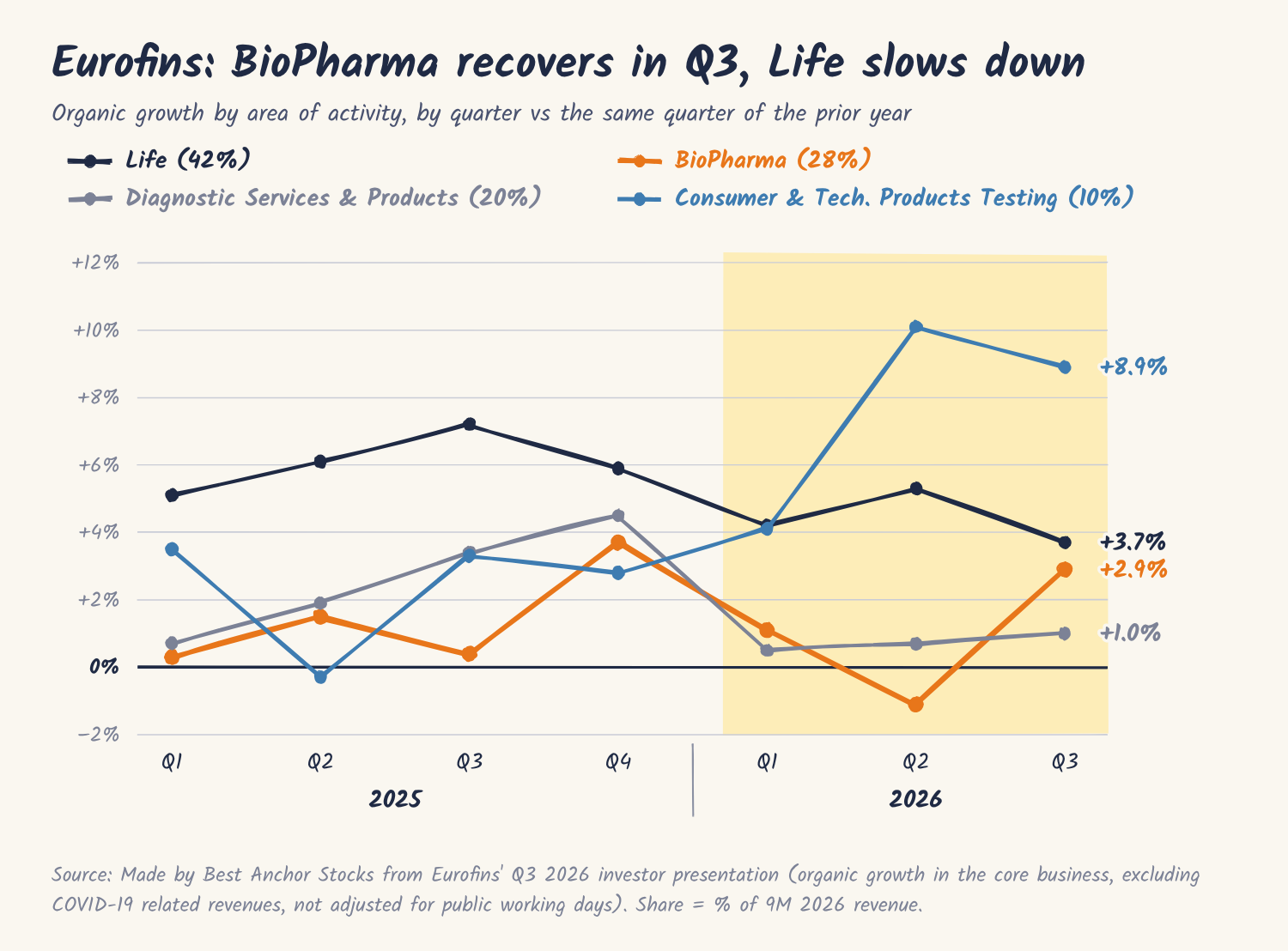
Management attributed the still subpar performance of biopharma to delays in clinical programmes (these sit in ancillary services).
Some expected clinical programmes will not restart in 2026.
Which is not something new...
“We have signed contracts, and we think there will be a restart of those contracts. As usual, for clinical research, it’s difficult to know exactly when our clients will restart.” (Gilles Martin, Q3 2025 call)
“Central Lab and Bioanalysis, we have some fairly large contracts, and, our best guess now maybe would be H2 2026 for start of that.” (Gilles Martin, FY 2025 call)
“Some of them are signed to restart, but we don’t know when they will restart. When they do, this will be material in the growth.” (Gilles Martin, H1 2026 call)
In layman’s terms...the restart has moved from “soon“ to “H2 2026“ to “not in 2026.” Management also claims that projects can be lumpy and that the base effect has now been absorbed, which potentially means that growth can return pretty fast.
Gilles confirmed the delay today but sounded significantly more optimistic about 2027:
Unfortunately, we have some programs—clinical programs—that we thought would start in Q4 of this year that won’t start this year. We do have good signature of different programs which makes us optimistic for next year that we’re going to start seeing some improvement, for example, in our central lab, and hopefully in our bioanalysis, which have been hurting us for a few quarters.
Something that seems relevant is that next year’s MSD target doesn’t assume these programmes kick in, so they’re optionality on top of what has been “guided” to:
We have a key client, for example, in central lab that we believe will start next year. Vaccine probably not next year. That would have been a bigger shift. Our target of mid-single digit next year does not account a very significant shift on that. If that happened, that would be a plus, and that would have more positive impact.
Something that I don’t know whether to interpret as good or bad news was the geographical distribution of growth. The source of organic “weakness” remains concentrated in Europe (not a surprise), with North America trending within the MSD objective and the “rest of the world” far above it:
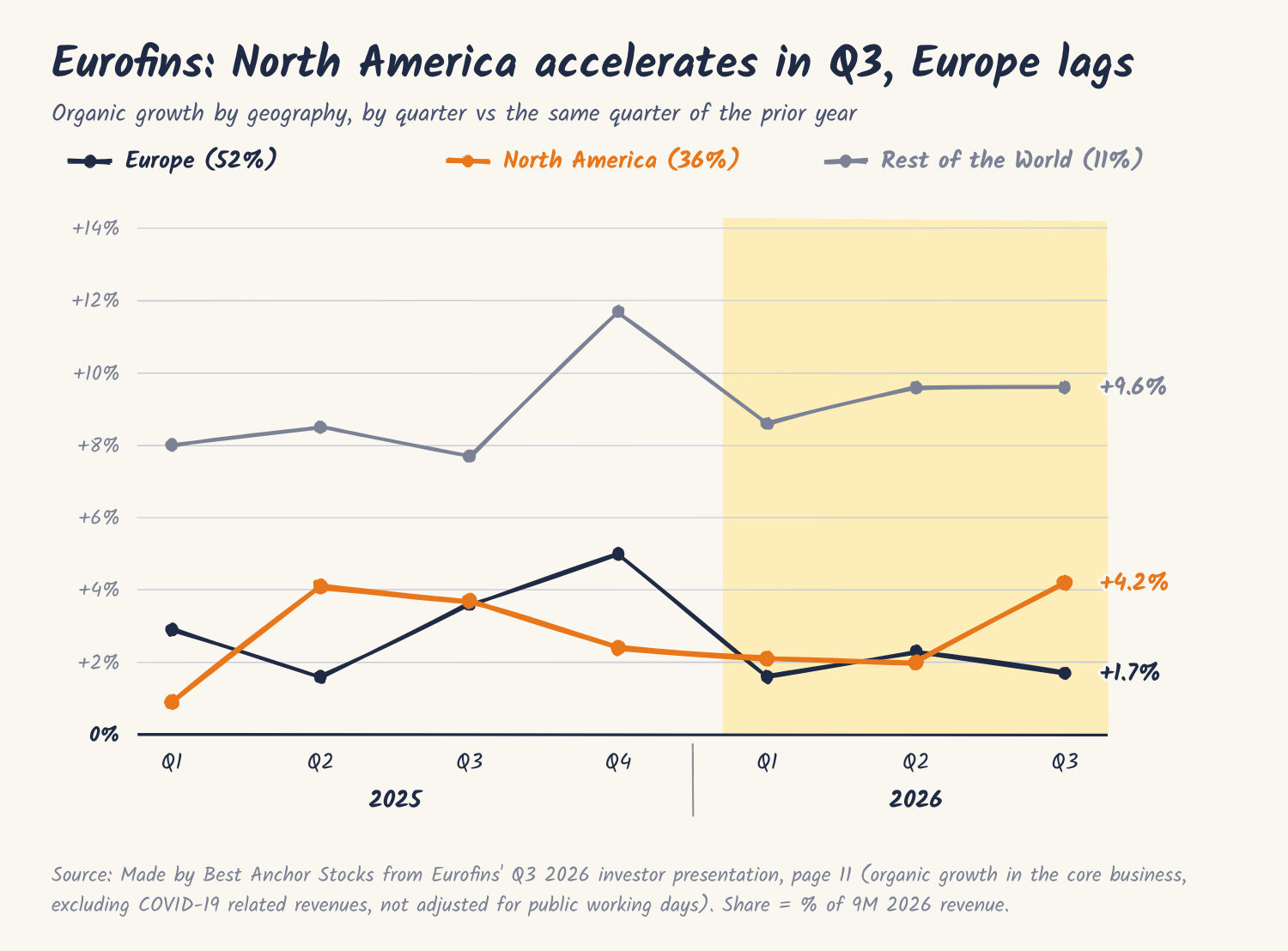
Management alluded to “macroeconomic” pressures in Europe which, as a European, I can somewhat confirm from anecdotal evidence! Things are definitely not trending in the right direction in Europe. The Rest of the world is growing close to double digits organically, and it’s no surprise considering that Gilles considers Asia to be a significant growth opportunity for Eurofins:
“We are very far along in building and completing our hub and spoke laboratory network in Europe and North America, especially. We still will have opportunities in Southeast Asia and Asia generally for the next 10 years or 20 years, also a little bit in Latin America.” (Gilles Martin, FY 2025 call)
“Of course, we also have a heavier weight in Asia in that area, and Asia is doing well. The economies in Asia are doing much better than in Europe.” (Gilles Martin, Q3 2025 call, on Consumer Product Testing)
Gilles was also explicit on the call noting that they believe they are past the worse:
“The economy is not as great as we would like in Europe, especially France and Germany. We see it a little bit in our numbers in this quarter. For life, for example, but overall, we have some areas that have been affected over the last few quarters, but we’ve hit bottom, we believe, in the ancillary activities like agroscience, genomics, et cetera. Also, this deployment of LIMS system has been really hurting our labs and costing us growth. Once this is behind us, our teams can much more focus on growth, winning new clients.
So, overall, a mixed story on the growth front but with some encouraging forward-looking comments. I’m still not done with these comments and I’ll share a bit more later on!

Still a profitability story
Even though we did not get profitability numbers, I’d consider profitability a highlight in the quarter. Despite claiming that they’d be under-delivering on the organic growth front and over-delivering on the M&A front (typically a bad mix for margins), management shared that they expect profitability and free cash flow to come in line with their expectations at the beginning of the year.
This must mean that the organic profitability of the business must have improved materially. Recall that Eurofins targets an Adjusted EBITDA margin of at least 24% in FY 2027 and they were already pretty close to it in H1:
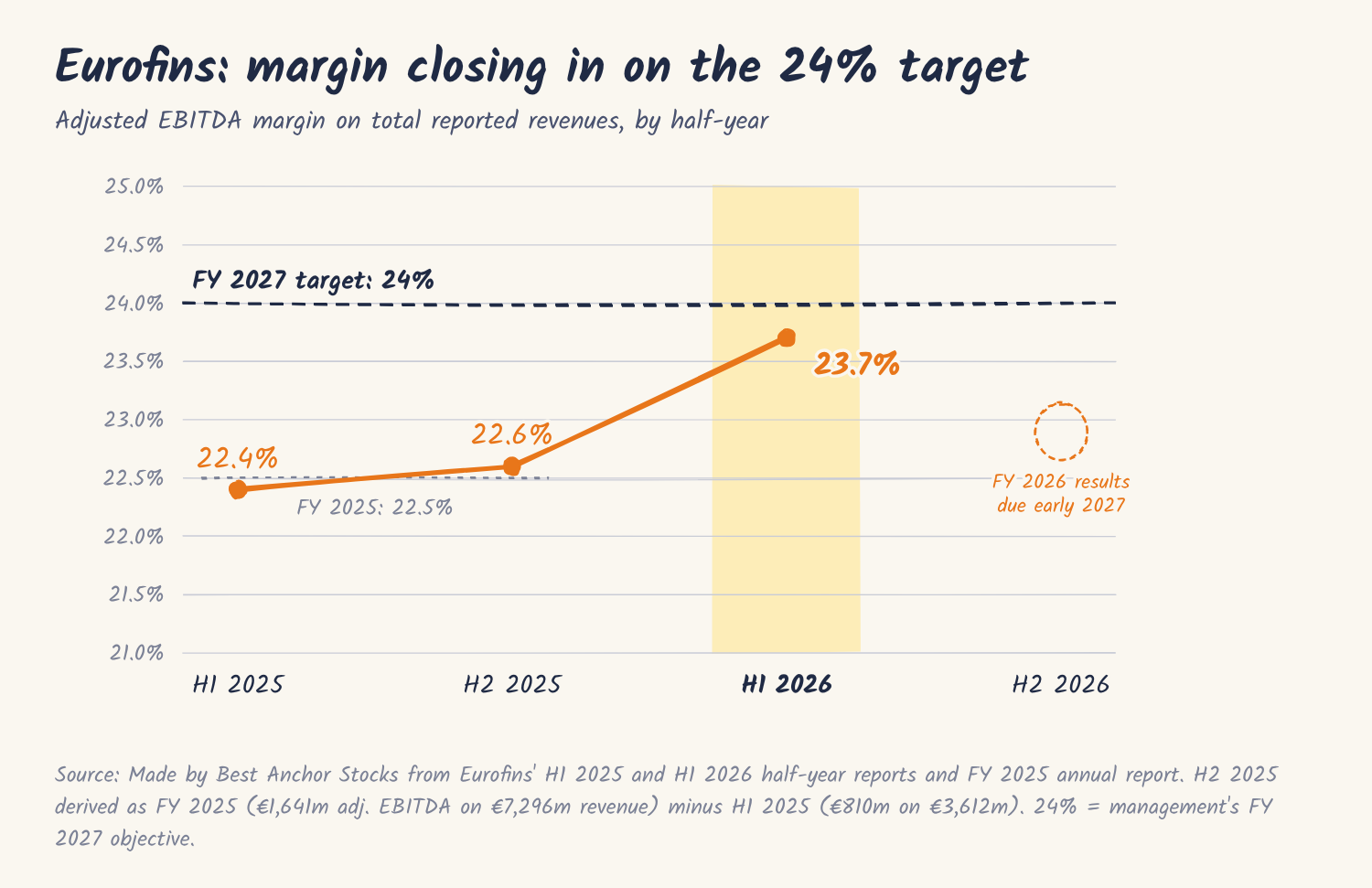
Considering that H1 2026 came in close to 24% despite a poorer organic performance than what we should expect in H2, I’m inclined to believe that the 24% adjusted EBITDA margin objective is beatable this year. We’ll see, but Eurofins has been a story of underdelivering on growth and overdelivering on profitability for a while.
We stick by our objectives that our profits will improve this year compared to last year. So will cash flow, and we should have a much—an even bigger step next year to achieve 24%. But indeed, H1 should demonstrate for people that we can—we are not very far from those 24% operating margin, and we should be getting there next year.
This has two potential readings, one optimistic and one pessimistic. The optimistic one is...what will happen to margins when/if organic growth accelerates? The pessimistic is...is Eurofins just a “milk the cow” story? Both are valid at this point in time although I still believe that organic growth re-accelerating to target is upon us.
The post 2027 period and AI optionality
Even though management stopped in 2027 when guiding investors numerically, they did give some qualitative commentary on what the post-2027 period might look like:
As a preview to what is beyond 2027, that is going to be more the main thing that will happen after that. We will have the footprint. We will not have to shut down labs, close down, move, with massive double cost of facilities. While we do the move, of course, capEx to build those sites, that will be behind us. We can then optimize our network, improve further our service to our clients. AI can bring a lot in many aspects of our business too, especially in the area of quality control, to make sure everything that we do is performing well. Automation, of course. That is the building phase, which has been a long one. I do acknowledge because we have been consolidating a very, very large number of small mom-and-pop labs that were sub-scale and were all doing a little bit of everything.
The only caveat I’d make here is that it’s not the first time that Gilles talks about the end of a Capex period which he then chooses to follow with a new one. He also discussed AI optionality in the call:
If the market really picked up, if AI brought a lot of candidates that have to be put through the physical testing in labs, or we could increase the capacity of our discovery business by just adding people. We have the footprint, we have the labs. More importantly, the bigger business is biopharma product testing, which the development work will have to be done in labs. AI cannot do the development work, all the method development and testing, et cetera. And for that, we have created a lot of capacity for biopharma product testing.
It seems like the company has enough physical capacity to enjoy this optionality even though it’s not baked into the long-term growth guidance. This should help us understand the magnitude of the capacity that the company has added in the most recent Capex period.
Updating the model
Gilles answer the following to a question on buybacks:
Yes, we are fortunate. We can buy as much as we want of a very good company at 9, 8, 9, 10 times EBITDA. Frankly, it is a no-brainer as long as we stay within our leverage to buy Eurofins shares at those multiples when I see the multiples that are paid for small assets sometime of very poor quality.
Eurofins is up around 30% since I published my in-depth report, which begs the question...is the stock still cheap?
Let’s take a look.