


(Eurofins is a company I profiled in May 2026. You can find the in-depth report here.)

Eurofins reported mixed H1 2026 earnings last week. Even though the company displayed very strong EPS growth (+29% YoY), the reality is that organic growth (+2.7% YoY) continues to fall short of management’s expectations (MSD this year and 6.5% over the long term).
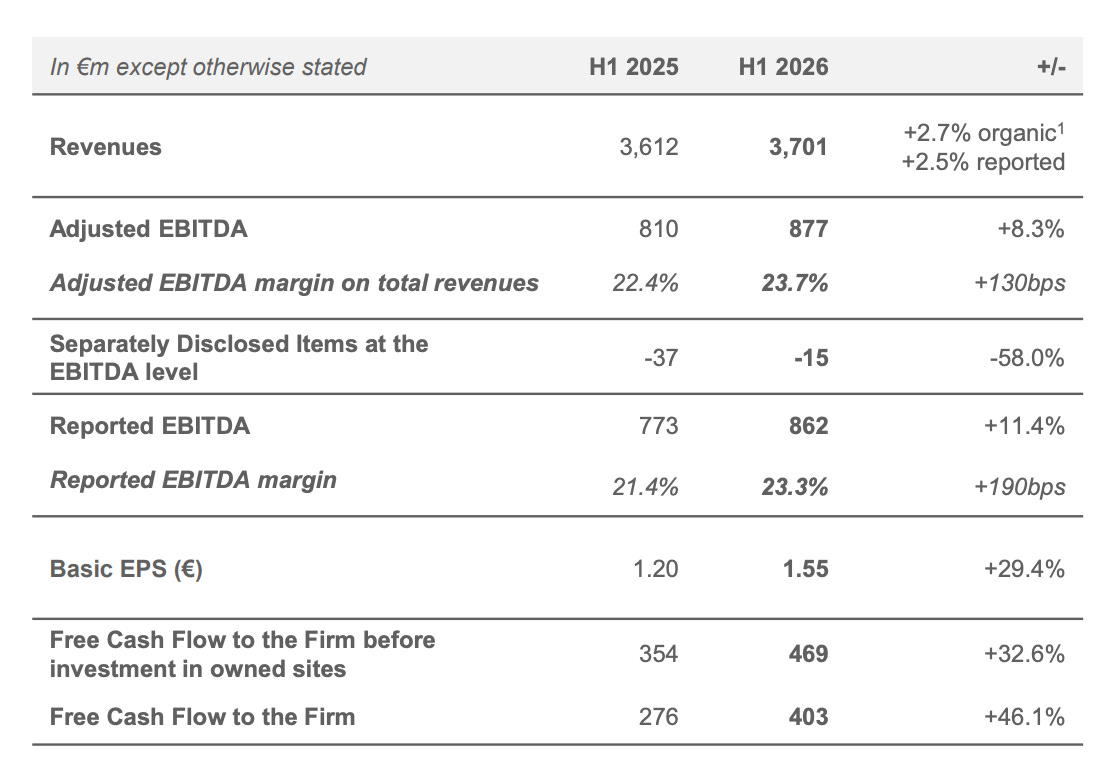
As most earnings releases, Eurofins’ earnings release had food for the bulls and the bears. Let’s begin with the “bad” news and leave the “good” news for later.
The “bad” news is that organic growth continues to fall short of management’s expectations. Even though management claimed that “organic revenue growth improved from Q1 to Q2,” the acceleration was not something to write home about (maybe not something to write about at all!). Organic revenue growth was 2.6% in Q1 and 2.7% in H1, meaning that Q2 organic growth must have been relatively close to that of Q1. They gave several explanations (or excuses, however you want to see it) for the weak organic growth, one of which I believe was somewhat worrying.
Gilles Martin talked several times about “easy comps” as a future tailwind for organic growth, which I believe is a rather terrible way of framing it and something that probably “scared” investors. The first thing that came to my mind after reading the “easy comps” explanation was that Eurofins is not a secularly growing business (because secularly growing businesses don’t need easy comps to grow at an acceptable rate). This explanation made it seem as if Eurofins needed easy comps to grow at its long-term objective, which means that the long-term objective is secularly unachievable. I believe this was a communication mistake by Gilles and that he actually doesn’t believe that Eurofins won’t secularly grow in the future, though.
The other “explanations” behind the weak organic growth made more sense, albeit some must be contextualized. The “Life” segment performed poorly in Q1 due to some weather related impacts and Gilles mentioned back then that it would improve throughout the year; it did. The Life segment is already back at the MSD objective after experiencing some catch-up during Q2 (+4.8% organic growth in H1 and +5.3% in Q2).
This ultimately means that the weakness in Q2 must have come from another place, and this was the usual suspect: Biopharma.
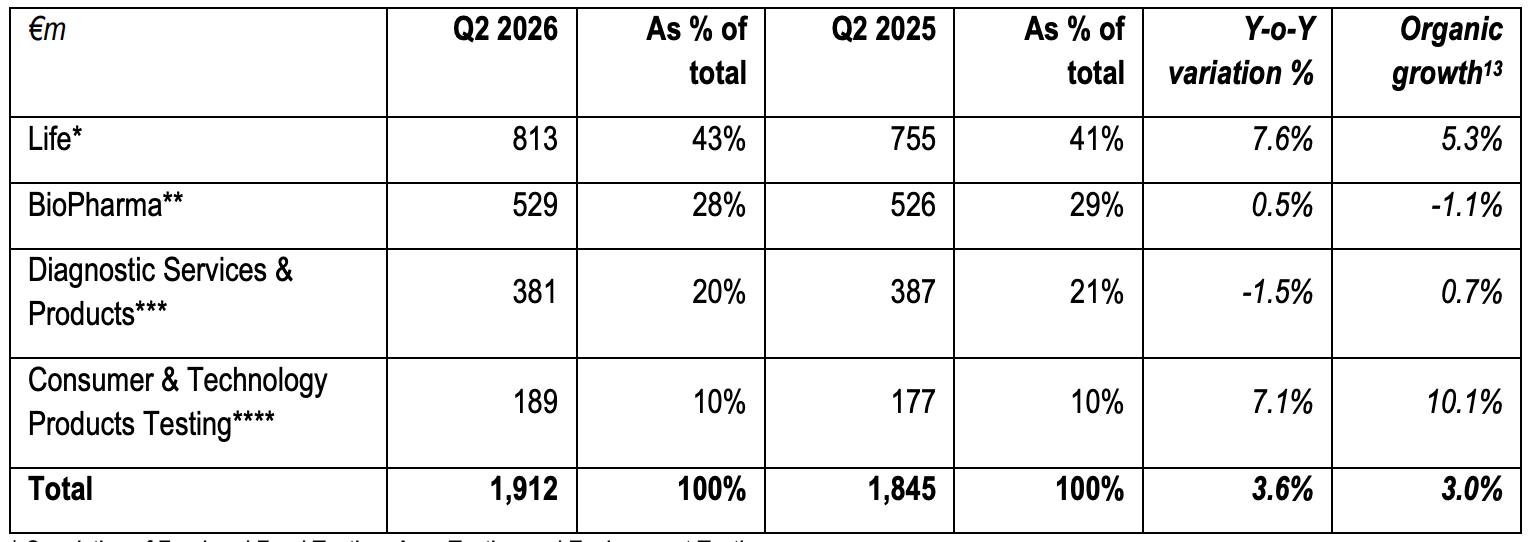
Biopharma worsened significantly (-0.1% organic growth in H1 and -1.1% in Q2) for several reasons (discussed below). Management explained that they expect the segment will have a better H2 when easy comps materialize and as several important contracts are reactivated. The first explanation (easy comps) actually doesn’t make much sense as H2 2026 seems to have significantly tougher comps than H1 2026. This is what management said in the H2 2025 earnings press release:
Organic growth strengthened as the year progressed, with the highest growth rate observed in Q4.
This was also the case for Biopharma as the segment saw its revenue growth accelerate in H2 2025. I might be missing something, but I actually don’t see the easy comps management is talking about. The only thing that might explain it is that management is already talking about easy comps for next year:
If you look at the numbers for the first half of this year, it probably makes very credible our objectives for next year.
Let’s not forget that Biopharma is made up of a couple of subsegments, each with their different drivers and levels of lumpiness. We could summarize these subsegments and their performance as follows…
Biopharma Product Testing (BPT): was softer in Europe than in previous periods because a couple of large contracts ended. Management believes this was the main driver behind the sequential worsening of the Biopharma segment (it’s also the largest sub-segment), but they believe the weakness is temporary
Discovery (aka. the early phases of biopharma): still soft, but they see some green shoots related to biotech funding:
We have requests for quotes, but we have not seen a big impact on the actual numbers yet, although that should materialize at some point.
I’d say that the green shoots were somewhat confirmed by Medpace last week, as August Troendle claimed that biotech funding was picking up and that it was broad-based. I’d imagine that the impact of improved funding on Medpace is more immediate than it is for Eurofins (as customers are likely to fund first the programs that are closer to the commercial phase). This said, Eurofins should see a considerable pick-up here if/when AI starts to help in drug discovery (although there’s also a bear case to be made here as it might result in less early stage work)
Central Lab & Bioanalysis (i.e., clinical): management claimed that this business is small relative to the size of the contracts. This means that it is lumpy and volatile (due to timing):
“We have some (contracts) that are signed, but we’re not exactly sure when they will start being implemented, pick-up when the patient recruitment shows some significant momentum. We cannot give precise timing, we do think we’ll see an impact in the back end of this year when those contracts start.”
The CRO pipeline might be a good leading indicator of what’s to come here. It was evident in Medpace’s earnings that CRO RFPs are picking up. Eurofins already shared in Q4 2025 that they expect this segment to inflect in H2 2026: “On biopharma, yes, Central Lab and Bioanalysis, we have some fairly large contracts, and, our best guess now maybe would be H2 2026 for start of that”
Development & Manufacturing (i.e., CDMO or the final part of the value chain): a lumpy business because a few large contracts make up most of the revenue.
All of the above resulted in Biopharma weakness that management deems temporary due to cyclicality:
In Q2, just to give you an idea, we are at -16% in our phase I clinics in Europe, 20% in our European CDMO because some contracts ended in CDMO. That can revert also to +40% once your contract starts in those activities.
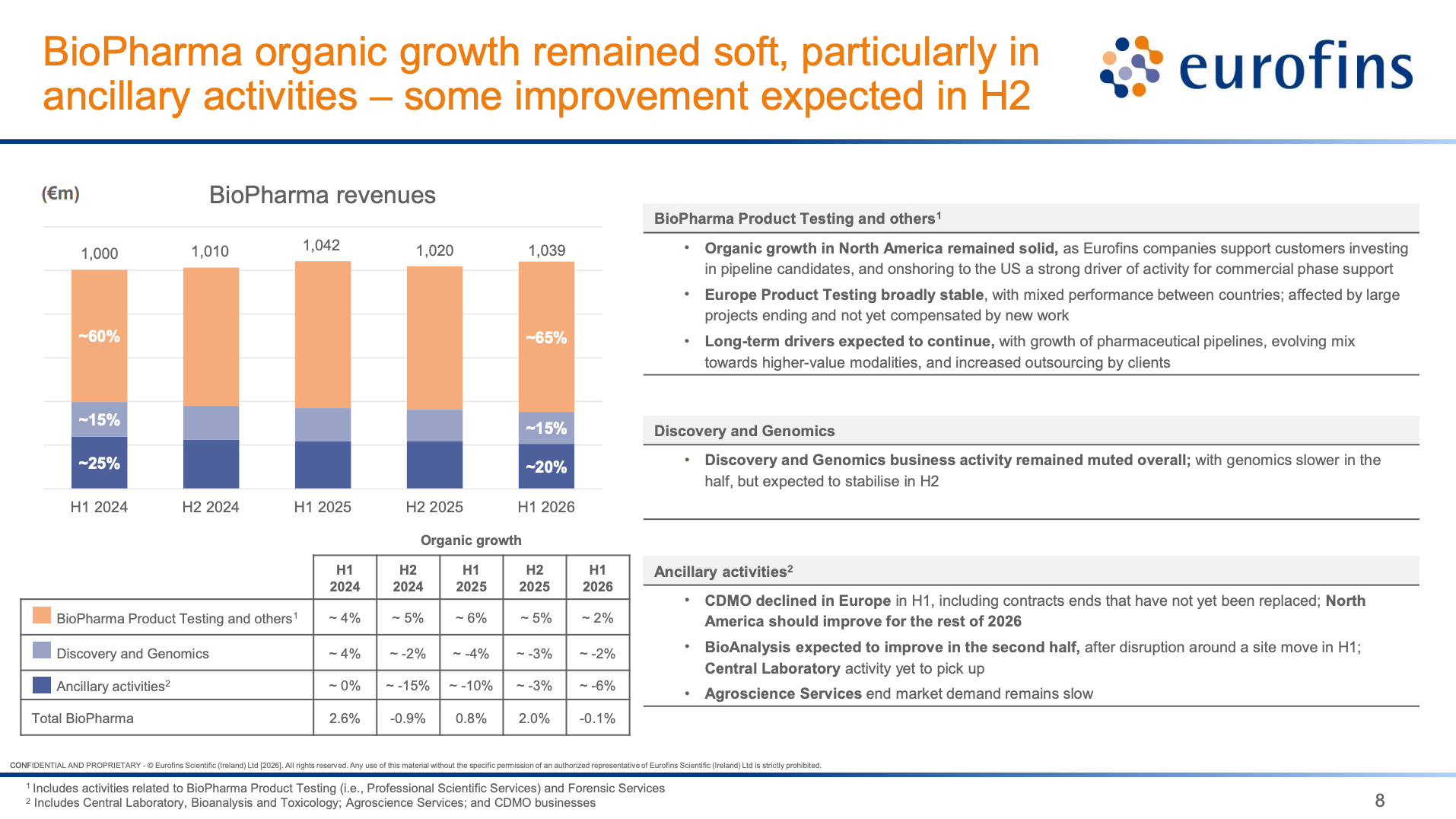
We shouldn’t forget that this segment is poised to benefit from the potential inflection in the industry once funding solidifies and AI starts to fill the drug pipeline. When will this happen? No idea, but I am pretty sure it will. Biotech funding is already inflecting and there are signed contracts waiting to start (coherent with Medpace’s pipeline comments in the most recent earnings), so it all bodes well for a stronger H2 2026 and potentially 2027:
And what it may be, as I said, 2027, I think overall, biopharma, even our core biopharma product testing, could grow more than the mid-single digits where it is now. And that could also increase. When would that be? That’s why maybe I said 2027 or- but overall, biopharma, I don’t see why biopharma as a whole shouldn’t grow faster than life.
Source: Q4 2025 Earnings Call
The restructuring programs/investments the company is undertaking are also negatively impacting organic growth:
Operational performance will also significantly improve. At the moment, we lose clients because we are changing LIMS., because when you change IT systems, your performance decreases, you have issues, and at some point, this is done. Then the opposite happens.
We’ve ended a lot of loss-making contracts at SYNLAB. That also impacts our organic growth.
So, all in all, not a great start to the year from an organic growth POV, something I believe only increases the pressure on management’s credibility. Even though Gilles said this…
It is obvious that to hit mid-single-digit organic growth for this year, we need to have a significant pick-up in H2. We believe we’ll have a pickup in H2. We still think MSD is achievable.
…I highly doubt the market/investors are buying it at this point. After having grown considerably slower than MSD in H1, Eurofins needs its organic growth to pick up quite considerably in H2 to meet this year’s objective. It’s definitely possible, but the company is coming up against tougher comps and “when” those contracts ultimately make it into revenue is not 100% under management’s control. It seems pretty evident that management has been a tad more optimistic than they should in terms of the timing of the recovery (I don’t expect them to be good at this) but Gilles believes that, whether or whether not they achieve this is not important due to currently low valuation:
I don’t think any of that matters because the business is valued now at such a low multiple compared to the components that all of that is basically irrelevant.
I don’t agree with his POV. Credibility is always important in financial markets and repeatedly falling short of guidance is ill-advised in terms of building credibility (something I discussed at length in the in-depth report). With this I am not saying that I believe this breaks the thesis, I actually believe Gilles and think that the timing is anyone’s guess. The good news is that the valuation does support waiting for this growth to return.
Now, even though management has lost credibility on the organic growth front, H1 2026 served them well to gain credibility on the margin/execution front. Let’s talk about the good news now.
The main highlight of the release could be found on the margin/cash conversion front. Eurofins reported very strong margin performance, significantly ahead of management’s mid-term expectations. Let’s not forget that management’s mid-term target (FY 2027) was 24% EBITDA margin (which they left unchanged). The first half EBITDA margin was 23.3% and, more interestingly, the mature scope EBITDA margin was 25.3%, already considerably above the mid-term objective. Gilles has mentioned a couple of times that the 24% guide should not be considered a ceiling, and we are starting to see why.
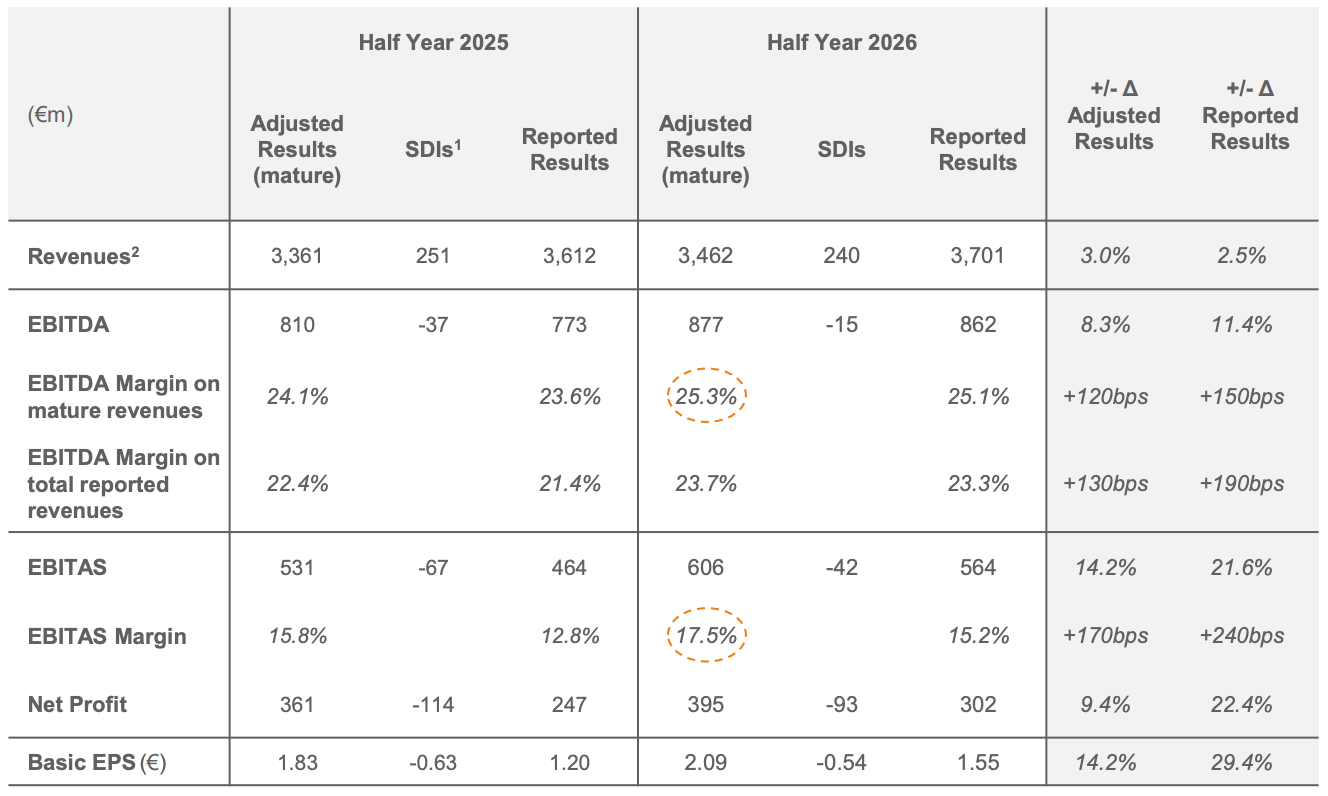
This together with better cash conversion and lower Capex (as investments ease) also resulted in a 46% YoY increase in Free Cash Flow to the Firm. Eurofins generated €403 million in FCFF in H1 2026 (this is before “acquisition of subsidiaries” which should end up trending towards 0) which it continued to reinvest into buybacks (Gilles has also continued buying shares in the open market). This takes us to a potentially ideal scenario for LT shareholders: one in which organic growth returns back to historical norms but does so with a lag as Eurofins’ cash generation ramps up.
So, all in all, I would categorize Eurofins’ earnings as a mixed-bag: great on the margin and cash conversion front, and relatively weak on the organic growth front. I don’t think the investment works as well as I outlined in the in-depth report if organic growth doesn’t return at least to a MSD level regardless of the execution in the margin front, but at the same time I see no reason yet to believe that the current headwinds are secular.
The company also announced a $400 million EV acquisition in July: the Life Sciences segment of Element Materials. They believe that they are a better owner for this asset than Element Materials and paid an EV/sales of 2.6x, which is again considerably higher than where Eurofins is trading at. Profitability of this asset is similar to the Eurofins average, which means that it will generate EBITDA of around €36 million in 2026 for an EV/EBITDA multiple of 11x. The interesting thing is that it generates profitability similar to the Eurofins’ average without access to Eurofins’ lab network, meaning that the post-synergy EBITDA is likely going to be considerably smaller.
2.6x sales is definitely not a bargain multiple (and there’s no multiple arbitrage as Eurofins is trading at 2x sales) but this is a significant acquisition and therefore Eurofins has had to pay a tad more. The company, however, tends to pay low multiples in its consolidation effort which do come with some multiple arbitrage (even when trading at the currently low valuation): in H1 2026 the company closed 17 acquisitions at an average of 1.7x sales! Again, I don’t think the investment works just purely due to consolidation, but if organic growth returns to normal, the multiple might re-rate on a significantly larger base that Eurofins has been building.
Have a great day,
Leandro