Sabre (SABR): Constellation’s most asymmetric bet
Heads I win, Tails I still get paid

Before we start: most of today’s article (around 65-70%) is free. You’ll get the full story: Constellation’s PEMS strategy, why Sabre ended up in its crosshairs and what the market is missing.
The last part is for paid subscribers: the valuation, the risk/reward maths and how I’d size a position like this. That’s what decides whether Sabre is really an asymmetric bet (or not).
Until Sunday 29 November, 23:59 CET, you can join Best Anchor Stocks’s Premium+ subscription with 22% off the basic annual plan (you’ll be upgraded automatically). After that, the price goes back to $459. You’ll also have automatic access to my new report (published this week)
You can read this article in PDF format here.
(I’ve written about Sabre before, you can read that article here.)
Before getting right into today’s article, it’s worth trying to understand what Constellation is trying to do here. Earlier this year, the company “formalized” what it calls its “Permanent Engaged Minority Shareholder“ strategy (aka. PEMS). In Mark Miller’s (Constellation’s President) words, “permanent” means “long-term holders, not traders“, engaged means they “care about governance, management incentives, and capital allocation“, and minority means they are “not acquiring these businesses outright“. In plain English and for your and mean, PEMS is a way to put large amounts of capital to work in businesses that are too big (or not for sale) to buy outright. Mark Leonard left the board in May due to health issues, but interestingly stayed on as an advisor focused precisely on PEMS.
The template of the PEMS strategy was arguably Asseco Poland (Poland’s largest IT company). In 2025, Topicus bought 9.99% of Asseco from Cyfrowy Polsat and then added 14.84% to its stake at PLN 85, taking its ownership to ~24.8%. This came together with a shareholders’ agreement with founder Adam Góral’s foundation and a cap of 27.96% (will sound familiar in due time). Asseco remains independent and listed, and so far it has worked out pretty well for Topicus. The shares trade at around PLN 220 (>2.5x the treasury share price), and Asseco decided to pay out PLN 13.05 per share in dividends for 2025 (somewhat “putting to rest” the cash return argument that PEMS faces).
Sygnity is somewhat similar but it’s also a different story, as Topicus took a 72.7% stake through a PLN 12 tender in 2022 (i.e., a majority stake), but it also kept the company listed in Warsaw. The shares have recently traded around PLN 91 (~8x the tender price). Miller called Sabre “the first meaningful expression“ of PEMS (for Constellation that is), which brings us directly to the company’s recent investor day.
At the very end of Sabre’s investor day this week, an investor asked the question on everyone’s mind:
How are you going to refinance the 2029 and 2030 maturities?
He then went to add...
I don’t know if Damian is in the room, but I would love to understand what are some things you could do together.
Damian was indeed in the room. Damian McKay is the CEO of Vela (one of Constellation Software’s operating groups) and has sat on Sabre’s board since March as Constellation’s representative. He didn’t answer the question, but Kurt Ekert (Sabre’s CEO) answered on Constellation’s behalf, and that answer is the main reason why I decided to write this article.
As I hope to make clear throughout the article, Sabre qualifies more as a special situation than the type of company I’d make a core portfolio holding. Just for context...the company carries ~$4.6 billion of debt, interest will absorb around 70% of next year’s EBITDA, and the stock trades at a very distressed valuation. At the same time, management has outlined a plan to grow EBITDA ~9% a year until 2030, there’s a 12.7% shareholder with an outstanding track record, and secured bonds yield around 14%. All of this taken together should more or less tell you that there’s a mismatch between what management/Constellation thinks about the company and what investors are willing to believe.
Now, I do believe that this combination creates a pretty asymmetric setup, especially if one is willing to look beyond the equity.
Let’s see why.
The 2030 guide: modest growth, plenty of operating leverage, and the debt bridge
The investor day brought two new sets of numbers. First, official guidance for 2027 and, secondly, a set of targets for 2030 (both are directionally similar). Sabre isn’t guiding for heroic growth, but it’s guiding for mid-single-digit revenue growth, high-single-digit EBITDA growth, and almost every extra dollar of EBITDA dropping to free cash flow.
This is what management guided to:
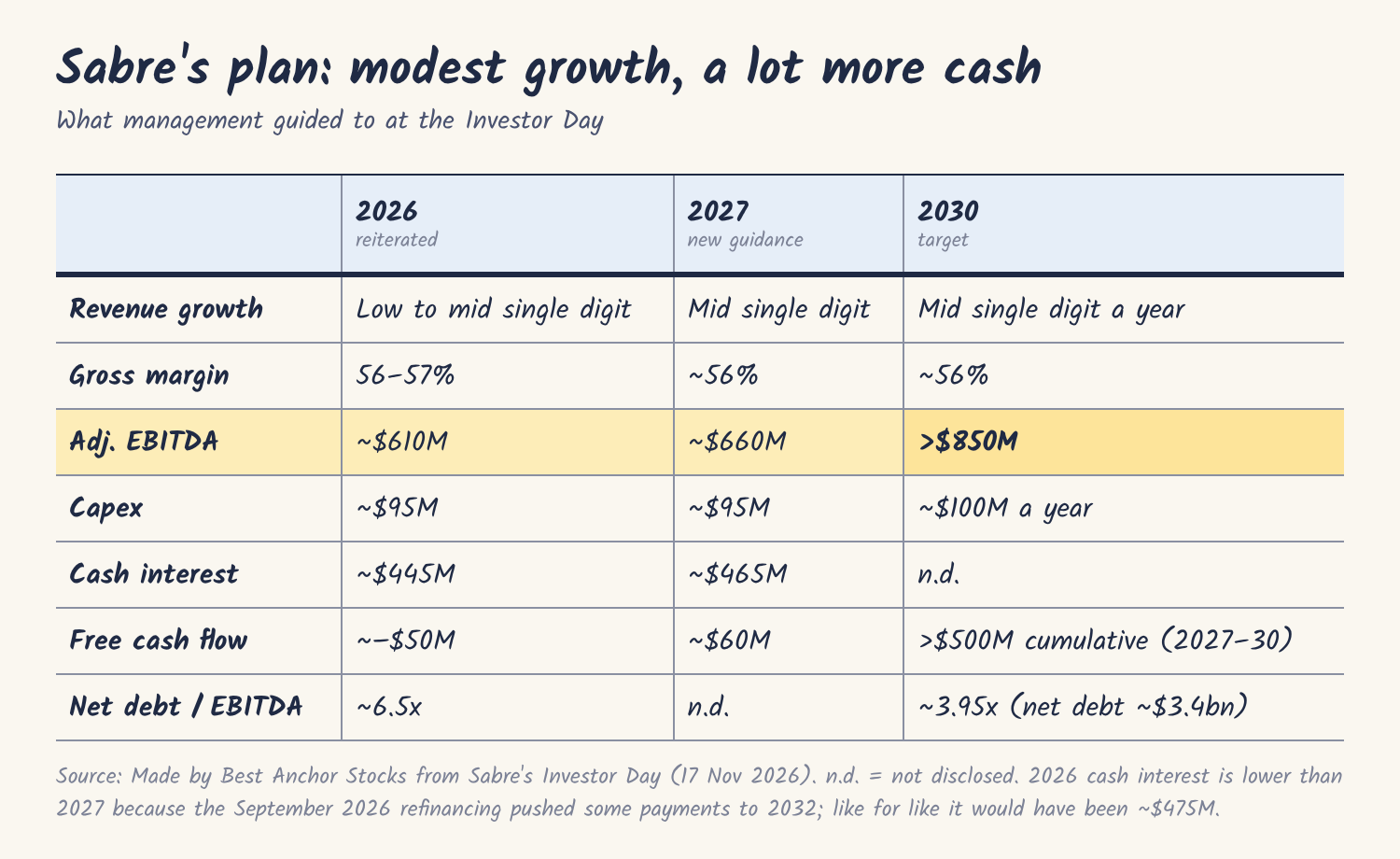
The interesting thing lies in the capital structure, though. The 2027 free cash flow bridge is pretty straightforward: $660M of EBITDA, minus $95M of capex, $465M of interest and ~$40M of cash taxes and other items, leaves ~$60M in free cash flow available to equity holders.
Management decided to leave agentic AI out of the revenue guide even though they believe it can potentially become a relevant tailwind:
“The airlines would all say, ‘We’d love to have direct participation, direct connects.’ The reality is the physics of search are going to make that very challenging for them. They’re having trouble handling look-to-book ratios on NDC today, despite relatively low adoption. They’re suppressing searches. In the world of agentic AI, look-to-book is going to grow exponentially.”
— Kurt Ekert, CEO, Investor Day (17 November 2026)
This is the core of Sabre’s “AI won’t disintermediate us“ argument and it’s pretty intuitive. An AI agent shopping on behalf of a traveller will run far more searches per booking than a human ever would (which results in a much higher “look-to-book” ratio). Airlines already struggle to handle that load on their own systems, but Sabre can answer most of those searches from its cache (management claims a hit ratio of 90% or above at over 20,000 shops per second) without touching the airlines’ systems. It’s also an advantage for an LLM that doesn’t want to build 400 direct connections.
Sabre also claims to be early to the agentic era. The company launched its agentic APIs and its own MCP server about a year ahead of competitors, and management says over 80 customers already use them, with over 70 live AI projects (including a ChatGPT plug-in). The key Q is what value accrues to Sabre from all of this. Today, Sabre pays travel agencies an “incentive” (i.e., a commission) for every booking they route through its system, but they expect to split the fee with the agent instead (a “revenue share“ model). Unit economics (according to management) will look pretty similar to today’s distribution channel, with an opportunity for upside. In other words, management doesn’t expect AI bookings to be worse business than the bookings it already gets from the agency channel. Nobody knows how this will unfold, but Sabre does seem to have a strategy for the “new” world regardless.
There’s also a cost angle to all of this. Sabre runs its systems on GCP (Google Cloud) and pays for the computing power it uses. This makes it fair to think that if AI agents multiply the number of searches, Sabre’s tech costs should explode too. Management’s answer is, again...the cache. Sabre stores the most likely answers in advance instead of working out every search from scratch, which makes extra searches cheap to serve. On top of that, its contract with Google runs into the next decade, so Sabre knows what it will pay for the capacity it uses. Ekert was pretty clear that the “protection” lies in the cache:
“If we did not have caching capability, we couldn’t show the projections we showed here.”
In plain English: the same feature that makes Sabre useful to AI agents is the one that stops GCP (Google Cloud) from eating its margins.
Going back to the consolidated P&L... on the cost side, adjusted SG&A goes down to ~13% of revenue and technology spend grows slightly slower than revenue. That’s where the operating leverage and the cash generation come from, and management has a pretty clear idea of what to use this cash for:
“That EBITDA margin allows greater EBITDA growth. That then in turn, dollar for dollar almost, flows into free cash flow. The free cash flow allows us to delever.”
— Mike Randolfi, CFO, Investor Day (17 November 2026)
This has pretty relevant implications for the capital structure (and therefore for the equity). Sabre’s net debt is currently ~6.5 times its annual EBITDA, but management wants to bring that down to ~3.95 times by 2030. It can get there using two levers. First, by growing the denominator. EBITDA grows from $610M to $850M, so the same debt looks smaller relative to earnings (that alone takes the ratio down by 1.6x). Second, free cash flow is used to repay debt, which shrinks the debt itself (another ~1x). Longer term, management targets debt to be 2.5–3.5 times EBITDA.
Like we saw at the beginning, management seems to be well aware that debt is the problem. This is what Ekert said right at the beginning of the investor day:
“Importantly, I am not proud of this, but it is the reality, Sabre trades at a significant multiple discount to our peers, whether that is peers within travel or peers across the technology spectrum. That is due largely, obviously, to our leverage position today, which is unique for a technology company.”
— Kurt Ekert, CEO, Investor Day (17 November 2026)
Even though all of the 2030 plan looks great, the reality is that Sabre’s guidance hasn’t been very reliable in the past...and it’s the same team guiding for 2030. Kurt Ekert joined as President in January 2022 and became CEO in April 2023, and Mike Randolfi was already CFO back then. Take a look at this:
February 2025: more than $700M of EBITDA and more than $200M of free cash flow.
May 2025 (after agreeing to sell Hospitality Solutions for $1.1bn): more than $630M of pro forma EBITDA (removing the ~$70M the business contributed) and still more than $200M of free cash flow, as lower interest would offset the lost EBITDA.
Actual 2025: $536M of normalised EBITDA and $57M of pro forma free cash flow.
So, even adjusting for the Hospitality Solutions divestment, they missed their own guide from earlier that year by ~15% on EBITDA and by more than 70% on free cash flow (with ~$450M of fixed interest costs between EBITDA and FCF, a 15% EBITDA miss becomes a 70% free cash flow miss, ouch). The original 2023 targets ($900M of EBITDA and $500M of free cash flow for 2025) were never close either, even adding back Hospitality Solutions! The bottom line is that this team has over-promised before and their track record in meeting guidance is pretty poor (some would say that it’s nowhere to be seen).
Constellation is small for revenue, but potentially big for the debt
Constellation built its position during 2025 and Sabre’s board didn’t exactly roll out the red carpet for them (unsurprisingly, management teams don’t like to be told what to do). Sabre adopted a poison pill on 1 March 2026, but both sides signed a strategic governance agreement four days later. Constellation ended up getting a board seat for Damian McKay, the pill was dropped, and Constellation accepted a peace treaty. The agreement itself has two interesting details, one more than the other:
Constellation can’t go above 15% of the shares, nor propose a takeover, while the standstill is in place.
Constellation can’t buy any of Sabre’s debt without Sabre’s written consent.
The first point has one nuance worth considering: if somebody else puts a takeover to a shareholder vote, Constellation “shall be permitted to vote in their sole discretion“ (i.e., the agreement doesn’t prevent Sabre from being taken over).
The second point is not so straightforward and is arguably the most interesting one. Under the agreement, Constellation can’t, “without the prior written consent or authorization of the Company or the Board“:
“(B) acquire, offer or seek to acquire or agree to acquire, by purchase or otherwise, alone or in concert with any Third Party, or direct any Third Party in the acquisition of indebtedness (or shares of preferred stock) outstanding under Debt Instruments of the Company;”
— Strategic Governance Agreement, Section 2(c)(i)(B) (5 March 2026)
Why does this matter? Because a classic way to take over an over-indebted company is to buy its debt for cents on the dollars and then swap it for ownership in a restructuring (a “loan-to-own“ strategy). Sabre doesn’t need to look far from home for an example. In 2023, its competitor Travelport restructured over $4.3bn of debt and ended up owned by its creditors and existing investors, including Elliott and Davidson Kempner.
With this clause Sabre is effectively closing that door. If Constellation ever shows up in Sabre’s capital structure as a lender, a bondholder or with new equity, it will be because Sabre’s board invited it in. That fits pretty well with Ekert’s words below:
“So far, they’ve been a very engaged, supportive investor. We’re very interested in, one, Constellation’s capital, two, obviously their businesses in terms of how we might collaborate more in the future.”
— Kurt Ekert, CEO, Investor Day (17 November 2026)
The order is pretty telling and pretty much tells you what Sabre’s management is fixated on: capital first, business second (likely because they know that the second is not possible without the first). The context also matters, as Ekert said this right after a question about refinancing the 2029 and 2030 maturities...
Don’t get me wrong, there are some potential revenue synergies as well. Constellation owns several travel businesses (Deem, DerbySoft, Juniper), and Deem (which was built around Travelport) could move corporate bookings to Sabre. Even 0.5–1 extra point of growth a year would add ~$25–65M of EBITDA by 2030 (~$0.40–1.05 per share at 7x), which isn’t trivial for a stock with this capital structure. That said, I wouldn’t put it in the base case, and it’s not why Constellation matters here.
The real lever is capital
This is where things get very interesting. Sabre has ~$3.3bn maturing in 2029–2030 and guided free cash flow until then of only ~$360M (2027–2029, my interpolation of the guide; the “>$500M” target includes 2030, when most of the debt is already due). This means that roughly $2.9bn has to be refinanced, and Constellation can potentially help in two main ways:
Funding. A loan, a debt purchase (with Sabre’s consent) or an equity injection that bridges part of the 2029–2030 wall. Even the “remote” possibility of this happening likely makes the bond market more comfortable.
A bigger stake, or the whole thing. Constellation reportedly said it wanted its Sabre stake to resemble its holding in Asseco Poland (24.8%), and that its intentions “would appear clear with the benefit of time“. The peace treaty prevents that today, but treaties don’t last forever.
The bottom line from this section is two-fold. The revenue overlaps are real but probably not extremely material for growth (they are for the equity). What Constellation really brings is a lower probability of the worst outcome playing out. As you’ll see later, that is exactly the scenario that matters most when deciding between the stock and the bonds.
Valuation: we don’t need a rerating...
Let’s start with the current picture. At $1.72, Sabre’s market cap is ~$695M. If we add $4.03bn of net debt (30 September), we get to an enterprise value of ~$4.72bn, which is 7.7x 2026 EBITDA, 7.2x 2027 EBITDA and “only” 5.6x the 2030 target. In other words, the equity is a thin slice on top of a lot of debt, which is what makes execution crucial (Sabre is walking on thin ice here).