


Welcome to the seventh issue of “On The Radar,” it has been a while!
If you want to know what this series is about, I recommend reading the first issue. Let me save you the click with a short summary: the goal is to share interesting companies that I’ve looked at but have not researched in-depth yet (at least not to my standards). Therefore, the “On The Radar” series should be understood as a well-curated list of companies that fit my investment philosophy and that might (in the future) make it into the portfolio.
So far 2 out of the 19 companies I have profiled in this series have made it into the portfolio, with good (but still early) results: +17% and +5% (in not much more than two months). The average return of the companies profiled thus far is around 10%, albeit this series started not long ago.
Today’s issue brings yet another three companies (one for free and the remaining reserved for paid subscribers) that I’ve been looking into or that I plan to look into in the coming weeks/months. Some of these will most likely end up as in-depth reports:
An unknown engineering business with growth capped by supply rather than demand
An aerospace aftermarket business with a very interesting and controversial model
A very interesting set-up in a business with a balance sheet “problem”
Note that all of these businesses get included in the “On The Radar” tab of the Portfolio Management Tool with their respective price evolution since the issue.
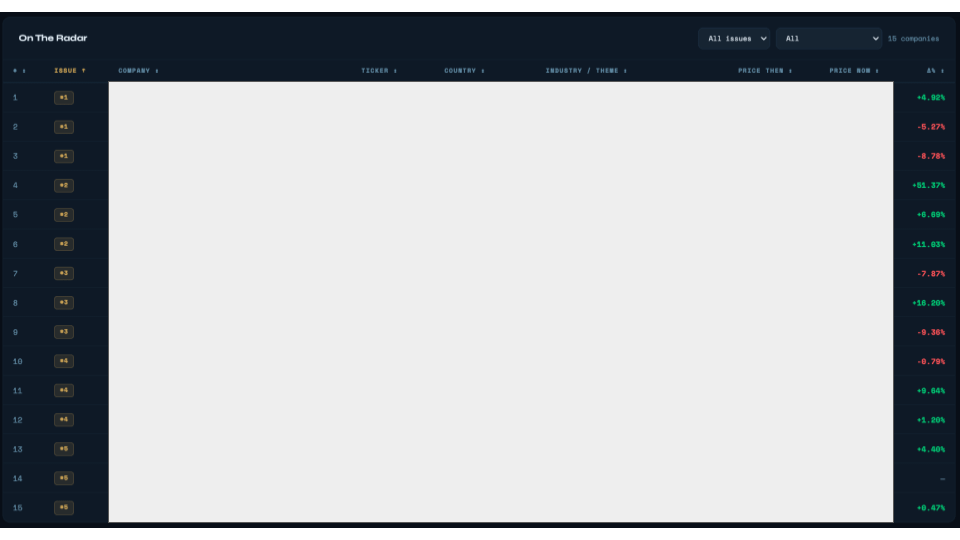
As this is the seventh issue, free subscribers have had access to 7 companies (one for free per issue) whereas paid subscribers have had access to 22!
So, without further ado, let’s jump into today’s issue.
Friedrich Vorwerk (ETR:VH2)
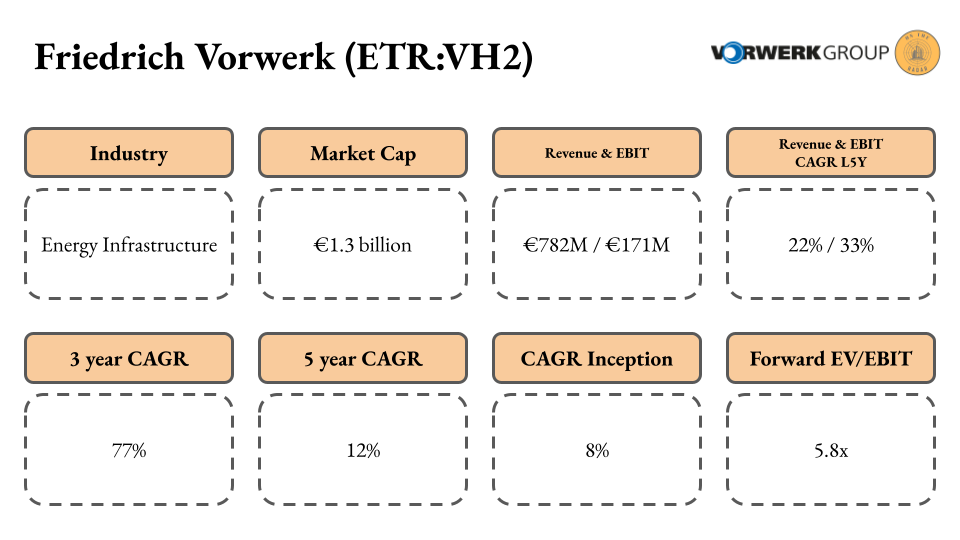
Brief description of the business
In all honesty, I’d be very surprised if you’ve heard about Friedrich Vorwerk. This is not in any way criticising your knowledge about businesses because, for what it’s worth, Vorwerk is a small cap ($1.39 billion) German company that operated in a pretty boring industry. At its core, Vorwerk is an engineering services company specialized on energy infrastructure projects in Germany.
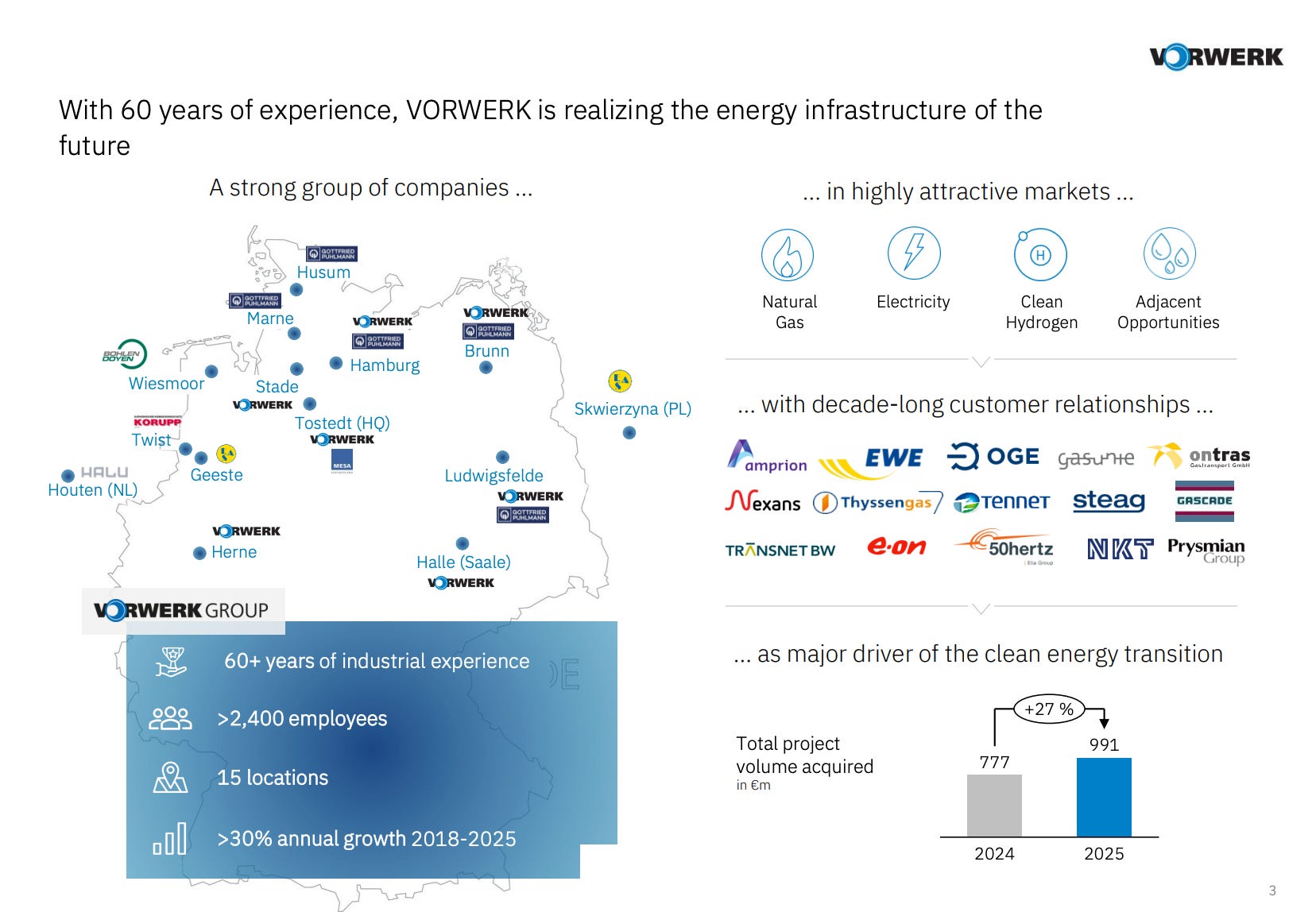
There are several things that make the company rather special/interesting. For example, Vorwerk is vertically integrated across specialized equipment and labor, two tasks that its peers generally choose to outsource. This helps the company earn higher margins than peers (albeit carrying higher capital requirements) while being able to manage projects in a more organized manner.
Even though the company specializes in services, we can also find several technologies at the core of its competitive advantages:
5C Tech’s (a subsidiary) automatic welding system. This technology not only lowers the need for specialized welding labor but also carries lower defect rates
A specialization in Horizontal Directional Drilling, a key technology for laying underground pipes/cables
The company was historically exposed mainly to natural gas projects, but these have increasingly been “substituted” by “new energy” such as electricity, CO2 transportation, and (in the future) hydrogen. The way Vorwerk makes money is pretty straightforward: a new energy infrastructure project gets tendered, Vorwerk bids (and hopefully wins it) and gets paid throughout the project as they execute it. This revenue cycle must be repeated over and over again (i.e., there’s very little recurring revenue related to infrastructure maintenance, although there is some).
Why it caught my attention
The company caught my attention after looking into MBB SE, a German serial acquirer of industrial companies. MBB still holds a significant position in Vorwerk and the latter’s stock price evolution seemed pretty intriguing.
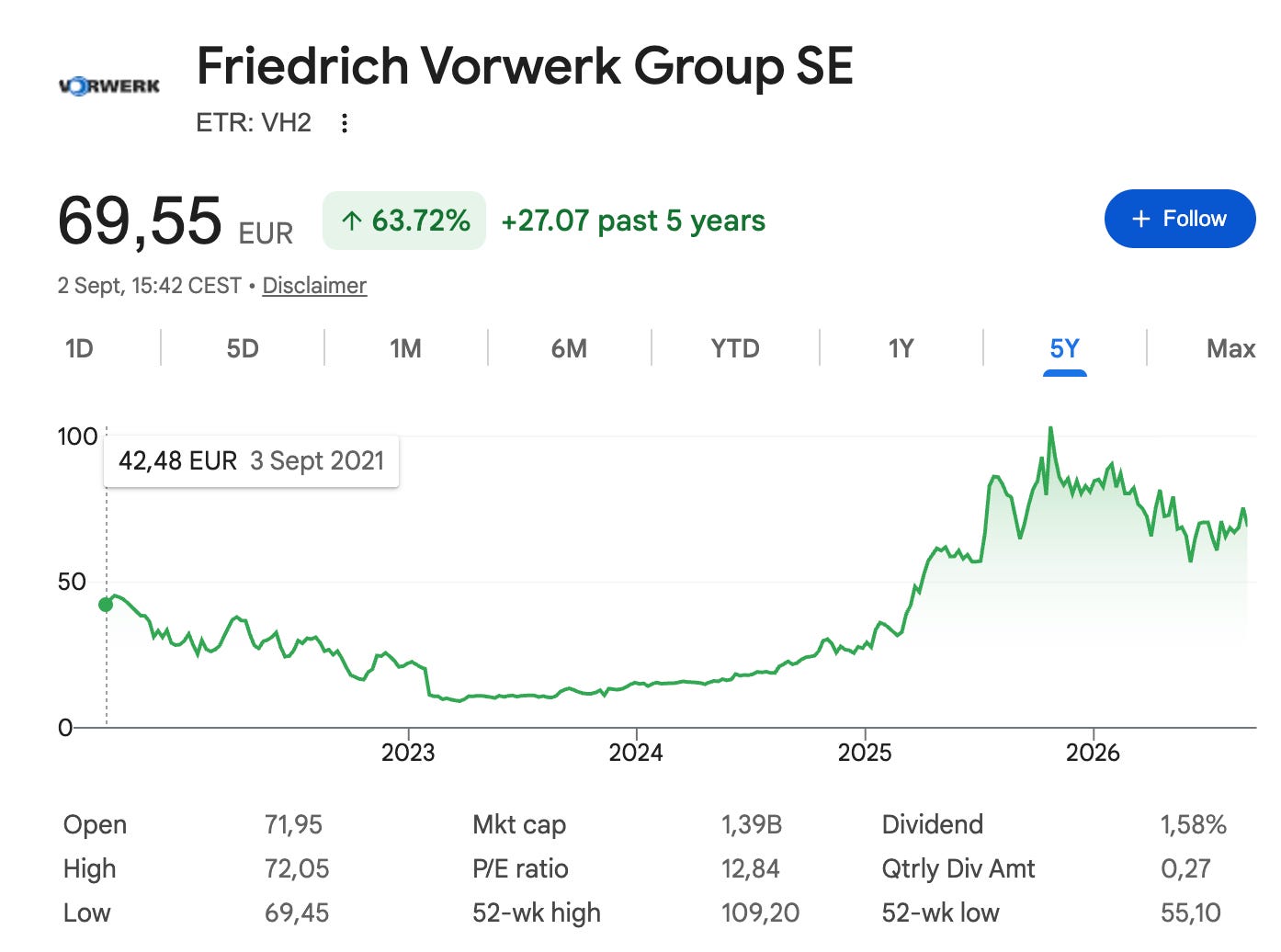
The stock got clobbered (down 77%) after IPOing at a decent valuation of 9x EBITDA, but recovered in spectacular fashion from the lows to deliver an almost 10-bagger at the peak:
What was the reason behind such obnoxious mispricing? This is what ultimately got me interested in Vorwerk. After a bit of reading, I found out that the “mispricing” was caused by inflation. 2022 and 2023 (as you know) were years of considerable inflation after the post-pandemic spending surge, and Vorwerk had not included inflation-escalation clauses in its contracts. This evidently led to significant margin contraction. However, things slowly but steadily turned into Vorwerk’s favor: these legacy contracts eventually ended and the company included inflation-linked clauses in new contracts. The war in Ukraine also made the German government worry deeply about energy independence, leading to a considerable pipeline of projects. So not only did margins rise considerably, but Vorwerk also saw a significant influx of new business. EBITDA inflected hard, rising from €32 million to more than €200 million only a couple of years later (so much for efficient markets!):
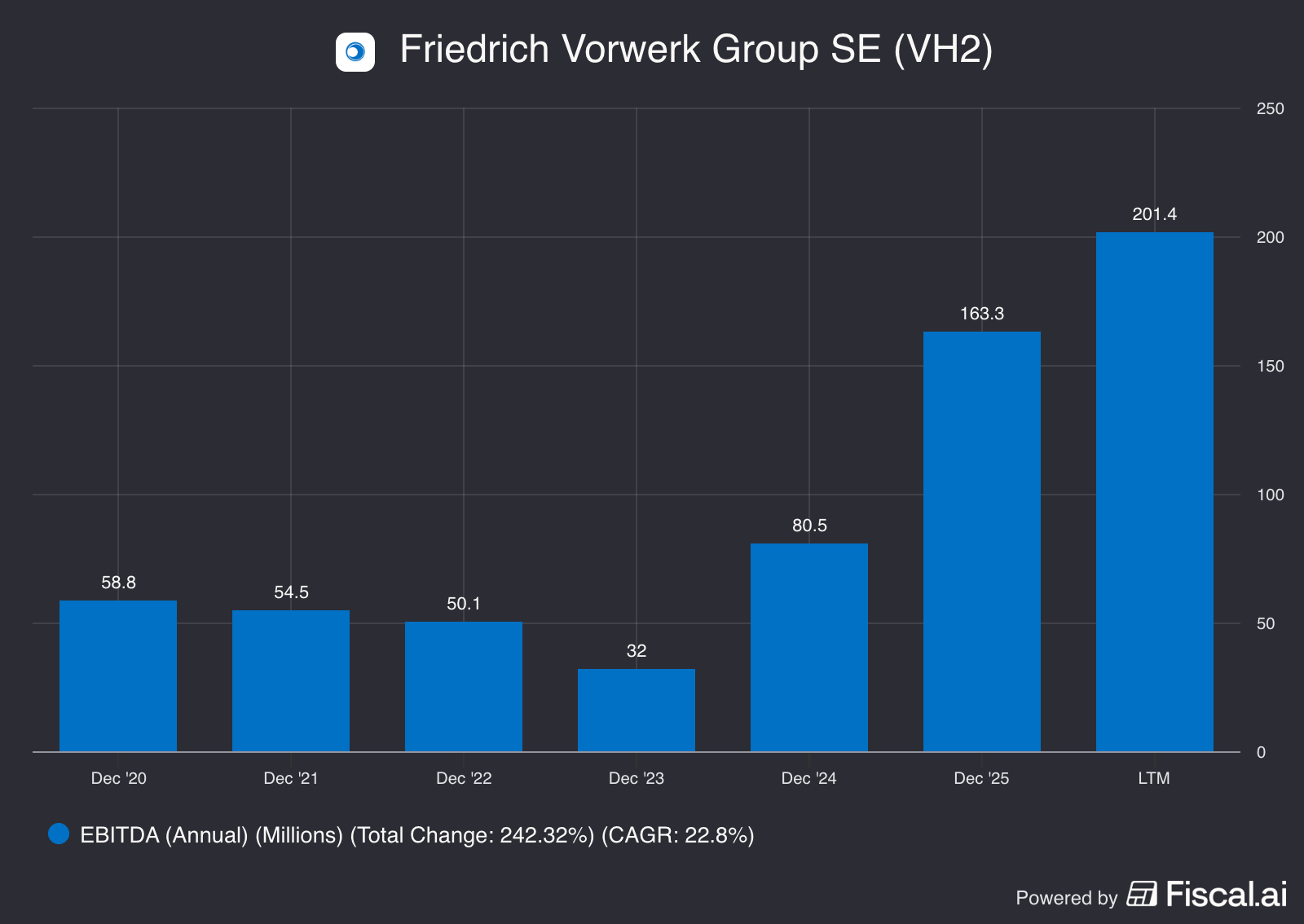
At €200 million in EBITDA and an EV of €995 million (the company has a considerable cash position), Vorwerk is currently valued at an EV/EBITDA of 5x. This seems low on three dimensions:
The path the company is in and the secular growth drivers it is exposed to
What the business has historically traded at (an average of 8x)
What peers trade at
To this we must add that it seems pretty obvious that the current limitation for growth is not demand but supply (mostly labor). My research into Vorwerk is a quest to answer the following question:
Does Vorwerk deserve to trade at a 5x EV/EBITDA multiple?
What I like
There are several things I like about Vorwerk:
The company is exposed to significant long-term tailwinds as Germany rebuilds its energy infrastructure after the Russia “scare”. There doesn’t seem to be a shortage of energy project currently and many of these are long-term in nature
There’s considerable skin in the game. The current CEO owns more than 18% of the shares outstanding and MBB owns around 40%
The business is currently supply-capped, meaning that its fate is currently dependent on execution. Management has been executing well with labor supply growing at a 10%+ rate over the past few years
The labor constraint discussed above acts as a significant entry barrier because potential disruptors can’t source labor. The largest players are increasingly making acquisitions to source labor and consolidating the market
The company is relatively unknown and trades at an (apparently) low valuation multiple
Management is not afraid to follow their own path and are not driven by industry standards (proprietary tech, vertical integration…)
The cash on the balance sheet gives management considerable investment optionality, both organic and inorganic
There’s also optionality in the company’s automatic welding technology, which has opened up international opportunities (mainly in Asia)
I also believe there’s a miss-understanding about the company’s non-IFRS metrics such as backlog and orders. The large projects are mostly managed through JVs (Joint Ventures), but Vorwerk only includes in the backlog and orders the equipment and labor they “sell” to the JV. This is not necessarily representative of the money they’ll make through the JV, meaning that these metrics are not great leading indicators (very similar case to Medpace)
Now, despite Vorwerk having a lot of things to like, there are also several things that give me pause.
What gives me pause
The main thing that gives me pause is the overexposure to the following…
Germany
Underground projects
Natural gas, electricity, and hydrogen
#1 is straightforward to understand, but the second and third maybe less so. Even though laying underground infrastructure is 100% the safest and most efficient long-term bet, it’s not the cheapest. The German government has hinted at above ground infrastructure becoming a possibility to save on costs. If underground projects shift to above-ground projects, Vorwerk’s involvement in the infrastructure build-up will most likely decrease. Management believes this is a longer-term problem (if it ends up playing out) as the projects that are already in the pipeline last at least until 2035 and those will certainly be underground projects. The third point there is also interesting, because any kind of a return to nuclear energy (probability seems low), would also reduce the demand for Vorwerk’s expertise.
Lastly, another thing that somewhat worries me is a revenue cliff. Vorwerk has executed over the past few years a very sizable project called A-Nord. This project lasts until 2027 and will need to be replaced with new business, with management claiming that it will. The reality, though, is that revenue growth has decelerated significantly once the project has started to have a less significant participation in the company’s revenue.
What I am watching
I have been trying to speak with IR/management to clarify some doubts, with no success thus far. I will keep trying, but I don’t anticipate owning Vorwerk unless I’ve had a chance to speak with management and settle some doubts regarding the accounting of the JV pipeline.
Let’s now jump into the next company.