Living History (NOTW #115)

You can read this article in PDF format here.
Best Anchor Stocks has a partnership with Fiscal.ai (the research platform I personally use), through which you can enjoy a 15% discount on any plan. Use this link to claim yours! You’ll find KPIs, Copilot (a ChatGPT focused on finance) and the best UX:

It was a very interesting and panicky week in financial markets. It was unique in the sense that it was pretty unusual and we are probably living history right now even though we don’t know it yet (not saying this only because markets dropped considerably).
Without further ado, let’s get on with it.
The new in-depth report is live
This week I published a new in-depth report.
(NEW REPORT) Wrong Sellers, Right Business

Today’s in-depth report covers a company led by a founder with one of the best track records I’ve come across. Despite that, it’s been one of the worst-performing stocks in its industry this year, and I believe the reasons have much more to do with
The company is currently unloved (maybe not irrationally), operates in a secular industry suffering from cyclical headwinds, and is headed by an operator with an outstanding track record. In the report I go over the following…
Section 0: Executive Summary
Section 1: What the company does today
Section 2: Management’s track record and the early signs
Section 3: The context
Section 4: The moat
Section 5: Management, Incentives, & Capital Allocation
Section 6: The risks
I also explain why I believe the company can achieve a mid-teens/low-twenties IRR without having to make heroic assumptions (reason why I have started a position).
This is this year’s fifth in-depth report, with the other four having performed as follows (all none AI-related):
BBB Foods (TBBB), published on January 26th: +92% vs +3% for the S&P 500
Eurofins (EPA:ERF), published on May 14th: +44% vs -4%
Undisclosed position, published on July 16th: +4% vs -5%
Undisclosed position, published on September 15th: +3% vs -6%
This means that this year’s in-depth reports have returned on average 36% against an average return for the S&P 500 of -3%. All four have beaten the market. I believe the two undisclosed positions here are pretty cheap, and only time will tell if these + the most recent in-depth report will follow the steps of Tiendas 3B and Eurofins.
Articles of the week
Besides the in-depth report, I published another article this week: Sabre (SABR): Constellation’s most asymmetric bet.
Sabre (SABR): Constellation’s most asymmetric bet

(I’ve written about Sabre before, you can read that article here.)
I go over Sabre and how I think one can actually build a pretty good risk-adjusted return by looking beyond the equity.
Without further ado, let’s see what the markets did this week.
Market Overview
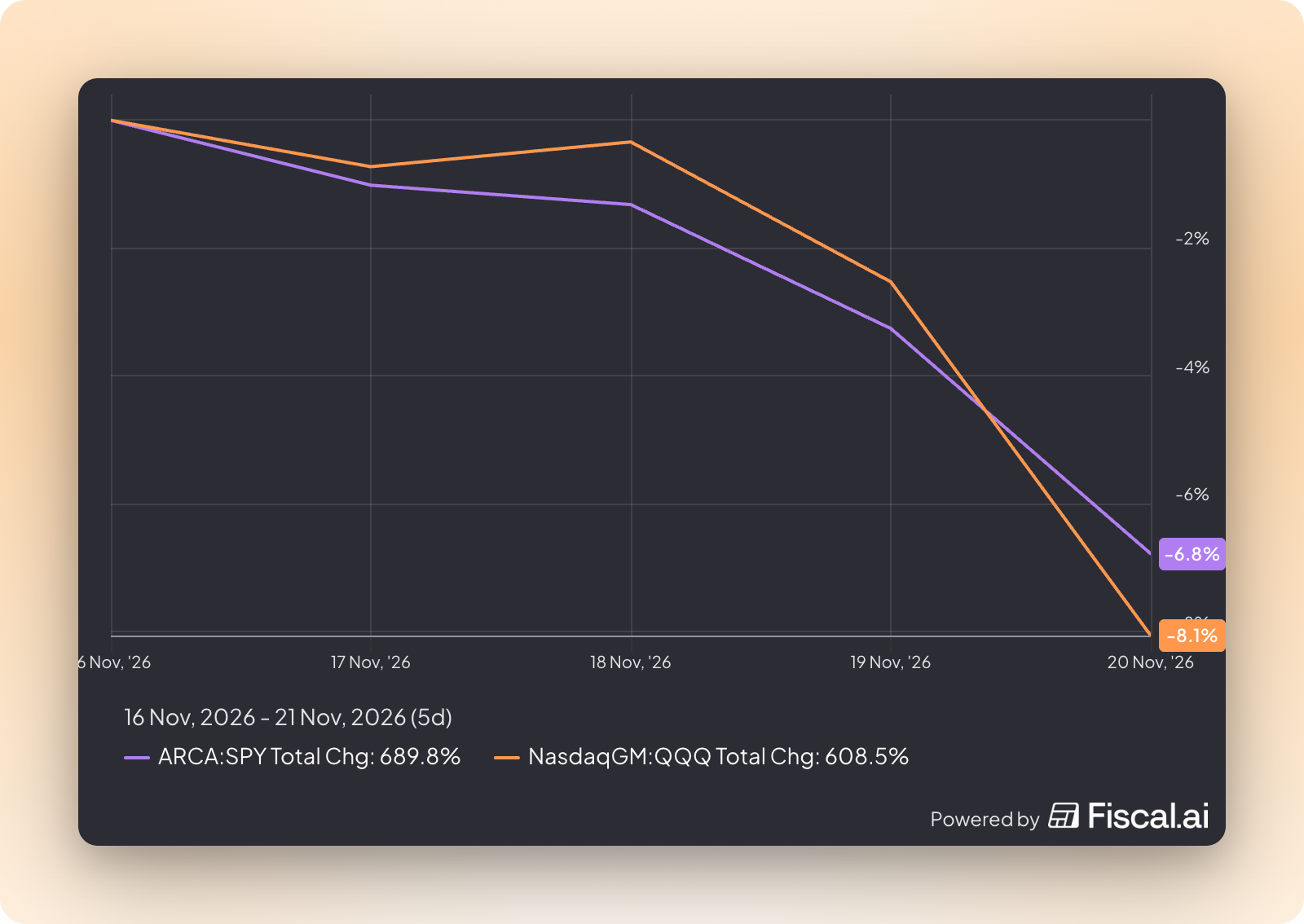
If you were hoping for a quiet week before Thanksgiving, I’m sorry to disappoint you! The S&P 500 fell 8.6% (its worst week since April 2025) and closed in correction territory after seven straight down days. The Dow lost 8% (its worst week since March 2020), the Nasdaq lost 10% and is now negative for the year, and the Russell 2000 shed 7.5%. The VIX closed Friday at 35.9, its highest close since late March. On Friday alone, semis fell close to 11%, tech was down more than 7% and consumer Staples was the only sector that finished green. Are you not entertained?
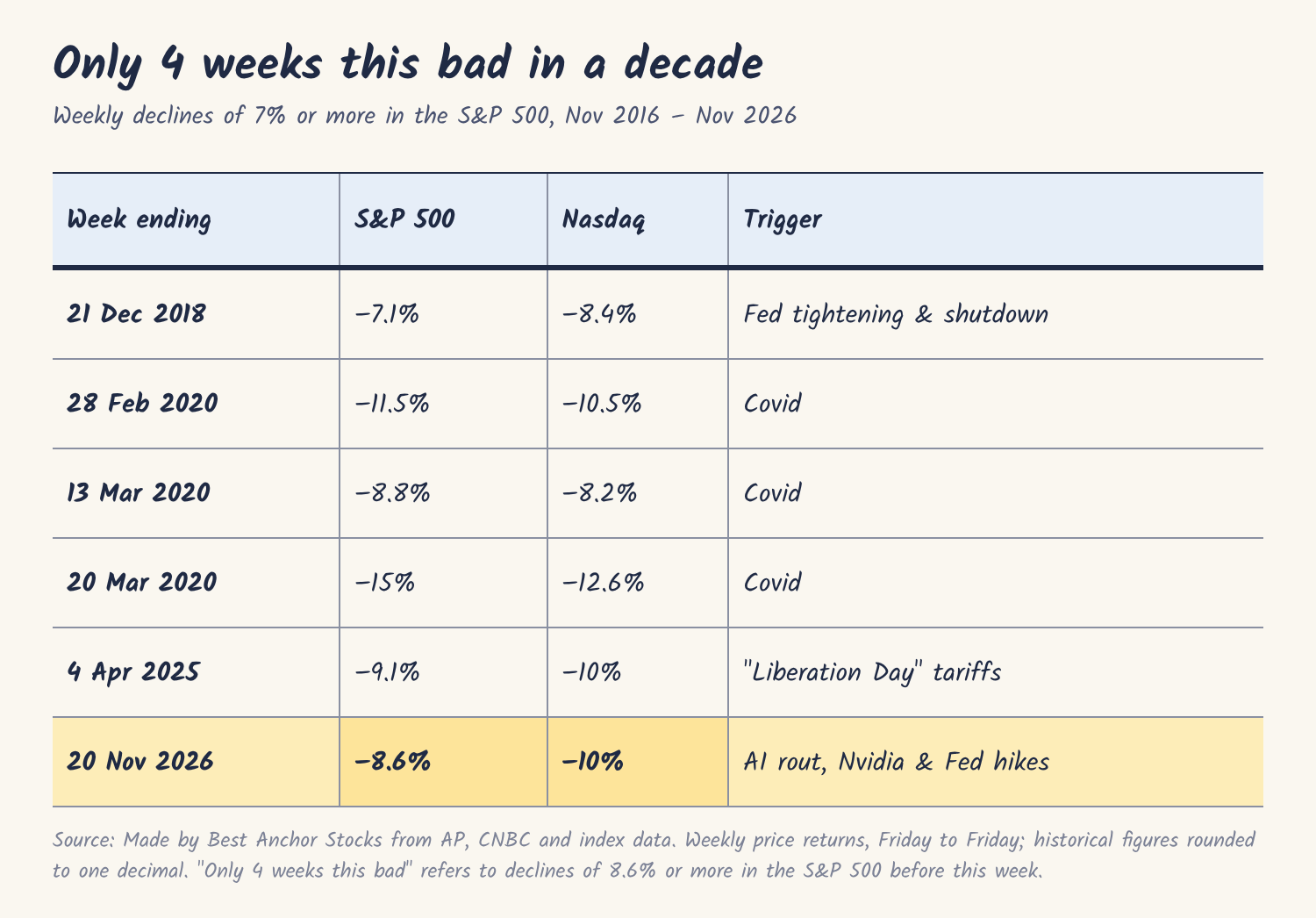
In case you were wondering whether what happened this week is rare…it is. Over the past decade, weekly drops of similar magnitude have only happened 4 times!
The macro picture doesn’t look exciting either. Markets now price a 90% chance that the Fed raises rates on December 9th, and some Fed officials are openly talking about back-to-back hikes. Commodities were also crushed…Copper dropped considerably one day after Stanley Druckenmiller said in the TomorrowX conference in Austin that he is short copper. He sounded pretty cautious because, in his view, the US economy is still strong, but the investment backdrop has worsened significantly. The Fed has stopped cutting, commodities are weakening and credit spreads are widening. In his own words:
“I’m really alert to the fact that the second half of ‘27 could be economically disappointing.”
— Stanley Druckenmiller, TomorrowX, November 17
He now holds very little net exposure to equities, holds only small longs and shorts, and is focused on capital protection. He summed it up like this:
“I’m just taking a break, which could last two days or six months.”
The part I found most interesting (and most relevant for non-macro investors) is what he is looking at within the AI world:
“In equities we’re looking for AI use cases as opposed to infrastructure.”
This comes from his belief that AI labs likely won’t continue charging per token but will end up selling tasks. This makes sense considering that profitability at the labs has to rise considerably in a short period of time and that they have the tools to offer products as well (not only intelligence). One place I actually like for this thesis (although this is unlikely where he is looking) is healthcare picks and shovels.
The other hot topic of the week was, once again, Nvidia. I would categorize what’s going on at the chip giant as… “There’s always more than one cockroach in the kitchen.” The company’s stock fell 23% this week, its worst week since October 2008! Its losing streak is now seven weeks long and the stock closed Friday at $125.53, about half of its ~$243 October high. Now trading at a single-digit P/E for next year!
What makes this more surprising is that the business itself reported very strong earnings (with a catch). Nvidia reported record revenue of $115.8 billion (+103% YoY) and guided to ~$130 billion next quarter, ahead of analyst expectations. In any other month, those numbers would probably have sent the stock soaring, but when you find one cockroach in the kitchen…you should assume it’s not alone! Here’s how events at Nvidia have unfolded over the past two weeks:
Nov 8–12: Jensen Huang admitted to an extramarital affair, later reported to involve the former CEO of Megaspeed, a Singapore company US authorities have investigated since 2024 for possibly moving Nvidia chips into China. He resigned on November 12, and Colette Kress became interim CEO.
Nov 9–10: A securities class action was filed, and the board brought in a former acting US Attorney for the Southern District of New York to investigate.
Nov 17: The WSJ reported that the SEC has opened a civil probe into whether Nvidia’s disclosures misled investors. The California Attorney General then served Nvidia with a subpoena over chips possibly reaching China.
Nov 17 (earnings call): Kress said Nvidia has stopped shipping Hopper data center products licensed for China, including the H200, without saying why or for how long. The 10Q report was also stated as “needing a couple more weeks.”
Nov 20: Reuters reported that SEC enforcement staff are now examining potential accounting issues. The stock fell 14% that day, its worst day since DeepSeek.
The point I would stress most is a detail the FT dug up. Last year Nvidia changed how it reports revenue by geography (switching from the customer’s billing address to the customer’s headquarters) with the effect that Singapore disappeared from the breakdown (suspicious). That happened right when the Singapore subsidiary accounted for ~48% of fiscal 2026 revenue (~$104 billion of external sales). Nobody knows yet whether this is part of the SEC probe and an investigation doesn’t mean anyone did anything wrong, but there are more and more reasons to believe that there was something “fishy” going on at Nvidia.
If you add to all of the above the DOJ antitrust review of the $12.9 billion Hugging Face deal and the ongoing debate about “circular” AI financing (Nvidia funding customers who then buy its chips), you get that the valuation looks very cheap but maybe you can’t trust the “E” in the multiple (maybe you can, though, we just don’t know yet). This is precisely the risk with accounting and governance issues: they don’t show up in the income statement until it’s too late and by then the market has already taken a shot.
Anthropic went public somewhere in all this chaos! It priced at $83 a share, above its $70–78 range, and raised over $80 billion. That makes it the largest IPO in history, ahead of SpaceX’s $75 billion in June.The stock opened at $111.50 (+34%), hit $115.10, and closed its first day at $97.17 (+17%). On Friday, its first full session, it fell 8.5% to $88.91 and briefly traded at $83.05, right at the IPO price. Welcome to the public market’s volatility!
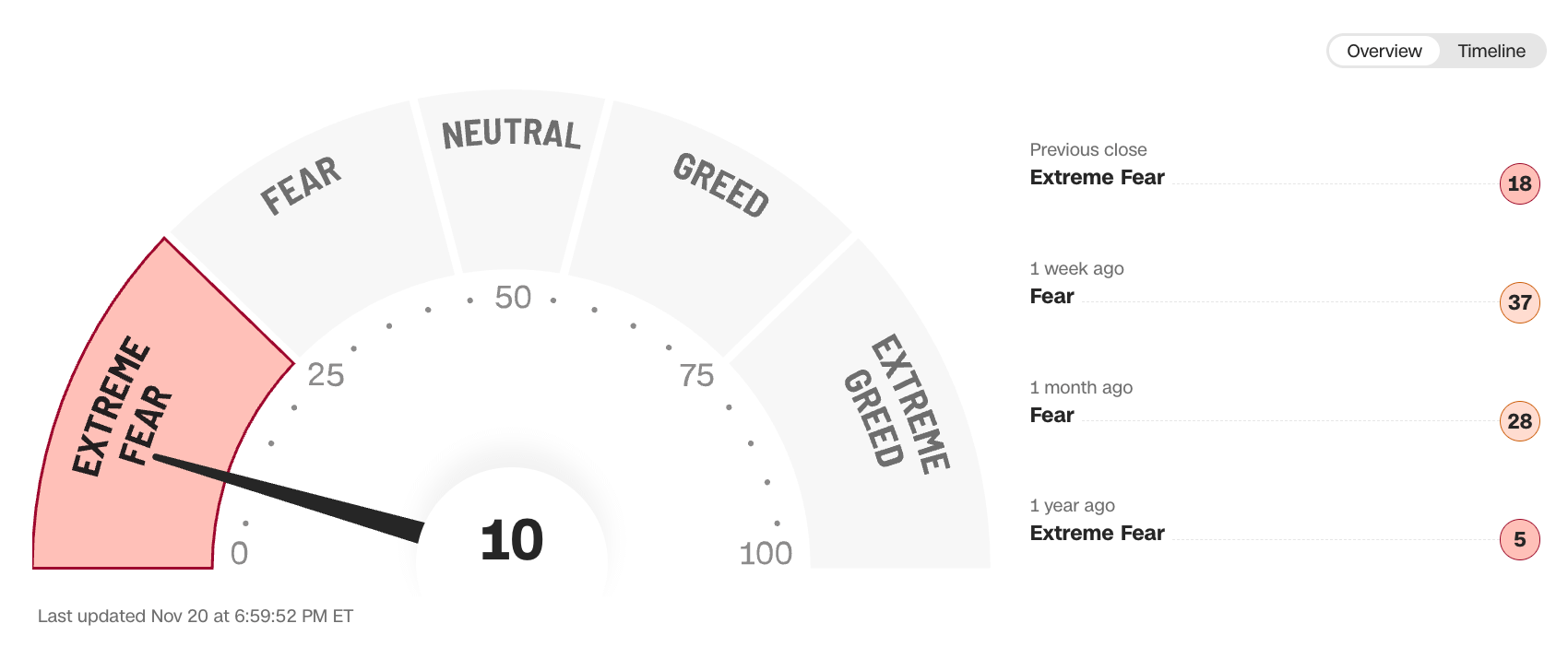
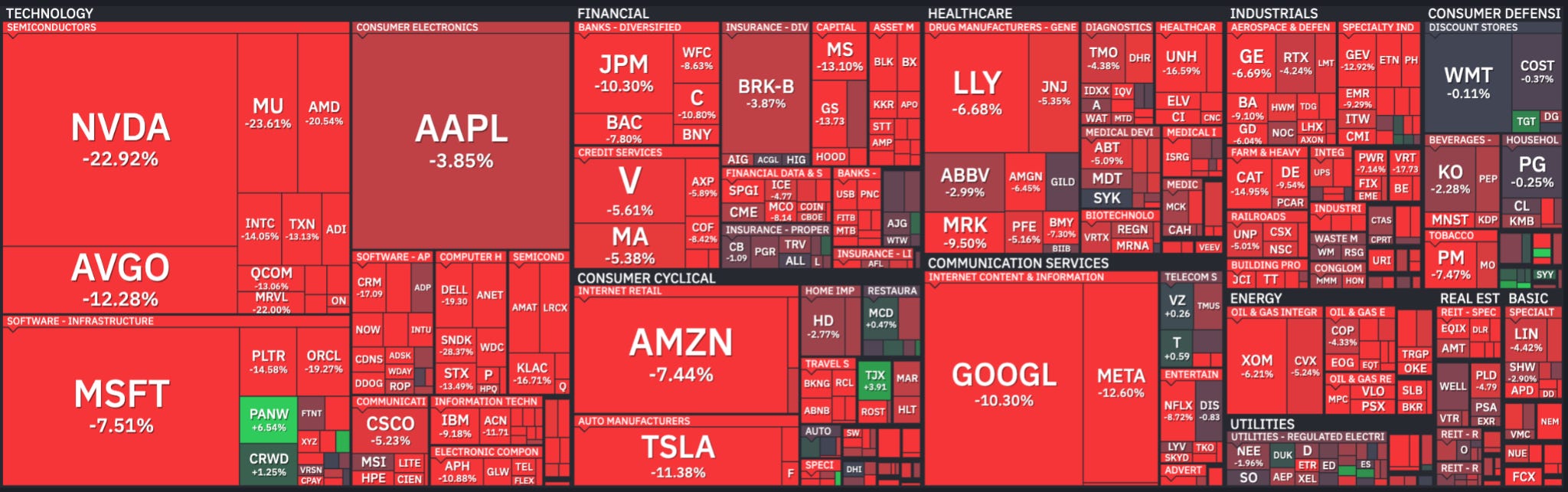
All in all, a week where good numbers didn’t matter and where we saw the first signs of panic since the tariff tantrum. The industry map evidently reflected this panic:
As did the fear and greed index: