Lessons from Jensen’s scandal, and a new in-depth report (NOTW #114)

You can read a PDF version of this article here.
Best Anchor Stocks has a partnership with Fiscal.ai (the research platform I personally use), through which you can enjoy a 15% discount on any plan. Use this link to claim yours! You’ll find KPIs, Copilot (a ChatGPT focused on finance) and the best UX:

It was a pretty entertaining week in financial markets as the CEO of Nvidia stepped down. I discuss what I think about this and what it can teach investors. There was also some interesting company-specific news with some insiders stepping up to buy shares.
Without further ado, let’s get on with it.
The next in-depth report is around the corner
After a lot of looking and a lot of passing, I’ve settled on the next addition to my portfolio. Just for context, this is how the stocks of the last four in-depth reports have done since I published them, compared to the S&P 500:
BBB Foods (TBBB), published on January 26th: +96% vs +9% for the S&P 500
Eurofins (EPA:ERF), published on May 14th: +48% vs +1%
Undisclosed position, published on July 16th: +9% vs +0.8%
Undisclosed position, published on September 15th: +15% vs flat
I believe that the two undisclosed positions are still very cheap and I can’t say that neither TBBB or Eurofins are very expensive even after the run, but the above means that the four last in-depth reports have provided on average a 42% return vs the S&P’s 2.7%.
The company that I’ve now settled for shares several characteristics with the above, of which I would highlight…
A CEO with an incredible track record that’s not getting enough credit. He is applying the same playbook that made him succeed over and over again.
The stock is not reflecting the business and I believe much of the selling has little to do with fundamentals but rather comes from “forced” selling.
I believe we are at or close to the bottom of the company’s industry. Its end market is in a downturn but the long-term drivers are intact. This is the kind of setup that I like and that has worked so well before (Deere, Keysight…)
I get to mid-teens returns with pretty conservative assumptions. My model points to a ~15% annual return which doesn’t give much credit to management’s operational track record.
The board has just authorised a buyback, and this management team has an excellent track record of share buybacks.
Paid subscribers will have access to the report early next week.
Articles of the week
I published several articles this week. The first one was the Q3 earnings digest of one of my undisclosed positions.
In Control of Its Own Destiny

If you are a paid subscriber you can find a PDF version of this article at the end of this article.
The company reported very good earnings, and even though it has significantly beaten the leading indices since I included it in my portfolio, I believe it’s very cheap. You can read the in-depth report here.
The second article of the week was Constellation’s and Topicus’ Q3 earnings digest, where I also shared an in-depth discussion on PEMS.
The numbers are lying to you

Constellation Software and Topicus reported their respective third quarters last week and you probably came away a tad confused if you only read the headlines. Constellation grew revenue 19% but reported a
I believe that the accounting is getting even murkier and people are arriving at the wrong conclusions based on the headline numbers.
The third article of the week was the Q3 earnings digest of another one of my undisclosed positions.
A 40% Compounder’s First Bump: Timing or Trouble?

I also published an in-depth report on this company not long ago which you can find here.
This small-cap Japanese company again reported very solid earnings and continues to trade at a valuation that’s too low for its growth/quality. The stock rose 14% on the results but even so it continues to trade at a low double digit EBIT multiple while growing at 30%+ rates and expanding margins. You can find its in-depth report here.
Without further ado, let’s see what the markets did this week.
Market Overview
Both indices were flat this week:
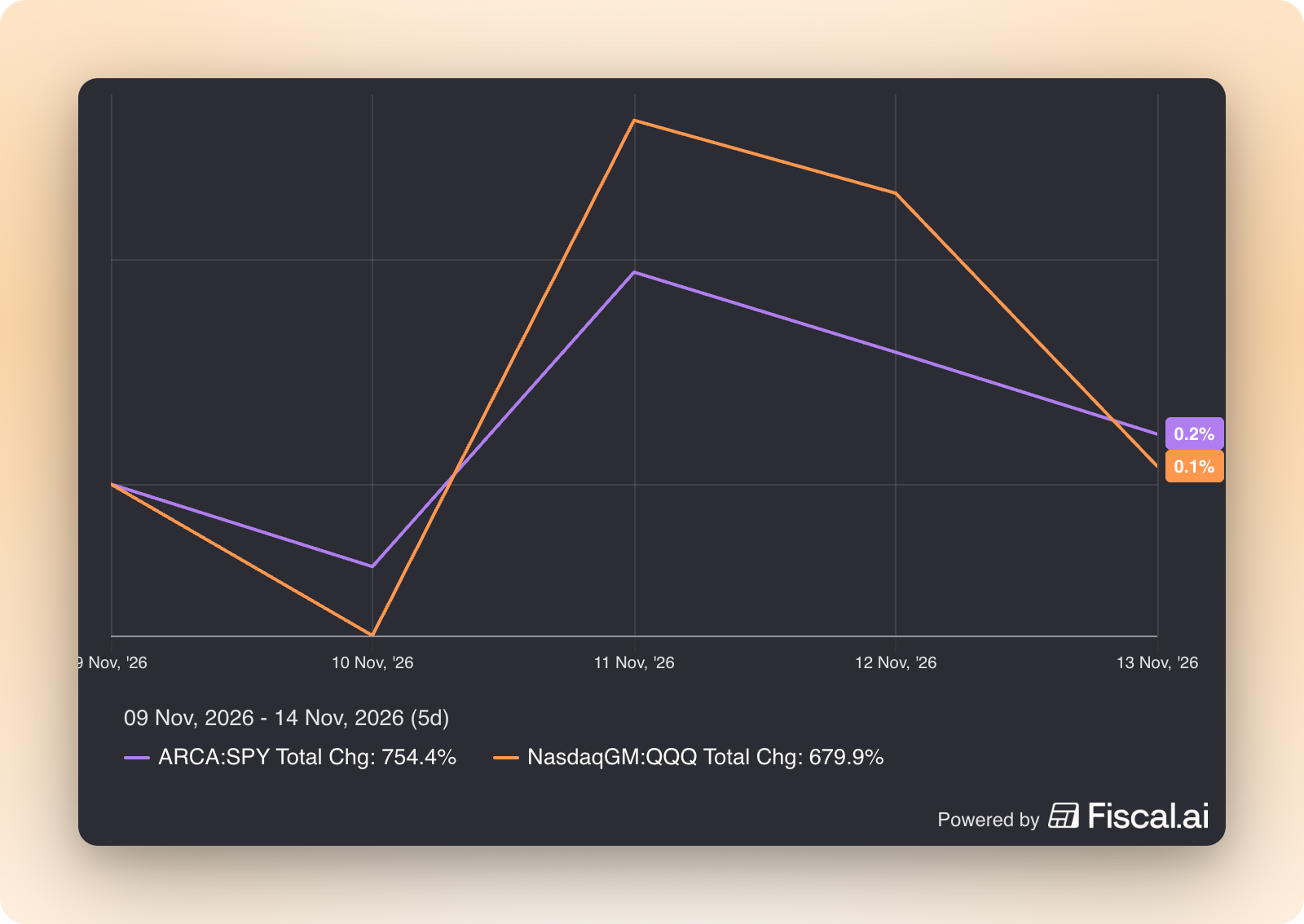
You probably don’t live under a rock so what I am about to say will most likely not surprise you…but Jensen Huang, Nvidia’s CEO, resigned this week. The reason behind his resignation was supposedly the “scandal” around his sexual affairs with a (again, supposedly) Chinese spy and an Nvidia employee. While I am not here to morally judge his actions, I do want to share my opinion on the topic and the lessons all the situation brings.
What I believe (with the information available at the current time) is that the fact that he resigned and cut every relationship with the company before the board even ended their investigation probably means there’s something that we still don’t know. What that “something” is we’ll probably find out in due time. I also believe it’s pretty evident that someone wanted him out of Nvidia, who that “someone” is is also something that we’ll either (1) know in due time, or (2) we’ll never know!
I’ve seen plenty of Nvidia shareholders asking the board to reconsider their decision and bring Jensen back. While everyone is free to do whatever they consider optimal, I think that this displays that they’ve become too emotional. I mean, the way I see it is that, if Jensen was part of your Nvidia thesis (or maybe he was THE thesis outright), then you should just assume that an unknown unknown has happened (it was impossible to forecast Jensen’s extra-marital affairs and what they would mean) and move on. The reality is that there are stocks outside of Nvidia, and we must assume that things can simply go south without that meaning that we’ve made a mistake in our research. In short: we invest in a dynamic world that changes and adapting to those changes is fair.
If, on the other hand, Jensen was not part of your Nvidia investment thesis or maybe not a “crucial” part of it, then you’d be adding here if you were holding it before his departure. Anything between these two extremes is probably overthinking. I can talk about my personal experience with Nvidia. I held a very small position in Nvidia which I conveniently (and due to sheer luck) sold the week before everything broke out. Now, if I were holding my Nvidia shares through the “scandal,” then I’d most likely be selling here because Jensen was undoubtedly an integral part of my thesis. It would’ve sucked, yes, but sometimes you just have to take your medicine.
This brings me to a pretty relevant topic on emotions, unknown unknowns, and diversification. There’s no denying that our decisions are going to be influenced by our emotions (we are humans), but at the same time one must be aware that at least 50% of their positions will be mistakes. This means that, to do well, one needs to balance emotions with the acknowledgment of mistakes, not an easy task to do and arguably one of the toughest things in investing. The acknowledgement of mistakes is also an interesting topic. Information about a company can be divided in four groups across two variables:
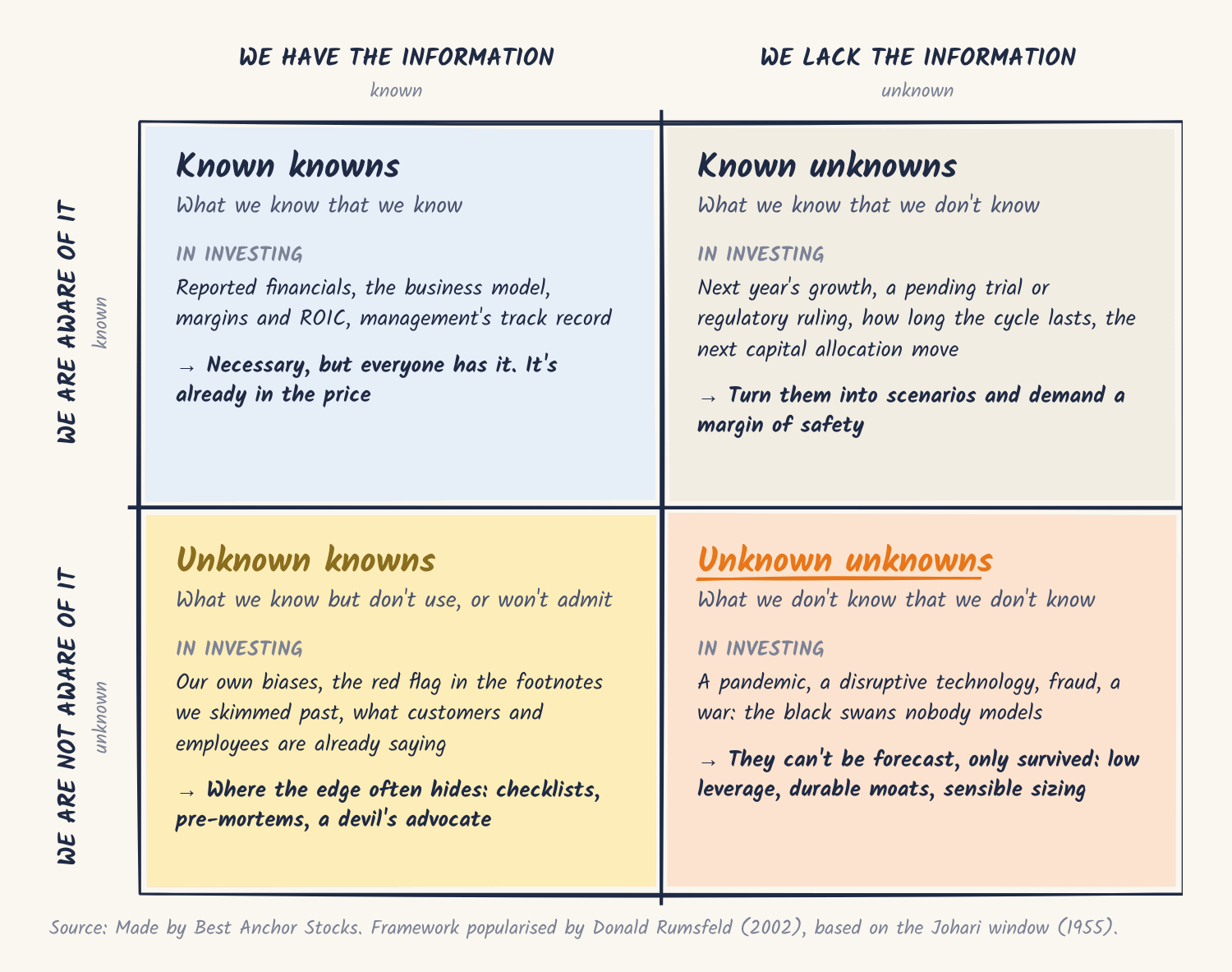
Some of these are “controllable” and can be baked into a thesis, whereas others can’t (and that doesn’t mean that a stock is not investable. As investors we must acknowledge that the possibility that an unknown unknown comes biting us back is non-zero and that if this happens we can simply move on and continue on with our lives (depending on the kind of unknown unknown, of course).
Now, the good news is that there’s a way to protect ourselves against the unknown unknowns, and that is diversification. If one is appropriately diversified, an unknown unknown is assumable and is just part of investing (uncertainty). However, if you are overly concentrated, an unknown unknown can (1) lead you to emotional decisions and/or (2) blow out your portfolio. It’s a pity that many people mock those who make mistakes, because mistakes are ultimately an inherent characteristic of investing and they shouldn’t be mocked but rather accepted as part of the game. The key issue here is whether a “mistake” breaks you or is simply a bump along the way.
The industry map was mostly green this week with the exception of Nvidia:
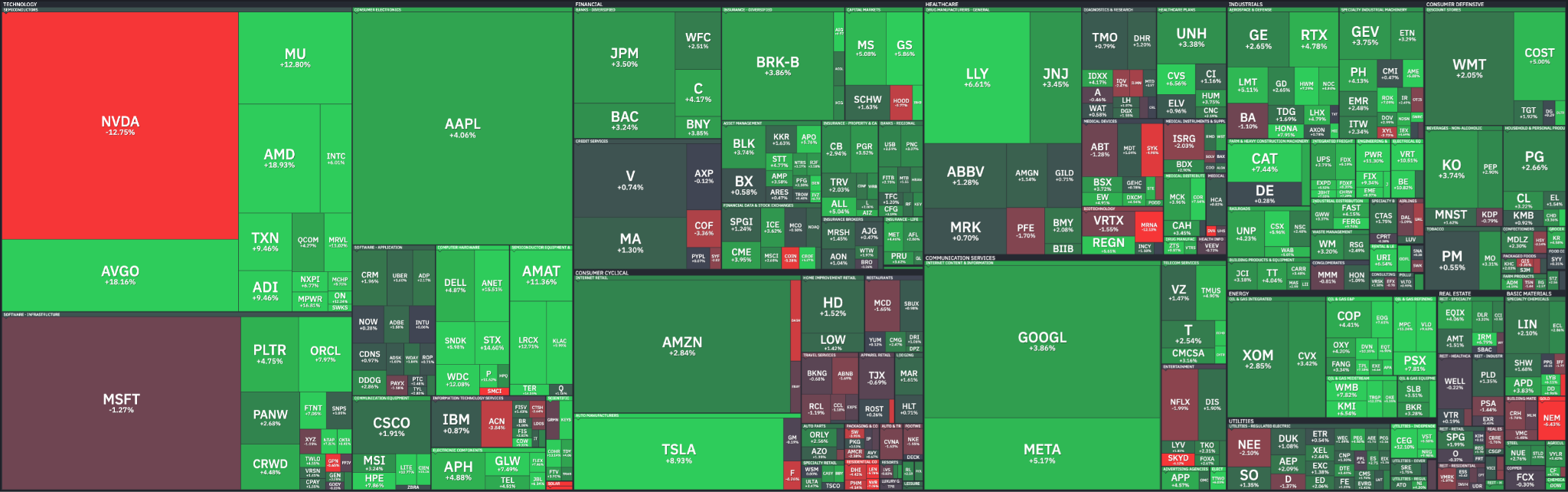
Source: Finviz
The fear and greed index improved markedly and is approaching neutral territory:
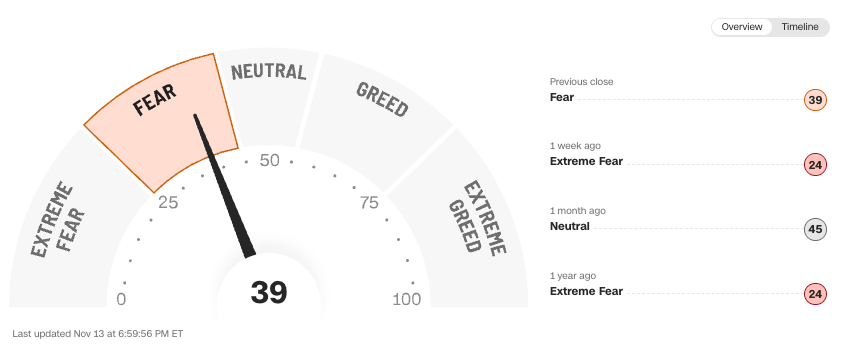
Source: CNN