


You can read the PDF version of this article (it’s long) here.
Constellation Software and Topicus reported their respective third quarters last week and you probably came away a tad confused if you only read the headlines. Constellation grew revenue 19% but reported a 16% decline in Free Cash Flow Available to Shareholders (FCFA2S). Topicus grew revenue 15% and also reported a 16% decline in quarterly FCFA2S, while its nine-month FCFA2S was up 19%. The question here is....
What the hell is going on?
The reality is that the quarter was pretty decent for both companies, but it was also the noisiest one I can remember (and that’s saying something for the Constellation universe!). The “good” news is that a big chunk of the noise comes from a single source: PEMS, the Permanent Engaged Minority Shareholder strategy. This is what this article will focus on clearing up.
Constellation now has two PEMS investments (Asseco and Sabre). These two investments influence in one way or another pretty much every metric investors use to track the business...and they often do in ways that are not intuitive at all.
This article revolves around two main topics:
A quick overview of the numbers for both companies
An in-depth look at how the PEMS strategy can blur the numbers (and how I believe these should be interpreted)
By the end of the article you should understand why some of the “weak” numbers this quarter are a side effect of PEMS investments working rather than failing. Accounting is almost never intuitive, but the Constellation universe takes it to another level!
Without further ado, let’s get on with it.
A quick overview of the numbers
Let’s begin with the headline figures for both companies:
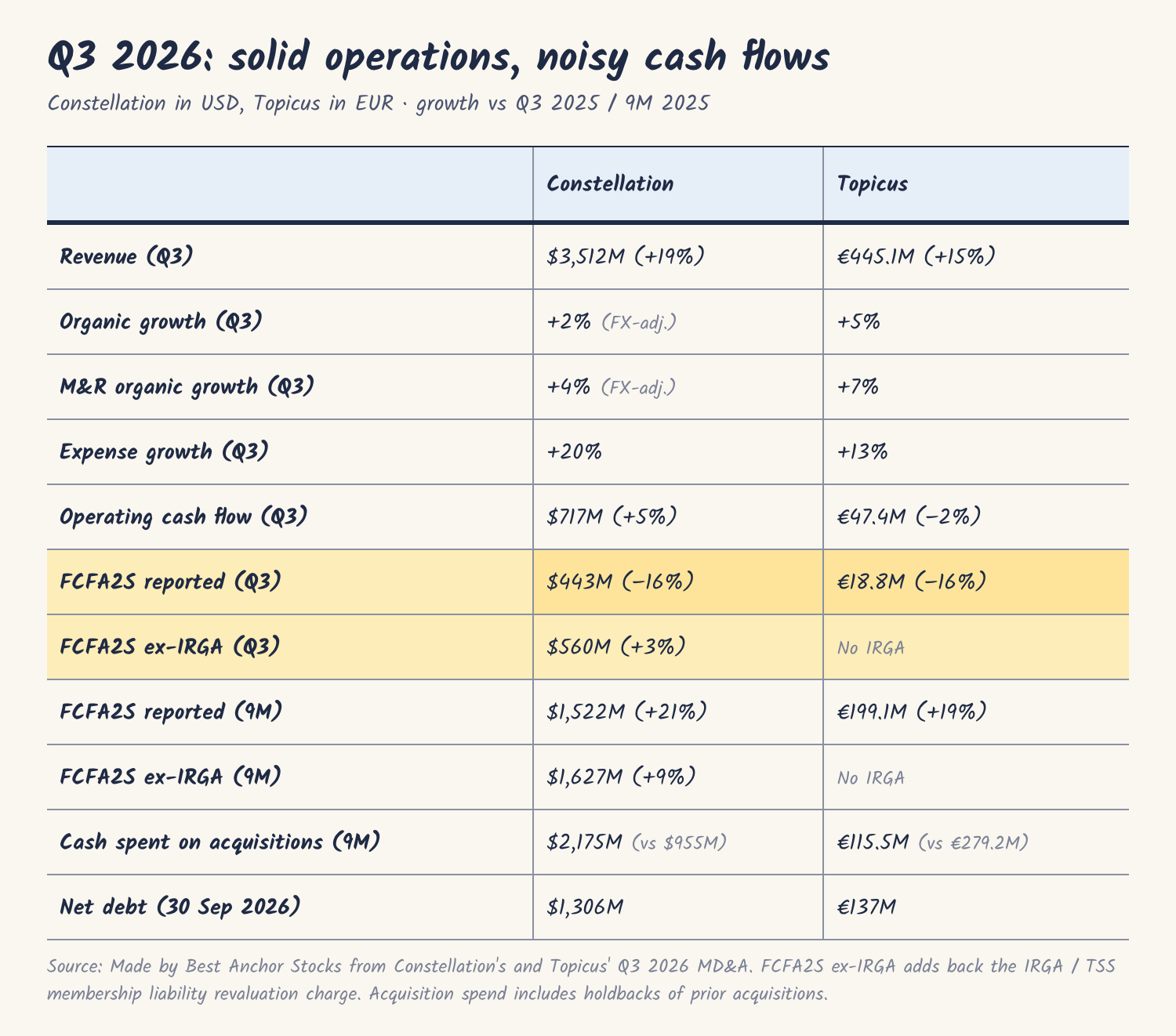
Let’s start with Constellation. The “mothership” grew revenue 19% in Q3 and 19% over the first nine months, but expenses grew slightly faster (+20%). This kept margins flat, which should be nothing unusual in a period of record capital deployment. Management actually shared a wild stat during the earnings call. They basically came to say that newly acquired businesses are a very significant headwind to consolidated margins, but that these tend to improve VERY significantly and fast (which seems like an understatement):
“I think I pointed out Q1 that we had, what was it, negative 16% margins with that cohort of the Q1 acquisitions. That cohort is now at 27%. The same thing, like the Q2 cohort went from 12% to 21%. They are improving. It’s just that we are making so many acquisitions that it’s still a drag on our overall.”
Mark Miller, Q3 2026 earnings call
The above basically implies that if Constellation were to slow down/stop M&A, margins would likely go bananas because this drag would disappear. Now, this doesn’t mean that we should root for it! Slower M&A would probably mean a derating of the multiple and not great news to keep the flywheel going.
AI and organic growth can’t be understood separately at Constellation (or any software business). Constellation’s organic growth was 2% (both as reported and FX-adjusted), but Maintenance and Other Recurring (M&R) grew 4% organically (FX-adjusted).
Constellation added a few new useful disclosures this quarter. Management isolated the group of businesses that have been dragging organic growth down for years (mainly the US healthcare group and Altera). Excluding these, M&R organic growth was 5% in Q3, pretty much “in line” with what Constellation has delivered since 2016 (recall that the post-2021 period came with a significant wave of inflation that was a tailwind for organic growth). My hunch is that management shared this in the hopes of reassuring the market that AI is not slowing down organic growth (as there was no ChatGPT in 2016), but based on the market’s reaction this did not work as intended!
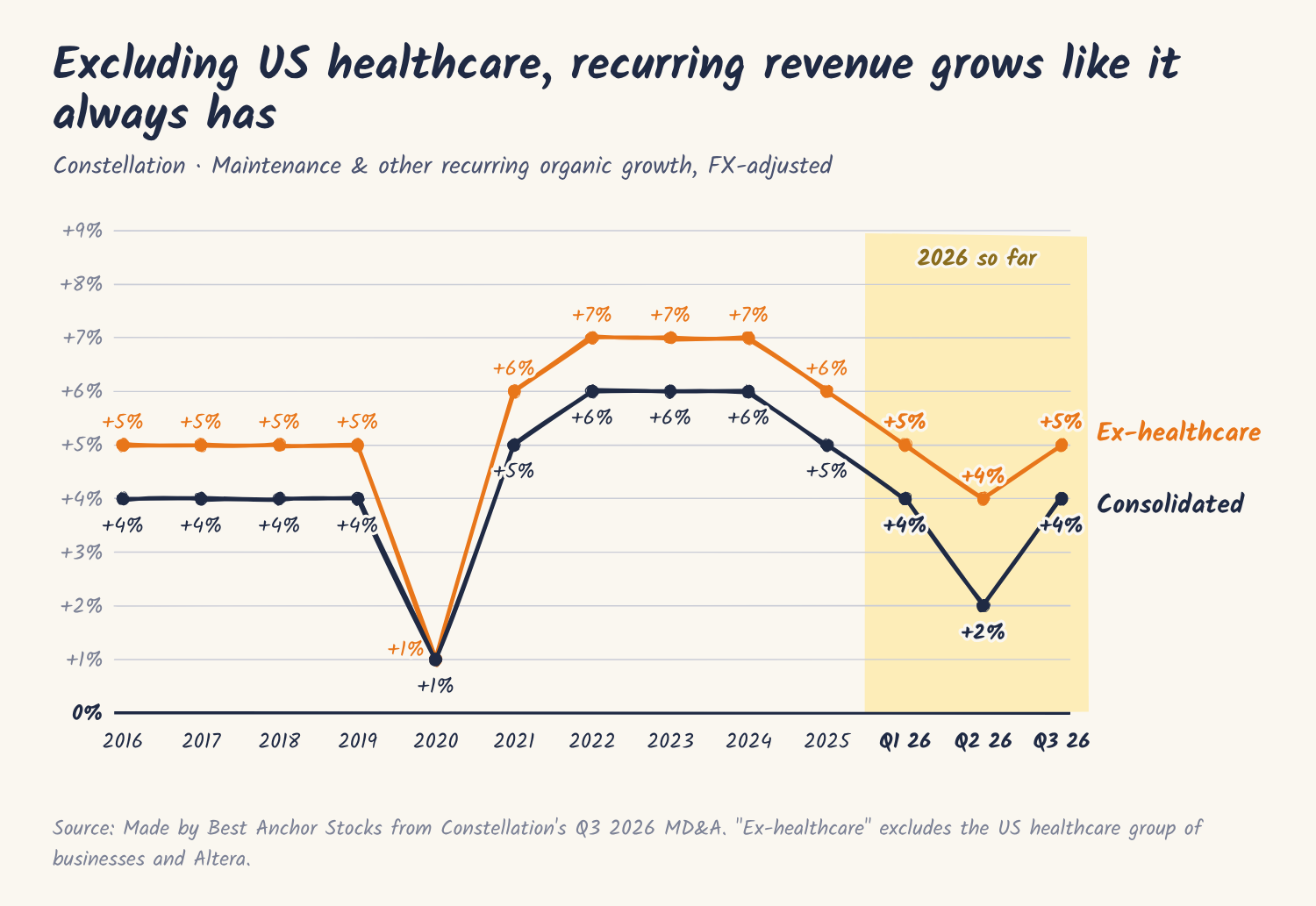
There was also an interesting conversation around the organic detractors. The US healthcare group (excluding Altera) dropped to -10% in Q3 (from -1% last quarter), but management explained that this was mostly due to two businesses acquired during the period that are suffering “very high customer attrition rates.“ These problems were known and modeled at the time of acquisition. Excluding these two customers, the group would have been at -3% (i.e., still not great but much better).
Altera was again a drag (-8% in Q3) and management now expects the departure of several sizable clients to run its course by the end of 2027. While this is evidently a headwind to organic growth until that clears, one can only wonder if it can become a tailwind to organic growth post-2027...
Now, all of this brings back the same “problem” that Constellation has historically faced, only that now many might believe that it’s caused by AI (which is evidently not great for sentiment). The bottom line is that Constellation cares about IRR, not organic growth. This means that the company is perfectly happy buying shrinking businesses at the right price, even if these temporarily shrink its organic growth profile. Mark Miller was very clear that this shrinkage was part of the plan (and fyi it’s not the first time management says this):
“It’s pretty important to understand that we did model that into the investment thesis, and all of our healthcare investments that I’ve mentioned today are expected to perform to our IRR expectations that we underwrote, including the two where we’ve seen that shrinkage in the quarter.“
Mark Miller, Q3 2026 earnings call
Regardless of all the explanations above, it’s normal for many to still worry about AI eating into Constellation’s organic growth. Bulls and/or bears can say whatever they want, but the reality is that nobody knows how it will play out. Being honest and acknowledging that one doesn’t know what the future will bring is not what management teams usually do... but Constellation is a rare beast:
“I think our stronger businesses can get stronger. Our weaker businesses that have high churn rates, and that’s a small percentage of our recurring revenues, I think they have always had such a lower long-term, like a lower LTV, like to keep the customers around. So, I wonder about some of those businesses. But overall, I wish I could say there are any like general trends we are seeing. So, nothing really.”
Mark Miller, Q3 2026 earnings call
Cash flows were also controversial. Operating Cash Flow grew 5% in Q3 and 8% over the first nine months, held back by working capital (-$157 million in Q3 vs -$47 million last year). Jamal Baksh explained that working capital swings are mostly a timing issue and that they are influenced by the type of businesses acquired and when in their cash cycle they are bought.
“I always point out one thing with that line item. If we buy a business with a ton of positive working capital, we might pay more for that business, and you’d have the price, an increased price go through cash flow from investing, and then we could collect that cash the next day, and you’d get cash flow from ops. You could buy that same business, had negative working capital, let’s just say we bought it two days after the collections, you’d pay less for it, but then you wouldn’t get that pop in working capital, right? It’s not purely like an organic number. It is influenced by the timing of what the type of businesses we’re buying and when we buy them in their cycle of cash flow.”
Jamal Baksh, Q3 2026 earnings call
Then we have FCFA2S. The FCFA2S “decline” of 16% is pretty much entirely explained by the IRGA revaluation charge ($117 million vs $16 million in Q3 2025). Holding the IRGA flat and FCFA2S grew around 3% in Q3 and 9% over the first nine months. So, working capital was the main culprit in cash conversion, but not only in Q3. Working capital consumed $175 million over the first nine months vs just $2 million in the same period of 2025. Excluding both the IRGA and working capital swings, FCF before NCI would have grown around 20%. The real question to ask ourselves here is whether this has happened before...and what comes next.
Let’s start with the basics. Working capital at Constellation is seasonal because cash comes in with Q1 maintenance renewals and goes out in Q2 and Q3. Over a full year it (the change in working capital) has historically been a small number, which means that this year’s -$175 million is significantly larger than anything in the last couple of years, and history doesn’t suggest that Q4 will reverse it. If Jamal’s explanation is right (that it’s driven by what is acquired and when), it should normalize as the acquisition mix changes rather than reverse in one quarter. This means that there’s no precedent for the current working capital swings, but there’s also no precedent for the pace of capital deployment...which was again the highlight.
Constellation has spent $2,175 million in cash on acquisitions over the first nine months (including holdbacks of past deals), compared to $955 million in the same period of 2025, and has completed or committed to another $673 million (total consideration) since the end of the quarter. Compared to FCF before NCI and excluding the IRGA ($1.83 billion), that’s a reinvestment rate of around 120% of the “universe’s” cash flow. Bernie Anzarouth was clear that the pipeline remains busy despite still intense competition.
He also made it clear that there isn’t a wave of software owners “throwing in the towel,” but rather a team that’s executing well:
“We’ve been very busy, as you could see, for the first three quarters of the year, and that activity is still ongoing. I don’t know that there’s a massive trend for everyone throwing in the towel in the software business. I think they’re just selling as they feel like selling. I think our people in the M&A world and the BD world are stepping up, and they’re doing an excellent job against competition.”
Bernard Anzarouth, Q3 2026 earnings call
So, all in all, a pretty decent quarter from Constellation despite the “noise.” Let’s briefly look at Topicus.
Topicus came in better than headlines suggest
Topicus’ quarter was, in my opinion, better than Constellation’s from an operating POV. Revenue grew 15% in Q3 (18% over the first nine months) while expenses grew 13%. This means that margins expanded, which is something that shouldn’t surprise us considering that Topicus’ capital deployment has been significantly slower lately than that of Constellation.
Organic growth came in at 5%, and M&R organic growth was 7%, meeting the high-end of the range over the past 2 years. As I mentioned last quarter, Topicus has never reported M&R organic growth below 6%, which is pretty impressive in VMS!
Topicus’ cash flows also need context. Q3 is seasonally a small quarter for Topicus (customers are invoiced for annual maintenance in Q1 just like for Constellation), so a 16% drop in quarterly FCFA2S (from €22.3 million to €18.8 million) is not very meaningful in and of itself. Over the first nine months, FCFA2S did display significant growth at Topicus (+19%). This looks great, but pretty much the entire increase is explained by one item...the €59 million dividend Topicus received from Asseco in Q2. I’ll discuss this in much more detail in a bit.
Capital deployment remained “meh” although it picked up in Q3 (around €53 million vs around €62 million in the entire first half) and seems to have improved considerably post quarter-end. Topicus spent €115.5 million in cash on acquisitions over the first nine months (including holdbacks), and the MD&A only shows €16.5 million committed since the end of the quarter. That figure, however, predates the completion of the acquisition of Grupo Softland on November 6 (two days after the results). Softland is headquartered in Madrid and is a relevant ERP and business management software player in Latin America, which makes it Topicus’ first big step outside of Europe. The price was not disclosed but it does look like a pretty significant acquisition.
Topicus has used the “weak” capital deployment period to build its firepower. Net debt is down to €137 million from €366 million at the end of 2025, which leaves the balance sheet in good shape for when opportunities show up. I said it last quarter and I’ll say it again: capital deployment (when done right) is inherently lumpy (and Topicus has been a great example of this over the years).
All in all, solid operating numbers from both companies. The problem is that the cash flow numbers which are the ones investors typically use to judge both businesses are getting murkier. PEMS opens up a whole new avenue for capital deployment, but it is also distorting the numbers in ways that most investors (and most headlines) are getting wrong. In the next section I break down (metric by metric) how PEMS blurs revenue, net income and FCFA2S, what Constellation and Topicus would look like if their PEMS were consolidated, why part of this quarter’s “weak” cash flow is actually a sign of PEMS working, and the uncomfortable question I believe every CSU and Topicus shareholder should be asking right now:
Is owning CSU or Topicus really the best way to benefit from PEMS?
Let’s take a look.
The PEMS fog: what the numbers aren’t telling you
If there’s one thing I want you to take away from this article, it’s the following: