


Hermès reported Q3 2026 revenue this morning and the stock dropped pretty significantly, marking new 52-week lows!
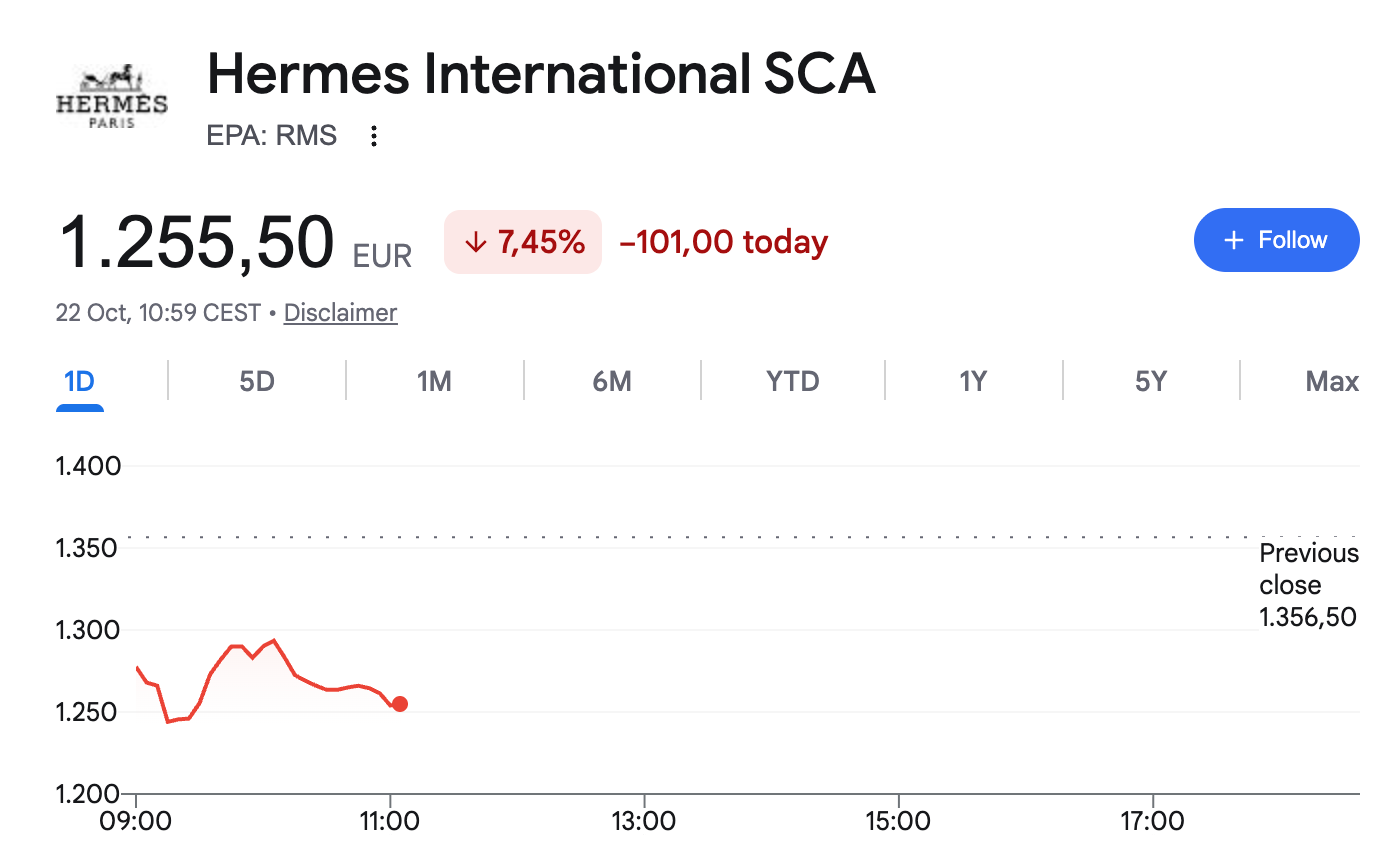
The revenue update comes almost exactly a month after I discussed in Is Hermès “there” yet? whether the stock was finally cheap. Headline organic growth slowed to +4.3%, but the details tell a more interesting story. We are going to probably be bombarded with...
Why pay a 30x multiple for 4% growth?
...because it’s the “easy” take (and who knows, maybe even a reasonable one in hindsight), but I believe this misses a good chunk of the story (hopefully you’ll understand why after reading this article).
I’ll start by outlining the numbers of the quarter, by region and by métier. Then I’ll go through what I believe matters most from the call and the qualitatives, ending with what I think about the whole situation.
Without further ado, let’s get started.
The numbers
Hermès grew Q3 revenue +4.3% at constant currency to €4.1bn. This might not seem impressive in and of itself, but I believe it’s pretty decent in the context of what the luxury industry has been going through:
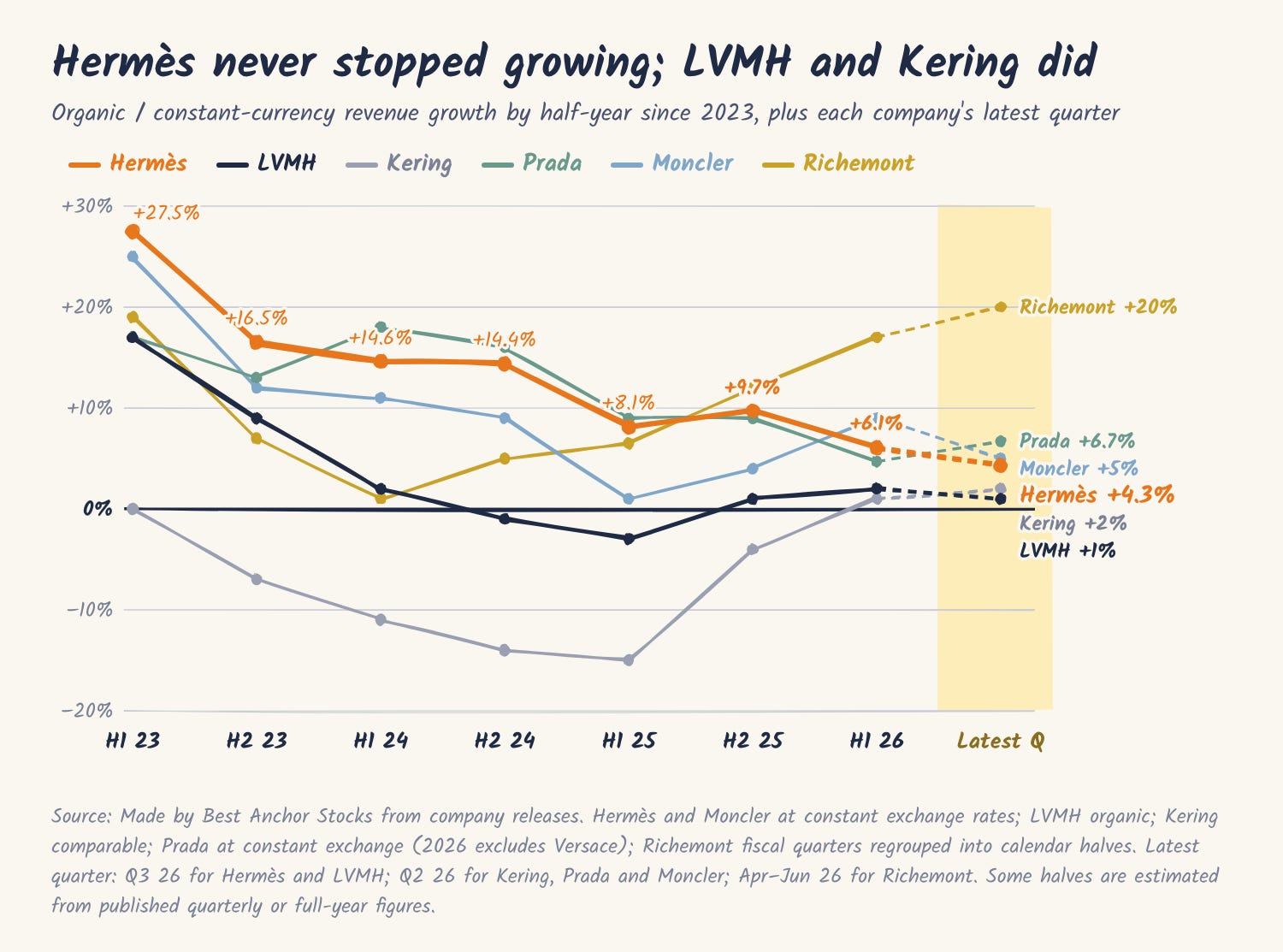
Hermes’ largest peers (mainly LVMH, which is likely a better barometer of the industry’s health) continue to grow slower despite enjoying pretty easy comps from a lackluster 2025 in which Hermes was growing close to double digits.
Reported growth was +5.5% and the fact that it was higher than constant currency growth is more relevant than many people think. Q3 was the first quarter this year where FX helped rather than hurt the numbers. Q3 sales were roughly equal to Q2 in absolute value as well, portraying that Hermes might have reached some kind of stabilization. Management confirmed that there had been no change in trends (i.e., that things did not get worse) during early Q4:
In October, no change in trends, and that’s true for all regions, including China. China is following the trend that we’ve seen so far for August and September, so no drop there.
Éric du Halgouët, CFO, Q3 2026 call
This is encouraging considering that things had indeed gotten worse from Q2 to Q3.
Let’s go with some highlights.
1. Leather accelerated despite the broad-based slowdown
In my view, leather is the métier that best represents Hermès and its investment thesis because it’s the metier that remains the most in management’s control. Leather grew +10.8% organically in Q3, ahead of the +10.2% nine-month pace (wow). Management claimed that no single region drove the strength, that all regions grew (implying that China did as well), and that every bag produced was sold:
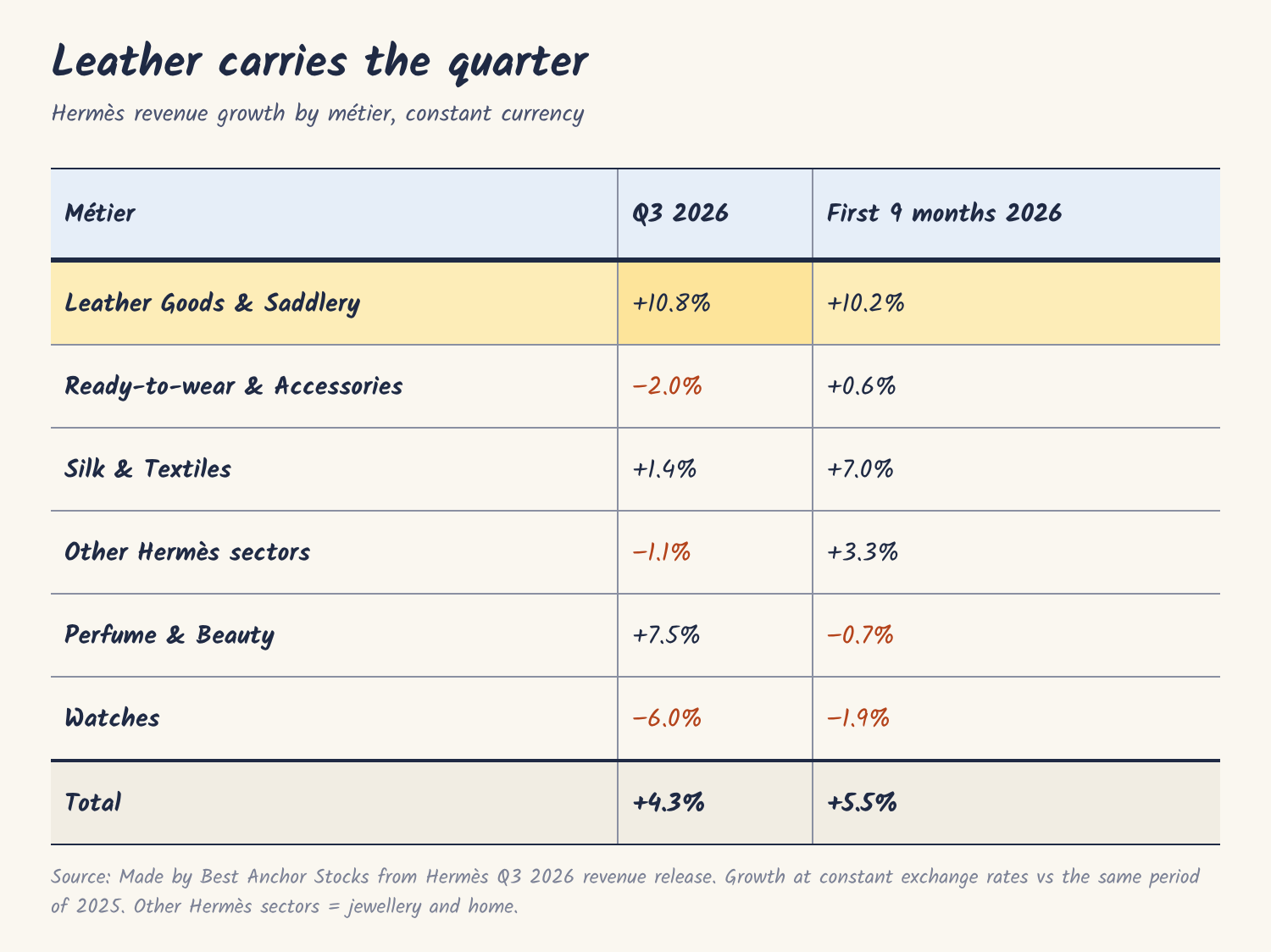
Ready-to-wear posted its first quarterly decline in about a decade and management attributed it to China and a tough comparison base after +80% growth over four years. Note that the overall tone was the following (I’m paraphrasing here or rather sharing how I interpreted it):
Volume-related categories slowed down, whereas Hermes made up some of this slowdown through value.
LVMH tells the opposite story in leather. Its Fashion & Leather Goods division fell 5% organically in Q3 as Chinese demand weakened, missing analyst expectations:
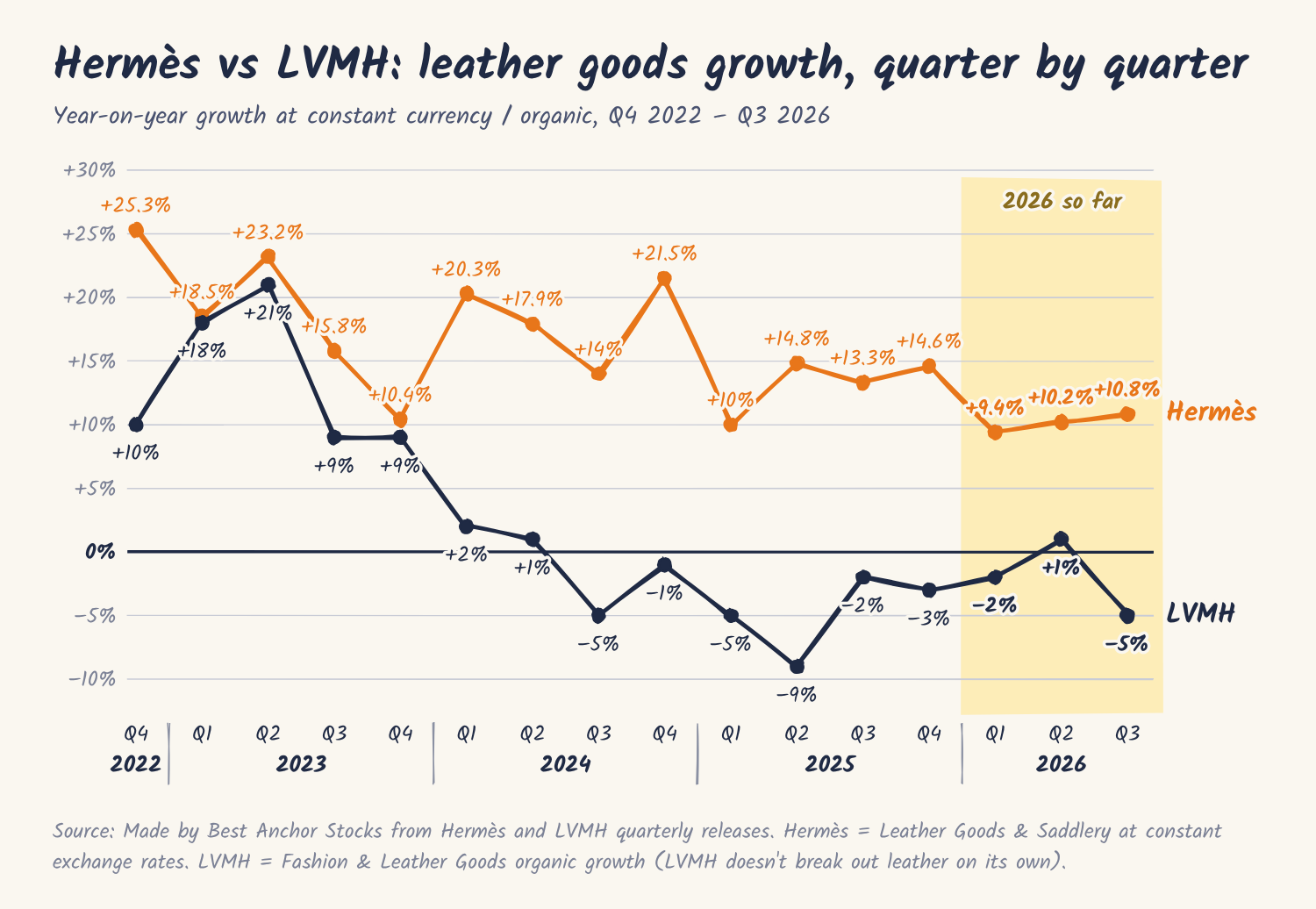
I don’t know exactly what analysts expected for Hermes’ leather metier, but judging by the questions asked in the call I’d say that it beat everyone’s expectations (including mine).
Management mentioned that leather supply keeps growing (rose about 6% in 2026) and that every single bag produced was sold. Hermes’ leather metier continues to be desirable.
2. The geographical breakdown and the wealth effect
The strongest regions were the Americas (+13.1% over 9M), Japan (+10.5%) and Europe ex-France (+9.0%):
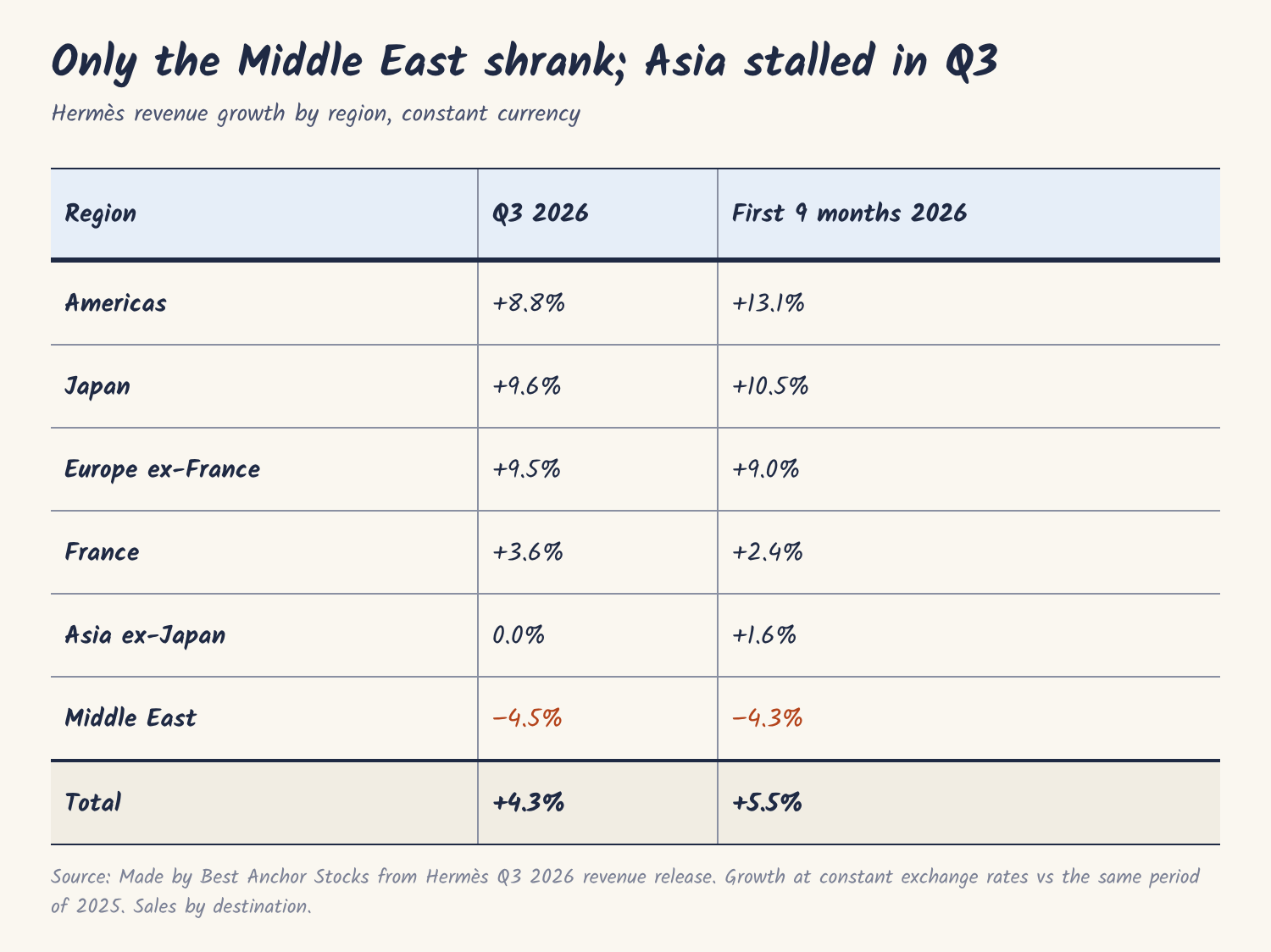
That makes (to an extent) sense when we think about how luxury demand is created. Wealthy customers (or even the middle class in some countries) feel wealthier when equity indices and real estate valuations are at ATHs. Equity indices are at ATHs in Japan and the US, although I must say that Europe ex-France has been a surprise.
China is literally the mirror image. The country’s equity indices are far from ATHs and the company has suffered a property crash on top. Want to add more fuel to the fire? Let’s talk about taxes. China has introduced a new tax on foreign assets, which hits the wealthy customers who shop for luxury in other geographies. Management gave their POV during the call:
There was this new tax that was introduced, which aims at taxing all offshore goods to the tune of 20%, and it is retroactive. It applies to the 3 previous years.”
Éric du Halgouët, CFO
Those back taxes have to be paid quickly, which likely weighed on spending in Q3. Now, despite all the bad news in China, the country was stable for the first nine months and management alluded to stabilization running into Q4. Stabilization is not great (because it’s not growth), but I’ll take it.
There were two other pain points (geographically speaking). Firs, the Middle East (−4.3% over 9M). The Middle East was the only geography reflecting a decline due to the prolonged Iran conflict. And then we have France which has been all over the news lately.
France grew only +2.4% over the first 9M, and management credited the strengt to...
The solid performance of seaside stores and the loyalty of our local customer base.
If you are not blind you might have noticed that tourist-heavy Paris isn’t on that list. Management shared that Paris footfall fell over the summer and blamed on the heatwave, claiming that September and early October improved. There were also some encouraging comments on the riots (especially after to what happened to Carrefour this week):
We haven’t noticed anything different over the last couple of days. It is mainly our store in Marseille that was attacked, which will not be reopening anytime soon. Otherwise, we have very few damages.
The open question and one that we are unlikely to have an answer to anytime soon is whether recent events keep tourists away from Paris/France in Q4.
3. The valuation: currency, and what one is really paying for
Q3 was the first quarter of 2026 where reported growth (+5.5%) outpaced constant-currency growth (+4.3%). After roughly €310m of FX drag over nine months, management’s tone sounded more confident about future currency headwinds (albeit they are totally unpredictable). Even though currency might seem unimportant, I believe it carries more significant implications than many believe it does (especially those taking valuation multiples at face value).
It’s exactly the scenario I described a month ago in Is Hermès “there” yet?. Hermès hedges its currency exposure to protect margins, but the company reports fewer euros of revenue and operating profit when the euro appreciates. When the euro gives some back, both metrics march higher even if organic growth is unchanged. As you might have imagined, the reported multiple is calculated on reported metrics, not on organic ones.
The stock currently trades at an LTM P/E of about 30x on LTM reported revenue growth of only 2.7%. Much of that apparent slowdown has been currency, not the business itself. As FX turns (who knows if it will next year), reported earnings rise with basically no change in business performance, so the multiple compresses mechanically at a given share price (and assuming everything else stays the same).
And we’ve seen this movie before but with an opposite impact. The euro slid against the dollar toward parity and briefly below it in 2022. This made Hermès’ reported figures run well ahead of the underlying business (i.e., the organic growth): revenue grew about 29% at current rates versus roughly 23% at constant rates, and recurring operating income rose about a third.
A more similar scenario took place in 2015, when the euro’s sharp fall against the dollar pushed reported revenue growth to around 17%, roughly double the ~8% constant-currency figure. In both cases a good chunk of the earnings growth came from translation rather than from selling more bags, which is precisely why reading a P/E without adjusting for FX (or the cash position) can mislead in either direction. Now, why is this tough to do? Because we ultimately don’t have a clue how FX will move (but at least we should be aware of it).
Of course, we’re now going to get bombard with people who claim that the multiple is too rich “for 4% growth,” but I don’t think this connection makes much sense. I don’t think many people own Hermes at current prices for 4% growth, they likely own it for the ability to keep growing when the industry is not doing great. Hermès has grown every year through four difficult years for luxury, and the company experienced acceleration in its core metier.
Still, all this said, there’s no denying that the luxury industry is going through an important bump and the shares will most likely remain out of favor for a while. We’ll see. I do think that the report was much better than the share price reaction implies, but maybe that’s just me.
Have a great day,
Leandro