


In March this year, I published an article titled “the stock is down 40%, the business isn’t.” In that article I discussed whether I believed Hermes was already cheap after having suffered quite a significant drop (at least for Hermes’ standards!).
The stock was trading at €1.600 then, but it has come down a further 15%+ and is currently trading at €1.350 or so. Just for context…the stock had not seen similar levels since 2022, so the absolute and relative underperformance compared to the indices has been significant.
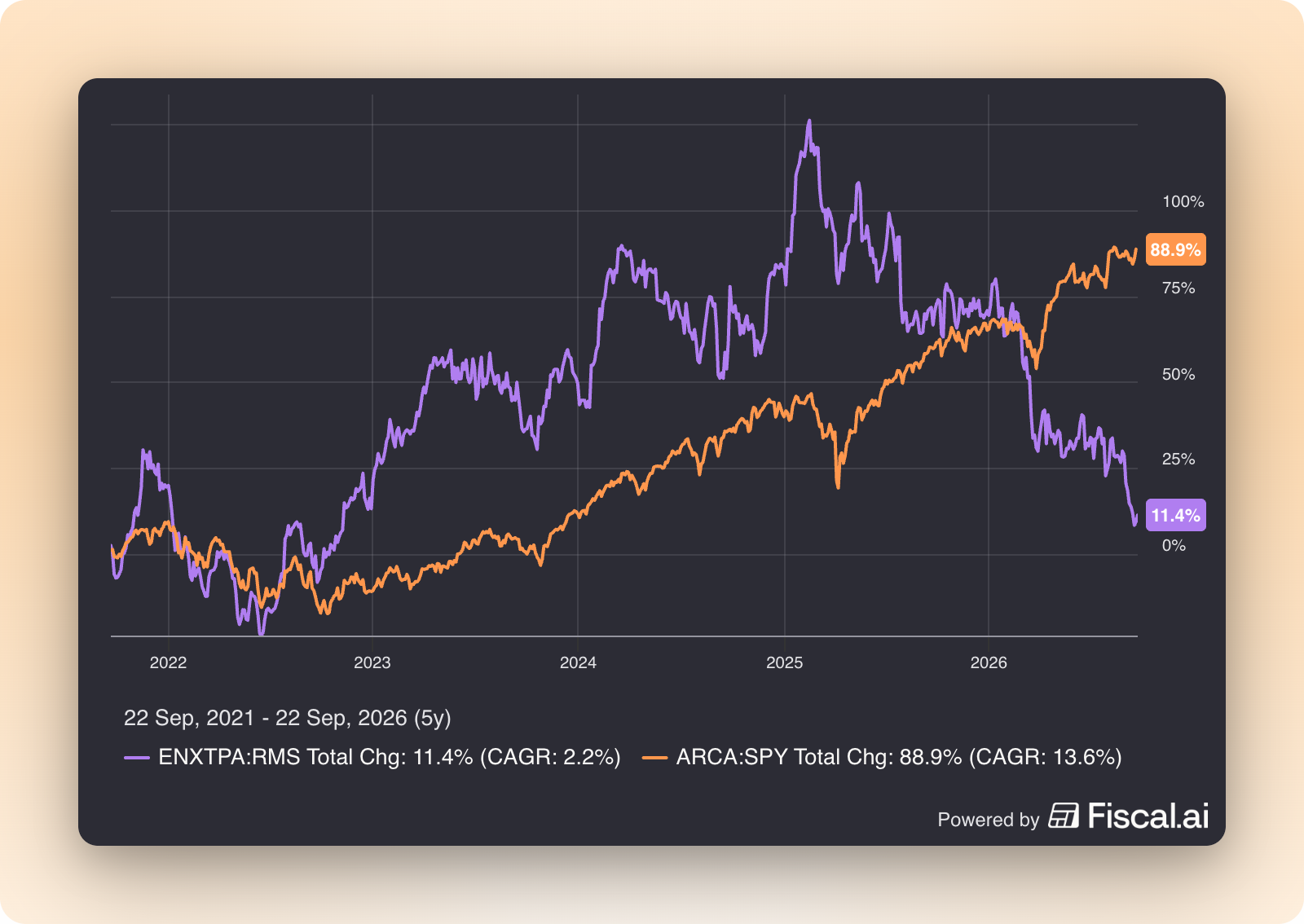
I ended that article with the following:
I believe Hermes can potentially and realistically deliver 10-12% returns over the coming years. This is a very attractive return in periods in which there’s not many investment opportunities, but Hermes’ drop has coincided with a broad market selloff (not talking about the indices) and an abundance of opportunities, making its price comparatively less attractive. I hold a small position in Hermes and plan on holding on at these prices, but I believe my incremental dollars can find a better home for the time being. Context and opportunity cost always matter in investing.
Is this time different? Let’s take a look.
First things first: the reasons for the drawdown. I believe that there might be several plausible reasons behind the recent drawdown, some of which remain unchanged since I published that article. I’d quickly summarize them as follows:
China: the sentiment in the most important luxury market in the world has not been the best and many luxury companies continue to struggle in China. Despite all these struggles, Hermes continues to grow in China, albeit slower
The conflict in Iran: what seemed to be a “short” conflict at first has been lengthened considerably, which most likely means that the impact to companies like Hermes will be more long-lasting than previously anticipated
I would add a third potential reason this time around, which funnily enough makes for a fascinating story: Hermes’ missing shares.
Nicolas Puech (one of Hermes’ heirs) had historically been one of the company’s most significant shareholders. The thing is that his original 5-6% stake was handled by a Swiss wealth manager who went by the name of Eric Freymond. Puech is now alleging that Freymond sold part of his stake to Bernard Arnault against his will.
Everything happened around the year 2010 when Bernard Arnault was acquiring Hermes shares using derivatives in an effort to acquire the company against the family’s will. LVMH surprised everyone by building a 23% stake in Hermes, but the company was eventually forced to distribute a good chunk of these shares to its shareholders. This is the well-known story and, until here, all good.
Now, in 2022, Puech supposedly started to see something “strange” in his accounts: a good chunk of his Hermes’ shares were missing. He pointed his finger at Freymond and filed a criminal complaint for fraud in Geneva in September 2023, which was ultimately dismissed. Now, here’s where things get REALLY interesting. In 2025, Puech sued Bernard Arnault and LVMH seeking compensation of around €14 billion as he alleged that his shares had been sold to LVMH back when the company was trying to build its Hermes stake. LVMH denied the allegations and (importantly) denied ever wanting to acquire Puech’s stake. This ultimately meant that Puech did not have a way to prove that this had happened…until recently.
Reuters reported this month that some court documents demonstrate that LVMH signed an agreement in 2002 to acquire Puech’s shares, which goes directly against what LVMH manifested in a 2026 court filing. The more interesting piece is Freymond. According to Reuters, Freymond had been paid more than $20 million throughout a period of 8 years (2001 - 2009) in connection with LVMH’s effort to build its Hermes stake. It’s tough to envision a scenario in which Freymond could act in the best interest of both simultaneously, making Puech’s allegation plausible. Uncoincidentally or not, Freymond committed suicide in 2025 while the matter was being investigated.
So, what does all the above mean? Not only is China weak, not only does the Middle East conflict continue, but now we also have to face a “conflict” between the two most relevant luxury companies in the world. A pretty interesting environment for luxury!
The key question here is whether all of the above justifies Hermes’ stock price decline. That’s a different question entirely and one that imho is typically not well answered by the many who ignore all the moving parts.
Let’s take a look.
The moving parts and their implications
The first thing we must be aware of is that Hermes’ reported numbers (both the financials and the multiples) require significant context. Let’s start with the why. This is something that I discussed with paid subscribers in a relatively recent NOTW, but ultimately, if you look at the reported figures for Hermes you are most likely going to see the following:
LTM (last twelve months) reported revenue growth of 2.7% YoY
An LTM P/E ratio of 31x
What would most “quick-glance” investors say about these numbers? REJECT. Fine. But there’s considerably more context needed to understand these. Let’s begin with revenue growth.
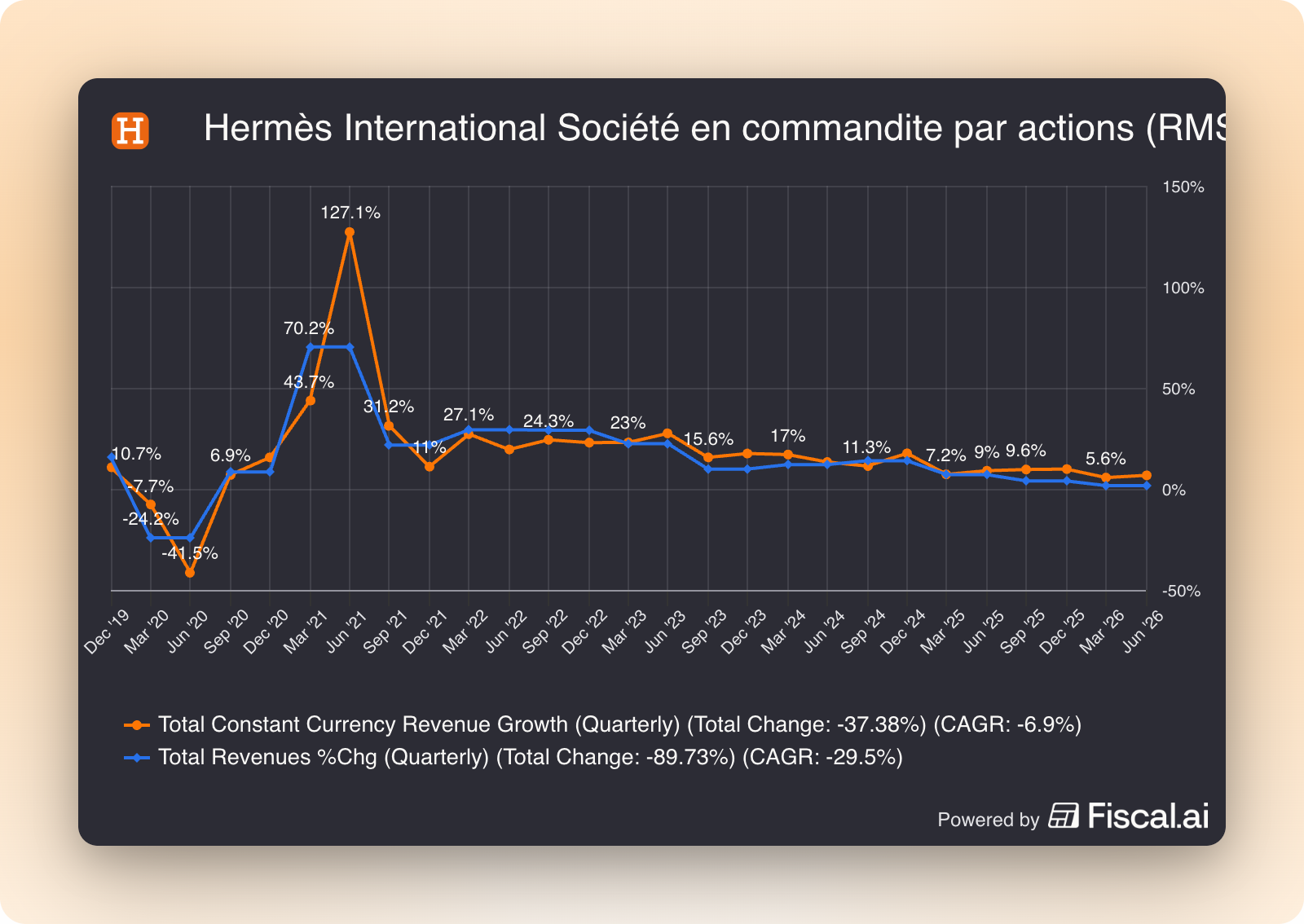
Hermes’ has faced considerable FX headwinds over the last twelve months due to the strong appreciation of the euro. So, in short, FX has considerably pressured its reported growth. The reality though is that, despite all the aforementioned headwinds which are not minor, the company has managed to grow its top line at an FX-adjusted rate of 6% (H1 2026) with revenue accelerating from Q1 (+6%) to Q2 (+7%). Is this great? It’s definitely not the best that Hermes has ever seen, but it’s not something unheard of for the company.
The most interesting thing, though, is the implication that FX has on the reported multiple. Hermes hedges its FX exposure to protect margins, but when the euro appreciates, the company ends up with fewer absolute revenue and operating profit dollars. The opposite happens when the euro depreciates: both revenue and operating profit march higher even if organic growth stays constant. This ultimately means that Hermes’ valuation multiple can’t be understood without taking FX into consideration.
Now, there’s good news and bad news. The good news is that this means that the valuation multiple would potentially contract simply if Hermes enjoys a favorable period of FX. The bad news, though, is that we don’t know whether that will happen. I don’t consider myself an FX expert by any means, but if I had to guess, I’d say that the euro has appreciated quite materially against many currencies and see no reason why it shouldn’t give up a bit of it. Looking back at Hermes’ reported growth vs FX-adjusted growth, it sure seems like a cyclical phenomenon:
All this said, because an FX tailwind/headwind is totally unpredictable, I’ll simply focus on the organic performance of the business.
Now, the other relevant topic here is taxes, which is where things potentially get “structurally” interesting. In 2025, the French government decided to come up with a “solidarity tax” (they always call them solidarity) through which companies generating more than $3 billion in French revenue would be required to pay a “special and non-recurring” tax. The name in French sounds better (“contribution exceptionelle sure les benefices des grandes enterprises”) but it’s the European playbook (higher taxes to pay excesses) all over again but with a cute name.
The tax is pretty significant: an additional 41% over the corporate income tax used as the tax base. So this means that Hermes is paying roughly an additional tax of 10% over the profits of the revenue it derives from France (which is significant). For FY 2025, this special tax added almost 500 basis points to the consolidated effective tax rate.
The bad (or one could say: “the expected”) news is that this special tax is likely going to be more recurring than previously envisioned. It was initially thought for only 2025, but it was subsequently lengthened to 2026 as well. In August, the French government proposed one additional year: 2027. While the latter is a proposal, it seems like this is the start of a new tax for Hermes. The bad news for Hermes is that the company has its roots in France and going elsewhere seems unlikely. There’s a potential and non-trivial implication for investors from all of this: the current P/E multiple might be closer to normalized than it looks.
We could definitely strip out the special tax or normalize it, but what if it becomes permanent? You convert something in a source of downside rather than in a source of upside. This also means (and here comes the hard part) that all else equal, the EBIT (or any pre-tax multiple) that investors should be willing to pay for Hermes should now be lower. The reason is pretty straightforward: the French government is keeping a larger piece of the pie. Hermes is still an outstanding business that (imho) deserves a high optical multiple due to its high terminal value, but this is something worth discussing.
Let’s take a look at the model.
Is Hermes’ “there” yet?
I’ve divided the valuation into three scenarios: a bear, a base, and a bull. This is what I have decided to assume for each in terms of constant currency revenue growth:
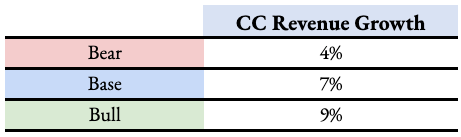
For the bear case I assume revenue growth considerably below history, which I deem pretty unlikely. For the base case I assume that revenue growth remains as is, despite Hermes (and the industry) suffering considerable headwinds currently. For the bull case, which I also don’t deem extremely likely, I model revenue acceleration to 9%.
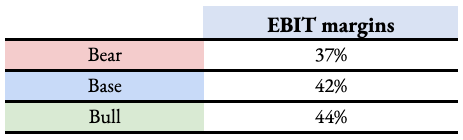
For operating margins I assume that they barely expand 100 bps over 5 years in the base case. I believe this is realistic as Hermes is currently investing significantly and margins seem to have stabilized around those levels:
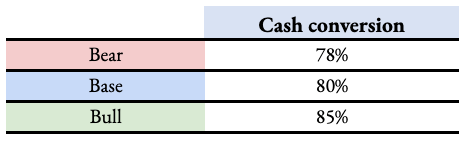
Things get interesting in cash conversion. Hermes has historically enjoyed an OCF/EBIT cash conversion of around 85%. I decided to drop this to 80% in the base case due to higher cash taxes paid (which don’t impact EBIT but do impact OCF). This might prove to be conservative, but I believe it makes sense to do it this way if we assume that taxes will stay higher for longer:
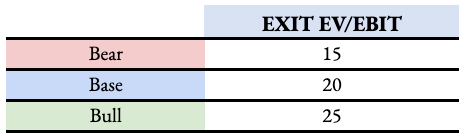
Finally we have to think about exit multiples. I do believe that Hermes deserves a relatively high multiple due to its terminal value (especially when looked over a 5Y period). If we combine this with the fact that the EBIT multiple should (all else equal) be lower than history due to the higher taxes that I’m assuming, I decided to give the company an EV/EBIT exit multiple of 20x in the base case. The average EV/EBIT multiple has proven to be significantly higher in the past, but I believe these levels make sense in a conservative model:
Add the current dividend yield on top of this and we can finally calculate the total 5Y expected return CAGR for the three scenarios:
Bear: 0%
Base: 11.5%
Bull: 19.7%
I believe the base case scenario is the most likely although I wouldn’t entirely rule out the bull case. I believe my scenarios are pretty conservative and that a 12% expected CAGR for a company like Hermes and its risk profile is pretty enticing. As I have historically had a small position (currently around 120 bps), I have decided to increase my position.
Have a great day,
Leandro