


Constellation reported this week one of the most “controversial” quarters that I can remember as a shareholder. Investors either thought the quarter was outstanding, or that it was “mid,” and although I was in the latter camp after taking a quick peak at these, I must say that I moved slowly but steadily into the former group. In short, the quarter had fuel for the bears and fuel for the bulls. I believe that the controversy stemmed from the amount of noise in Constellation’s earnings (even for Constellation’s standards!), so without further ado, let’s jump right in.
Constellation reported good headline numbers in Q2. Revenue grew 17%, although margins contracted on the face of expenses growing 20%. This is nothing unusual in periods of very strong capital deployment. Management claimed that new acquisitions will eventually trend towards the normalized margin:
Or margins, but there were a couple large it's more the purchase accounting, like there was some bonuses that we couldn't put as part of equation that we had expense, etc., but that cohort in 20 in Q2 went from being, I think it was -16% in Q1. And it's now positive 16 in Q2. It is going to trend up to 2025 cohort similar thing. I think it started off around 16, 17%. It is up to 20%. It is moving up. It is not that these businesses will continue that way, as it is just taking time to improve them to the levels. If you look at all the cohorts prior to that, they are probably in the 30s or high 20s, right? It is just taking longer for them to go there, but it is not going to be inherently lower forever.
I should also note that (even if not extremely material to overall expenses) contingent consideration expenses grew considerably (+200% YoY) in Q2. This is a “good” expense to have because it demonstrates that the investment theses are playing out:

Contrary to many believing that revenue is a “clean” number, Constellation’s total revenue number also needs context. For starters, the company is deploying capital into opportunities that “entirely” bypass the consolidated revenue figure. I explained this in my most recent Topicus article, but Asseco is being reported through the equity method, meaning that it’s not consolidated in revenue but the company’s share of its profits comes included in “share in net (income) loss of equity investee.” What this ultimately means is that Asseco is indeed present in Constellation’s net income figure (after deducting Topicus’ non-controlling interests) but is not consolidated in the revenue line. Something similar happens with Sabre in the sense that revenue bypasses the revenue line. Sabre, however, is not accounted for in the same line as Asseco but rather in “finance (expense) income.”
Topicus deployed around €400 million in Asseco (around $500 million at current exchange rates) and Constellation deployed around $90 million in Sabre. This ultimately means that Constellation has deployed around $500 - $600 million into acquisitions that are entirely bypassing the company’s revenue and therefore not contributing to revenue growth (even though these are indeed having an impact down the income statement). There’s nothing wrong with this, but I believe it’s something important for people to consider as the relationship between capital deployment and revenue growth will not be perfectly linear if Constellation and its universe continue using these capital deployment options.
This quarter’s organic growth rate also requires some context. Constellation’s organic growth (both the total and maintenance and recurring FX adjusted) clearly decelerated in Q2:
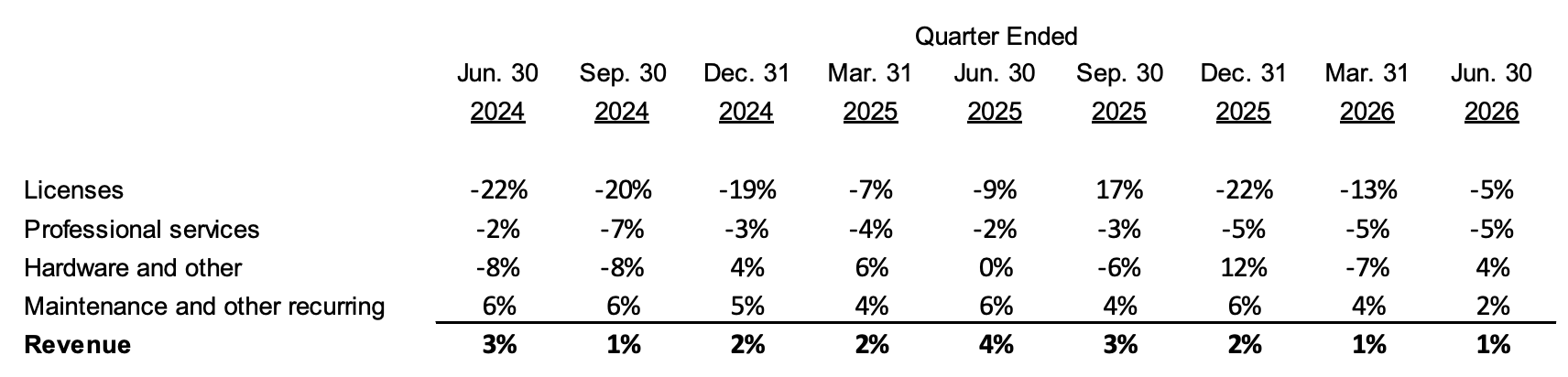
Management attributed this deceleration to Altera, claiming that the company had enjoyed $17 million in non-recurring revenue benefits in Q2 2025 (the comparable period). So, in short, Constellation’s management attributed this deceleration to tough (and non-recurring) comps. They also shared that, without this impact, maintenance and recurring organic growth would’ve been 4%:
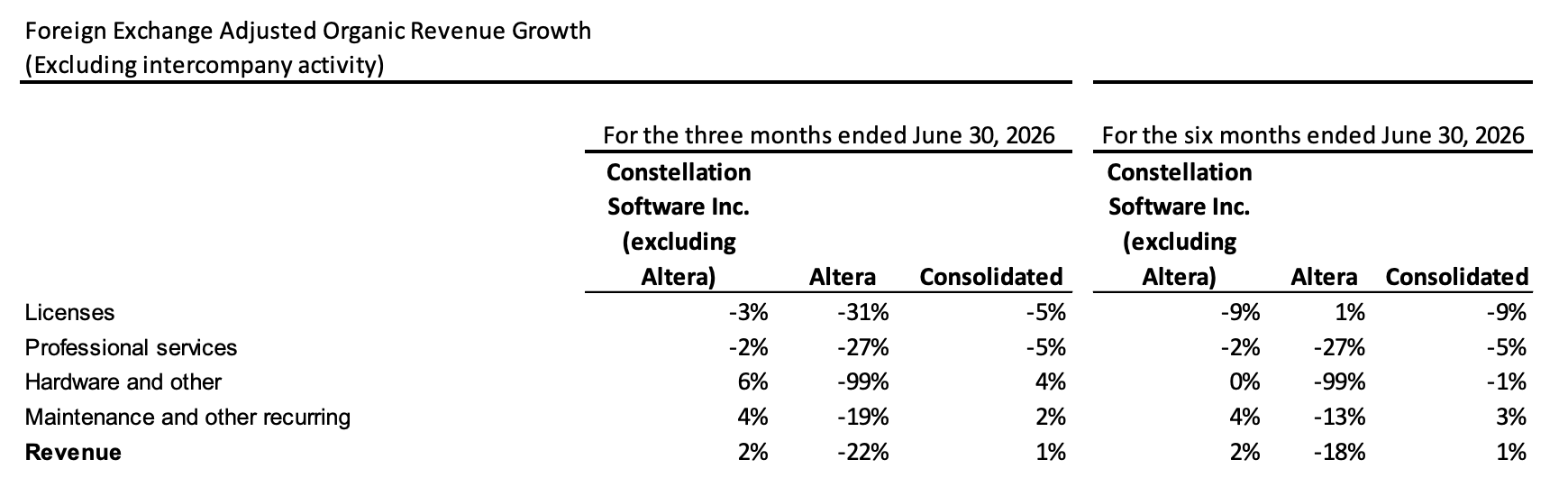
4% organic growth is not an outstanding figure either and is in the low-end of what Constellation has historically achieved in FX-adjusted maintenance organic growth, but it’s nonetheless acceptable. I don’t think there’s anything worrying going on with Altera (although I would’ve appreciated management flagging this in the Q2 2025 MD&A) and I believe that, regardless of organic growth, it’s proving to be a pretty good investment for Constellation.
Altera generated yet another $21 million in FCFA2S in Q2 2026. Constellation acquired Altera in Q2 2022 for an EV of $892 million and has already generated $400 million in FCFA2S from this asset. Note that Constellation’s equity in this acquisition was less than $400 million, meaning that the asset is virtually paid and any potential stabilization could be considered “free” for Constellation.
One could argue that organic growth is not looking great, but Altera’s performance/market share seems to be stabilizing when “ignoring” the quarterly volatility:


Management simply believes it’s a temporary issue caused by comps:
I tried to put it in the MD&A there, but it was a very, in Q2 2025, they had a very strong quarter. They actually had a couple new name sales. The way IFRS makes us account for things. Now, if you have a large contract, you have to recognize a certain amount upfront. They actually showed it was positive. 1% organic growth in Q2 of 2025. The trend line for this business is going to be a slow shrinker for the next year or so, or a couple of years, I would say. That is the driver of it. If you normalize for that strong Q2 2025, you know, things are, you know, there is nothing terrible going on. I would expect that organic growth to revert back on a full year basis to what it has been trending at recently.
It was only not isolated to Altera, but there were a couple of other “issues,” none driven by AI:
It is tough because we do not talk to specific BUs in the MD&A, but you know, we had a couple of larger acquisitions, like TDC. We had a similar thing where in Q2 2025, they actually recorded organic growth of it was 10%, right? This is a business that we’re still fixing. has negative organic growth right now, but you had this huge Q2 2025. Therefore, you have like a -18 in Q2 2026 because of that comp.
The other thing, if you look at some recent acquisitions, so lumen is broken out, you can see that they have made some large acquisitions recently that they are pulling out their organic growth in the quarter was 1%. Right. Again, a drag on Constellation Software Inc. Things that they are expecting to turn around. There was another large or a business that we had in South America where they lost a large customer. This was an example of a business that we knew at the time we acquired it, that that customer was leaving, having nothing to do with AI. The customer is now left, but it was sizable. That customer loan was like a 30 basis point drag on CSI numbers, right?
There are a few of these, like one offs that are causing it many, or the two that I talked about, like the Altera and the dark matter are purely accounting related and should revert back next quarter. The lumen thing is like they are fixing these businesses. I do not know the exact timeline of when they expect to turn around. However, if you back out those three or four things, you would normalize back down to that sort of 5% number that we have always trended at.
Regardless of the discussions around organic growth, I believe the Altera example comes with several important lessons, with the most relevant one being that Constellation cares about IRR, not organic growth. Altera is not Constellation’s fastest-growing asset, but that’s fine so long as the IRR is great. Now, one can’t ignore the market’s current AI-SaaS narrative. Even though Constellation’s model is ideal to generate great returns for its shareholders, it doesn’t seem to be ideally positioned to fit the market’s narrative. I’m okay with this, but it’s definitely something to be aware of. This reminds me of a famous Puru Saxena post (“do you care about accounting numbers or do you want to make money?”). For Constellation this would translate into:
Do you care about the market’s narrative or do you want a high IRR?
My friend Liberty 💚 🥃 succinctly put it in the following post (which I agree with even though I don’t know if it’ll fit well with the market’s narrative):

Now, all this said, management did address this during the call and argued that AI-driven organic growth will most likely come, just further down the road because they are currently in the phase where they understand customers needs to see what they want to develop:
We are seeing our development processes getting much better. They are moving faster through backlogs. We are seeing a productivity increase across the group, not everywhere, but it is starting to adopt because we spent a lot of time working on training up all of our resources on how to use AI tools better for development. Right now they are working to talk to customers about potential add-ons or additions to their products that are using some of this functionality to develop the software. We still haven’t seen a real pickup in organic growth from it. I think that’s a ways out. What I always say, you can build products fast, however, selling them is a whole other thing. A customer has the budget for them and see. You have to be solving a need that they are willing to put some money on the table for before it is going to impact our organic growth.
Things get even murkier below the “expenses” line (are you not entertained?). Constellation’s P&L has several items which make net income misleading. The easy way forward might be to look at Free Cash Flow Available to Shareholders, but this metric is also misleading and the reason is the IRGA (which was revaluated downward in H1 2026 primarily due to foreign exchange gains). A downward revaluation is a tailwind to Constellation’s reported FCFA2S and I discussed extensively in this article what the IRGA is and why I think it’s an asset rather than a liability (albeit I understand why CSU treats it as a liability), but the bottom line is that it’s better to exclude it from the numbers when contextualizing FCFA2S. FCFA2S showed strong reported growth…
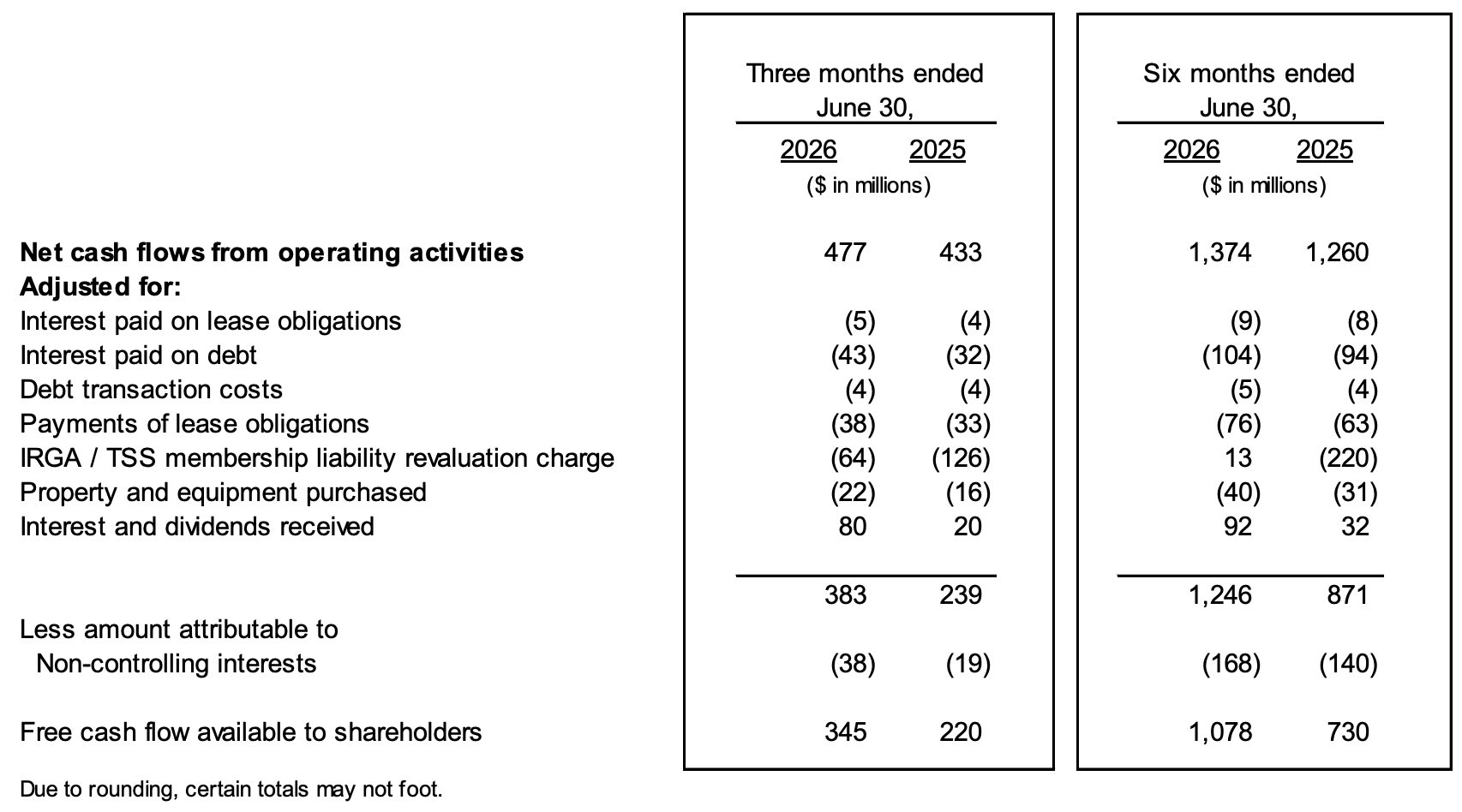
…but growth was more moderate (+18% in Q1 and +12% in H1) albeit acceptable when excluding the IRGA revaluation charges. OCF growth was also subdued, but after checking the financial statements (including those of Topicus), the lower cash conversion can be attributed to temporary items which will eventually resolve themselves (it’s not the first time that it happens).
The highlight of the quarter was definitely capital deployment. Constellation Software is off to the races and is going to report an outstanding (and record) capital deployment year. The company deployed…
$809 million in Q1
$893 million in Q2
$818 million thus far in Q3 (half-way through)
This means the company has deployed $2.5 billion YTD, which is already close to matching the record year of 2023 (with a quarter and a half to go!). This is outstanding performance, and the best news is that Constellation remains lightly levered (net debt over LTM OCF of under 0.5x) and cash generative, meaning that there’s still significant leeway to continue pursuing acquisitions.
As discussed at the beginning of the article, I believe Constellation’s current quarter has food for the bulls and for the bears, although I believe there’s more food for the bulls (I’m definitely biased). The relatively weak organic growth is a way to fuel the bears’ “AI kills SaaS” narrative, but the record capital deployment is a way to demonstrate that Constellation can materially benefit from valuation dislocations and that the capital deployment runway remains long.
I do get the point (and somewhat agree with it) that underlying organic growth ex-Altera is acceptable, but again I don’t think any of us (including myself) adjusted Constellation’s Q2 2025 organic growth downward (especially considering that the MD&A did not disclose it). So yes, adjusting it out makes sense, but as Hermes’ CEO said a couple of weeks ago:
If you take away all the bad news, all that’s left is good news.
I believe Constellation reported a solid quarter of exceptional capital deployment and “okayish” organic growth. This should lead to substantial revenue acceleration (although remember the relationship between capital deployment and revenue growth is not the same as it was in the past) and demonstrates that Constellation is still finding opportunities to deploy its capital across the VMS space.
Have a great day,
Leandro
Hey, thanks for the shoutout! 💚 🥃
Agree with everything here.
So much focus on +/-2% organic growth in one specific quarter... the tree that hides the forest !
And now with all that cash deployed YTD, there are good chances we see accelerated growth next year (maybe even near 20%)