Best Anchor Stocks has a partnership with Fiscal.ai (the research platform I personally use), through which you can enjoy a 15% discount on any plan. Use this link to claim yours! You’ll find KPIs, Copilot (a ChatGPT focused on finance) and the best UX:

You can read this article (almost) entirely for free. If you like what you read, consider becoming a paid member to get access to…
All in-depth reports (16 companies profiled thus far, and growing)
Earnings follow-ups
Other investment related content
A community of like-minded investors
Complete access to my portfolio and transactions
Occasional webinars
You’ll also get access to the 30+ page detailed report on the robotics industry.
The in-depth reports of Stevanato and Deere are also free to read to gauge the quality of the research.
Join today:
Markets dropped this week as AI-trade stocks continued to disappoint “stock-performance” wise but not in terms of fundamentals. I explain what this might mean in the brief market commentary. There is also plenty of company-specific news this week.
Without further ado, let’s get on with it.
Articles of the week
I published two articles this week, both earnings digests. The first one was Texas Instruments’ Q2 Earnings digest: “The converging inflection.”
The converging inflection

Texas Instruments reported (again) a spectacular quarter yesterday. Just to contextualize how good the quarter was, take a look at the company’s performance against sell-side expectations:
TI reported very strong earnings, but the stock has run up quite a bit over the last few months, so is it still a good buy? I go over this (and more) in the article.
The second article of the week was Medpace’s Q2 earnings digest: “Long live the buyback king.”
Long live the buyback king

(Medpace is a company I profiled in May of 2025. You can read the in-depth report here)
The company reported very solid earnings and portrayed two things:
A lot of people still don’t really understand the business’ dynamics
Excellent capital allocation (shocker)
I’ll leave a spoiler on the first point from my article:
While many expected FY 2027 to be a “cliff” year after two consecutive quarters of weak book to bill, it seems like the pipeline is filling up nicely and the cliff will most likely be avoided. This is a very interesting topic because the backlog figure is actually a terrible leading indicator of future revenue growth. You’ll be wondering “how can this be?.” There are two reasons.
Without further ado, let’s see what the markets did this week.
Market Overview
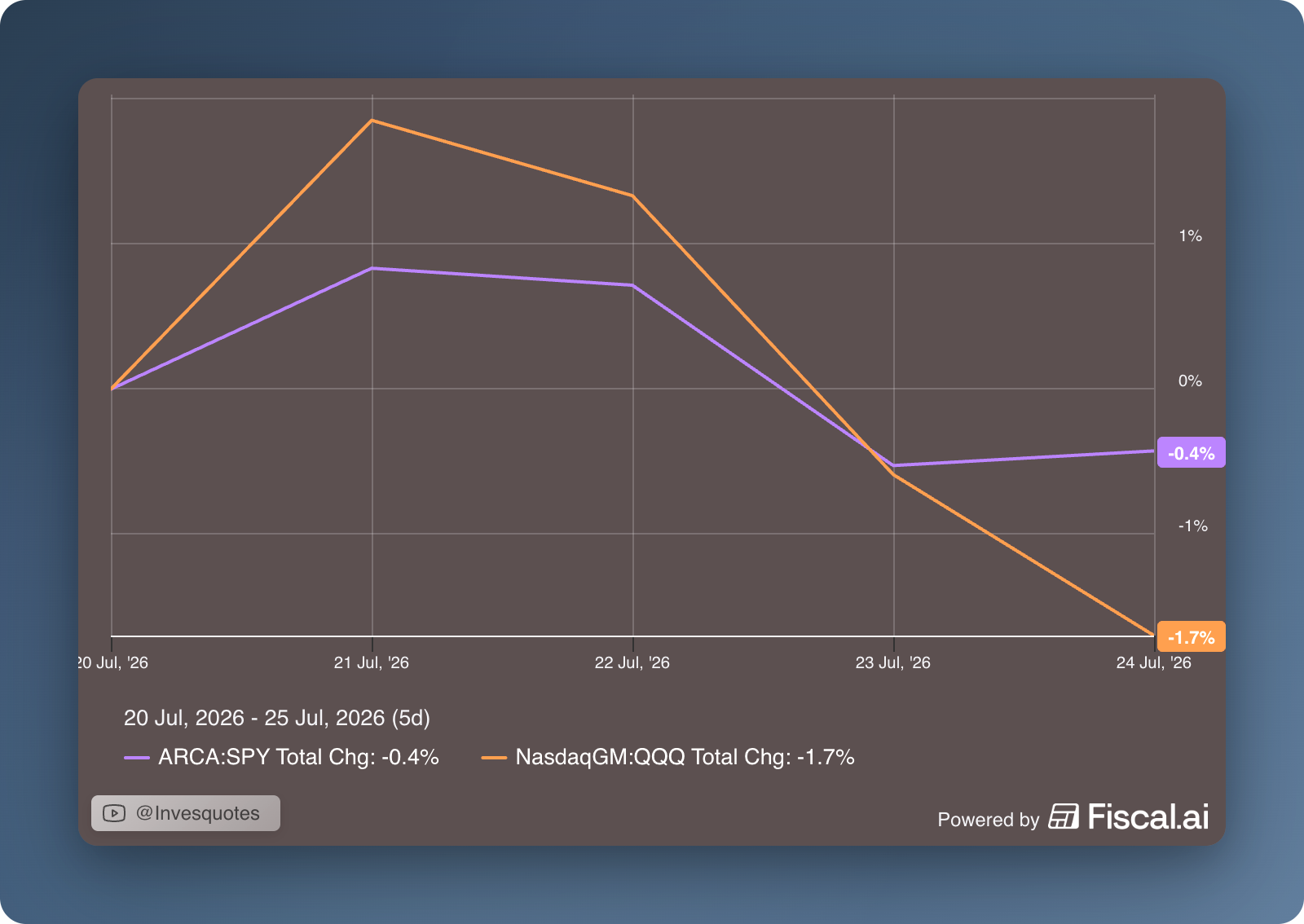
Both indices were down this week. The S&P 500 dropped 0.4% whereas the Nasdaq dropped 1.7%. When one sees this divergence across the indices one can be pretty much sure that the AI-trade did not do well:
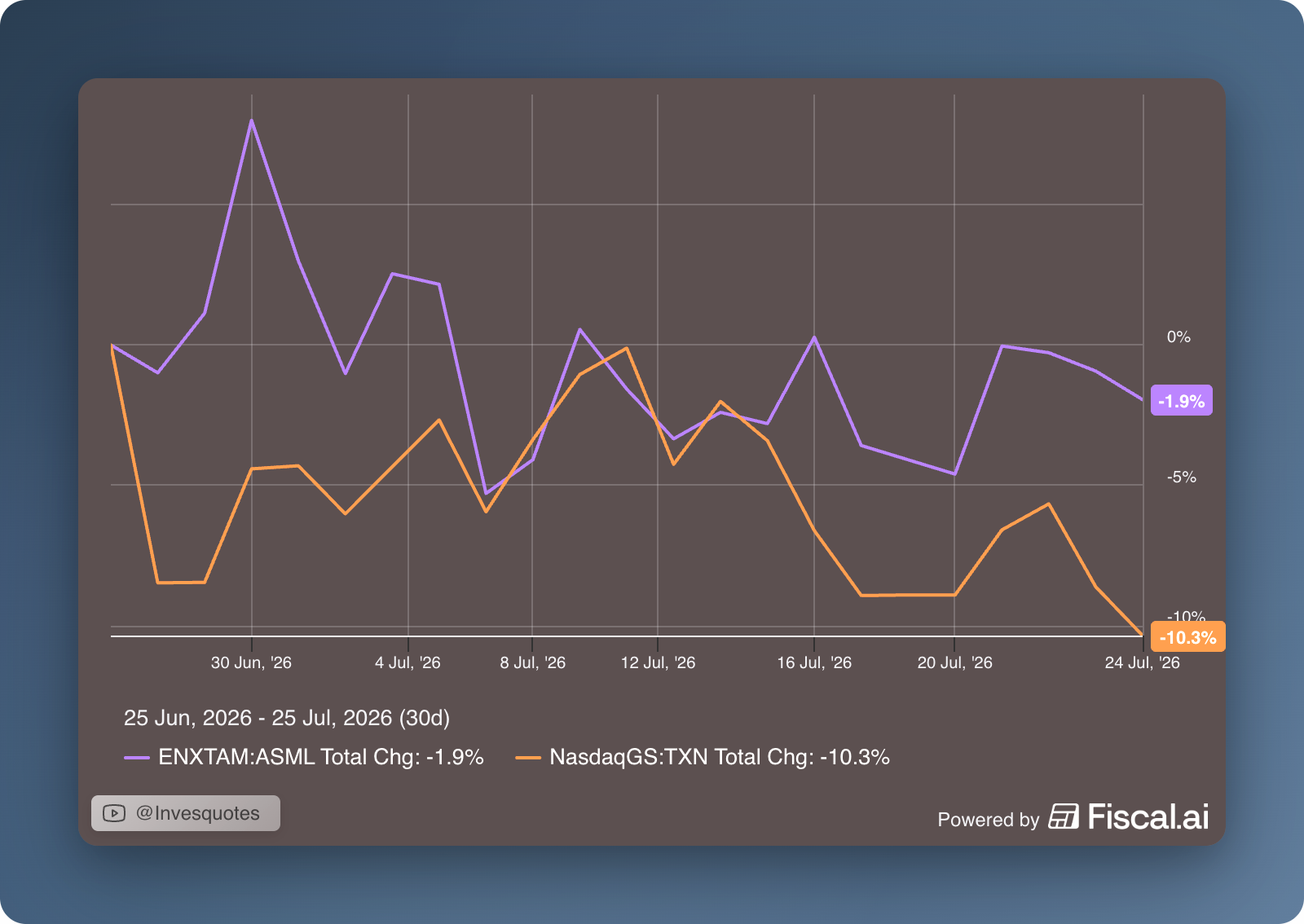
One thing I found interesting (which I suffered with Texas Instruments’ and ASML’s earnings) is that several semiconductor stocks have begun showing “cracks”, and not precisely in their fundamental performance. Semi stocks (and the AI complex in general) continue blowing numbers out of the park, but the stock reactions have now started to disappoint. Let’s take a look at a couple of examples.
Texas Instruments and ASML beat by a wide margin what already seemed like pretty optimistic expectations, but their stocks did not do much post-earnings (in fact, they dropped):
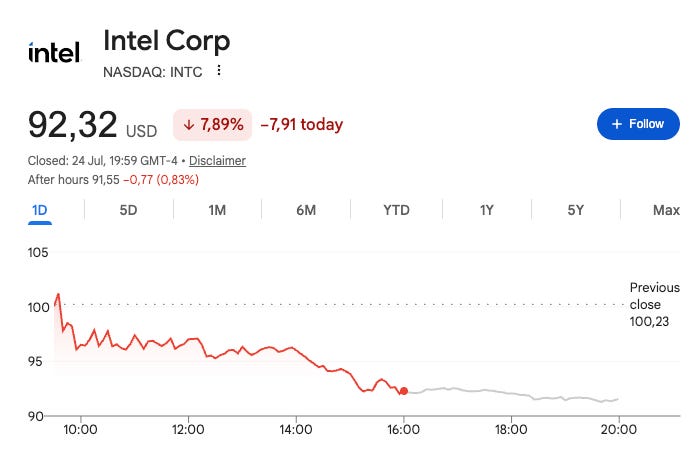
Something similar can be said about Intel or Google. After Intel reported earnings considerably above market expectations, the stock rose 15% in AH (after hours) only to drop 8% during the day when markets opened their regular hours:
Maybe a better way of looking at this dynamic is looking at the performance of the SMH and the SOXX, the two most-followed semiconductor indices. Despite most of the companies included in them having reported outstanding earnings, both are down between 15% and 20% from their most recent highs:
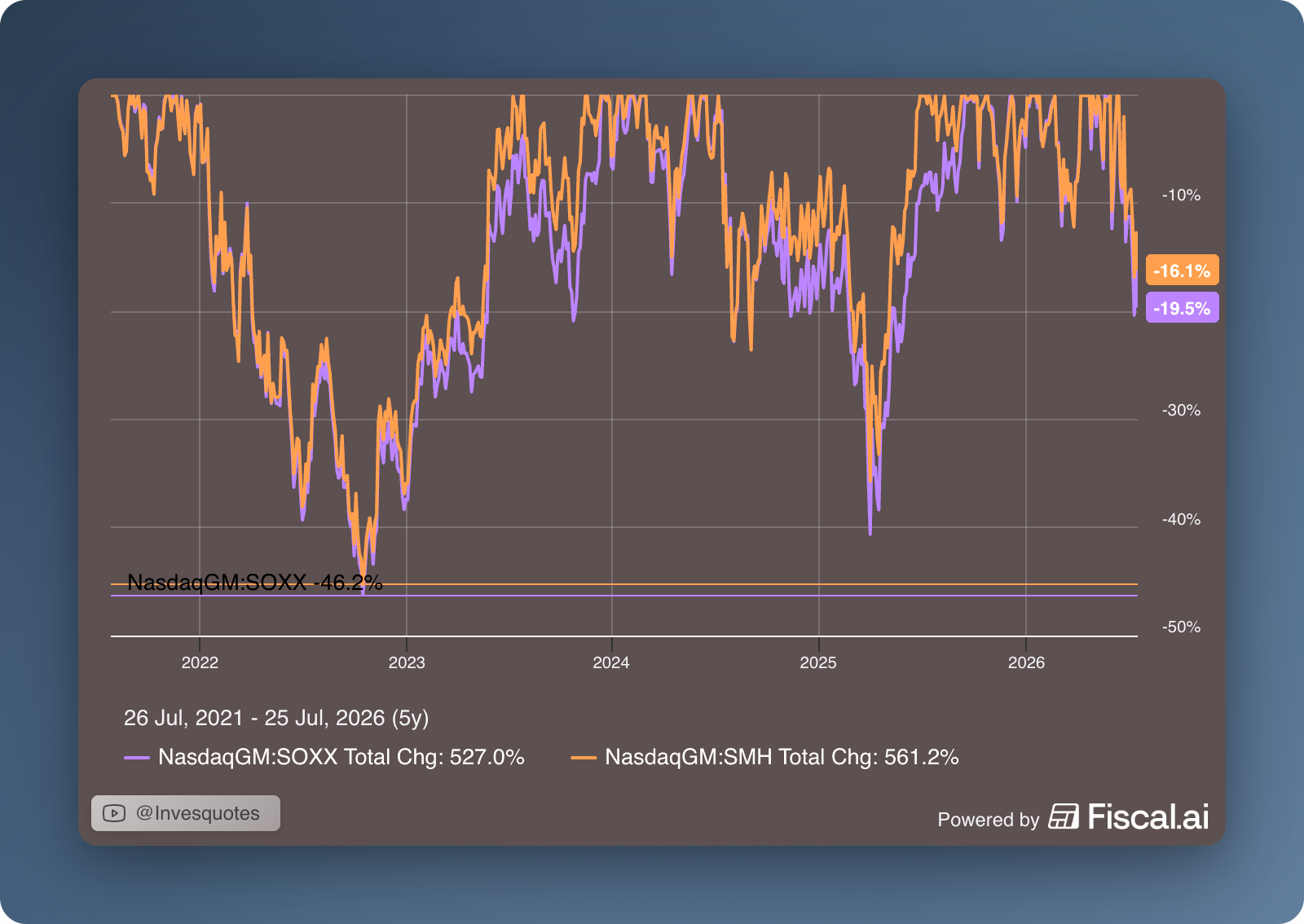
You might have gotten to this point thinking that I am about to explain why this has happened and what’s going to happen from here on out, and I am sorry to disappoint you; it’s not happening although I wish! Now, I can share my POV. I believe that the market (most times) takes quite a while to catch up to great fundamental performance (i.e., it can be slow), but not only does it eventually catch up but most times ends up running ahead (this is called recency bias). If we zoom out we can see that both the SOXX and the SMH are up 118% and 95%, respectively, over the last year. The fact that some people believe that “nothing has been priced” into the AI complex is a tad worrying and portrays that we might be getting close to a short to medium term top. Can I be wrong? Not only I can, but I probably will.
In NOTW#93 (May 30) I shared what I believed were 10 signs of exuberance (some of which continue to be present today). Here they are with a small update (in bold) when applicable:
Hyper-concentrated portfolios around one theme: every time one starts to see that investors are concentrating their portfolios around one theme (crazy that some actually think that holding 20 names in the same factor is being diversified), watch out. I’ve also seen a considerable amount of one-stock portfolios, which is also a sign that risk management is nowhere to be seen. This continues to be the case, and the recent “drawdown” has portrayed why it’s dangerous. With indices barely below ATHs some people were experiencing 30%+ drawdowns and were clearly getting too emotional.
Leveraged thematic ETFs everywhere: several leveraged ETFs have appeared around topics like AI, memory chips, optics…This is never usually a sign that valuations are low, but who knows! This has gotten to a point in which regulators have started to intervene. South Korea has started to enforce stricter margin requirements to be able to hold one-stock levered ETFs.
Sell side upgrading companies based on 13Fs: the actions of a very prominent AI investor (who some people claim is the Cathie Wood of the current generation, although I don’t necessarily agree with this) are clearly influencing sell side price targets, which not only is a sign that things are hot, but also doesn’t say anything good about the professionalism of some sell-side analysts. Not much to comment on here.
YTD screenshots daily (and investors being “humble”): this might actually be one of the most solid indicators. We are seeing a constant flow of people sharing their YTD returns which in some cases are astronomical (upwards of 1,000%). This would be, in and of itself, a strong sign, but the best people are those who are up 30% YTD and say that “it could be better.” Return expectations are out of the charts, and this is also visible in the following “topping” signal. This actually surprised me because with the recent drawdown the screenshots flipped to people trying to portray what a strong drawdown they were experiencing. But nevertheless we don’t see many screenshots today. With the bounces some people share that their portfolios are up 20%+ in a day, which I don’t think is the flex they believe it is (i.e., portrays terrible risk management).
Stocks that are up 20% YTD categorized as “not moving“. Return expectations are so high that AI-stocks that are up 20%+ YTD are categorized as “stale” or a source of opportunity cost. People are in for a rough surprise when stocks eventually stop returning 100% every month! This continues to be the case.
13Fs moving stocks double digits: when prominent AI investors reveal new AI positions in their 13Fs or other regulatory fillings, stocks are moving 10%+. This is not a sign of a healthy market. This is now not happening, and good news are not having the desired effect on stock performance (a signal of where expectations had gone)
People believe that under no circumstances can the AI trade falter: despite all these signs, some people believe that AI is unstoppable and that it can only go up. The reality is that, despite AI being very real, the AI trade can falter anytime and there are many ways that AI slows down that have little to do with the technology per se. Of course, this doesn’t mean it has to happen but it does show that many are not even considering the potential risks. Self explanatory because the AI trade is “faltering” despite strong fundamental performance
PTs based on “vibes”: Price targets are being updated based on questionable 2030 multiples. The only thing you need to enjoy such optimistic multiples from the sell-side is being categorized a “bottleneck.”
Luxury car dealerships in Korea are full: memory chips are doing so well that Korea is experiencing an incredible wealth effect. This in and of itself is not a sign of anything, but definitely not a sign of a bottom! I guess they are not full anymore considering that a lot of South Korean “investors” were levered and a good chunk of them have gotten margin calls.
All the AI/space companies considering an IPO: this is always a strong indicator that things have run ahead of themselves. Post the SpaceX IPO the shares of space companies dropped considerably, including that of SpaceX.
Both the SMH and SOXX are down since I published these signs of exuberance and regardless of what this means (probably nothing), I believe one can simultaneously believe two things:
That AI is real
That some stocks run considerably ahead of their fundamentals
If you join complacency together with leverage you get disastrous (and sometimes even comical?) scenarios. I read this week about a guy that went from a $10 million portfolio to -$500k and just began posting bible verses. Absolutely incredible, but we still see a lot of people who own 1-stock portfolios in the name of “conviction.” A 1-stock portfolio (imho) doesn’t portray conviction but rather terrible risk management (and don’t get me started about what these 1-stocks are!). With this I don’t want to portray that I am an AI permabear, I’m not and still hold AI-related stocks in the portfolio. The only thing I am trying to portray here is that in investing not only the fundamentals matter but also the implied expectations priced into the stocks. I believe this is pretty obvious to everyone but it’s sometimes forgotten when investors become complacent. Oh, and the same applies the other way around: those sectors that have seen their multiples destroyed now have “easy comps” in terms of expectations, so it might not take much for them to turn around.
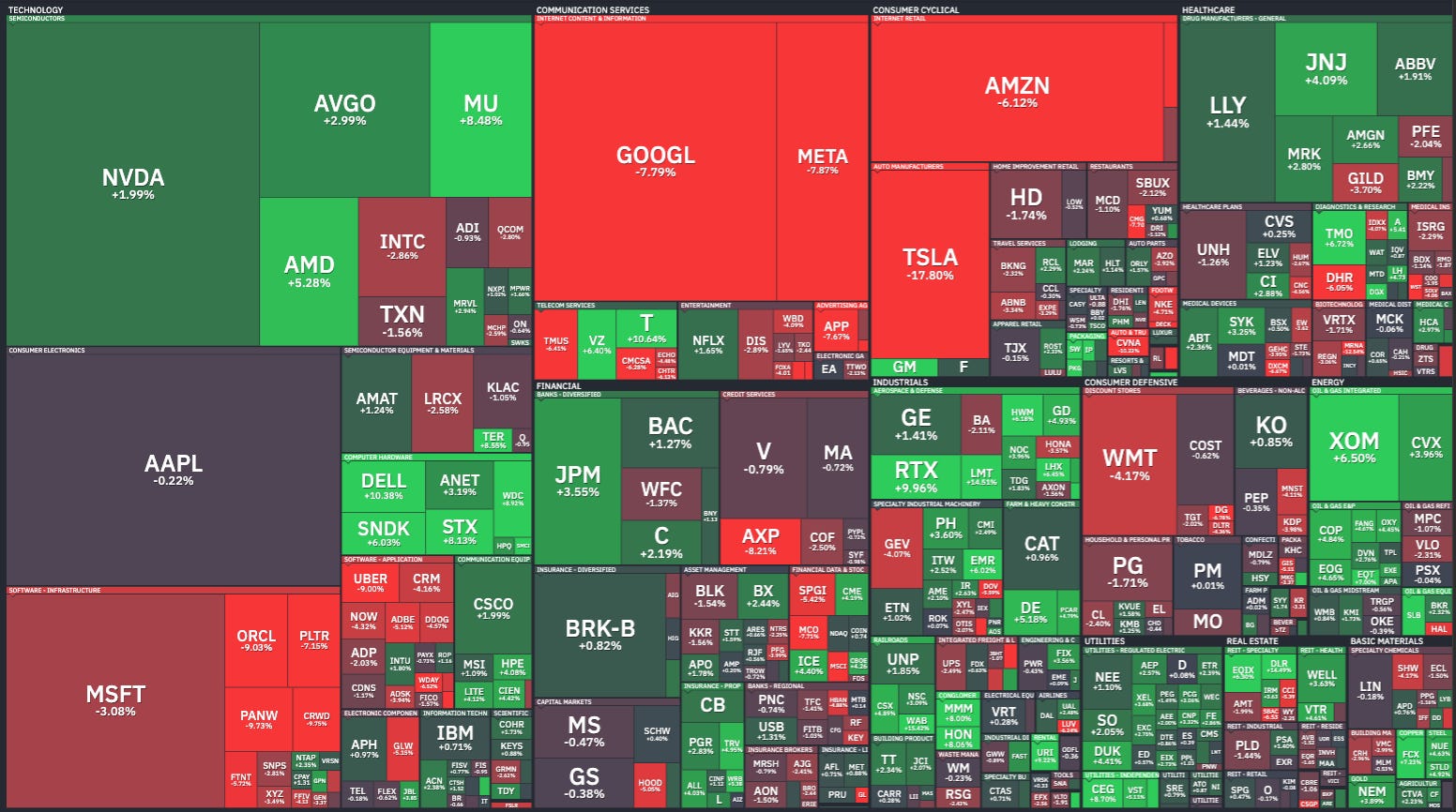
The industry map was mixed this week, with hyperscalers continuing to sell off on the expectations of higher future Capex. It’s interesting because the market seems to simultaneously believe that hyperscalers won’t earn a decent ROIC on their AI investments but that the supply chain of said investments is going to continue generating outsized returns (I can assure you that both are not happening):
The fear and greed index improved slightly but remained in fear territory: