


Texas Instruments reported (again) a spectacular quarter yesterday. Just to contextualize how good the quarter was, take a look at the company’s performance against sell-side expectations:
Revenue of $5.5 billion, up 23% YoY and beating expectations by 4%. Revenue growth accelerated as it was up 19% YoY last Q.
EPS of $2.14, up 52% YoY and beating expectations by 10%
Q3 revenue guide of $5.9 billion (midpoint), beating expectations by 6%
Sell-side analysts are aware that the cycle is inflecting but they have been quite “pessimistic” in their forecasts (at least thus far). With the exception of Q4 2025, analysts have been behind the curve since the upcycle began:
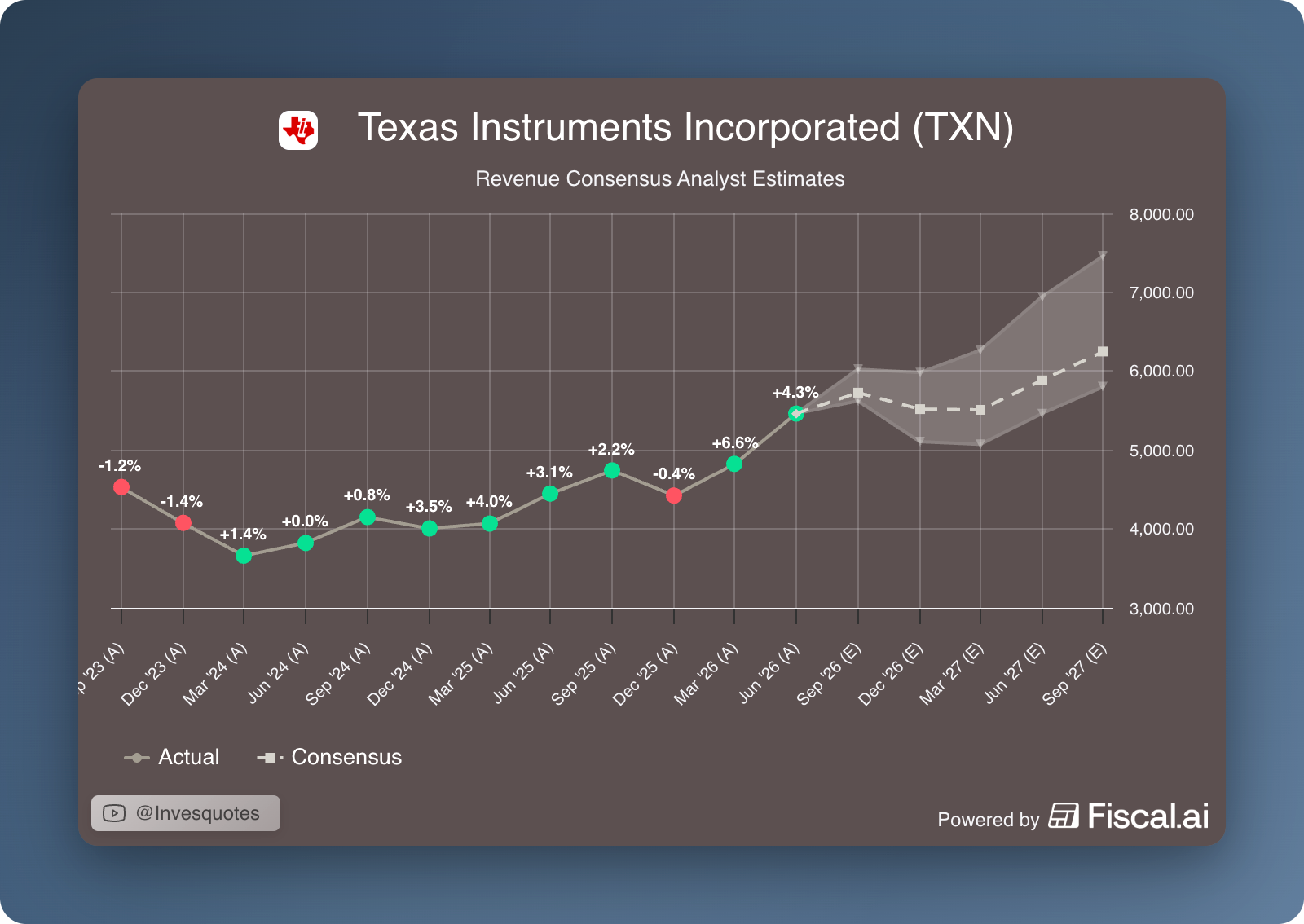
The Q3 revenue guide implies (at the midpoint) that revenue will accelerate again to 24% YoY. Probably the most “incredible” thing in the earnings was that management claimed that Q1, Q2, and the Q3 guide include little pricing tailwinds (if any). Pricing in H1 2026 was flat (better than usual, as it typically goes down over time), but management expects that it’ll start contributing positively in Q3, Q4, and going into next year (albeit not so much in the former):
If I think about the forecast for Q3, the vast majority of it is just unit growth and maybe a little contribution from pricing, but it’s almost insignificant.
This ultimately means that the uplift we are currently seeing is pretty much driven entirely by unit volume, which signals that the cycle is recovering but still doesn’t reflect that some pockets of the industry might start to become “bottlenecks.” Pricing is yet another lever that TI will have at its disposal to continue performing well over the next few quarters (evidently it’ll also be good for margins).
The stock “sold off” despite the great results (similar to ASML), portraying that expectations (whisper and buyside) across the semiconductor complex might be a tad high (to say the least). One can only wonder what would be happening here if TI had reported a miss. Well, we actually know what would have happened as one of the company’s peers, STM, dropped 15% after guiding below consensus citing slower recovery in automotive and industrial (this doesn’t seem consistent with TI’s commentary, though). You already know how this works, though: algos be algoing and TI dropped in sympathy with STM despite having reported just 10 hours earlier (make it make sense).
Regardless of this “expectations game”, I’ll go over the valuation at the end of the article, as we now have new information to more or less understand whether TI is fairly valued today.
First, let’s take a quick look at the quarter.
Texas Instruments’ quarter
I believe TI’s summary table clearly portrays that the quarter was excellent:
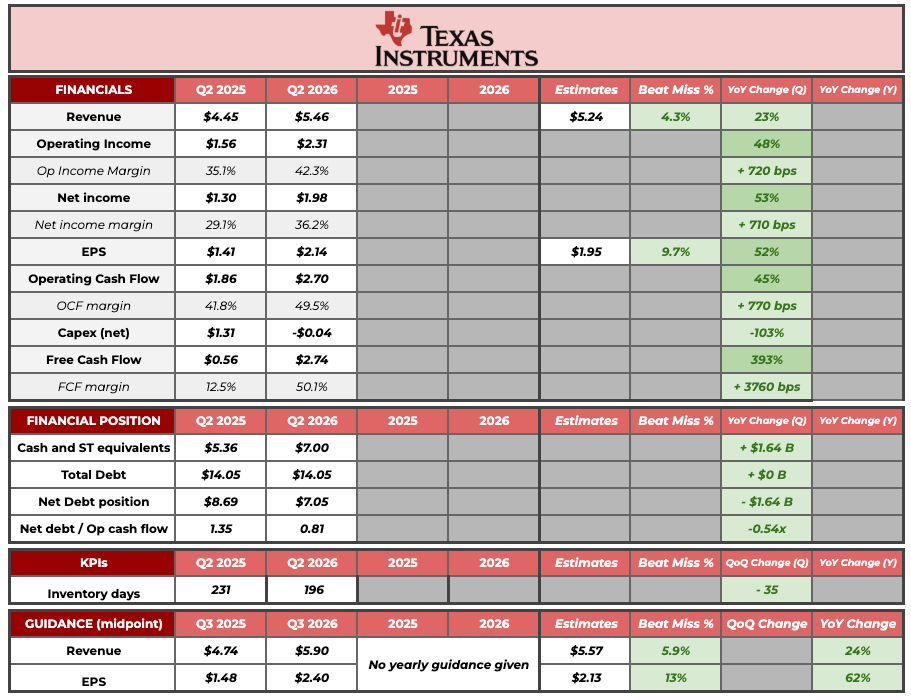
The margin uplift should not be a surprise (and remember that it comes without pricing tailwinds which should fall directly to the bottom line). I have explained several times (especially on the way down) how TI is a fixed cost business. The company suffers considerable operating deleverage during downturns, but this quickly flips into significant operating leverage as soon as demand comes back.
To this we must add that TI has been investing significant amounts into Capex to prepare for this demand. Gross capex is being scaled down and CHIPS Act subsidies are being received, so net capex is decreasing considerably and investors are enjoying the “holy grail” on the way up: faster revenue growth + expanding margins + improving cash conversion (due to lower Capex and working capital leverage). TI seemed very expensive on TTM numbers even when it was at $170, but the reality is that those TTM numbers in which the multiple was based on were far from being normalized.
As discussed in my last earnings update, the company is experiencing the convergence of two tailwinds: the cycle inflection in the legacy TI business (automotive and general industrial) and the data center tailwind. This not only has implications for the current quarter but also when thinking about what “peak” sales might look like a few quarters/years down the road. Management was asked the key question: “What point in the cycle are we in?” They replied the following:
We have a lot of opportunity in front of us. Even with a nice growth in Q2, I have to go back to 2022, and we are still lower than the peak, maybe five or six points lower than that 2022 peak.
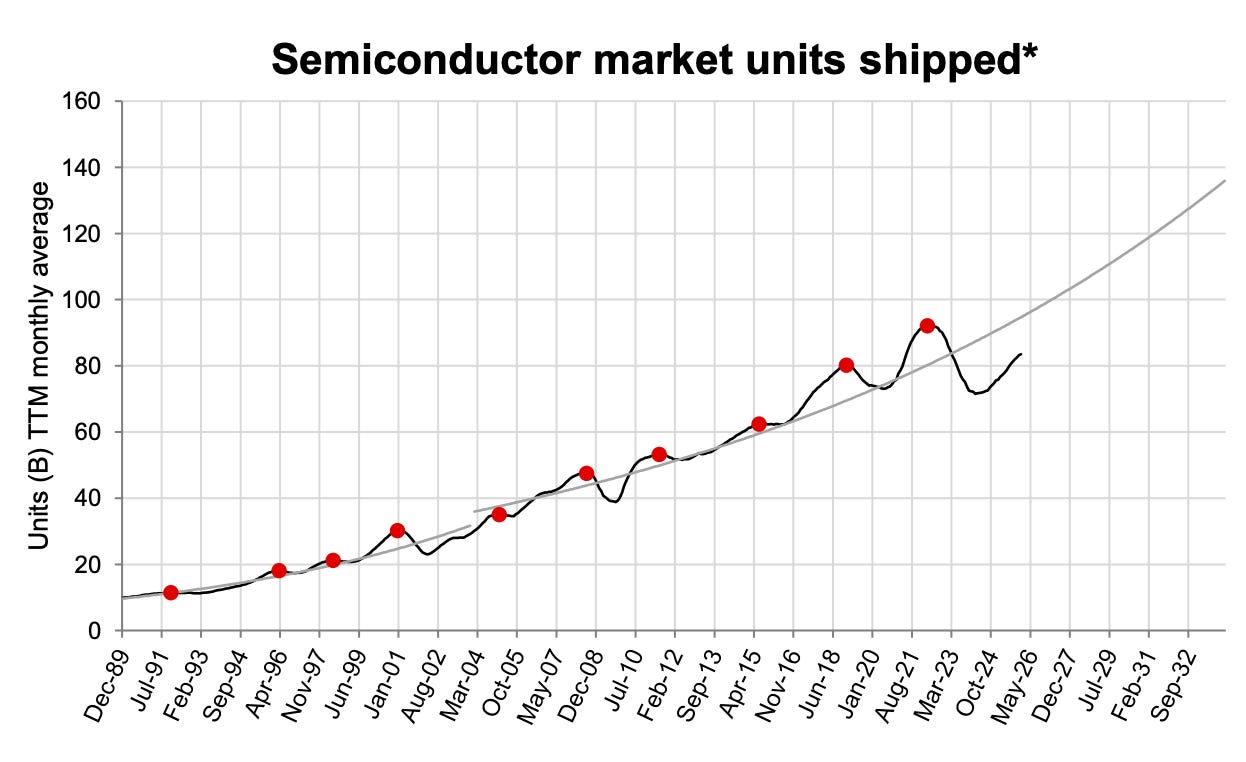
I.e., it’s still early, but more so when we contextualize the 2022 peak. The first thing to note is that the data center opportunity (with its first and second derivatives) was absent a couple of years ago. The second one is the higher content per application. TI’s industry grows secularly due to the higher semiconductor content across applications over time. In plain English, industrial systems and cars are more digitized today than they were in 2022, meaning that the next peak should be higher than the last peak. The following slide from TI’s Capital Management Update is pretty illustrative:
To this we have to add a booming data center segment. The data center segment was not even significant in the 2022 cycle, but it’s now at a $1 billion+ run rate and doubled year over year in Q2.
There is a third potential tailwind, although likely not unique to this upcycle: inventory build-up. After having suffered a considerable inventory glut in the past couple of years, customers might have taken inventory to levels that are too low and might now need to rebuild these on the way up.
Despite the obvious strength in data center, management claimed that strength was broadbased across all of the company’s segments:
First, industrial increased around 30% year-over-year and was up about 10% sequentially, growing broadly across sectors and regions. Automotive increased in the mid-teens year-on-year and increased in the upper single digits sequentially. The data center doubled year-on-year and grew around 20% sequentially. Personal electronics were flat year-on-year and grew in upper single digits sequentially. Lastly, communications equipment grew both year-on-year and sequentially
The strength in automotive surprised everyone, including management. They mentioned it was primarily driven by China (EVs and hybrids) and, even though I am not a fan of China driving results for TI (let’s not forget that Chinese authorities are investigating the company for dumping practices), I must say it sort of “invalidates” the bear thesis that prevailed a couple of years ago. Many claimed that, without access to ASML’s leading lithography equipment, Chinese fabs would focus on mature nodes and flood the market. 2-3 years have already gone by (with ASML selling quite a few DUV systems in China) and TI continues to do pretty well in China. Maybe there’s something more than just being able to manufacture the components! These same people, by the way, also claimed that TI management was “running investors off a cliff” when they had little visibility. Neither of these claims have aged well, at least not yet.
TI’s last couple of quarters have again demonstrated the importance of investment horizons. When Texas Instruments was spending Capex at an accelerated clip and building inventory aggressively during the downturn, the “word on the street” was that they were spending money like “drunken sailors.” Management always claimed that they were pursuing a similar strategy then they did during the pandemic: prepare the supply for the heightened demand that would eventually come (albeit not knowing when). This would allow them to gain share in the upcycle, and this is (surprise) what we are seeing today. With capacity tight across the industry, TI is very well positioned to gain a portion of its competitors’ business:
We are prepared with capacity and have clean room space available and are well positioned to support continued growth.
When some of the competition talks about lead times that are 52 weeks away, that’s an opportunity for TI, because that means that there is a little bit less visibility for customers, and sometimes they will start a new design, even on a very complex part.
Texas Instruments also has considerably more capacity already built and awaiting equipment depending on how the demand plays out (i.e., there’s still space to leverage the existing cleanroom).
Even though investors were again predated by short-termism, TI was able to look further out, eventually rewarding patient shareholders. As in many cases in financial markets, the edge here was the ability to be patient and holding something that nobody wanted to own until the inflection eventually took place. It’s not rocket science, but it’s hard to do.
So, all in all, yet another outstanding quarter for TI which is not showing signs of slowing down. With visibility into 3 quarters, we can now more precisely contextualize the current valuation.