


Best Anchor Stocks has a partnership with Fiscal.ai (the research platform I personally use), through which you can enjoy a 15% discount on any plan. Use this link to claim yours! You’ll find KPIs, Copilot (a ChatGPT focused on finance) and the best UX:

You can read this article (almost) entirely for free. If you like what you read, consider becoming a paid member to get access to…
All in-depth reports (16 companies profiled thus far, and growing)
Earnings follow-ups
Other investment related content
A community of like-minded investors
Complete access to my portfolio and transactions
Occasional webinars
You’ll also get access to the 30+ page detailed report on the robotics industry.
The in-depth reports of Stevanato and Deere are also free to read to gauge the quality of the research. Other in-depth reports have been written about…
Deere (DE)
FRP Holdings (FRPH)
Five Below (FIVE)
Diageo (DEO)
Hermès (HESAY)
Atlas Copco (ATCO.B)
Stevanato (STVN)
Keysight (KEYS)
Zoetis (ZTS)
Judges Scientific (JDG.L)
Medpace (MEDP)
Trupanion (TRUP)
AAON (AAON)
BBB Foods (TBBB)
Eurofins (EPA.ERF)
Sabre (SABR)
Rosebank Industries (ROSE.L)
Undisclosed position
Join today:
Both indices were slightly down this week with significant volatility. We had two interesting earnings reports as well as an interesting appearance by Druckenmiller who shared some thoughts around the AI trade. There were also several interesting company-specific news.
Without further ado, let’s get on with it.
Back in the Chit Chat Stocks podcast!
This week I was lucky enough to be able to attend the Chit Chat Stocks podcast with Ryan and Brett. We had a great time and discussed BBB Foods (TBBB) (in depth report available here) and my robotics report.
You can listen to it on Spotify:
Or YouTube:
What you can expect over the next few weeks
There were no articles this week as I continued advancing several companies through the pipeline. In the following week you can expect…
An in-depth article on a very interesting (and unknown) Japanese company growing at a 40% CAGR while trading at an 11x EV/EBIT multiple
An in-depth article on one of the most controversial companies one can currently find in financial markets. Yep, it’s Oracle (ORCL).
An in-depth article on an aerospace company that I believe is not yet well understood
So, plenty of things are coming to Best Anchor Stocks over the next few weeks.
Without further ado, let’s see what the markets did this week.
Market Overview
Both indices were down slightly this week, not without their fair share of volatility:
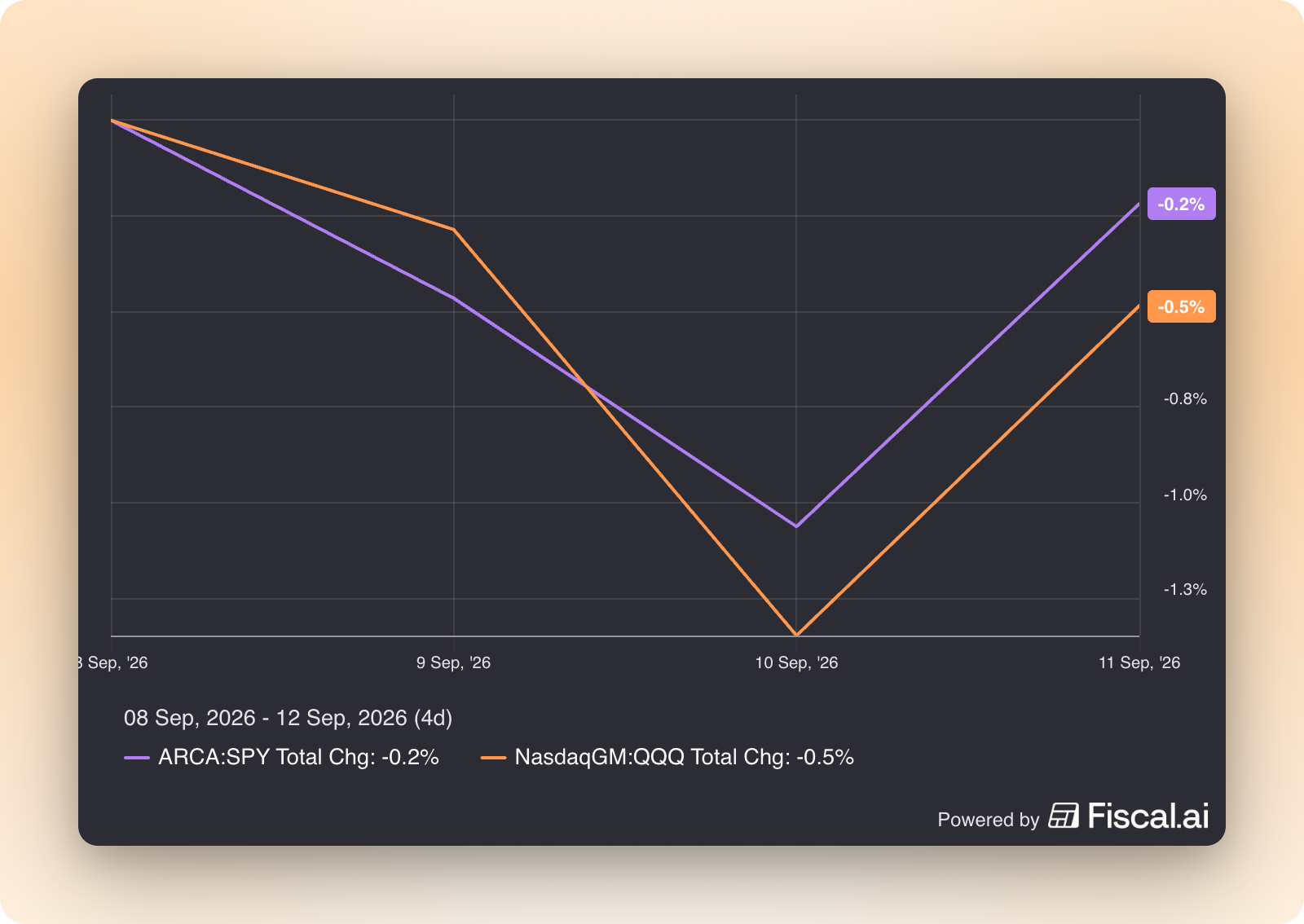
In yet another example of how unpredictable markets can be, both indices were significantly up on Friday despite inflation coming in hotter than expected. A lot of people thought indices would be considerably down because hotter-than-expected inflation gave the Fed more reasons to raise rates, but the markets did the exact opposite (I kid you not!).
We had a couple of interesting earnings this week. Adobe and Oracle both reported on Thursday, and once again, the first algo-driven move proved to be the “wrong” one. Adobe was initially down on earnings and Oracle was up, but the movements flipped throughout the day and Adobe ended up with Oracle down. I have been eyeing Oracle lately, and the main problem I see with the Oracle investment thesis is that I don’t think that bear concerns can be alleviated for a while:

Oracle claims that the unit economics on the Capex that is currently coming online are great, and while this is evidently true, the reality is that we are not currently in a normalized supply-demand environment. One is likely to see incredible economics when demand far exceeds supply, but this doesn’t mean that they are sustainable economics. The key here is to understand whether the different players (Oracle, the hyperscalers, or the neoclouds) have any competitive advantage to be able to charge a premium price for each GW of capacity once the supply normalizes. Some people argue that the normalization will take a long time to come (fair), but it nonetheless becomes a question of “when” not “if.” We’ll see.
Frankly, I believe the same is true for Adobe in terms of the market’s visibility into the bear cases. Despite many Adobe bulls claiming that the quarter was spectacular, RPO and ARR growth continue to decelerate. Management claims this is a self-inflicted wound as they push the freemium model through, but evidently a long-term concern has become whether they’ll be able to convert these users to long term Adobe paid customers. So, something that can’t be denied is that Adobe is growing faster today than it was a couple of quarters ago while enjoying a compressed reported valuation (both things are facts), but one can’t also not ignore that the leading indicators are not painting a rosy picture. Is this worrying? Well that’s where one needs to do more work, and frankly I don’t believe that a lot of people are focusing here.
In other (albeit related) news, Stanley Druckenmiller participated in a private conference this week. As one of the greatest investors of all time, I believe that paying attention to whatever he has to say is a must. Druckenmiller shared some thoughts around the AI trade and claimed that “there’s a good chance we’re in an earnings bubble because this AI build-out is going to end at some point, and let’s face it, banks are also on the AI trade. I mean, these guys are making hundreds of millions of dollars when they bring these companies public.”
I echo his thoughts in the sense that I believe there’s both a bull and a bear case to be made about the AI trade (there always is). The bull case is two-fold:
The technology is a revolution. I believe few people can claim the opposite at this point.
It remains far from being penetrated.
As for #2, I can only share my anecdotal evidence. It seems pretty obvious that X is a bubble in which people use AI much more than people do in the “real” world. I have coded agents to help me do things faster and improve my productivity, but in my close circle of people there’s not one single one of them who has ever coded (or uses) an agent. According to Jensen Huang (and this is something I went over in my robotics report), agentic AI requires around 10x the computing power of generative AI, with the robotics opportunity being yet another 10x of top on that. We seem to be extremely early in agentic, which means that the runway seems pretty long.
Now, the bear case to be made is that plenty of people believe there’s no limit to AI. I would be very careful thinking this because everything has a limit and we might encounter bottlenecks along the way that pretty much nobody expected. So I must say I’m torn between both, I do believe AI still has plenty of legs, but I also don’t think that a lot of the companies believed to be AI winners will be winners in the end and that there’s obviously a limit to the technology, probably driven by adoption/bottlenecks (pick your fighter). I mean it’s fine to make larger, larger, and better models, but maybe there will be a time when each incremental intelligence unit can’t be monetized economically because what we have is good enough for most tasks (just thinking out loud here).
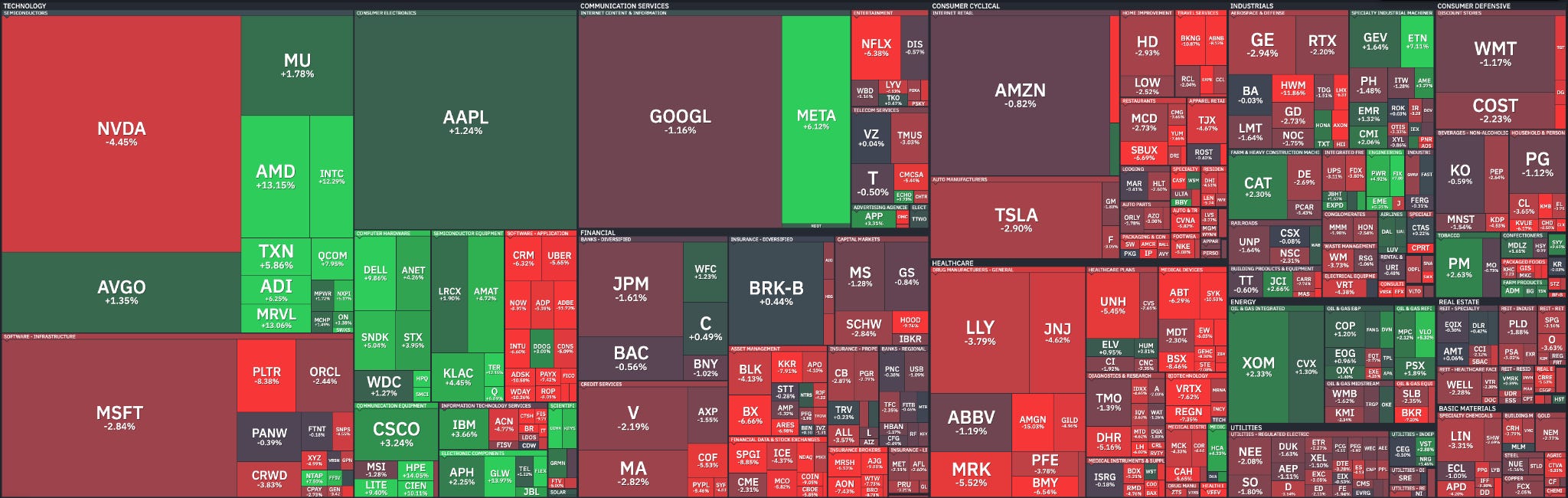
The industry map was mixed this week, showing some very green pockets in semis, hardware, and communications equipment:
Source: Finviz
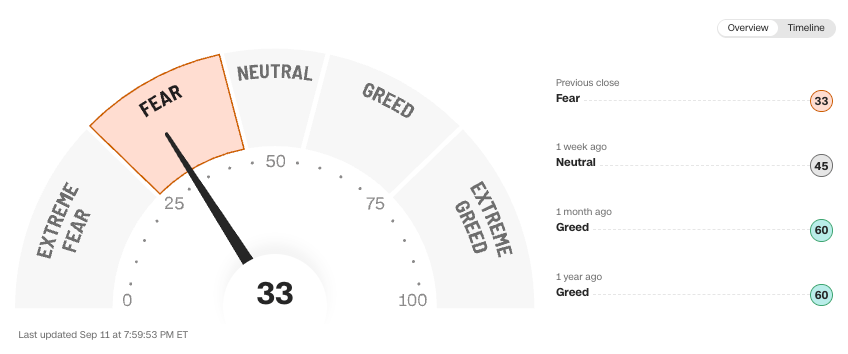
The fear and greed index retraced further into fear territory:
Source: CNN