Best Anchor Stocks has a partnership with Fiscal.ai (the research platform I personally use), through which you can enjoy a 15% discount on any plan. Use this link to claim yours! You’ll find KPIs, Copilot (a ChatGPT focused on finance) and the best UX:

You can read this article (almost) entirely for free. If you like what you read, consider becoming a paid member to get access to…
All in-depth reports (16 companies profiled thus far, and growing)
Earnings follow-ups
Other investment related content
A community of like-minded investors
Complete access to my portfolio and transactions
Occasional webinars
You’ll also get access to the 30+ page detailed report on the robotics industry.
The in-depth reports of Stevanato and Deere are also free to read to gauge the quality of the research. Other in-depth reports have been written about…
Deere (DE)
FRP Holdings (FRPH)
Five Below (FIVE)
Diageo (DEO)
Hermès (HESAY)
Atlas Copco (ATCO.B)
Stevanato (STVN)
Keysight (KEYS)
Zoetis (ZTS)
Judges Scientific (JDG.L)
Medpace (MEDP)
Trupanion (TRUP)
AAON (AAON)
BBB Foods (TBBB)
Eurofins (EPA.ERF)
Sabre (SABR)
Rosebank Industries (ROSE.L)
Undisclosed position
Undisclosed position
Join today:
Markets were mixed this week, with macro concerns now starting to loom in the background. Will this finally be the time when markets will really crash due to macro? Well, one never knows, but one always knows that markets will eventually crash (it’s rarely up and to the right with no bumps).
Without further ado, let’s get on with it.
A webinar next week
This upcoming week I’ll host a webinar to discuss the rationale behind some portfolio changes that I will make early in the week. There will also be time for Q&A so if you are a paid subscriber feel free to leave your questions in the comments or send me a DM.
The webinar will be held exclusively for paid subscribers and will take place on Wednesday at 1:00 PM EST. If you can’t make it, don’t worry as it’ll be recorded and you’ll be able to watch it offline. I’ll share more details early during the week.
Articles of the week
I published one article this week: “Is Hermes there yet?”
Is Hermes “there” yet?

In March this year, I published an article titled “the stock is down 40%, the business isn’t.” In that article I discussed whether I believed Hermes was already cheap after having suffered quite a si…
The stock (not the company) continues to tumble, so I wanted to shed some light on how one should interpret the current reported numbers and the multiple. I discuss what’s going on in the industry, discuss my valuation scenarios, and share why I added to my position.
I was surprised (because I was not expecting it) to see that the article has been one of the most liked and viewed in a while.
Early next week I plan on publishing an update on Judges Scientific (JDG.L).
Without further ado, let’s see what the markets did this week.
Market Overview
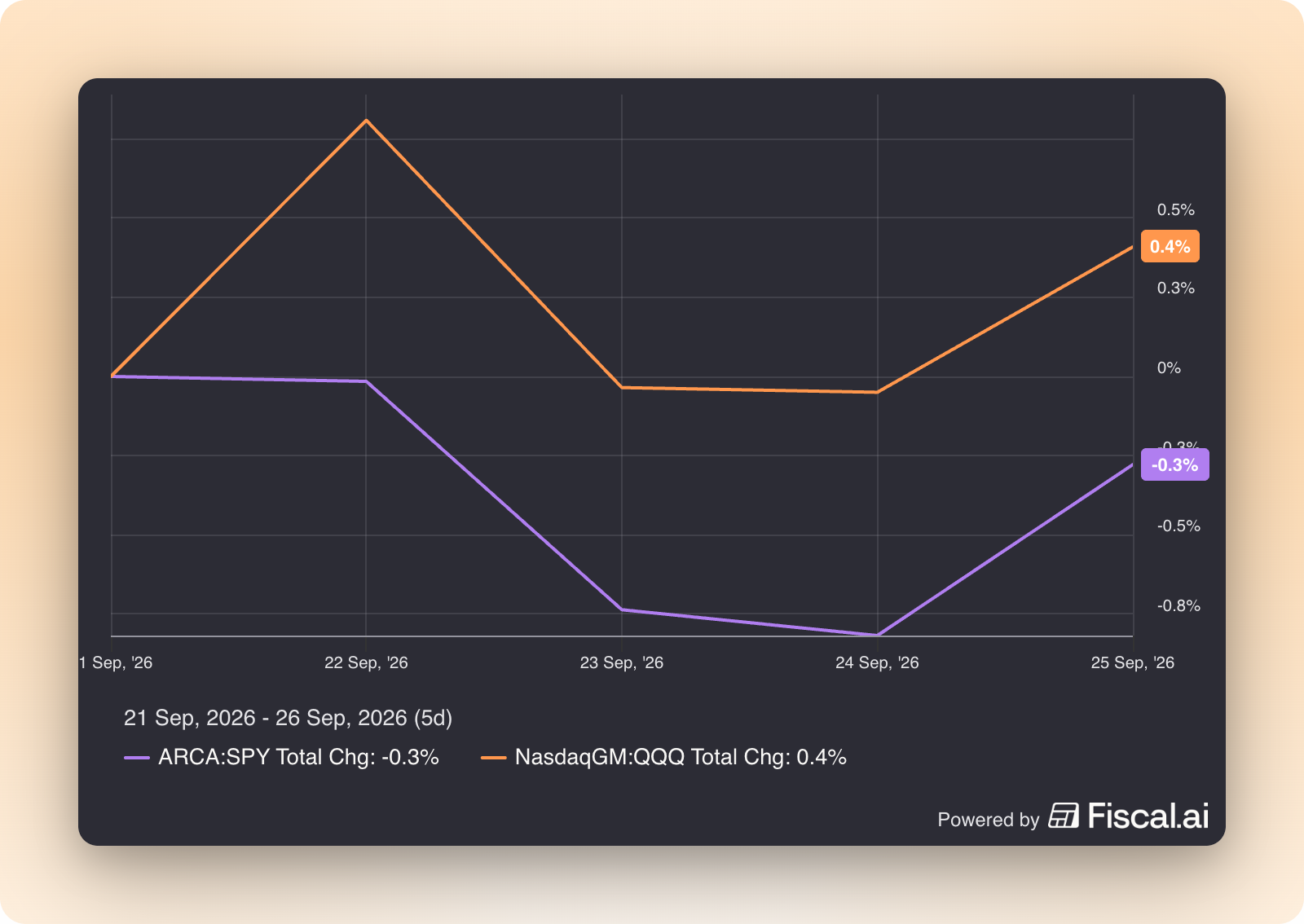
It was a turbulent week in financial markets. The indices continued to shrug off what seems to be like pretty relevant macro news and ended the week relatively flat. Again, with their fair share of volatility as one should always expect:
Where should I start? All the events are pretty much connected.
The markets began demonstrating a truth that investors seem to forget time and time again: the variables that matter the most are typically the ones that are hardest to forecast. Things such as interest rates, wars, tech disruption, and politics are evidently important for the well-being of the economy and the stock market, but knowing that they matter is very different than knowing (or claiming to know) how they will play out. This is the perfect combo for volatility: relevance + unforecastability.
Let’s begin with the not so great news: treasury yields surged again, breaking considerably above 5% and even reaching 5.20% on Friday, their highest level since 2007. There’s a combination of factors that’s likely playing a role in this; for example the expectations of higher inflation and the hawkish stance by the Fed. Higher rates are relevant because they increase the hurdle rate for every financial asset across the economy (i.e., equity valuation multiples should compress according to theory). Of course, if the reason for the rising rates comes from a stronger economy, equities might be able to counter the “lower” valuation multiple with faster earnings growth, but the market seems worried about the potential environment that higher rates might create.
Higher treasury yields also result in a higher cost of capital. This seems particularly relevant in a moment when a good chunk of the AI buildout is being financed with debt. We shouldn’t forget that this buildout is likely responsible for a good chunk of economic growth and index resilience. I was this wild stat this week on X:

The market might be worried about the fact that rates are rising while several companies are reporting that the consumer is starting to show some cracks. If you were alive and investing in 2022 this word might sound familiar to you: stagflation. The reality is that I’ve heard that we are going into an economic/stock market crash many times over the past few years and it always sounded very convincing. Will it be the case this time around? No idea honestly.
Part of the inflation that’s supposedly coming is caused by the war in Iran and high oil prices. The conflict has escalated over the past few weeks and oil temporarily rose above $100 (it has since corrected). There was good news on this front, though: seems like the US and Iran are ready (again) to begin diplomatic talks. We don’t know where these will take us but it’s a good sign nonetheless.
The final relevant event this week was Trump’s meeting with Xi (China’s leader) in Washington. I don’t think there was much great news besides a two month extension to the tariff truce, but it did seem as if it lowered the tension between the two most significant countries in the world (which is always good). I have talked with many people who have told me that they believe that geopolitical tensions have never been as high as they are today. While this may be true (pretty much impossible to quantitatively put a number on it), I think it’s also caused by a tad of recency bias.
Everything that we are currently living seems to be very worrying, but this is typically the case because we have forgotten how we felt in previous crises. Let’s not forget that we had almost double digit inflation and China doing military exercises around Taiwan not long ago. I would say that pretty much nobody thinks about those today, why? Because we typically remember that we lived through a crisis but don’t remember with what intensity we did so!
Now, leaving macro aside, I also wanted to share some thoughts on Muse (don’t expect to read what will happen over the next decade). You probably know that Meta has recently launched a new personal agent called Muse. The rollout of the product (primarily thanks to Meta’s distribution) was a huge success with some sources pointing to almost 3 million downloads in its first 12 days, even outpacing the rollout of ChatGPT in 2022 (which is something). This gave the market yet another thing to worry about:
How will Muse disrupt incumbent business models?
I must say that I was surprised (and not surprised at the same time) to see so many people jump to conclusions on day 1.
Many argued that this is automatically terrible for marketplaces/aggregators, Google Search, and Amazon (due to their ads business). While I can obviously understand the rationale behind these concerns, I think that we should just allow some time for things to play out before being categoric. There are great use cases for Muse (many of which have been widely discussed on social media), but there also seem people trying to assign use cases to Muse that likely don’t make any sense. If one reduces everything to “customers will want the lowest price and will not care about anything else,” the discourse seems pretty straightforward, but it’s unlikely that things will pan out the way we think today.
In similar “forecasting” scenarios, I always come back to Mark Leonard’s quote on a recent Constellation call discussing the impact AI might have on software:
For those of you who don’t know, Jeff is known as the godfather of AI and is a Nobel Prize winner for his work in the field. Long-term forecasting is very difficult. I talked about this before, and I’m happy to send you some source information if you’d like to delve into that further. Jeff’s forecast in 2016 was that radiologists were going to be rapidly replaced by AI. Specifically, he said people should stop training radiologists now. In the intervening nine years since he made that forecast, the number of radiologists has increased from 26,000 in the U.S.—these are U.S. board-certified radiologists—to 30,500, or a 17% increase. That’s outpaced the population growth in that period. The number of radiologists per capita is up from 7.9- 8.5. Jeff wasn’t wrong about the applicability of AI to radiology. Where he was wrong was that the technology would replace people.
Instead, it’s augmented people. The quality of care delivered by radiologists has improved, and the number of practicing radiologists has increased. I told you the story to make two points. Firstly, you and I will never know a tiny fraction as much about AI as Jeff did. Secondly, despite his deep knowledge of AI, he was unable to predict how it would change the structure of the radiology profession. I think we’re at a similar point today with the programming profession.
Admittedly, Muse is an entirely different beast to software in the AI era, but this quote is pretty relevant when trying to make such long term forecasts categorically. Of course, everyone in financial markets is likely going to talk their book. Many Meta longs will tell you that Muse is going to disrupt everything and become one of the best products ever. On the other hand, non-Meta longs will tell you that the product is stupid and that it sucks. The reality will likely fall in between those two and I can see arguments in favor of both.
I mean, the product does seem game changing because it’s likely the first time that the general population feels agentic AI. Now, at the same time, it seems like some people are assigning it use cases where it adds little to no value while giving an unproven product access to all of their data. Muse will likely not be the only agent out there in the coming months/years, and nobody knows how people will react once others start to come out, so it’s also likely too soon to claim that it’ll be incredibly profitable for Meta (as it’s still given out for free and at a cost to Meta). So, the conclusion from all of this is that products such as Muse do change the playing field, but I prefer to take the conservative route and update the probabilities as the evidence arises rather than shooting on day one (the market typically opts for the latter and this is potentially a source of opportunity).
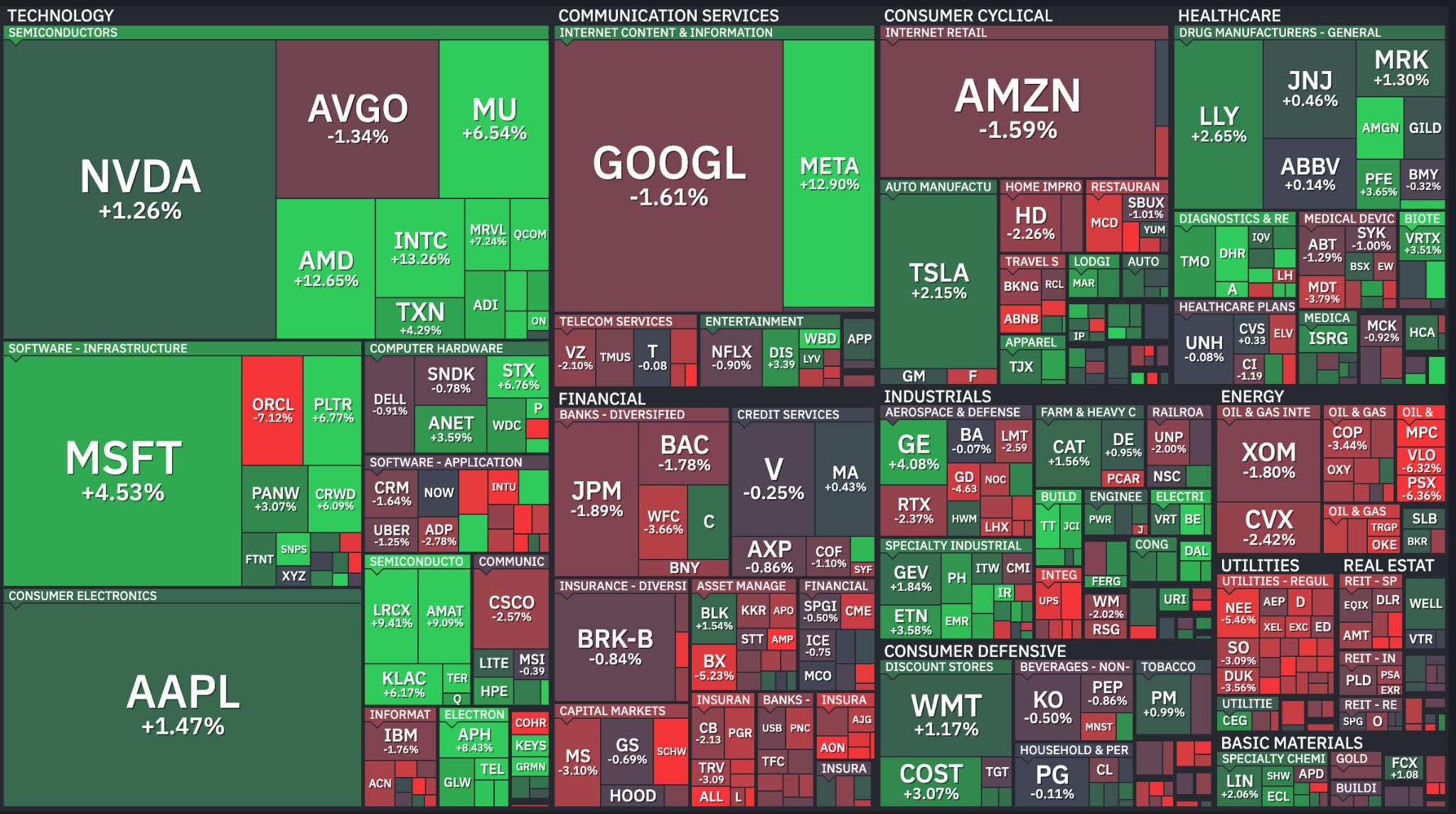
The industry map was mixed this week, with semiconductors doing particularly well due to the arrival of the agentic era:
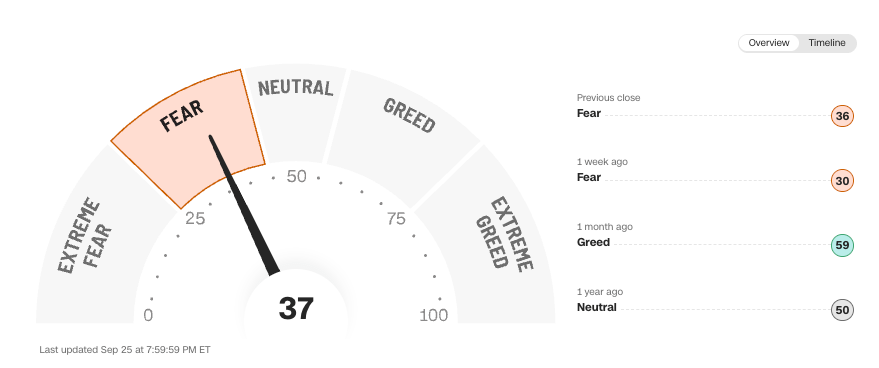
The fear and greed index improved slightly but remained in fear territory: