


Shift4 reported pretty decent Q2 earnings yesterday but management lowered the guide by 100 bps (on an FX neutral basis) due to ongoing headwings from the Middle East conflict…and the market had no mercy. Shift4’s stock dropped 19%:
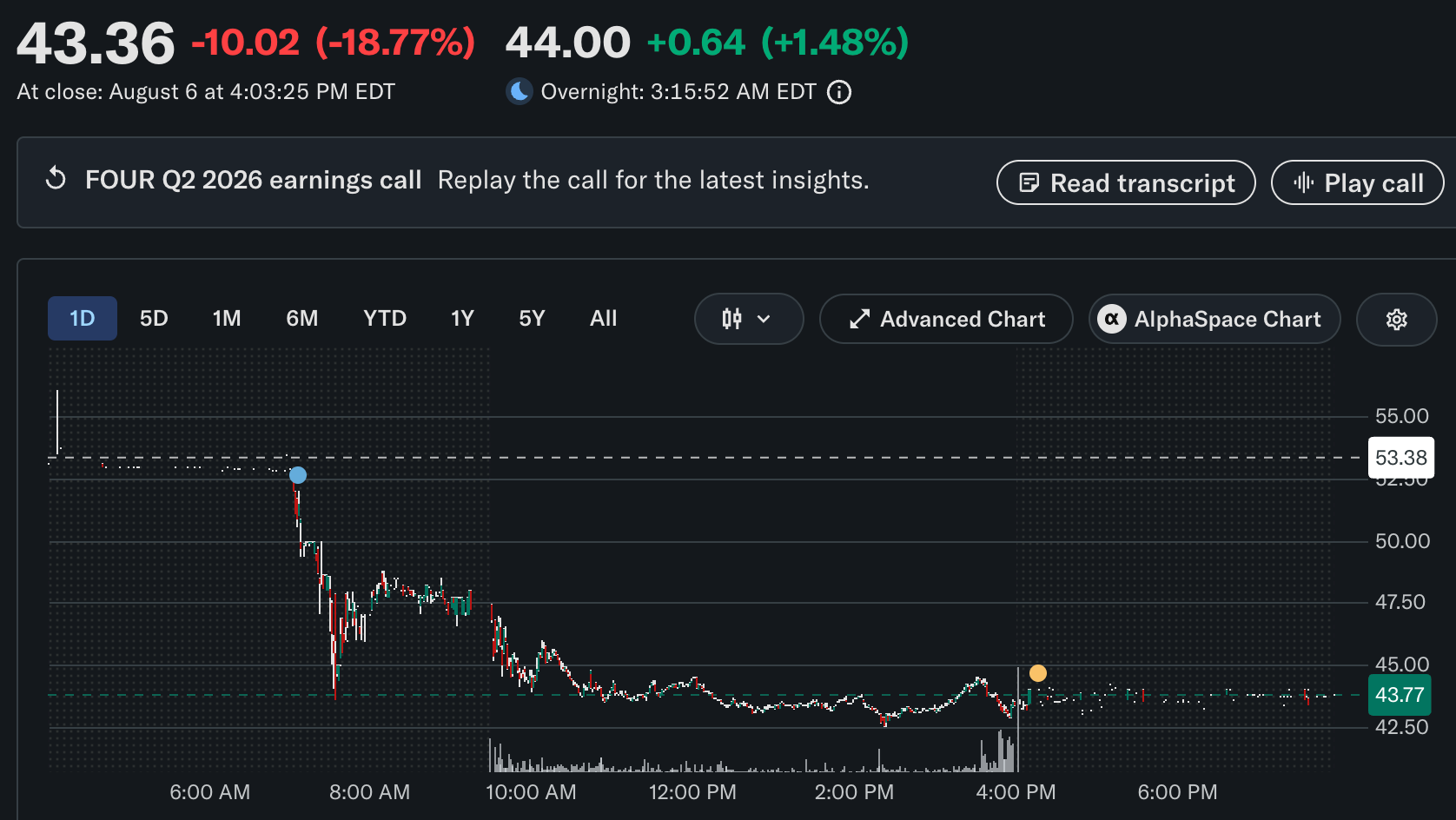
What makes this merciless reaction interesting is that it seems to be isolated to Shift4. The company suffered by far the worst stock reaction despite payment companies lowering the guide across the board (some even due to some similar headwinds that Shift4 is experiencing!). Their reactions were very different in what many consider to be a “bombed out” sector (Shift4 said “hold my beer!”)

Earnings were definitely not perfect but had certain things that were very encouraging and that portray that the thesis is intact (or even trending better than expected). Let’s start with an overview of the quarter. The headline numbers were pretty good: strong beats across the board:
Revenue of $1.3 billion beat estimates ($1.24 billion) by 5%
Adjusted EPS of $1.32 beat estimates ($1.25) by 6%
Adjusted EBITDA of $284 million beat estimates ($275 million) by 3.3%
GRNLF of $624 million beat estimates ($614.34 million) by 16%
One would’ve (incorrectly) thought that these metrics would’ve been enough for a stock like Shift4 to do well, but the market thought otherwise. Granted this is only part of the story. Here’s the summary of Shift4’s quarter:
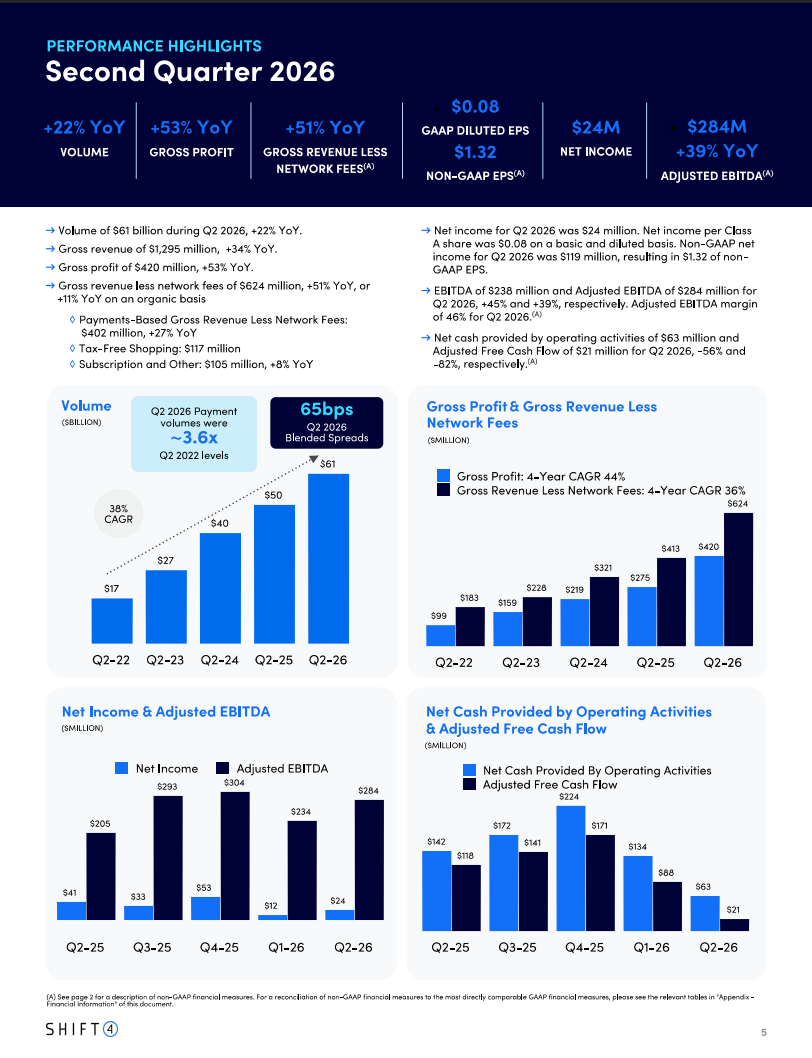
I believe several things are worth discussing about the numbers above. The first one (which likely played a role in the selloff) is cash flows. Even though all numbers appear to be trending in the right direction, cash flows seem to be doing the exact opposite (i.e., trending down significantly). Shift4 reported operating cash flow and free cash flow of $63 million and $21 million, respectively, in Q2. Both of these metrics were down a whopping 55% and 82% respectively (yikes?). Context is required. The cash flow seasonality of Global Blue (reported as TFS by Shift4) differs markedly from that of the rest of the business. Global Blue consumes significant capital in H1 and then “unleashes” significant cash in H2.
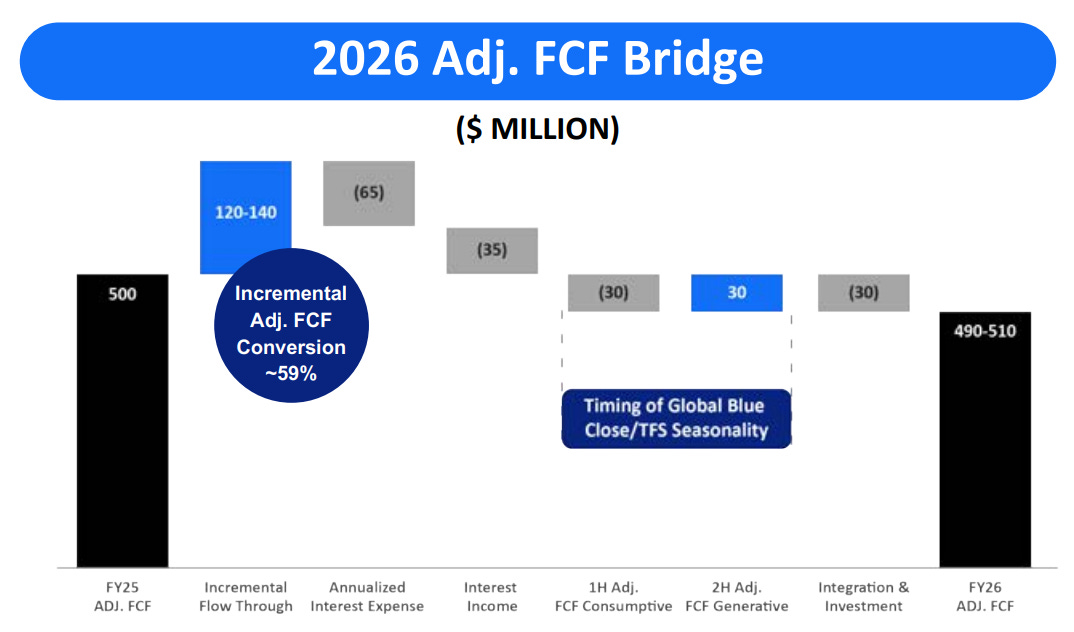
This effect is evident in the company’s full year guide. Despite having generated $109 million in Adjusted Free Cash Flow in H1, management is guiding for a midpoint of $470 million of Adjusted Free Cash Flow in FY 2026. This means that Shift4 will generate $361 million of Adjusted FCF in H2, or what’s the same, 77% of the year’s total FCF generation will take place in H2. This contrasts very sharply with the pre-Global Blue era when Adjusted Free Cash Flow generation was much more balanced across the year. For example, in 2024, Shift4 generated $399 million in Adjusted Free Cash Flow, with 40% being generated in H1 and the remaining in H2.
Now, there’s something to be said about cash conversion (and not good). Shift4 generated $399 million in Adjusted Free Cash Flow in 2024 on $677.4 million of Adjusted EBITDA for a 59% conversion. Management expects to generate $470 million in Adjusted FCF this year on $1.17 billion of Adjusted EBITDA for a conversion of 42%. So yes, the business is growing fine but the lower conversion is not helping translating this growth into Adjusted FCF. Part of it is definitely the higher leverage caused by the Global Blue deal, so we should see (over time) Adjusted Free Cash Flow conversion increase. Management mentioned that once the Term Loan refinancing and the impact from the Middle East are said and done, FCF conversion should improve considerably in 2027 (we’ll see).
Now, before claiming that the market is “retarded,” we should try thinking about what the market might be seeing here. The market is likely seeing significantly lower cash flows while net leverage remains close to ATHs:
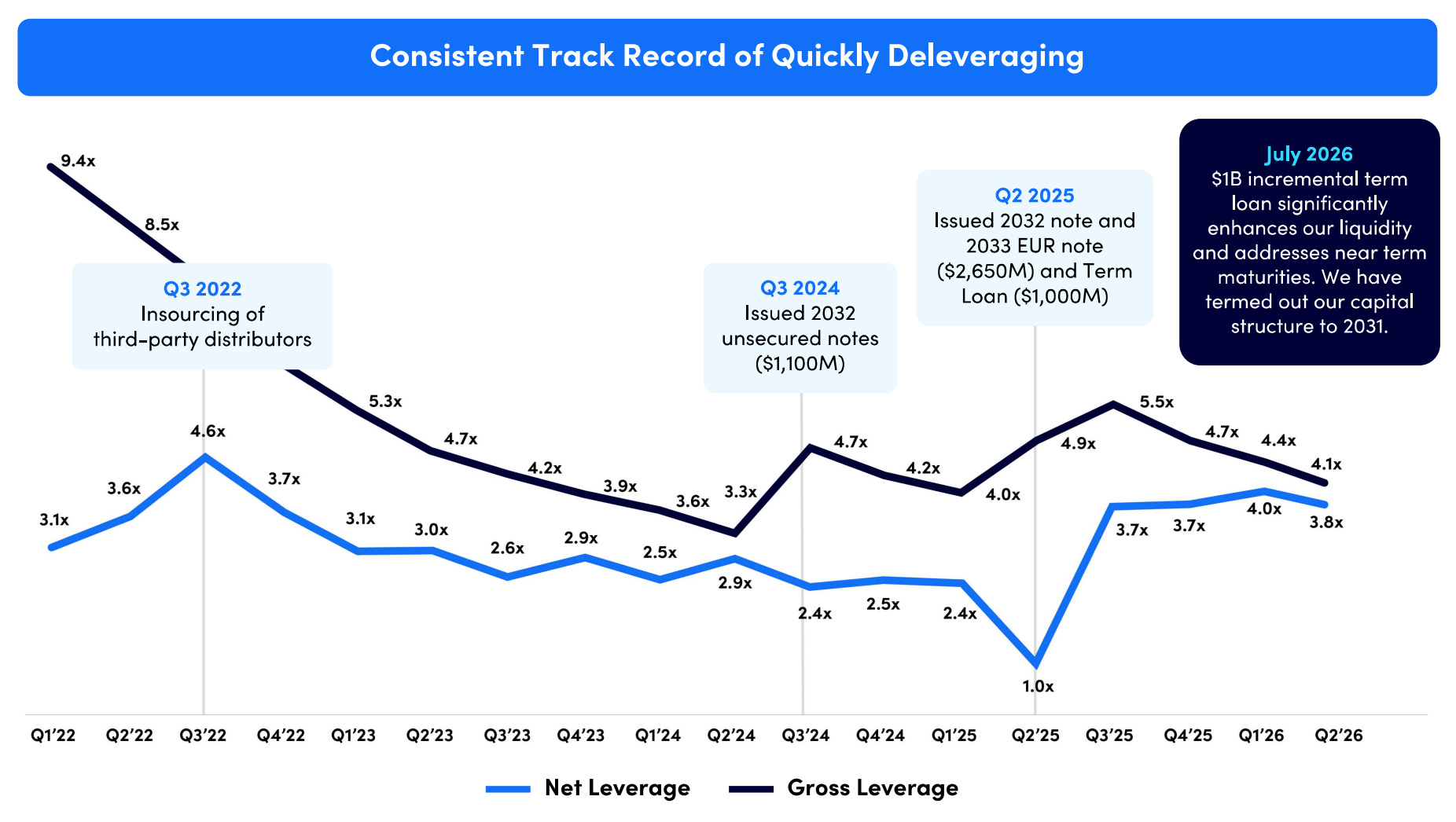
There’s no denying that Adjusted Free Cash Flow will improve in H2, but the market likely thinks that Shift4 has a balance sheet problem and we know that it tends to be merciless with these (many times, rightly so). Even though I am not worried about this year’s cash generation, there’s no denying that Global Blue’s seasonality is impacting capital allocation decisions at Shift4, portraying that the margin of safety is not high.
For example, the “poor” FCF conversion in H1 had implications for the buyback, which disappointed many. Shift4 only repurchased around 650,000 shares, but at $38 which is close to the quarter lows. This is evidently not great, but management alluded to low cash conversion and the company being close to their 3.75x net leverage target as limitants to increased buybacks:
We were intentionally conservative this quarter given current leverage levels and the cash-consumptive quarter we were in.
They plan to increase these in the coming quarters as cash generation improves, so after all it might not be the worse news that the stock was 20% down yesterday? (trying to remain positive here!). What seems pretty evident (at least for me) is that Shift4 would’ve reacted pretty differently to yesterday’s earnings if the balance sheet was not so levered and we were not in a “higher for longer” kind of situation regarding interest rates. I don’t think the current balance sheet is existential to Shift4, but there were clues this quarter that it reduces options for management, even if temporarily.
TFS (i.e., Global Blue) is an interesting business not only because it has totally shifted Shift4’s cash flow seasonality, but because it accelerated in the face of the Middle East disruption. Last quarter, management claimed they expected a $20 million headwind from the Middle East conflict on TFS. This impact ended up being slightly better than expected and other “corridors” helped offset it, allowing TFS to accelerate its growth from 4% in Q1 to 8% in Q2. What management said around organic growth was even more interesting.
Shift4 grew 11% organically in Q2 (pretty decent if you ask me) and also shared that Global Blue would contribute to organic growth starting next quarter. An analyst asked management what this meant for organic growth. It does seem “dilutive” in terms of organic growth when considering the Middle East impact (guided as $25 million in Q3) because 8% growth is less than 11% (duh), but management deems this impact temporary and believes that organic growth would mathematically land in the mid-teens ignoring this impact (meaning that Global Blue would be accretive to organic growth):
When you think about looking forward to something like a Q3, and you think about what the implied growth rates are there in that low double digits, you still have to keep in mind that that very same effect of being weighed down by the Middle East travel disruption, the $25 million number that we gave, that’s in that figure. Absent that figure being embedded within it, that low double digit just mathematically would be into the mid-teens.
I’d say this is a pretty impressive organic growth rate for a business like Shift4 which many deemed “unable” to grow organically, but the reality is that organic growth will likely decelerate next Q if the Middle East impact falls around what management expects. Now, regardless of the cash flow timing issues and the Middle East impact, Global Blue seems to be a decent business. Not only is the business growing at a HSD clip despite the impact from the Middle East, but it’s also proving to be a good tool to gain larger retailers (note that the initial synergies were expected to be found primarily in SMBs):
There is a lot of receptivity across the large retailer base. This is a group that Global Blue has had a marquee product offering in for quite some time., Increasingly, as the tax-free shopping sort of product adds new geographies, those retailers, you know, we are the default for those retailers in those geographies. I would say I would not want to challenge the sales motion that we have now, which is, you know, a lot of the SMEs that we would reference in the materials, these are same-day decision makers.
It’s also having a very positive impact on other of Shift4’s offerings, for example on Shift4 One (Shift4’s unique 4-1 payment terminal). ShiftOne continues its international rollout and is trending ahead of schedule:
Shift4One continues to resonate with retailers in Europe, and we are now live in 12 countries, well on track to surpassing our annual goal of being live in 15 countries by the end of 2026.
The international opportunity is a very interesting one for Shift4, not only because it brings a significantly larger TAM (enabled to an extent by Global Blue) but also because management believes that they are just scratching the surface:
Our goal is to be able to produce a few thousand merchants a month exiting the year. Admittedly, with an economic contribution in 2026, that is more expensive than gain because of the cost of building out these teams. It is the ability to annualize that merchant base through 2027 that we have had our eye on. That is the prize. We have had our eye on the entire time, and we are quite optimistic about the pace that we have had. We have got more countries to evaluate than we expected to have. The teams are just starting to get it, which is super exciting.
Not only does the above imply that they are just getting started internationally, but also that current international investments are suppressing margins quite a bit. Management stated the goal to achieve 50% Adjusted EBITDA margins as the international segment scales.
Despite this, the disciplined approach we have towards managing expenses hasn’t changed. We continue to maintain a relentless focus on driving incremental operational improvements and preserving our advantages in regards to minimizing customer acquisition costs relative to others in our industry. I am of the view that there is always room for improvement, and while we already deliver margins that are commendable relative to peers, I do see a path to 50% margins as we scale our international operations and continue to better leverage the resources that we have across the global organization.
Considering that they guided for 46.5% EBITDA margins for FY 2026, the margin expansion runway remains somewhat significant.
If one only reads the above, the stock drop might not make any sense if one thinks that Shift4 doesn’t have a balance sheet problem, but let’s take a look at the guide. Management lowered the guide by $40 million at the midpoint, which they divided between a $25 million impact from the Middle East and $20 million of further FX headwinds. This means that, on an FX-neutral basis, the guide was reduced by 100 basis points.
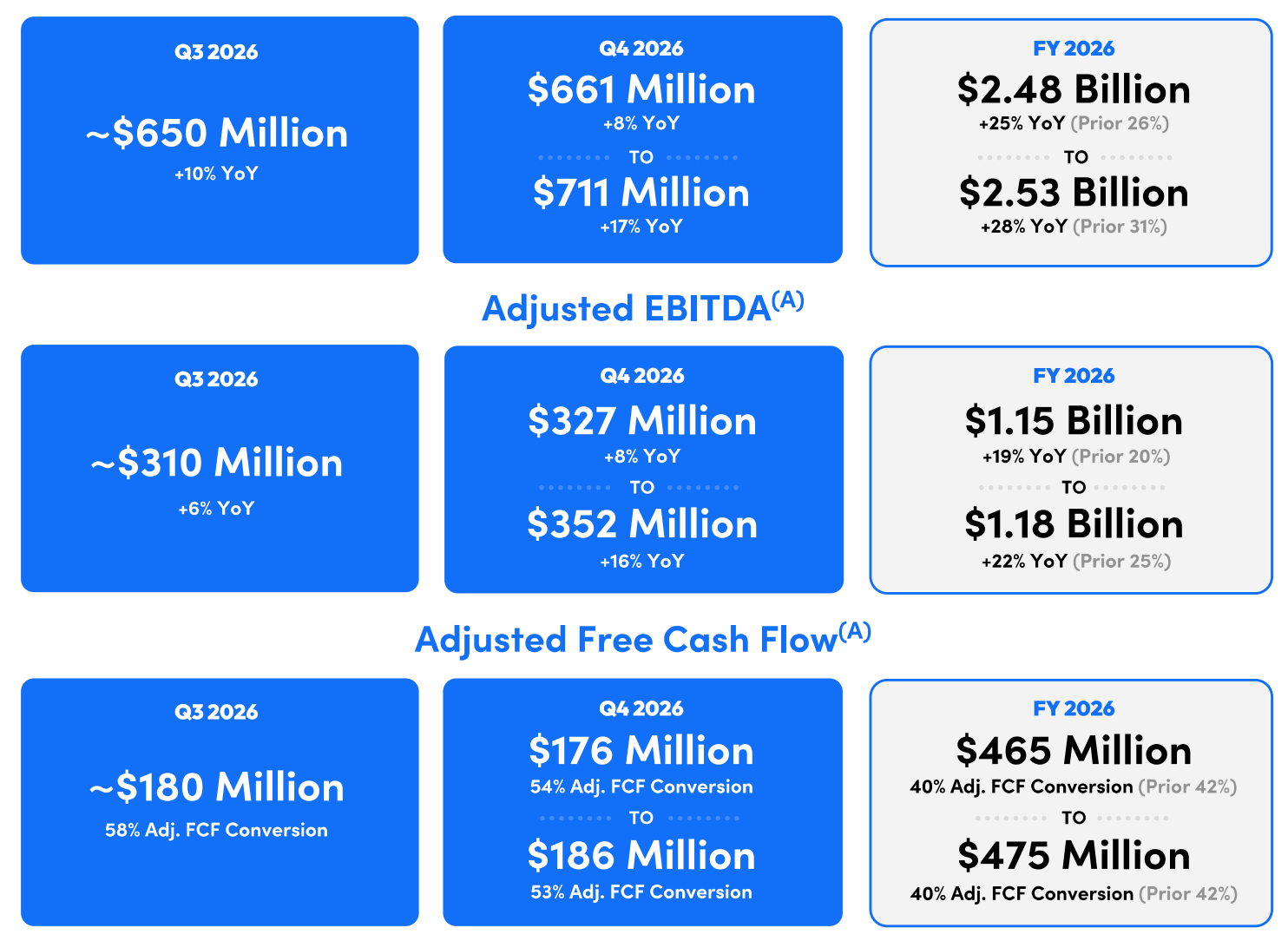
While not great, it doesn’t seem like anything thesis breaking when considering that the Middle East impact promises to be temporary and is consistent with what other businesses have reported. Now, there are sources of upside and downside to the guide and investors should have them in mind.
The main source of upside is that management seems to be being conservative, for two reasons. First, they also guided for a $20 million Middle East impact in Q2 which played largely as expected but were surprised with other pockets of strength within Global Blue. This may well repeat itself in Q3 (we’ll see). The fact that management lowered the full year guide on two stronger than expected quarters in Q1 and Q2 probably has the market concerned (and maybe rightly so). The second reason why they might be being conservative is that, despite positive trends in SSS (same-store-sales) growth in the US, they decided to leave their assumption for flat SSS unchanged:
This quarter, as Chris will highlight, same-store sales trends in restaurants and lodging were slightly better than our expectations, consistent with what we saw in Q1 and a further sign that the trend is encouraging. That said, our full year outlook continues to assume a neutral impact on same store sales, and we are not forecasting any material recovery in the back half of the year.
This seems conservative but also tough to forecast. The main source of further downside is the Middle East. Management shared that they only guide for the following 60 days in terms of the Middle East impact, which ultimately means that there’s “nothing” baked in for Q4. Now, I hope they’ve been sharp enough to have considered further conservatism because yet another guidance cut would be pretty terrible for their credibility (and therefore the stock). So, it’s undeniable that seeing the guidance getting cut is not great, but does it justify a 20% drop? I think it’s a bit too much, especially considering that other payment peers are reporting similar issues with no apparent negative stock market reactions.
Now, as discussed above, it’s true that Shift4 is close to its leverage limits and the market might be worried about survival. This has likely created a fertile ground for shorts. While not great, we must not forget that buybacks are likely going to resume in H2 and therefore a temporarily lower stock price might not be the worse news (even though every shareholder wants to see the stock moving again).
Lastly and just to finish, I wanted to talk about a narrative violation. Recall that payment companies (Shift4 among them) had been historically considered “race to the bottom” stocks. The rationale was that spreads would be perennially compressing across the board as there were “no competitive advantages to be had” in payments. Well, Shift4’s blended spreads seem to have stabilized around 60 bps (a bit higher even) and management even sees upside to these as they onboard SMBs. Evidently we’ll have to wait and see what happens in the future, but quarter after quarter, Shift4 seems to be putting this narrative to rest.
I think the 65 basis points spread relative to at the beginning of the year sort of gave people visibility that we expect spreads on a full- year basis to be greater than 60. There isn’t really much to the story of unpacking that. I think we view that spread mix as something that within this quarter is kind of well inside of what our expectations would have been. I want to say when it’s within, right? It was within the range of expectations that we had for spread. I don’t think there are any specific call-outs to make around the spread differentials.
I think what we had said in the past going into this year was that it is possible that we were going to see a bit of a change in terms of the dynamic of Relative to the last three years, where enterprise had been an accelerating portion of the book, and the enterprise spreads were having a mix shift downward on blended spreads. This year, as that enterprise merchant base is finally kind of sized and scaled, and we’re now growing off of that size and scale base, as we see more SMB business come through, we may actually start to see some expansion in spreads. That trend is something that we had called out as a possibility for the year, and it is playing out. We are seeing that, but it’s nothing outside of what we were already expecting.
So, just to summarize, I don’t think earnings were perfect, but I don’t think they deserved a 20% drop either. Management (imho) should be a bit careful with expectations management considering that they are currently categorized in the “losing” bucket by the market, a market that believes that Shift4 has a balance sheet problem. This said, with buybacks still to be done and free cash flow generation improving significantly in H2, one can’t deny that they might be able to turn this volatility in their favor.
I will continue to hold my shares.
Have a great day,
Leandro
Nice review of earnings - check out my post from earlier this year. Earnings seemed fine and, thinking long term, I’m not worried given the organic growth embedded. I do wish leverage was a tad lower. The pref is great and while you give up upside should it go above 80 you significantly lower your downside. If the stock goes nowhere for the next two years (unlikely) you still make 15 percent irr
Always a pleasure to read you. Great job, we have the same opinion. I will look an arbitrage with pref