


Danaher reported a pretty “interesting” quarter last week. Despite relatively strong earnings (top line in-line and beating EPS), the stock dropped 15% the day of the release. Now, in an unexpected turn of events, the stock has now recovered pretty much all of its post-earnings drop after “riding” strong earnings from other industry players (Thermo, Repligen, Sartorius…):
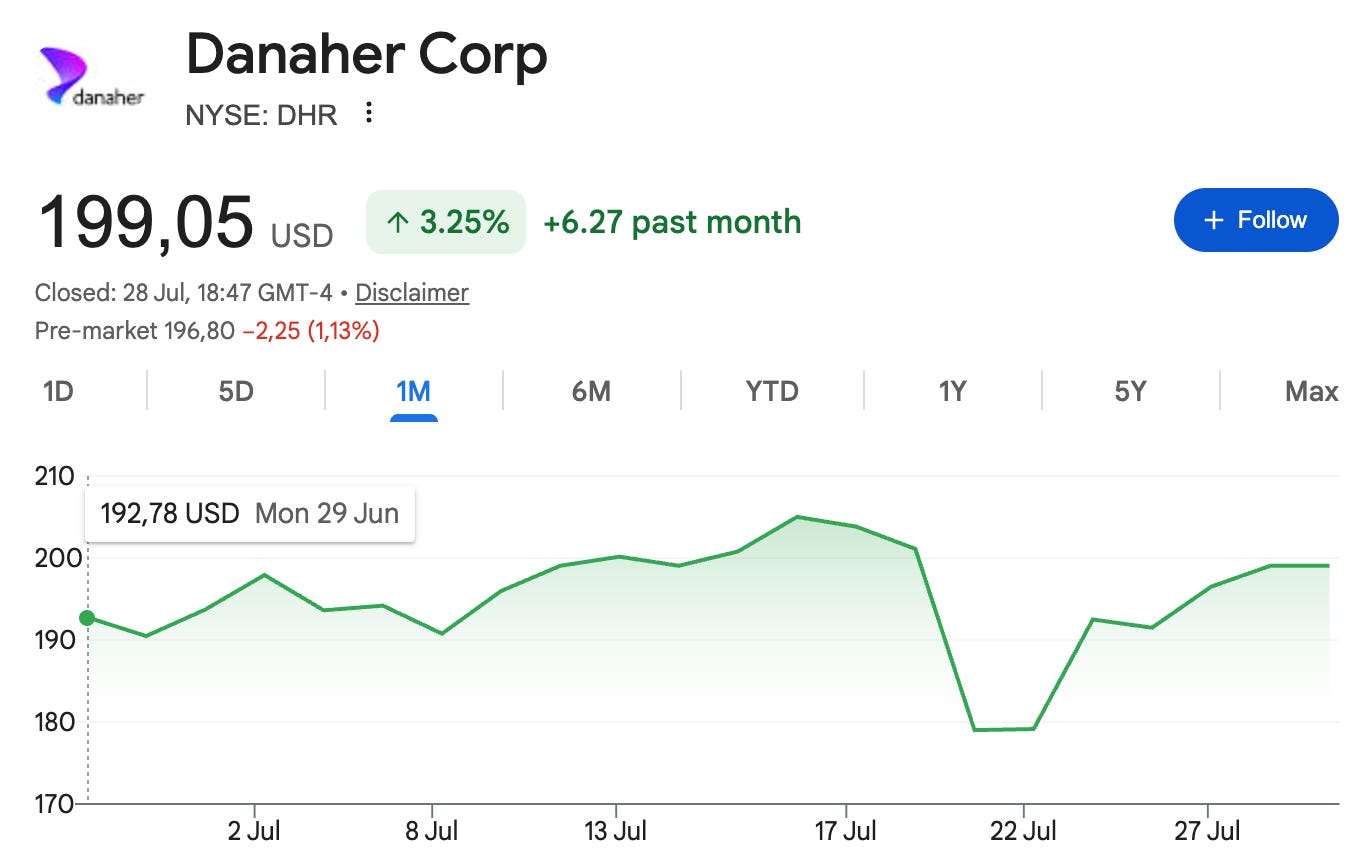
Even though earnings were not bad at first glance, there were a couple of things that were not great (to say the least). Before going into these, let’s take a quick look at the numbers:
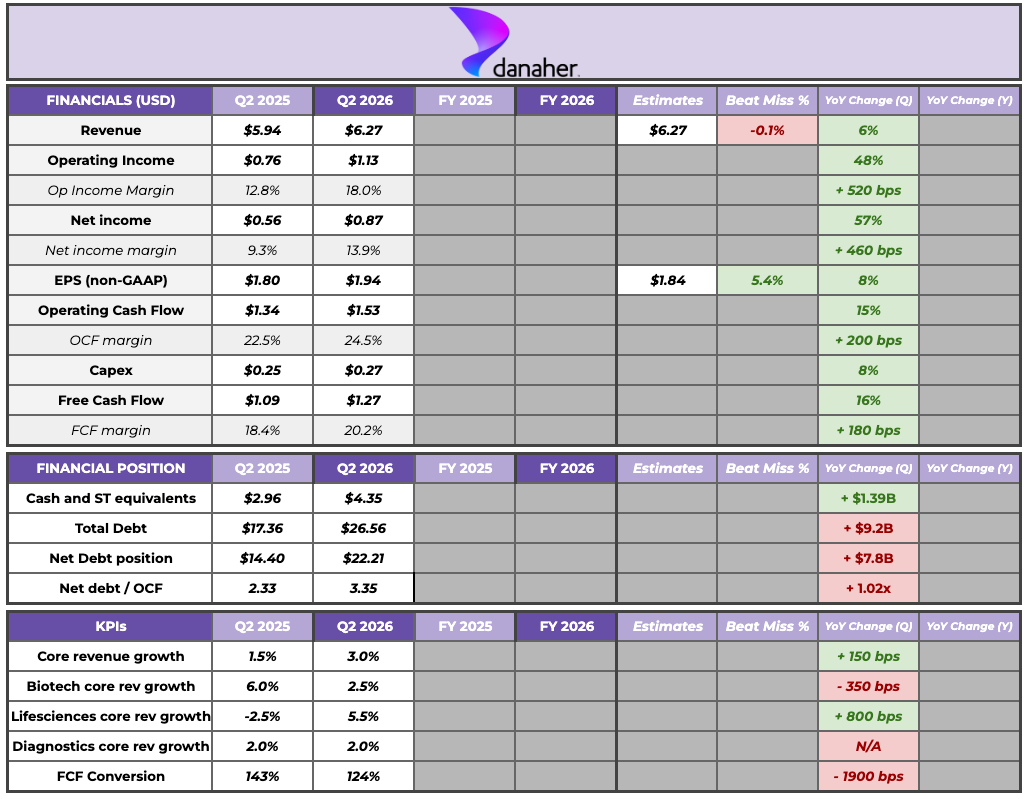
The summary table portrays that Danaher’s growth continues to be “meh” but that the execution on the margin front continues to be good. Reported margins expanded quite considerably because Danaher was up against easy comps after having incurred an impairment charge ($0.60 per share) in Q2 2025. This impairment charge was adjusted out in the non-GAAP figures, but these non-GAAP figures also portray that the underlying profitability of the business is improving as Danaher turns the corner.
Let’s understand what two things went “wrong” because both were evident in the numbers. The first one was the updated guide. At the beginning of the year, Danaher’s management claimed that the company would grow its top line somewhere between 3%-6% in FY 2026. I already explained in an article why everything seemed to be trending towards something better than the low end but that the high end would be pretty difficult to achieve unless all the stars aligned in Danaher’s favor. After some non-favorable events, management has decided to anchor to the low end; they now expect core revenue will grow 3-4% this year.
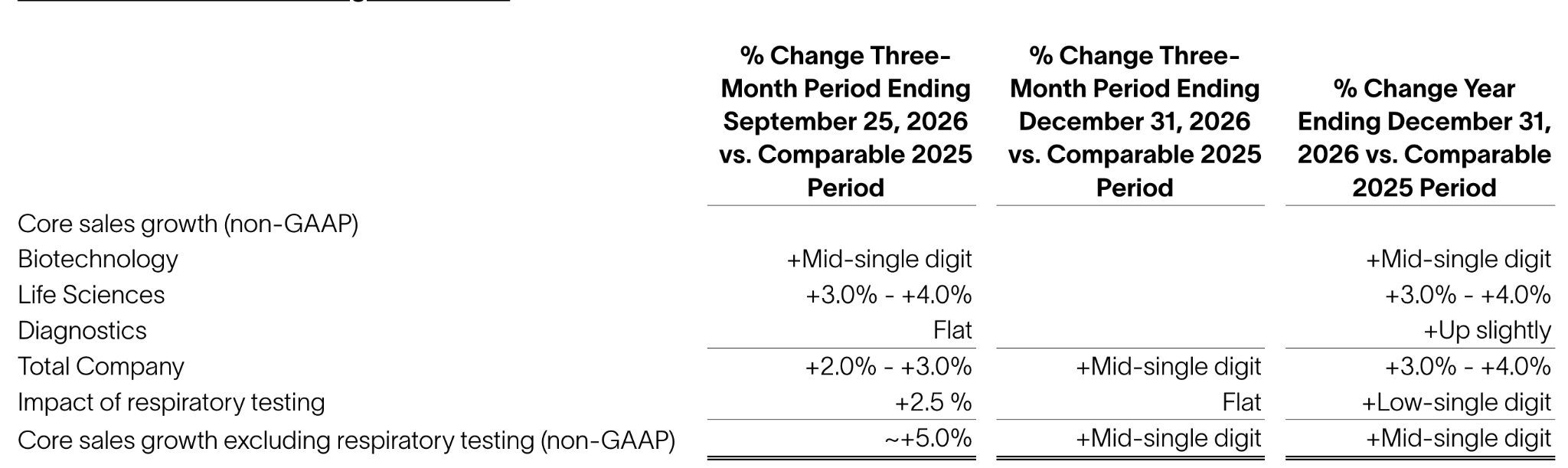
Even though this scenario was contemplated in the guide at the start of the year, there’s no denying that management implicitly lowered the guide (from a midpoint of 4.5% to 3.5%), which is not a great look in a market context in which many believed they were being quite conservative (myself included). Many shareholders have been waiting for Danaher’s growth inflection and seeing this inflection deferred once again is evidently not great news. Danaher’s core growth has evolved as follows over the past few years:
2024: -1.5%
2025: -2%
2026 (expected midpoint): 3.5%
So, while 2026 is expected to bring a 550 bps improvement to core organic revenue growth, the reality is that it’s still far from management’s expectations of HSD (high single digits) core revenue growth rate over the long term. Any additional hiccups in terms of the company’s growth rate only shed doubts on management’s credibility.
Now, what was really interesting about all of this was the “source” of the weakness. If you’ve been following Danaher for a while you’d know that, over the past few quarters, the different segments had moved pretty much always in a similar way: bioprocessing experiencing a strong recovery, respiratory (diagnostics) surprising to the upside, and lifesciences taking more than expected to return to growth. Well, in an incredible turn of events, we had pretty much the opposite this quarter: lifesciences surprised to the upside, whereas respiratory and bioprocessing surprised to the downside. Just when one thinks the other segments are going to stop “diluting” the growth in biotechnology, the opposite happens (are you not entertained?).
Management shared that “core revenue growth excluding respiratory” was 4.5% in Q2, which is an implicit 150 bps sequential acceleration compared to Q1. Even though this might seem like great news, I must say that it was disappointing to see management come up with a new metric. Management did not “invent” a new metric to strip out respiratory growth when it was accretive to core organic growth rate, but they are doing so now when it’s dilutive (heads I win, tails I win too!). Still, I can understand why they’d like to do this considering that they are trying to portray what the “recurring” business is growing at. Imho, investors should simply ignore this new metric.
Bioprocessing’s surprising weakness does matter for several reasons, though. The main one is that a lot of people likely own Danaher for the bioprocessing exposure, which means that weakness in this segment might have “broken” the thesis for some I totally understand why this might be the case, but the only thing I would tell these people is that you can get pure-play bioprocessing exposure through different companies (like Sartorius and Repligen). Who would’ve said that Life Sciences was going to “save” Danaher’s Q2? Definitely not me!
Anyways, the reason for the bioprocessing weakness is also interesting and has implications for next year’s growth rate (hopefully). Management claimed that the bioprocessing “issues” were isolated to project timing related to chromatography columns:
Later in the quarter, we had a few large chromatography resin shipments that were slated primarily for Q2 and Q3 move out of the year. As a reminder, these shipments tend to be about $10 million to $30 million and are destined for large batch manufacturing. These delays were at our customer’s request due to production schedule changes and site readiness challenges, which we have seen occasionally.
These shipments were primarily for commercial programs that were spec’d into, there’s really no change to the underlying trends, even given what we saw in the quarter.
They also quantified the impact:
I think in the second quarter, we saw about a 500-basis points impact to that overall bioprocessing growth, given that the dollar is probably more in that $50 million to $60 million type range. Then for the full year, we saw a little bit north of $100 million that shifted out of that Q2, Q3 into next year. That’s a couple of hundred basis points to our bioprocessing growth for the full year. Obviously, there’s some chance of this moving back into Q4. That’s not within our planning assumption today.
This ultimately means that, if these orders would’ve converted to revenue in Q2/Q3, not only would have Danaher delivered a more significant beat in the quarter, but the guide for the year would’ve been more “appealing.” Management did point out that the underlying trends in bioprocessing continue to be strong, with mid-teens growth in orders of both equipment and consumables.
Considering all of the above, this does seem more like a solvable, Danaher-specific issue than anything worrying in terms of the industry or Danaher’s competitiveness within it (this is why management was quick to point out that they’re spec’d into this program). What this does create is easy comps for next year in which we might see a better-than-expected growth rate despite Danaher managing to stay within its stated guide at the beginning of the year (3-6%). In short: is FY 2027 finally the inflection year? I highly doubt many still believe that it will be.
To all of the above we must also add that management still believes that a Capex “supercycle” is upon us:
We continue to believe that we are in the early innings here of a multiyear CapEx cycle that is required both to support the growing volumes of biologic therapeutics and the reshoring dynamic.
Now, even though I’ve tried to spin the “bad” news in a positive way, the reality is that growth continues to disappoint and that there always seems to be an “excuse” for the lower-than-expected growth (something that doesn’t particularly excite me). I also wasn’t fond of management talking about Pall’s growth in semiconductors. Yes, there’s a filtration business within Danaher exposed to semis (and it’s growing double digits), but what does this matter when it’s not relevant for Danaher’s core business and growth rate? Seems like management was trying to hype people up. Anyways, let’s talk now about capital allocation.
Besides investing in its core business, Danaher has deployed shareholders’ capital in two ways lately: buybacks and M&A. The company spent $900 million repurchasing 5 million shares during the quarter. Danaher has historically rarely done buybacks (and they were historically considered as “high signal” events) but the reality is that a good chunk of the buybacks the company has done over the past few years were conducted at valuations considerably larger than today’s stock price (and with fundamental performance continuing to disappoint all throughout):
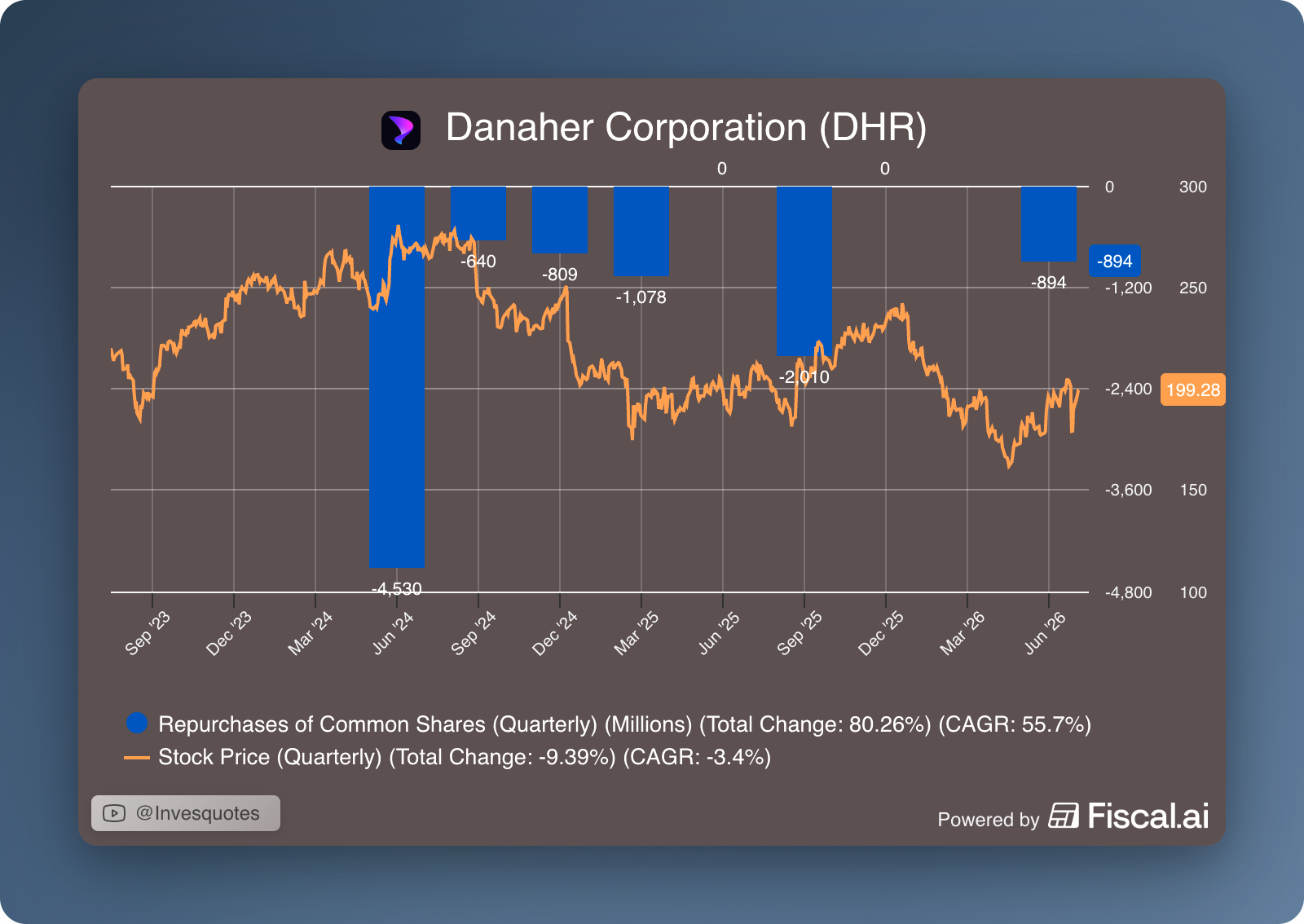
Management might indeed believe that the company is attractive today but they are not putting their own money behind their words. Insider buying has been “meh” although it’s true that insider selling has somewhat cooled down this year).
The other way (and probably main way) in which Danaher deploys capital is M&A. The company closed the significant Masimo acquisition in June (which I discussed in this article), and it seems to be doing well thus far: Masimo grew HSD during the quarter and management believes there’s upside to HSD growth. Let’s not forget that Masimo’s growth will eventually start to contribute to “core revenue growth” once Danaher anniversaries the acquisition.
Danaher has also conducted the acquisition of STAT Lab, which is expected to close by the end of 2026. STAT Lab complements Danaher’s Leica Biosystems business, has >85% recurring revenue, and is expected to grow HSD over the long term (like Danaher in theory should!). This business generated $250 million in revenue in FY 2025, so if it grows HSD next year it should generate around $270 million (i.e., it’s not that substantial for Danaher).
Now, even though I explained why I believe Masimo is a good asset, the reality is that we’ll only know if all this M&A makes sense in hindsight. I believe there are two things worth having in mind:
Danaher is not paying bargain prices for these assets (which doesn’t mean that they can’t or won’t generate decent returns over the long-term)
Both assets separate Danaher to a greater extent from becoming a pure-play bioprocessing business (which many investors want)
I don’t think any of these are necessarily bad, but there are what they are and we must take them into account.
I’ve also seen a couple of valuation headlines out there that seem pretty misleading/inaccurate.