


Stevanato reported good earnings today, although (once again) these were not precisely “clean.” The company has faced a couple of headwinds over the past few quarters that have not enabled management to transform the good underlying performance of BDS into a guidance raise. I would highlight two:
The weakness in engineering (Capex across the pharma industry is not undergoing its best period as the industry digests the pandemic overcapacity)
Currency headwinds
Engineering does seem to be finally stabilizing (-2% YoY in Q2 but improving margins and “decent” commentary on the outlook) and management began to disclose (finally) an organic growth figure so investors could look through the currency noise. One would’ve thought we would finally get an explicit guidance raise (not an implicit one), right? Well, we got a third “aggressor” this quarter!
Stevanato announced the divestiture of its California-based subsidiary Balda C. Brewer, which comes with a €15 million headwind to the guided reported figures. The midpoint of the reported guide was lowered by €5 million (from €1.275 billion to €1.270 billion). If we make an apples-to-apples comparison (i.e., excluding the €15 million divestiture headwind from Balda) then Stevanato actually raised its reported guide from €1.26 billion to €1.27 billion, a marginal increase.
One thing that confused me quite a bit (management definitely has to work on their communication skills) was the following:
Updated FY 2026 Guidance, Reflecting its subsidiary sales, better than anticipated currency translation, and higher organic growth.
This seems like great news, but the numbers are “nowhere” to be found. The thing is that, when one compares the guide provided in Q2 to that provided in Q1, the organic growth guide was maintained at a midpoint of 9%, so either we are talking about decimals here or the better than anticipated currency translation is doing the heavy lifting of the raised guide. Management provided the answer in the call, arguing that there’s a €15 million headwind from the Balda divestiture and a €8 million favorable adjustment from currency. This leaves a €7 million overall headwind from both things, and with the guide being lowered €5 million, we then can triangulate that management expects a +€2 million organic growth tailwind, which is honestly not something to write home about.
Despite this and even though my expectations might have been higher than what we got, there’s no denying that earnings were fine. Stevanato grew its revenue 8% organically, with BDS growing 10% at constant currency (driven by 18% constant currency growth in HVS) and engineering starting to show signs of life. The profitability performance of both segments might have surprised everyone though: while engineering gross margins were up considerably, those of BDS were down 10 bps:
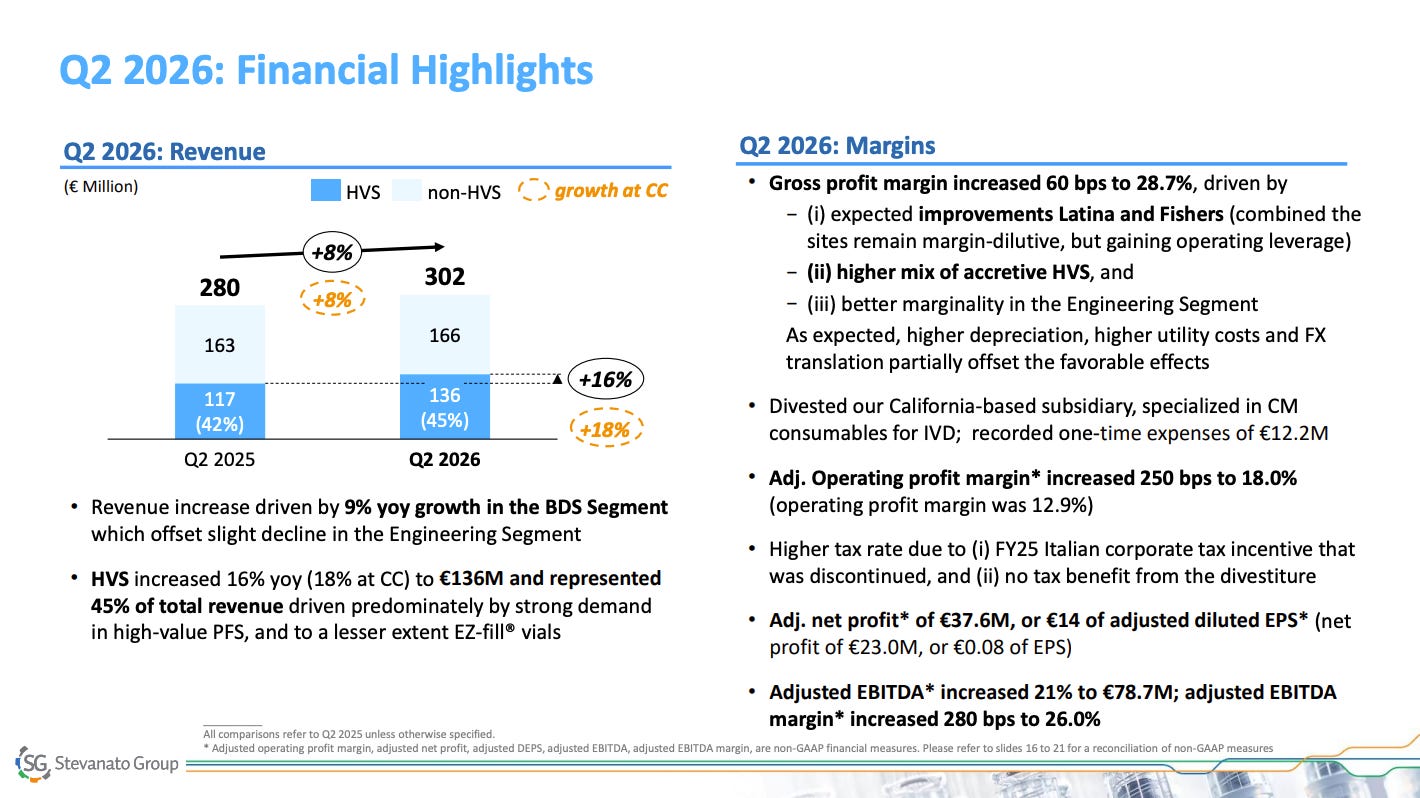
Now, the ongoing shift to HVS (together with the divestiture of Balda which was non-HVS) made margins look pretty good at the EBITDA and operating level. Note that the company incurred €12.2 million of non-recurring expenses due to the divestment of Balda (which seems pretty high for a subsidiary delivering €30 million in annual revenues), so this is adjusted out in adjusted figures. Adjusted Operating Profit margin increased 250 bps and Adjusted EBITDA grew 21% on 8% revenue growth.
The above is despite Latina and Fisher combined still being margin dilutive, albeit ramping up. This mix-shift is actually the core of the investment thesis. Not only is Stevanato growing its top-line at an appealing pace (HSD-LDD organic revenue growth) but it’s also expanding its margins significantly to achieve mid-teens/twenties organic growth in earnings. The run in Stevanato’s shares and the good earnings its peers have had might have raised expectations coming into Q2 significantly, but Q2 earnings were very good when considered in isolation and fine when considered within the reigning expectations. Even though the reported revenue guide was somewhat lowered due to the divestment of Balda, Stevanato marginally raised the midpoint of its Adjusted EBITDA guide (from €339.4 million to €340.1 million).
The main “lowlight” I’d say one could find here was in the communication which again left quite a bit to be desired. I believe this is pretty relevant because it’s an unforced error. It’s a pity that Stevanato is doing things well only to ruin it with how they are communicating things to the market (things improved quite materially in the call, which I will share later).
Engineering remains the wild card, but at least comments are getting incrementally more constructive:
We have a healthy pipeline. That is going to be step by step translate in order. If you combine from the beginning of the year to the second part of the year, we are starting really to move more and more of this pipeline into orders. We have very strong progress in winning new orders, in particular for what is related to visual inspection machines, in particular in Europe, in Asia, and as technology for assembly, for drug delivery systems in Europe, United States. We see, quarter after quarter, a progression in order to enlarge the confirmed orders compared to what was the order intake, the trend is starting to become better and better quarter after quarter.
Engineering revenue was 12% of Q2 total revenue so the risk/reward relationship from this segment seems to be improving in the sense that either…
It gets so small that it doesn’t matter
Any signs of life start to contribute to growth and are taken positively by the market
Now, all of the above said, I think the earnings call was great to understand the potential opportunity for Stevanato. Quarters here are pretty much baked in before they get reported (due to Stevanato’s visibility), so one can only wonder:
How early is Stevanato into its addressable opportunity?
Let’s begin with the exposure that makes the headlines: GLP-1s. If you’ve read other articles I’ve written on Stevanato, you’ll know that GLP-1 has been a relevant growth driver for the company and also that the market has remained skeptical on the growth of oral therapies (concerns which seem to have somewhat diminished). Franco Stevanato believes that, even though GLP-1s are the main growth driver today, we are still just scratching the surface. We could understand the GLP-1 opportunity through 3 lenses:
Higher penetration
Biosimilars
Integrated solutions
As for the first, management argued that GLP-1s are only 10% penetrated on a potential TAM of 1.5 billion people. To reach a higher penetration, prices will need to come down, and here’s where biosimilars come into play.
With all the biosimilars that are entering the market today, we see that all the biosimilars are practically using the same type of administration type injection. Stevanato is acting to serve this biosimilar that is still at the early phases through syringes. Next, cartridges Ez-fill even more.
Biosimilars lower the entry barrier and therefore drive penetration, and biosimilars are using similar drug containment devices as the original drugs (so overall they are additive to Stevanato’s business).
Then we have Stevanato’s “new” integrated solution. Stevanato has been working on the Alina injector pen for a while to offer an integrated solution (cartridge + delivery device) and while the success had been limited, the company might have just reached the inflection point:
We, in terms of investments, in terms of revenue, revenue around Alina are already captured in 2026 in our guidance. What we can tell to you that we will be heavily investing into the industrial commercial capacity in our plants in Germany in the next 12 to 24, 36 months in order to be able to serve this growing demand. Like I mentioned to you before, we count that we will be able to generate double digit revenue around the Alina product in the next years to come. Focalize in what we call our premium high value solution product.
Today, we have done the first registration with a certain number of clients, first in Europe, in the second part of the year, we will receive additional validation in North America, but what is more important, the fact that now we have this registration on the market is helping to boost and push other traction from other clients, in particular in biosimilar space for what is related to the weight loss management treatment. This is the real strategy. Our industry usually is a little bit prudent and conservative since there is not a real product on the market. Some clients are waiting now that this is proven is opening a big, big opportunity next year around our IP product.
So, if we combine the fact that penetration is still in the early innings and that Stevanato is not only going to participate in the increased penetration but will also try to capture more of the value (containment solution + delivery device), management believes that GLP-1s can grow at a double digit clip for the next 5 to 10. This contrasts quite significantly with the market, which seems to believe that these companies have already enjoyed most of the growth to be had in GLP-1s:
That GLP-1 is really what we call at the beginning of this journey, because if you look all the potential opportunities that we have to our originator clients even more with the biosimilar to very active in any region of the world, I think that we are really at the tip of the iceberg. Today there are less than 10% of patients penetration in a total potential addressable patient. That is 1.5 billion. So we expect that this will continue to represent a strong long term, durable, durable tailwind for all the industry, including Stevanato.
Now, the story doesn’t end here, we also have to add the broader biologics opportunity. Non-GLP-1 biologics are still not a main growth driver for Stevanato (grew 6% in Q2 off a small base), but there’s a reason for this and that is that Stevanato is generating for the most part clinical (not commercial) revenue. As these assets advance through the pipeline and make it to commercial volumes, management believes that the opportunity is considerably larger than for GLP-1s:
Today, in the biologics space, we have delivered plus 6%, like it was mentioned before, but because most of these programs are at the early stage, they do not represent a big, big revenue generation. If I can give you a sort of projection, GLP-1s are a well-established, opportunistic tailwind that will continue to grow in the next few years, and biologics will be much more spread to many clients and many therapeutic areas. And then if you look to combine all these opportunities, it’s going to be much bigger in the next few years to come compared to GLP one.
So, management is not only saying that growth will be good this year aided by GLP-1s, but that growth is much more durable than many believe it will be. Good news, although this doesn’t mean that they don’t have to work on their communication skills. Do shares deserve to be up 20% on these numbers? Not at all, especially due to the not-so-encouraging communication, but I do believe that they should move higher considering the durability of growth and margin upside Stevanato will most likely experience over the next couple of years.
I will continue to hold my shares.
Have a great day,
Leandro