


(I had been waiting for Nintendo’s Q&A transcript before publishing this article, but as that is taking longer than anticipated, I have decided to publish it and will bring any updates of the Q&A in a future NOTW article)
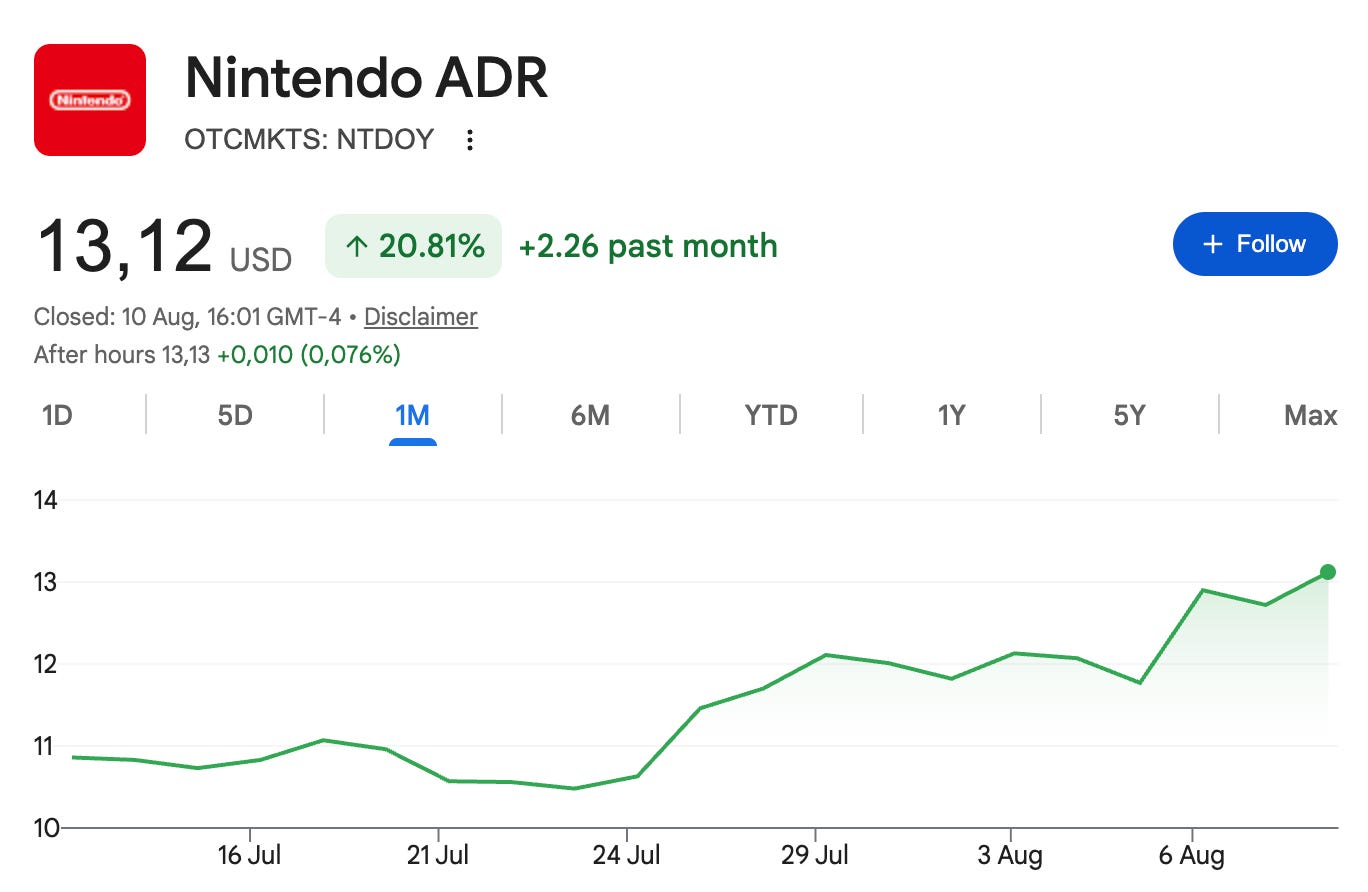
Nintendo reported fine earnings last week, although these could be considered pretty strong once contextualized (you’ll understand what I mean after reading this article). The stock reacted favorably after having been “destroyed” on the face of rising memory costs and becoming an “inverse-memory” stock. Nintendo is now up 21% over the past month, which is honestly not reassuring considering that it’s up almost the same amount as the KOSPI is down from its ATHs (all time highs)! This means that Nintendo may well continue to be an “inverse memory” stock:
Let’s start with Nintendo’s headline numbers. Sales dropped 9.5% but profitability improved quite considerably, with operating profit rising 150% year over year:
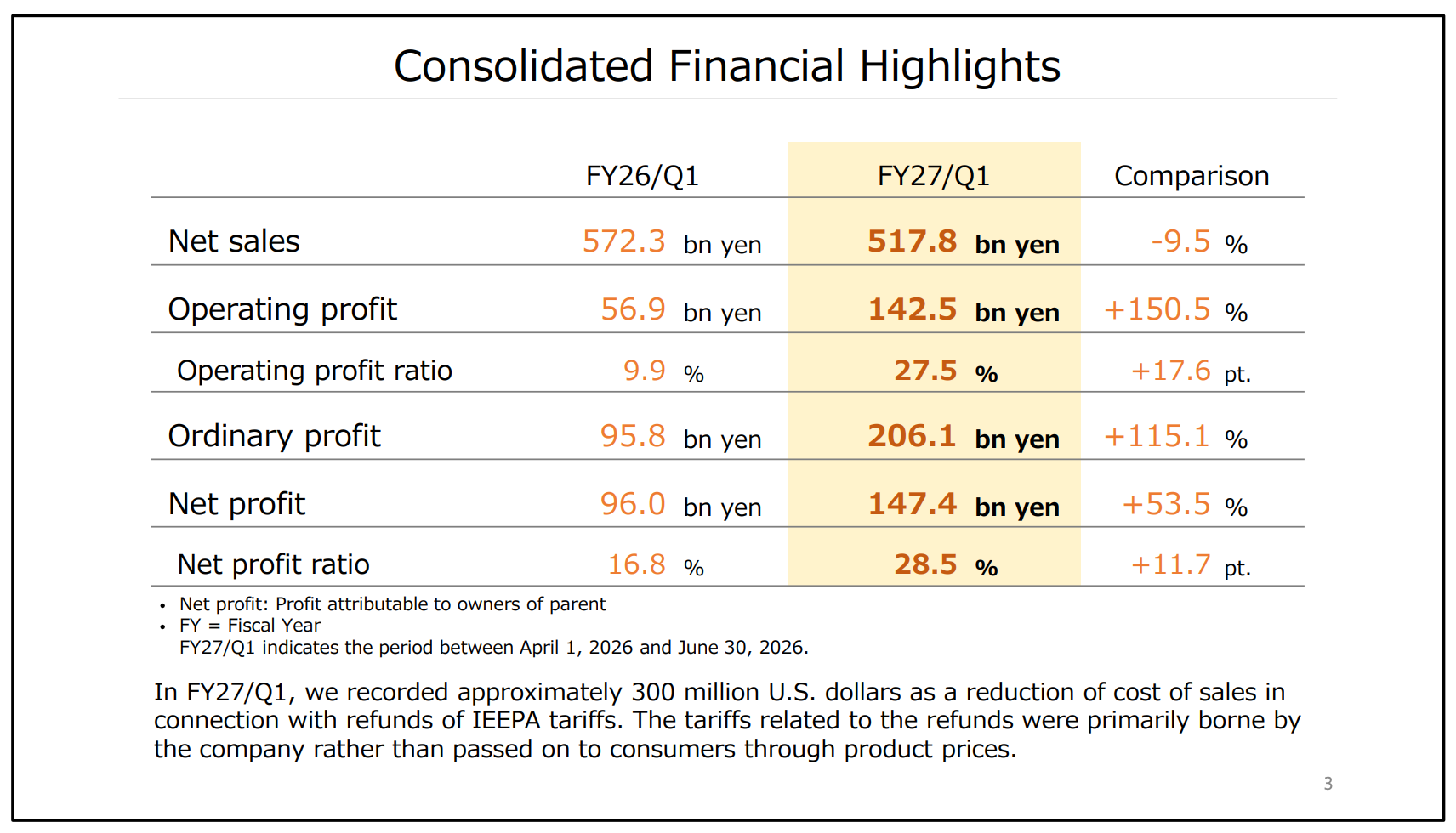
We need to understand two things to contextualize the numbers above. The first one is that the comparable quarter (Q1 FY 2026) was the Switch 2 launch quarter. This is relevant because it impacts both sales and margins comparisons. With hardware still carrying the bulk of the sales, it’s normal to see sales down when compared to Nintendo’s record quarter in terms of hardware sales. Let’s not forget that Nintendo sold 5.82 million SW2 in Q1 FY 2026 (which was not even a holiday quarter). Comps were pretty tough to say the least.
Now, in terms of margins we have to consider two things. First, as software is slowly but steadily becoming…
A more important driver of revenue (later we’ll see that software sales have to be contextualized)
More digitally focused
…margins should naturally improve over time. It has always been this way (especially the first point) and it also seems that digital software sales have gotten to an inflection point (likely driven by Nintendo’s tiered pricing according to the software format).
The second very relevant event was that Nintendo received a $300 million refund from the US government related to the IEEPA tariffs. Even though many will claim (and rightly so) that this is a “non-recurring” benefit, the reality is that one could also argue that Nintendo’s profits in past periods were depressed and therefore this is simply a catch-up event. Some companies have been returning these refunds to customers, but Nintendo is unlikely to do so because the company bore the cost of said tariffs (not customers). This ultimately means that Nintendo just received $300 million of fresh cash, that in pure Japanese fashion they’ll most likely store in the balance sheet!
I believe there was quite a bit of controversy regarding the SW1 and SW2 hardware and software sales numbers. I’ve already helped contextualize the 34.4% drop in SW2 hardware sales (comps were tough due to the launch quarter), but how can one explain the fact that SW1 software sales were up 39% with SW2 software sales only up 9.2%?
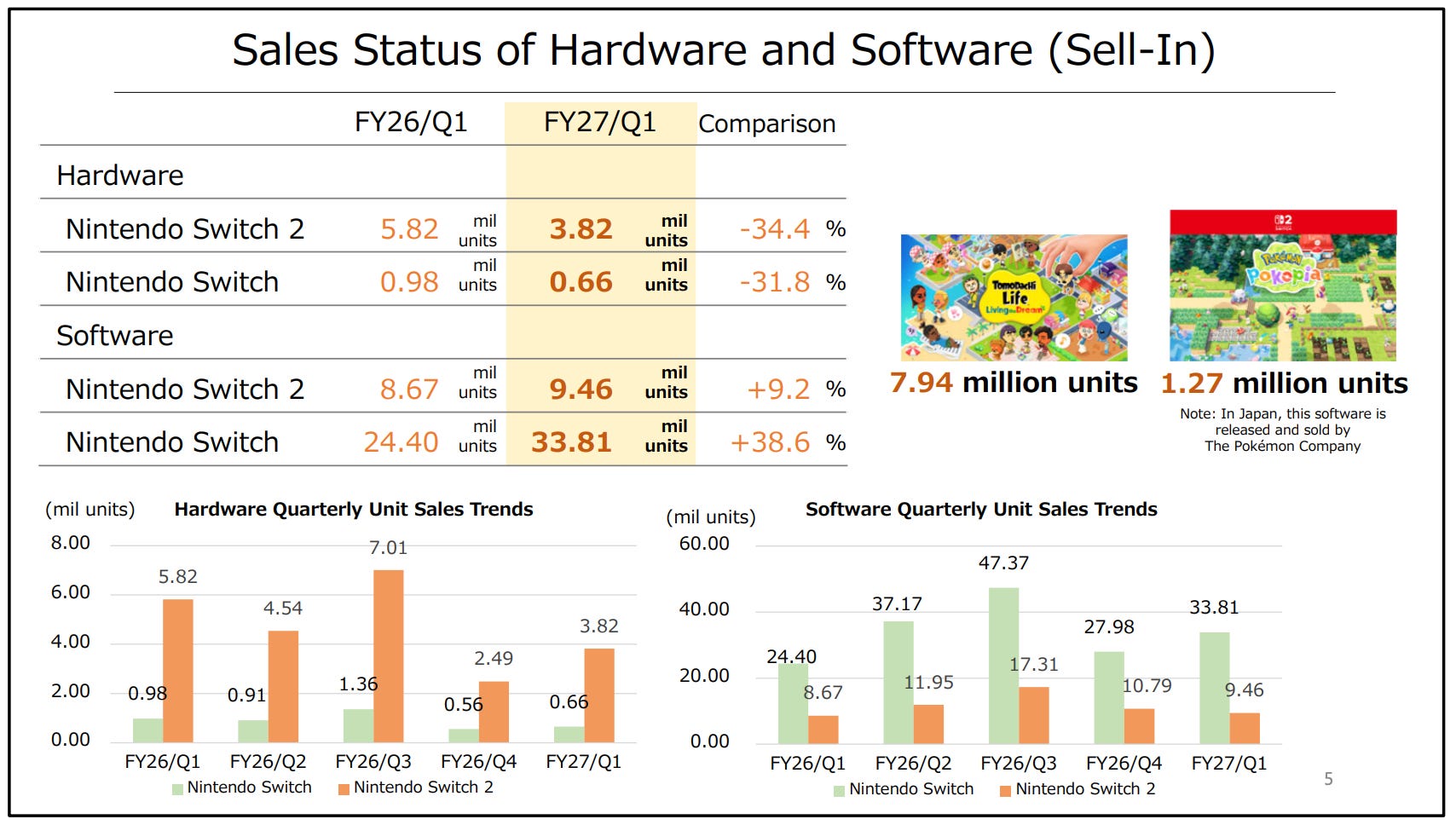
I believe there are a couple of potential explanations here. The first and probably most straightforward one is also related to the launch quarter. The most popular product offering during the launch quarter were the bundles (most notably with Mario Kart World). These bundles considerably improved the tie ratio and made software comps pretty tough. Just for context, Nintendo sold 8.7 million software units on an installed base of 5.82 million SW2 in Q1 FY 2026. That’s a quarterly tie ratio of 1.5, which is extremely high for a single quarter and could be attributed to the bundling.
The second reason for the “poor” SW2 software sales could be attributed to the software lineup. As I have been discussing for a while, Nintendo’s hardware sales are very impressive because the company has not used most of its best-selling software. Selling 3.82 million SW2 in the system’s second year and with no strong software release is outstanding.
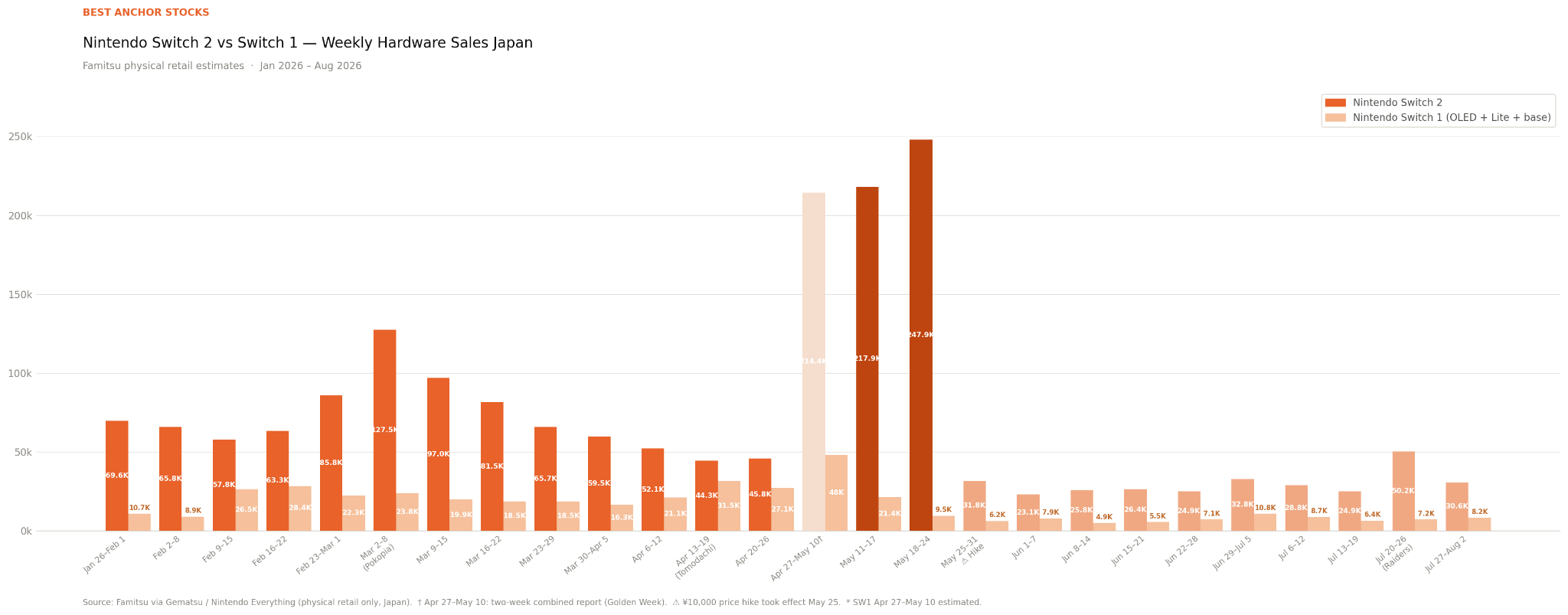
This said, the hardware numbers should also be taken with a “grain of salt” because there was a demand pull-forward caused by the price hike in Japan. Nintendo raised the price of the SW2 in Japan at the end of May, creating an unprecedented surge in SW2 demand. This likely boosted SW2 numbers in Q1 FY 2027, but it doesn’t make it less impressive. It’s worth noting that the SW2 sales in Japan have remained strong and have recently accelerated post-Splatoon Raiders launch (which we’ll see in Nintendo’s Q2), demonstrating that the new SW2 pricing is still attractive when software is there to justify it (and Splatoon Raiders is not precisely one of Nintendo’s heavy hitters):
Then we have Tomodachi Life, which sold almost 8 million units (Nintendo is by far the company with the most million-unit seller franchises in the entire industry). Tomodachi Life was not a SW2 exclusive and became a great success, so it stimulated SW1 software sales BUT (and this is pretty important when contextualizing the numbers) one must be aware that Nintendo counts its software sales according to the platform the game is made for, NOT where it’s played. This means that if Tomodachi Life also sold well across SW2 users, those sales are counted as SW1 software sales. So, ultimately, if there has been a strong SW1 release in any given quarter, it’s normal to see strong SW1 sales and “soft” SW2 sales in comparison even though actual SW2 sales might have been just fine.
So, for all that I have discussed above, I wouldn’t over-obsess with software sales and YoY comparisons this quarter. What’s great news is that digital sales as a proportion of total sales rose 220 bps:
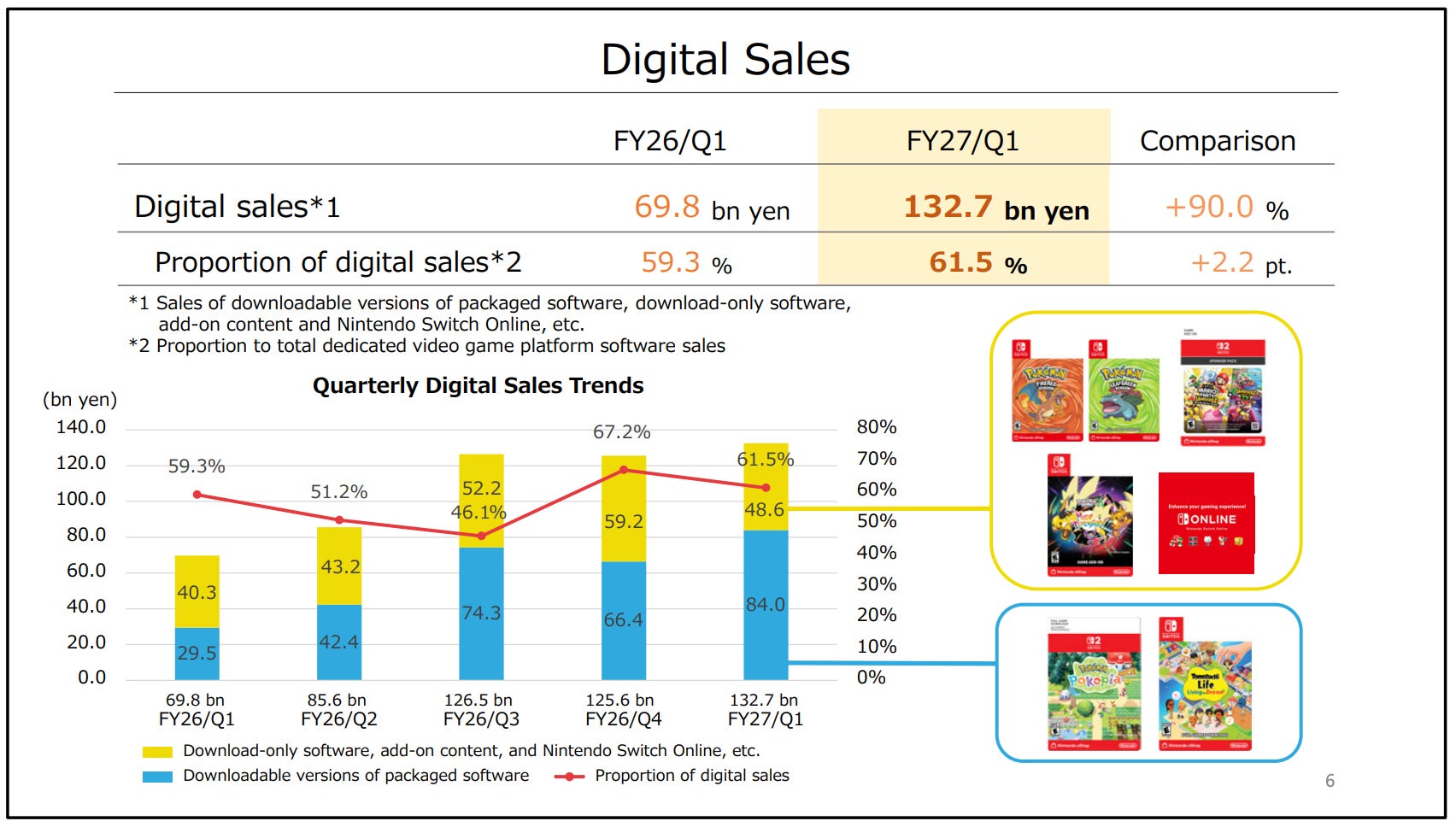
This transition is great for margins and I expect it to continue going forward considering that Nintendo is taking steps to become a more digitally-focused software provider. The success of Tomodachi Life also played an important role in the higher proportion of 1P sales, BUT the SW2 might be the platform with the most 3P support that Nintendo has ever had.
Many software publishers are contributing to the Nintendo Switch 2 software lineup. There are more titles for Nintendo Switch 2 than there were in the first year for Nintendo Switch, and numerous other titles are in active development.
Source: Nintendo’s earnings presentation
Now, the other controversial topic was the guide. Despite reporting a very good Q1, Nintendo decided to leave the guide unchanged, both financially and in terms of hardware and software units. Let’s begin with the financial guide:
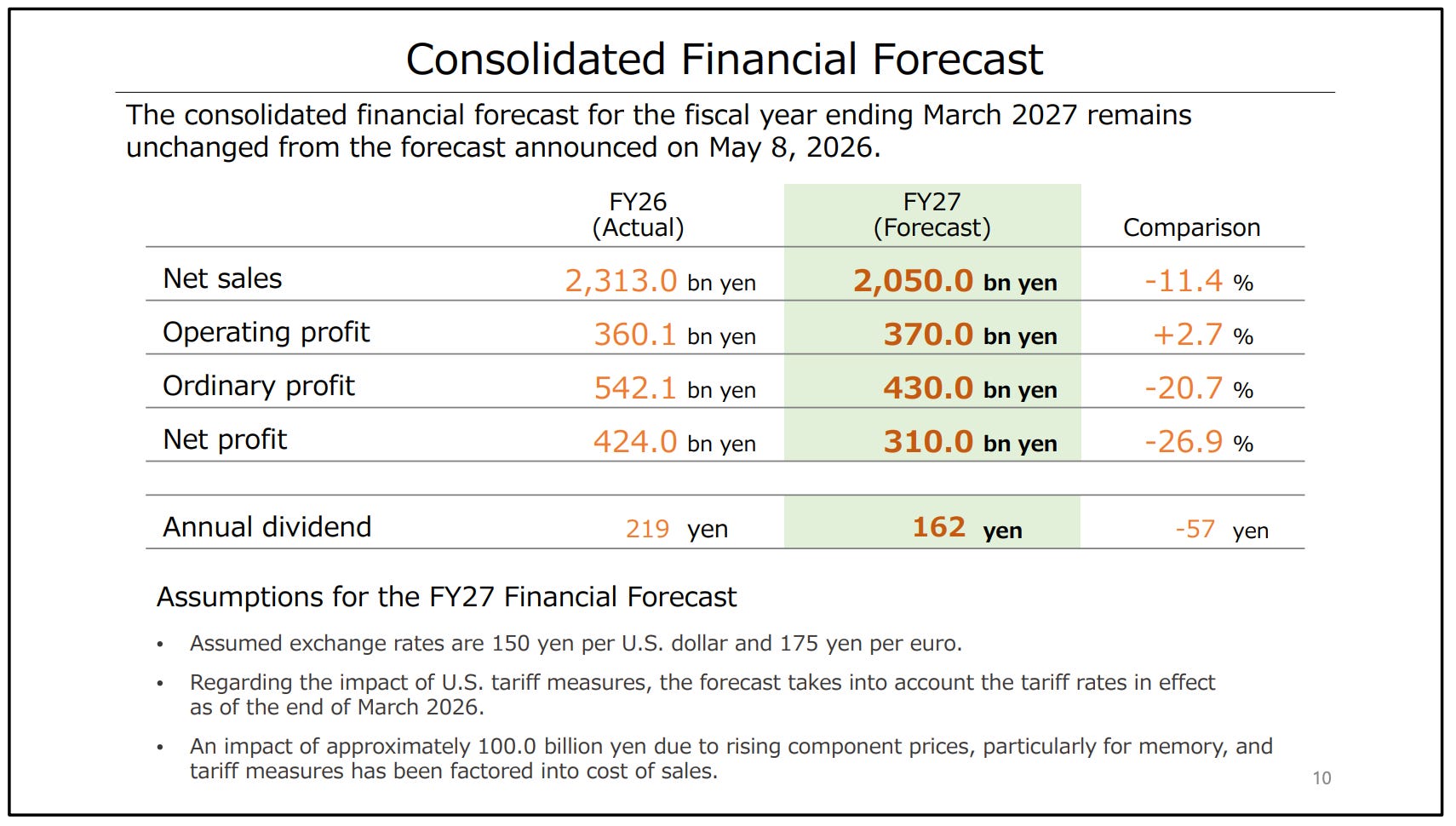
The fact that management decided to leave this guide unchanged even after receiving a $300 million refund from the US government can potentially mean a couple of things:
The memory situation got worse and Nintendo expects further headwinds in terms of profitability which the refunds helped offset (i.e., a neutral impact)
Nintendo assumed they would get the refunds when setting the guide
Management is being conservative because it’s still Q1
We’ll only know which one of these is the correct one in hindsight, but if I had to guess I’d say it’s likely a combination of the first and the third, and maybe more of the third. Nintendo’s management is characterized for their conservativeness, so it was unlikely they would change their guide in Q1 in such a turbulent year (at least in terms of memory costs). This conservativeness is more apparent in the hardware and software guide:
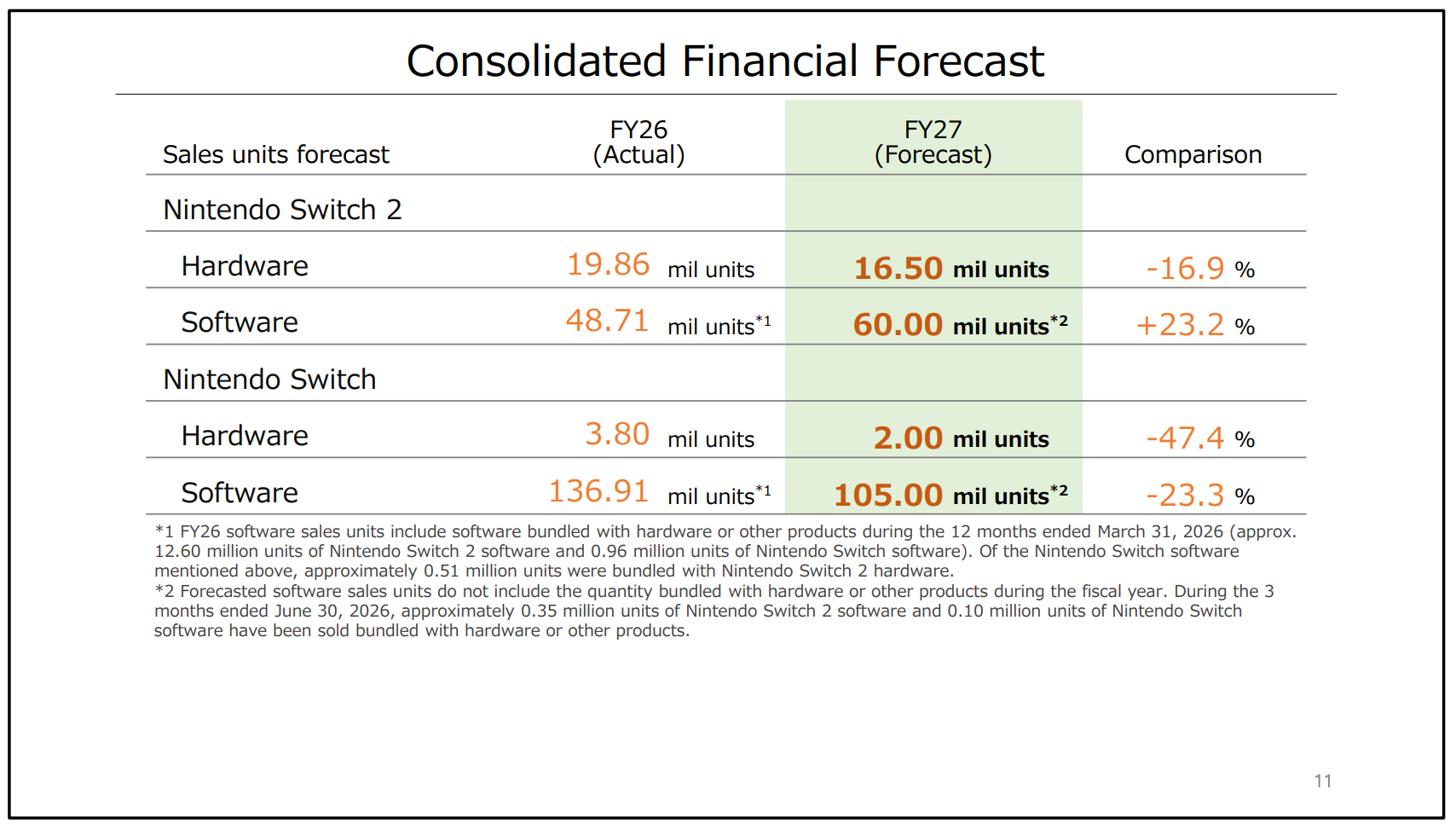
Management still believes they will sell 16.5 million SW2 units and 2 million SW1 units in FY 2027. This seems a tad conservative considering that the company has already sold 23% of the SW2 objective in Q1, which is (1) typically Nintendo’s worst-selling quarter and (2) not a quarter precisely characterized by strong software releases. To understand why (1) makes it conservative, we must try to understand how much this proportion was in the years prior. Across the SW1 lifecycle, Nintendo’s hardware Q1 sales were responsible (on average) for 17.7% of total annual sales:
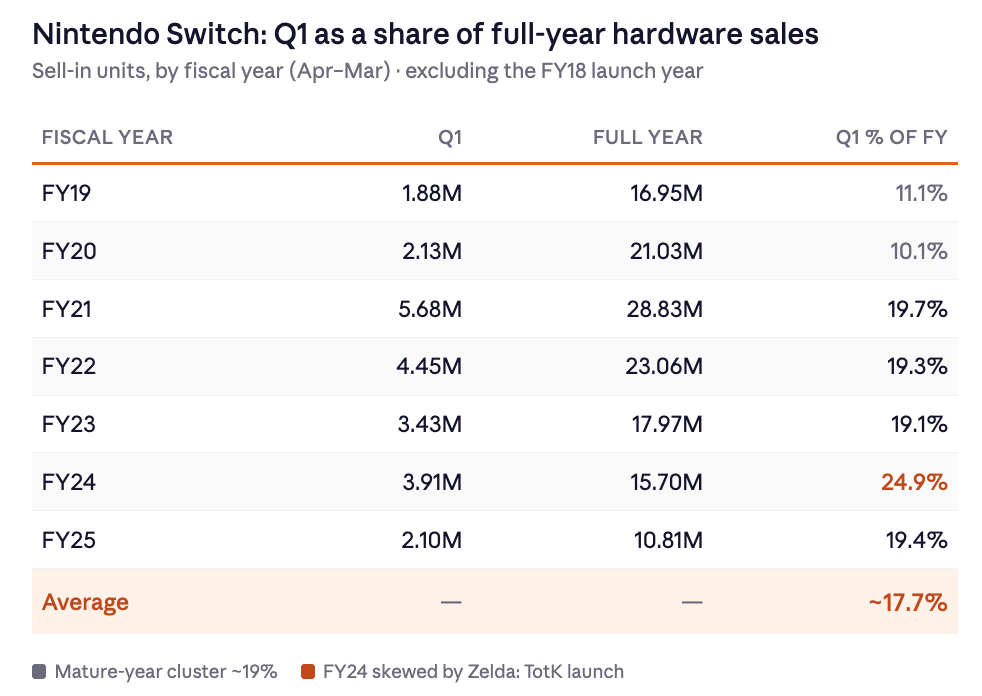
Seeing 23% this quarter definitely makes it seems like it’s trending above average, which leaves two potential options on the table. Either it’s going to be an above-average year in terms of Q1 hardware sales or Nintendo will end up selling more than it anticipates and therefore it will be a normal year in terms of Q1 sales. Now, some people might argue that this is normal due to the demand pull forward in Japan, but what I would say is that (while true) there’s still a demand pull forward likely coming in the US and Europe when Nintendo raises prices on September 1st.
In terms of software, we must look at it in a combined manner (for the reason I discussed above). Nintendo’s forecast calls for 165 million software units sold this year across the SW1 and the SW2. The company sold 43.3 million (26% of the total) in Q1. This also seems above average, especially for a period with no outstanding blockbuster. Now, I do believe that we’ll have the really strong year in terms of hardware and software sales in FY 2028 (very strong releases coming), but there’s no denying that the guide looks conservative. If history is any guide, Nintendo tends to be optimistic with hardware sales and pessimistic with software sales, which tends to result in positive earnings surprises due to the software mix, but we’ll see.
Management does seem to believe on the long term success of the business as Nintendo will invest 121 billion yen (a whopping 760 million USD) in a new Technology Development Center:
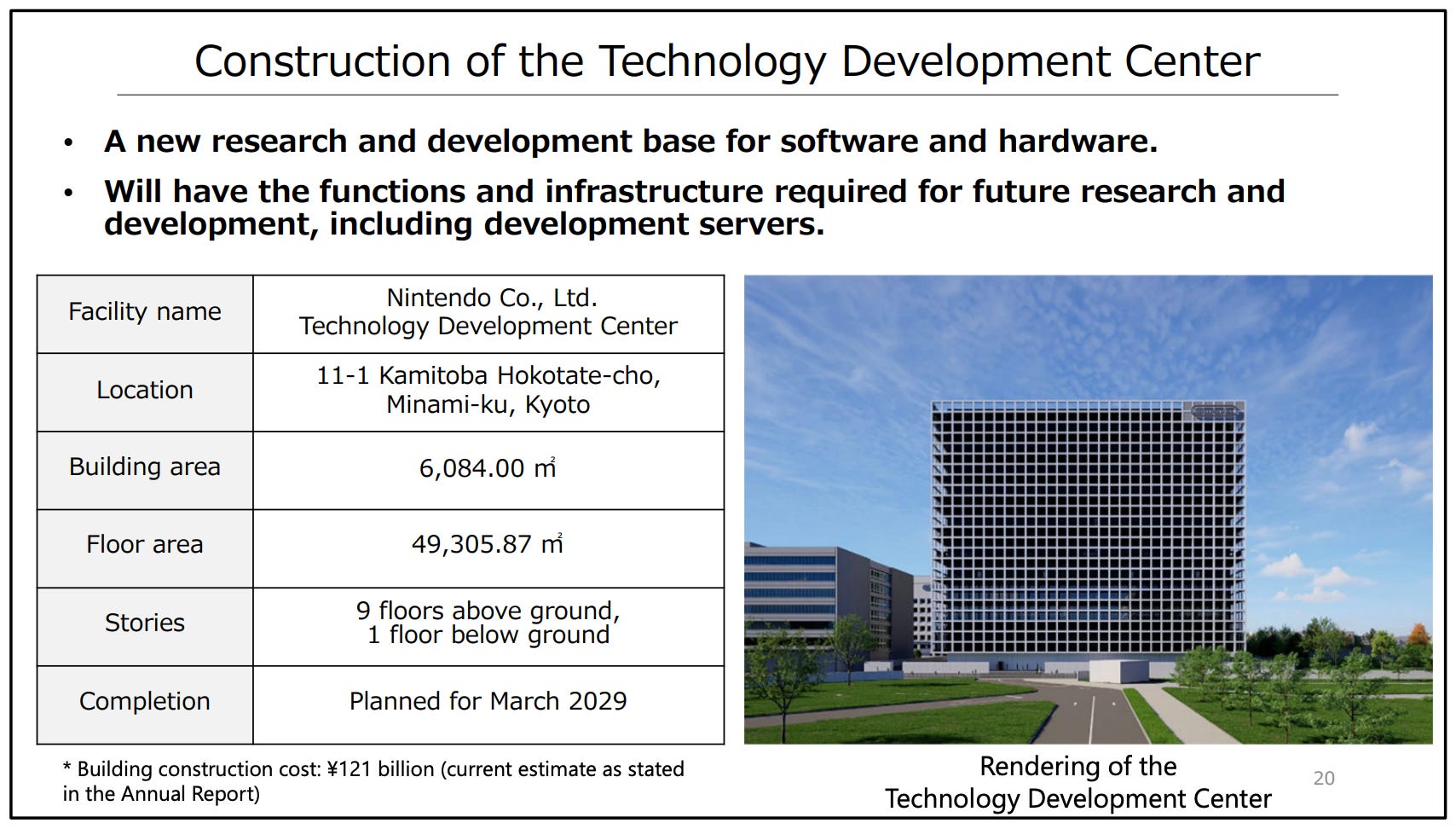
While the industry continues to struggle and downsize teams, Nintendo continues to invest for the future.
I wanted to end the article talking about the stock. Even though the stock has recovered somewhat from the recent lows, I still believe that it’s at the mercy of the “memory trade.” Nintendo’s hardware and software KPIs are all performing better than many believed (the SW2 sales are 11% ahead of the SW1 sales at a similar point in the cycle) despite the company not really pushing into its software line-up. Many believe that Nintendo’s SW1 cycle can’t be improved, but early signs seem to point out that it can. Now, despite this better than expected performance, Nintendo’s stock has suffered due to higher memory prices. This is not completely unjustified and it makes sense, but…
The memory pricing issue will eventually resolve itself
Nintendo has increased prices with virtually no impact on demand so long as the software lineup is good
So, I am in the middle of two cross-roads. On one hand, I believe that over the long-term, the current issues don’t make much sense. On the other hand, I can understand why the stock has suffered.
The good news for shareholders is that, even despite the memory issue, the KPIs continue to trend in the right direction. Nintendo is currently trading at an EV of 7.34 trillion yen. With management expecting 370 billion yen in operating profit this year, this means that Nintendo is currently trading at an EV/EBIT of 19x with a long runway of revenue and margin expansion ahead (I don’t believe the current year is representative of the run rate). While many will claim that EV is not the best metric for Nintendo as the cash position does not “belong entirely” to shareholders, this EV/EBIT metric is calculated without considering the company’s hidden assets (like the stake in the Pokemon Company, the stake in the Seattle Mariners…). I believe Nintendo remains cheap.
Have a great day,
Leandro
Thanks for the update.
Too much overthinking goes into SW1 vs SW2 software sales honestly. The distinction shouldn't even exists imho....
Great update Leandro! how do you get to the 19x ev/ebit? I arrive at a much lower multiple. either on a ttm or forward basis