


You can read the PDF of this article here.
I have read a lot of earnings calls over the years, but I honestly don’t remember many mic-drop moments. If there’s something close to a “mic drop” moment in earnings calls, Andy Jassy was close to it:
“What we’re building at Amazon is unlike anything that’s ever been seen before. There has never been a business with a trillion dollars of annual revenue. Amazon is on a path to have two of them in AWS and stores.”
Andy Jassy, CEO (Q3 2026 earnings call)
I titled my Q2 article: “you can’t sell the picks and doubt the miners“ because, at the time, the market was bidding up the entire data center supply chain while doubting whether the hyperscalers would ever earn a decent return on their Capex and...oh, how times have changed!
Q3 provided us with even more evidence that the miners are doing more than fine (and the Democrat sweep might be just another tailwind!). AWS accelerated for the sixth quarter in a row to +39.3% YoY, its margin stayed close to 39%, and management guided to AWS growing north of 40% in both 2027 and 2028. I may be mistaken, but this must be the first time that Amazon is “guiding” AWS two years out.
The above didn’t stop Q3 from being a very “noisy” quarter. Prime Day took place in Q2 this year, driving comps for retail and ads all over the place.
This article has a simple structure:
An overview of the numbers
Why I believe the hyperscalers almost always win
Some napkin math on AWS, including what happens if AI scales back and we end up with overcapacity
Without further ado, let’s get on with it.
The numbers
Let’s begin with the summary table:
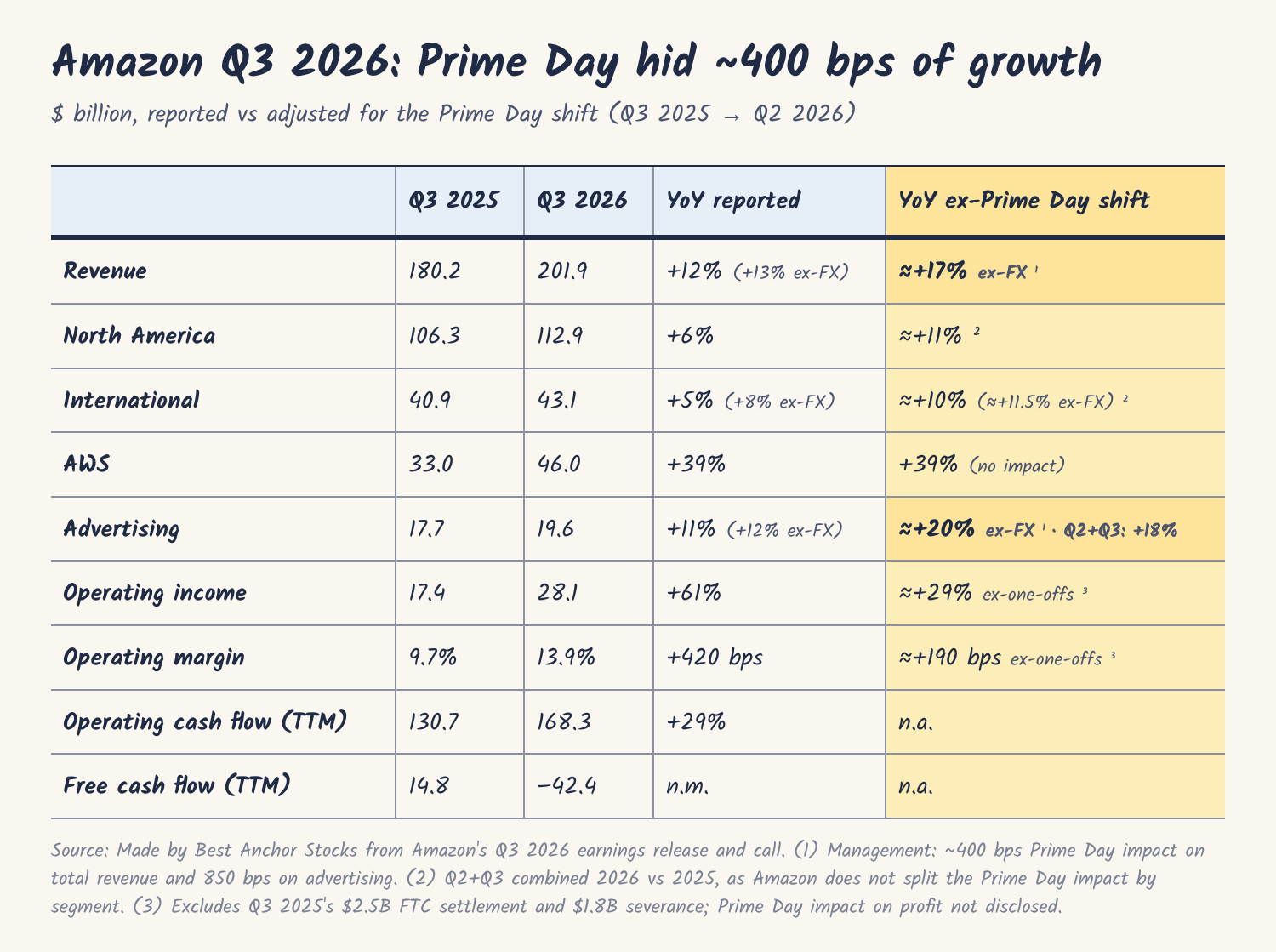
The headline figures portray a somewhat worrying quarter, especially on the retail side. Retail growth slowed to mid-single digits and ads slowed down materially to low-double digits, while operating income grew 61% to Amazon’s highest operating margin ever (13.9%). The explanation is two-fold and honestly one only had to read the press release to find out (many people didn’t even go as far).
For starters, the operating income comparison is pretty misleading because Q3 2025 included several non-recurring expenses such as the $2.5 billion FTC settlement in North America and $1.8 billion of severance. Excluding these one-offs, Q3 2025 operating income would have been around $21.7 billion, so “clean” operating income growth was closer to +29%. This is still pretty impressive, especially since it’s coming from profitable growth across the board (not just AWS). Secondly, the top-line figures were also distorted by Prime Day moving from Q3 into Q2 this year.
Let’s take a quick look at retail, which is always left out as the “ugly” sibling.
Retail continues firing on all cylinders
The cleanest way to get rid of the Prime Day noise is to add up Q2 and Q3 for both years. Doing this shows strong growth and improved profitability:
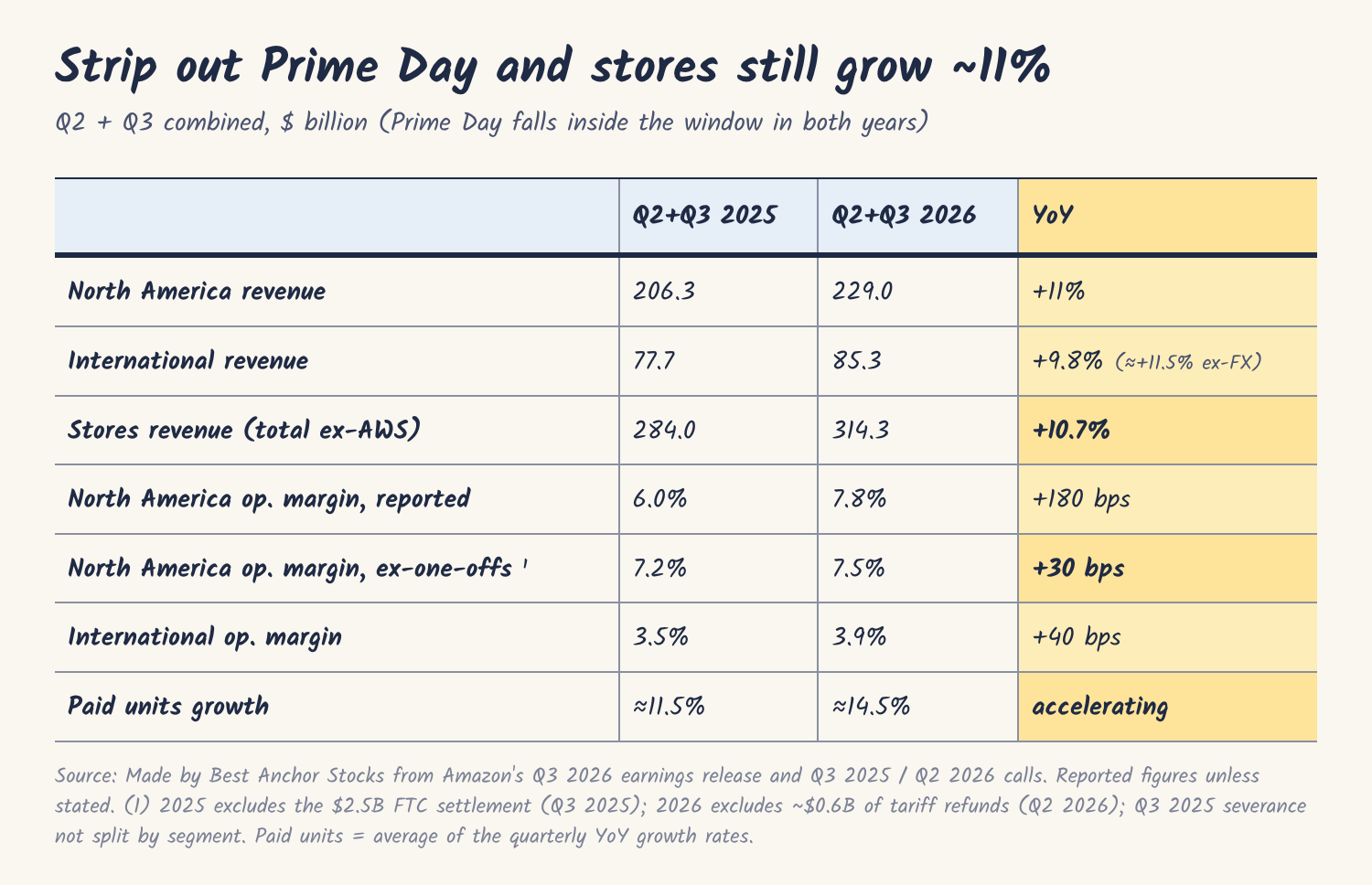
So, the bottom line is that Amazon’s store business is growing around 11% on a “normalised” basis. Double digit growth on this base is something we take for granted today, but we shouldn’t. The most underappreciated numbers in retail were units and how Amazon delivers said units. Jassy claimed that “Year to date, units have grown nearly 15% year-over-year.” This was a significant acceleration from 2025 (+12%) on a base of more than 30 billion items. Wowzers.
Margins continued improving, but the real story in retail is cost to serve. Shipping costs grew 11% against 12% unit growth. When excluding fuel and line haul inflation, they grew 8%, or about 400 bps slower than units. This means that Amazon is getting faster and cheaper simultaneously...
“We’re on track to reduce cost to serve per unit for the fourth consecutive year, which enables us to continue meeting or beating competitors’ prices, and cost effectively deliver a broad selection of fresh groceries and Everyday Essentials.”
Andy Jassy, CEO
This is something I’ve discussed in past articles, but it’s not only about margins. A faster and cheaper network allows Amazon to deliver categories it simply couldn’t serve profitably before (like perishables and prescriptions). Just for context...Amazon Now (ultrafast delivery) is already available in over 450 towns and cities with items ordered up 10x YoY, Amazon Pharmacy customers grew over 60% YoY and three-hour prescription delivery is live in more than 350 cities. The bottom line is that every new category the network can handle results in faster growth and a larger TAM for the retail business, and the ability to provide these categories relies on the optimization of the network. The best thing about these categories is that they tend to be rather “recurring”, which keeps people on the platform and imho significantly mitigates the agent (agent as in Muse) risk because it makes agents “need” Amazon.
Ads was a lowlight for many. Advertising grew 12% ex-FX, which is a sharp deceleration from 26% in Q2 and 22% in each of the four quarters before that. Management pointed to three timing effects:
“First, we shifted Prime Day into Q2 for most countries, moving significant sales and ad revenue that were in Q3 2025 into Q2 2026, a tailwind to our Q2 2026 rate and a headwind to Q3 2026. For advertising, that was 850 basis points sequential impact to Q3 year-over-year growth. Second, Q2 2026 included the first season of NBA on Prime, which last year’s Q2 didn’t have. Q3 does not include any NBA, it starts in Q4. Third, in Q3 2025, we changed our search engine marketing programs to drive more traffic to search pages on Amazon. [...] That helped accelerate advertising revenue growth starting a year ago, and we started lapping that in Q3. We expect year-over-year growth will return to the high teens in Q4.”
Andy Jassy, CEO
This is fine, but we are getting somewhat played by management here. Do you remember when management discussed last quarter that Prime Day was a tailwind to Advertising growth? Me neither, because it didn’t happen. We can do a similar exercise to the one above (taking Q2 and Q3 as a whole) but for Ads, which shows that Ads is growing just fine despite the inter-year volatility:
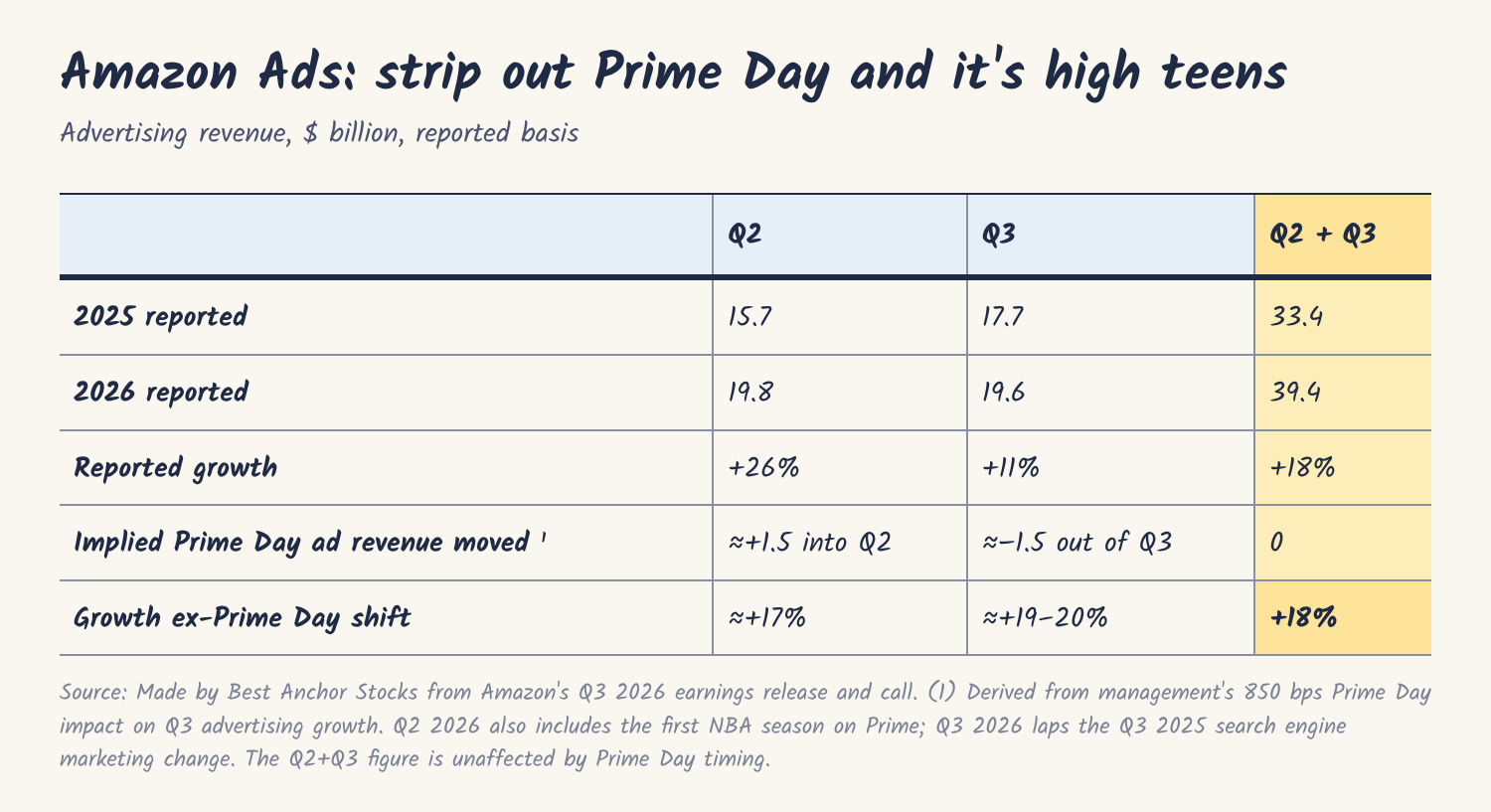
That said, there’s no denying that ads have genuinely decelerated from ~22% to high teens. I’d call this acceptable on a ~$80 billion revenue run rate. Of course, the long-term concern here is shopping agents and how these might impact ads. Management addressed this upfront...
“The natural question is whether agentic shopping from external horizontal agents is meaningfully impacting Amazon Ads. The answer is no. Few customers are doing much shopping this way yet, as the experience is still not great nor more convenient than coming to a retailer directly to research or one-click order there.”
Andy Jassy, CEO
I do agree here because the shopping experience on Amazon is as convenient as it can get, and you also get a bunch of “perks” that many are unlikely to ignore (like faster delivery) due to agents, but technology is definitely advancing fast and “monitoring the situation” seems like the way to go here.
Why the hyperscalers always win
Let’s begin with the quarterly figures. AWS revenue grew 39.3% to $46 billion (now at a $184 billion run rate) and enjoys a 38.7% operating margin, with depreciation growing 63% YoY to $9.2 billion (20% of AWS revenue). For those looking for “lowlights,” you can find one in the sequential figures. AWS added $3.8 billion QoQ versus $4.6 billion in Q2, but the caveat here is that growth is very likely an output of capacity. Jassy somewhat hinted at this being the case:
“The amount that we add every quarter is not equal. We have a lot of capacity coming as well.”
All of this capacity evidently comes at a cost, which has been the subject of many debates. Cash Capex was $75.9 billion in Q3, bringing TTM free cash flow to an outflow of $42.4 billion.
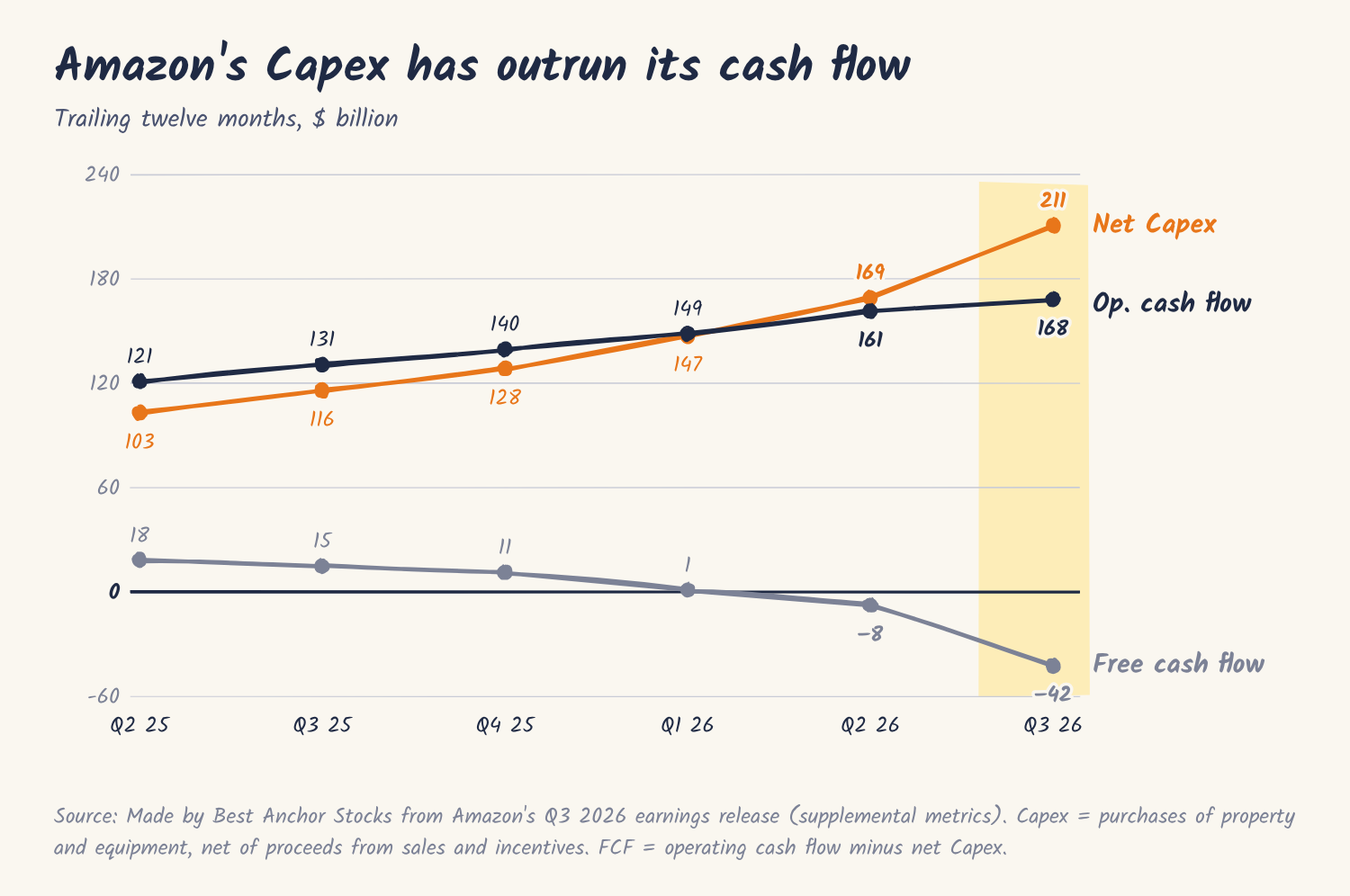
Management is still guiding to ~$220 billion of Capex in 2026 and “meaningfully more“ in 2027. But what does Amazon expect to get for all this money? Accelerating growth at a $184 billion run rate. Not bad I’d say!
“With our continued pace of innovation, new core and AI functionality, enterprises wanting to run their core and AI workloads in AWS, and the amount of capacity that we’re adding each year, we believe that AWS can grow north of 40% in each of 2027 and in 2028 and be a trillion-dollar revenue business in the next five to 10 years.”
Andy Jassy, CEO
Amazon’s forward-looking commentary here is unprecedented, but visibility is also supposedly unprecedented. I am not going to outright judge the quality of said visibility, but I will say that the quality of AWS’ AI revenue is higher than I had imagined...and the reason is inference. Inference is ultimately one of the reasons why “hyperscalers always win.”
Jassy described the AWS flywheel (borrowing Jim Collins’ definition from Good to Great, which I didn’t particularly enjoy) like this:
“In AWS, having the leading functionality, security, and operational performance can’t help but drive customers to run their apps and store their data in AWS, which can’t help but drive AWS AI demand because customers prefer their production inference to be near the rest of their data and apps, which can’t help but drive core AWS demand because AI uses core for work like reinforcement learning, post-training, and tool usage, which can’t help but drive reinvestment back into our broader AWS functionality. This is a different model than primarily hosting GPUs or renting short-term data center capacity.”
Andy Jassy, CEO
That last sentence is a pretty big (and unexpected) jab at the neoclouds (which I will discuss in more detail later). The logic is pretty simple. Training can happen anywhere there is power and GPUs, but inference in production needs to sit next to the applications and the data that the enterprise is already running. Due to their historical core cloud businesses and their reputation, that data overwhelmingly sits in the hyperscalers.
Everything discussed above comes “to life” in one data point that honestly took me by surprise:
“Enterprises are still very early in using inference at scale, and yet inference already accounts for well over half of AWS’s AI revenue and growing, and we have a lot of training revenue as well.”
Andy Jassy, CEO
The bear case on pretty much all the clouds (hypers and non-hypers) has historically been (and still is) that the AI money was only going to the labs’ training clusters and that this money would eventually fade away. The reality, though, is that inference (the recurring part of AI spend) is already “well over half” of AWS’ AI revenue, and this is before enterprises have deployed it at scale...
AWS Backlog grew triple digits to $578 billion (from $496 billion in Q2), which included OpenAI’s $100 billion expansion over 8 years and Anthropic’s $100+ billion over 10 years. I would evidently take this backlog rather skeptically. A good chunk of it likely comes from two customers (OpenAI and Anthropic) who are burning cash and whose ability to honor 8-10 year commitments depends on them continuing to raise capital or on them becoming very profitable fast. Is this possible? Yes. Is it probable? Not so sure. This is the reason why I think that the inference stat matters more than the backlog. The good news for investors, though, is that the market also doesn’t seem to be taking the backlog of the hyperscalers seriously.
The second reason why the hyperscalers likely win is because the models seem to be “commoditising” and this is a dynamic which favors the aggregator/distributor. Jassy was very explicit about how he sees the model layer playing out:
“I’ll say in the next two to three years, I think there are going to be 6-8 models that are about as good as each other, or at least good enough for 95%+ of the workloads. Most customers are going to use multiple models, and many will use multiple models in the same generative AI application.”
Andy Jassy, CEO
This doesn’t bode particularly well for the LLMs, but it bodes very well for whoever sits between those models and the enterprise (cough cough, the hyperscalers). This is ultimately what AWS Bedrock is...an LLM marketplace with Anthropic, OpenAI, Kimi, GLM, Grok and others, plus the security and access controls enterprises need (which is what sets hyperscalers apart). Fortune 500 companies are spending nearly 7x more on Bedrock YoY, token volume grew nearly 17x, and Jassy believes Bedrock “could be a service as large as EC2.” In other words and simple terms...Amazon is basically commoditising the model layer and keeping the relationship with the customer. This, by the way, would also be good news for many software providers.
Security is also interesting optionality for the hyperscalers. Jassy mentioned that a significant share of tokens over the next year or two may end up being “security,” so it makes a lot of sense for the clouds to enter this arena as LLMs are finding vulnerabilities “at unprecedented rates.”
And then we have the chips advantage. Just to give a bit of context...Amazon’s chips business continues to grow triple digits, revenue commitments for both Graviton and Trainium grew more than 20x YoY, and customers using Amazon’s custom silicon saved more than $2 billion in Q3 alone. Most of Bedrock already runs on Trainium, with management hinting at third-party Trainium sales starting late 2027. Evidently this begs a relevant question:
Why sell chips to third parties if AWS is supposedly supply-constrained and earning great returns?
Very fair point, and here’s Jassy’s answer explaining the trade-off:
“If you sell externally, you are able to realize more revenue in the short term because you get to recognize the revenue as soon as it leaves your inventory. On the flip side, if you decide to use it inside your cloud in the form of EC2 instances or Bedrock, you actually will end up driving more absolute revenue and free cash flow from those chips because you get to use them over five to six years and drive revenue for a longer period of time.”
Andy Jassy, CEO
To be honest (and I might be a bit picky here), does the fact that they are signaling late 2027 as the beginning of this new venture mean that this is when they expect supply and demand to balance out after the 2027 Capex ramp? No idea, but it surely sounds like it!
Andy Jassy also noted that the number of companies with a significant cloud business and a chip strong enough to sell externally “is effectively two“ (the other one being Google), and that everybody gets an allocation from the same foundry. This likely implies that TSMC is going to remain a bottleneck for a while, which makes the stock quite interesting at its current multiple (should do some more work here).
The flipside of all of this is Nvidia. The reality is that Nvidia’s ecosystem is very hard to beat in a training-heavy world, but maybe not so much in an inference-heavy world. In the latter, it’s price performance that matters and that is exactly what ASICS are built for (especially for 80%+ of workloads). Could Nvidia face some issues in an inference world? Potentially, but still TBD.
Yet another reason why hyperscalers win lies in ownership. The last question of the Amazon call was about margins, and Jassy explained why hyperscalers supposedly out-earn everyone (yet another jab at the neoclouds):
“If you think about margins in the cloud space and you are looking at different players and what their cost structure looks like, there are a few things to pay attention to. The first is for their data centers, how many of them are they actually buying or long leasing versus doing colo or neoclouds? Neoclouds are about 3,500 basis points worse in operating margin than if you long lease them.”
Andy Jassy, CEO
Even though this is Amazon’s own estimate (never ask a barber if you need a haircut), this is a significant delta which only adds to the cost savings of ASICS and results in Amazon being able to price lower in what could be considered a “commoditized” market. Now, there’s ALWAYS a flipside. Owners face supply gluts while owning the asset, whereas one would think that renters enjoy much better protection. I don’t know whether to believe this myself (even though I wrote it) as many of these renters are ultimately signing commitments that make their risk profile come closer to those of owners, basically making them assetless owners.
So, now really, why do the hyperscalers always end up winning?
Putting all of the above together, I’d argue the hyperscalers win in pretty much every AI scenario for a simple reason: they “own” the demand. Hypers own the enterprise relationship, the data, the apps, the security layer and (to a great extent) the silicon. The supply chain (chips, memory, power, neoclouds) likely captures a lot of the value during the build-out because they become the bottleneck, but bottlenecks eventually get resolved and/or shift elsewhere.
Jassy (and the hypers) is also making a bet on Jevons’ Paradox.
“The cost of compute has come down a lot and I think it will come down meaningfully more.”
Lower prices per token sound terrible for revenue, but this is Jevons’ Paradox at work. Every time compute gets cheaper we supposedly end up using a lot more of it, and there are numerous examples of Jevons’ Paradox playing a role in tech penetration over time. As I wrote last quarter, the “scarcity premium” is helping the hyperscalers today, but the long-term model doesn’t really depend on it...or does it? Hello midterms!
Democrats took both chambers of Congress by storm this week, and the data center buildout was on the ballot pretty much literally. At least 33 US communities voted to restrict them (bans, moratoriums, energy caps or mandatory public votes), with only one measure going the other way. Voters in Trenton, Ohio, passed a ban on data centers above 25MW, which blocks the city’s plan to annex land for a 1,000MW Amazon campus. The newly elected governors of Texas, Ohio and Georgia have all floated some form of moratorium or pause on new construction. And then we have X posts like this one:

But here’s the catch...all of these target new capacity, theoretically making what’s already built significantly more valuable. This would theoretically extend the “scarcity premium” and make the supply glut less likely. Now, it’s also worth noting that the AI race seems existential to remain the first power, and neither Democrats nor Republicans like to put that under question so I highly doubt we’ll see a complete stop or even a slowdown in AI ambitions.
And...you guessed it, there’s a flipside! Amazon’s 40%+ growth guide depends to an extent on capacity it hasn’t built yet, so those growth targets could get scraped. Growth could potentially be covered by higher value realization in the existing asset base and Amazon could well start to generate significant cash flow if its Capex trajectory is impaired (again, hyperscalers win!). So, is the AI buildout slowing? Is it accelerating? Hyperscalers seem to win long-term no matter what.
Valuation: what are we paying for AWS?
I’ll keep this one brief. If we take management at its word (40%+ growth in 2027 and 2028), AWS reaches ~$245 billion of revenue in 2027 and ~$344 billion in 2028. At a 35% EBIT margin (below today’s 38.7%, as the AI mix and depreciation start to weigh on margins), that’s ~$86 billion and ~$120 billion of EBIT, respectively.
At $266 per share, Amazon’s market cap is ~$2.9 trillion and its EV ~$3.05 trillion. If we value the stores business at 20x EBIT and haircut the Anthropic stake by 50%, this is what’s left for AWS:
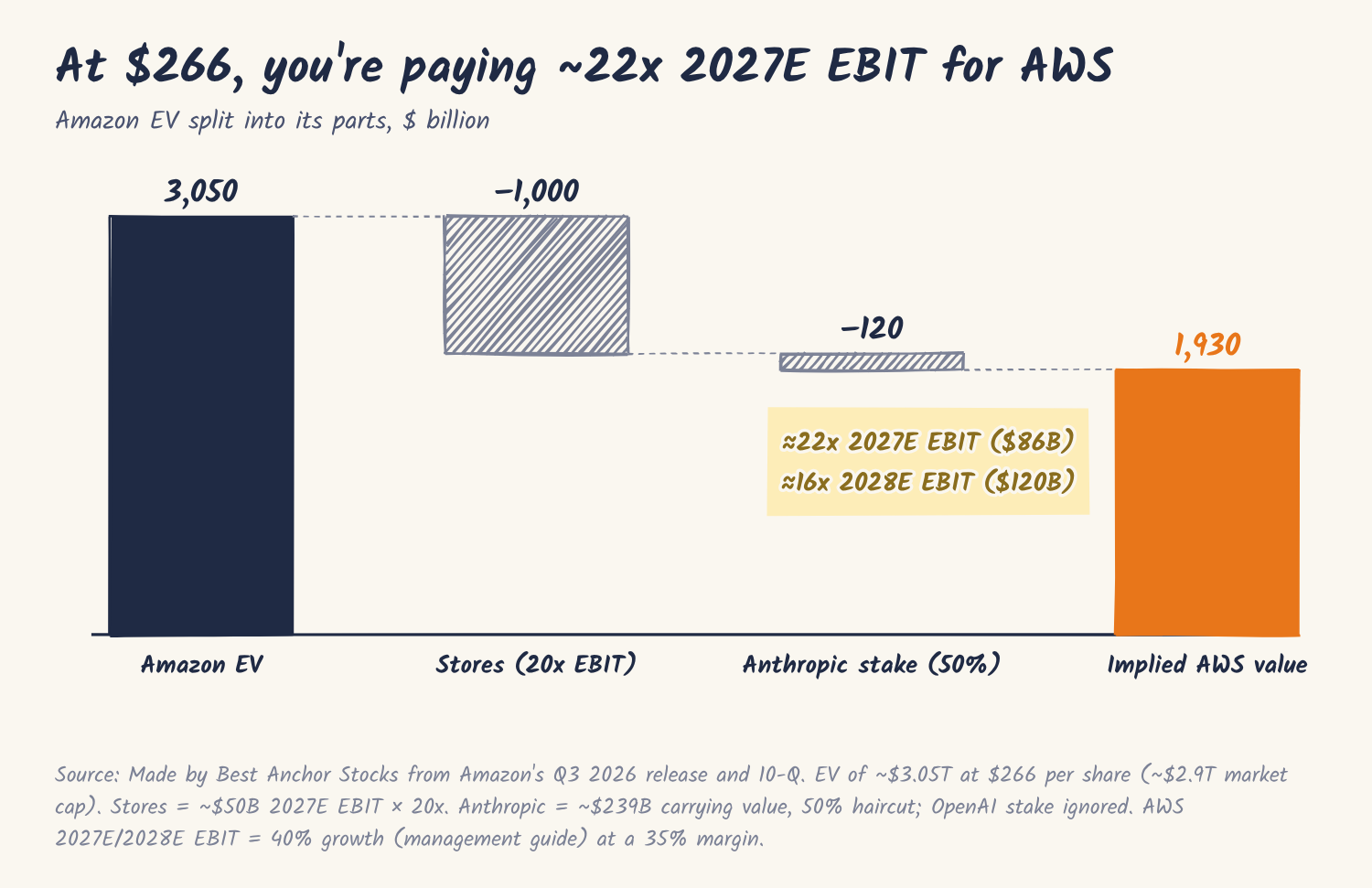
That’s ~22x 2027E and ~16x 2028E EBIT for a business growing 40% and generating 35% EBIT margins. That looks pretty undemanding to me, but of course the market is worried about one of two things, or both:
Growth sustainability
Margin sustainability
Both would theoretically become true (and not in a good way) in a supply glut scenario, so what happens then? The problem here wouldn’t be revenue, but mainly depreciation. AWS added $123 billion of net PP&E in nine months, and that’s going to hit the P&L regardless of demand. Holding the rest of AWS’ cost base at Q3 levels, margins would fall back to the mid-20s (similar to the 2022-23 optimisation trough) and the multiples would become significantly more demanding:
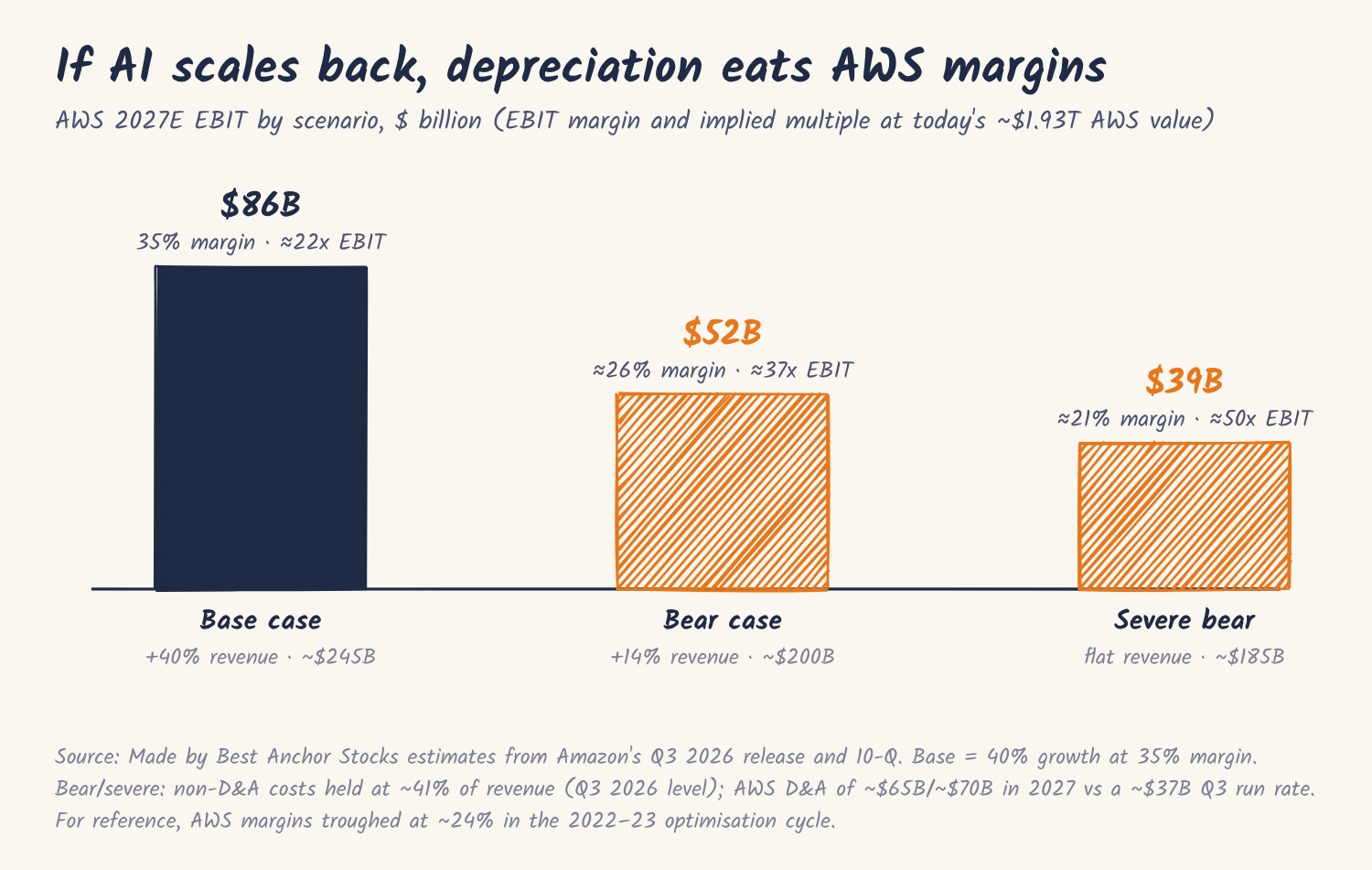
Evidently any investor must have a view on where AI is going, and I’d say that the fact that more than 50% is inference and growing significantly derisks the thesis. This “glut” situation is also where the hyperscalers shine over the long term (very important caveat).
Chips have short lead times, but the shells last 30+ years, so Amazon could simply stop buying chips. Cutting Capex to ~$120 billion against $168 billion of TTM operating cash flow would swing free cash flow from -$42 billion to roughly +$50 billion, cash that could go to buybacks at depressed prices (because prices would most likely be depressed) while the shells fill up over time (as they did in 2023-2024). Meanwhile, other business models across the AI supply chain get zeroed...
So, the bottom line is that if AI keeps scaling, you’re buying AWS at ~22x 2027E EBIT; if it slows, Amazon turns into a cash machine. Either way, the hyperscaler is the one left standing, although I am not denying that the stocks of the hypers would get pounded (let’s be clear).
I’ll close this article with Jassy’s closing quote:
“Would it be more convenient if this type of acceleration and opportunity happened over 25 years and you could spread the CapEx over 25 years? Yeah, it might be more convenient, but that’s not the world that we live in, and that’s not the opportunity. We can fund this plan. I think it will forever change the size of Amazon.”
Andy Jassy, CEO
Based on Amazon’s earnings I am making a portfolio move.