


You can read this article in PDF format here.
If you only looked at the headline numbers, Stevanato’s Q3 2026 would read like a pretty uneventful quarter. Revenue grew 8% organically, adjusted EBITDA margin expanded 150 basis points to 27.2%, Fishers broke even at the gross profit level for the first time and full-year guidance was reiterated. Not outstanding, but good enough, right? Right?
The not-so-minor problem is that the market doesn’t tend to price what has just happened, but rather what’s coming, and things weren’t pretty there. What’s coming is a 2027 that, in management’s own words, will see a “temporary moderation of growth“. In a market where “we only buy accelerating top lines” this is precisely what you don’t want to hear.
Stevanato now low single digit revenue growth in 2027, well below the high-single-digit to low-double-digit range of its long-range plan (aka “LRP”). The “air pocket” is pretty concentrated on one GLP-1 customer (likely Novo Nordisk) across one program (Nexa Syringes), which surfaces some concerns (discussed in more depth later). The stock did not like the news one bit and opened down a whopping 30%:
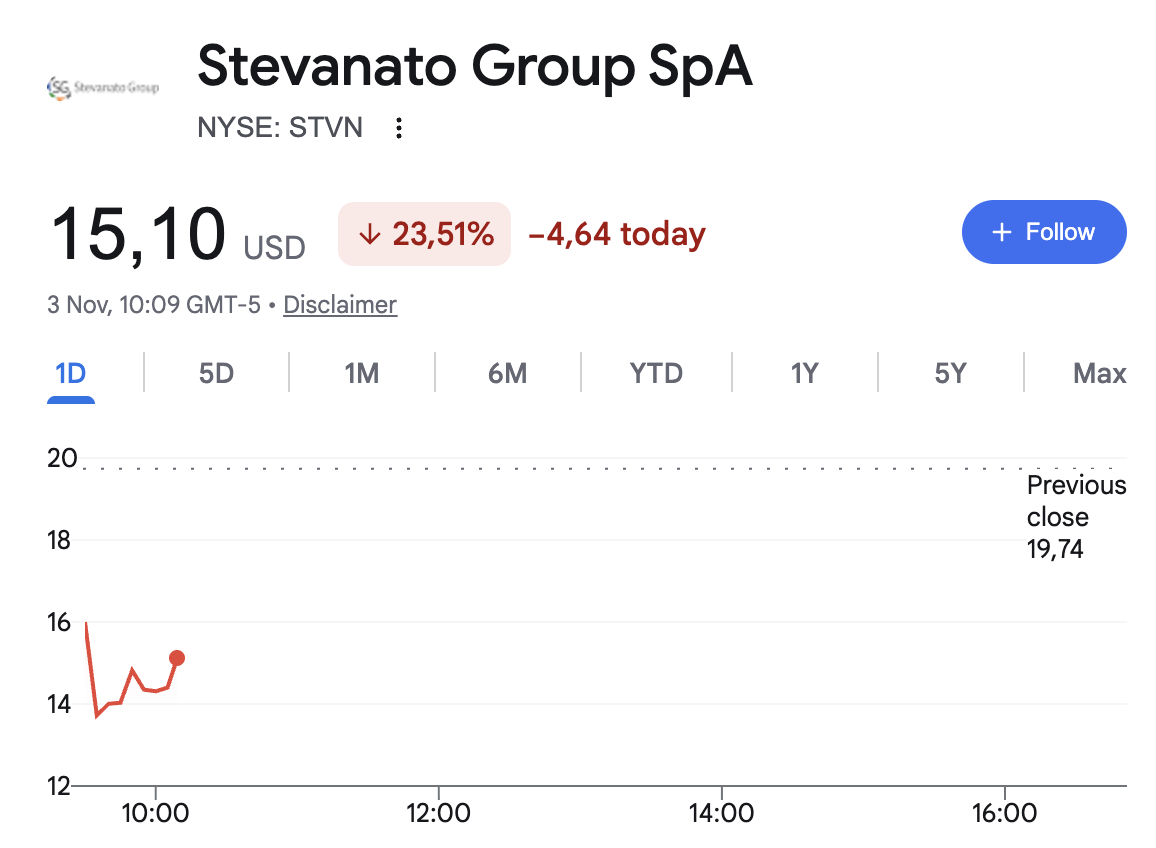
I’ll go over two things in this update. First, the numbers, which were actually decent. Second, and most importantly, the 2027 air pocket: what it is, why it is happening, what management is doing to fill it and whether it changes the long-term thesis. By the end you should have a clear picture of why I believe this is (or isn’t) a thesis-breaking event.
Let’s jump right into it.
Q3
Let’s start with what was good, because there was quite a bit of it (the market doesn’t agree though). Revenue grew 8% organically to €326.1 million and profitability kept moving in the right direction:
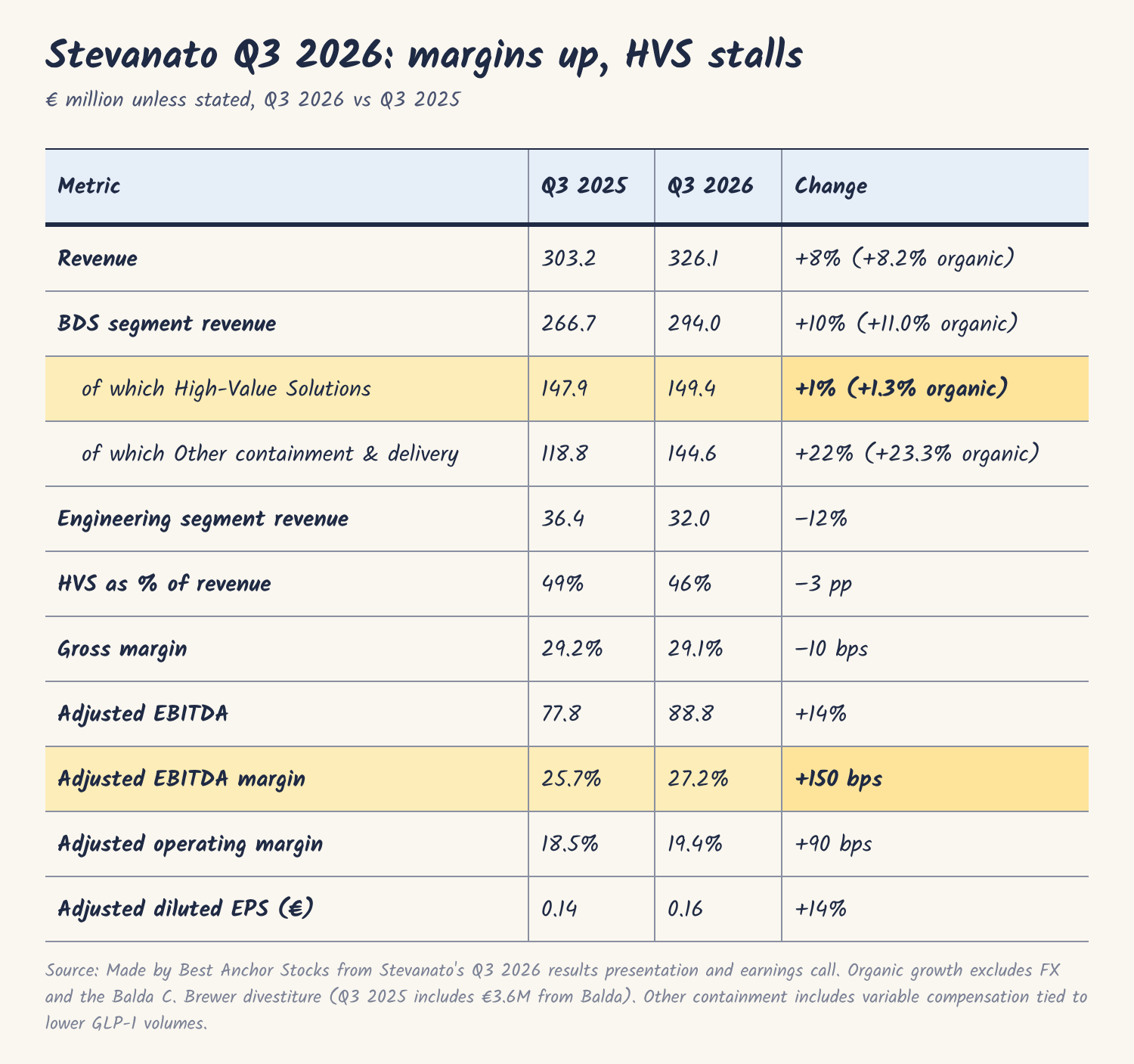
Now, the devil tends to be in the details, and this wasn’t different this time. The BDS segment grew 11% organically, but the growth didn’t come from where we have been accustomed to. HVS (High Value Solutions) grew a meagre 1% and its weight on total revenue fell from 49% to 46%. The reason is that GLP-1 revenue declined in the quarter (a significant surprise based on what peers had reported) and represented around 17-18% of group revenue, down from 22-23% in Q2. As discussed in the intro, a big chunk of that GLP-1 revenue is Nexa syringes (an HVS product), but there were also some good news in HVS revenue:
“Revenue from non-GLP biologics increased over 30% in the quarter, offsetting the decline from GLP-1s. On a year-to-date basis, revenue from non-GLP biologics was up 13%, demonstrating once again the diversity of the broader demand landscape.”
— Franco Stevanato, CEO, Q3 2026 earnings call
This is good news and it’s worth keeping it in mind because it will be relevant later on.
The 23% organic growth in Other containment and delivery solutions also deserves a word or two. Part of it came from bulk cartridges and the first CMO contracts for drug delivery systems in Fishers, but it also includes variable compensation paid by a GLP-1 customer for taking lower volumes than committed (i.e., Stevanato got paid for product it didn’t deliver). This is the take-or-pay contracts working as they should, but Marco (CFO) explained why they decided to book it in non-HVS while also mentioning that it was trivial both in the quarter and the year:
“We decided to put there because we did not deliver the product, and we didn’t want to inflate our main KPIs, like high-value solutions and GLP-1 revenue.”
“What I can tell you is that it’s not relevant in the quarter in the year.”
— Marco Dal Lago, CFO, Q3 2026 earnings call
Even if minor, the above ultimately means that we can’t fully separate underlying growth from contractual compensation. What does this mean? That we should take the 11% BDS organic growth with a small pinch of salt.
Engineering remained weak (surprise!). Engineering revenue fell 12% to €32 million, although cost optimisation lifted the operating margin by 220 bps to a still meagre 1.1%. Franco was candid about where the issue lies but honestly the engineering underperformance is becoming a tad tiring:
“So, overall, from operational point of view, we are fine, we are on track. Where we are struggling today is the conversion of the pipeline into orders.”
— Franco Stevanato, CEO, Q3 2026 earnings call
Consolidated margins were a highlight again. Adjusted EBITDA margin expanded 150 bps to 27.2%, with Fishers breaking even at the gross profit level for the first time. This is even more relevant when one considers that only around 50% of Fishers’ capacity is installed and the plant is supposed to be fully ramped by the end of 2028 (i.e., steady-state margins are still far from where Fishers is today).
Management also reiterated FY2026 guidance, but with yet another “mix” change. BDS should now grow organically at double digits at the midpoint (upgraded), offsetting (again) a weaker Engineering (downgrade).
All in all, a solid quarter at first glance, but evidently the quarter was not why the stock dropped 30% at open. Let’s take a look at that.
The 2027 air pocket
This is the part of the call that really matters to understand the market’s reaction and why earnings were ultimately not great. Let’s take it step by step. What exactly is going to happen in 2027, why, and is it really temporary as management claims?
Stevanato is still working through the forecast process with its customers, and while “official” 2027 guidance will only come in March (Q4 earnings), management decided to rip off the band-aid in Q3 by giving the market a rough idea of what’s coming:
“In the short term, the adjustments to anticipate the GLP-1 volume will temporarily moderate growth in 2027. Based on what we know today, we believe we can still grow low single digit in 2027, driven by favorable secular trends across the broader biologics area. Without this temporary headwind in 2027, we believe that we would have grown in line with our long-range plan of high single digits to low double digits.”
— Franco Stevanato, Chairman & CEO, Q3 2026 earnings call
So, simply put: 2027 goes from HSD-LDD growth to LSD growth, with a return to “more normalized growth“ expected in 2028. Management also expects HVS to keep growing, margins to keep expanding and free cash flow to remain positive next year.
Let’s put some rough numbers around this (this is my own back-of-the-envelope math). The gap between, say, 2-3% growth and the 9-10% midpoint of the long-range plan is around 7 percentage points. On a ~€1.27 billion revenue base, that’s in the region of €85-90 million of revenue that “misses” 2027.
Management also shared that they are backfilling a significant portion of this lost revenue with non-GLP-1 demand. If this is the case, why should growth in 2027 be lower than the LRP? Because backfilling isn’t instant. In this industry, turning pipeline into revenue takes several quarters, and 2027 is likely going to be the “transition year:”
“Today, if I capture your second question, we believe it will be on the range of low single digit in 2027 because we have already backfilled most of these syringes. These are high-value product syringes, Nexa, but we are not complete to have completed this backfill because this is taking time. We have a strong pipeline of new customers coming, but we need also still some quarters to finalize additional validation for new program.”
— Franco Stevanato, CEO, Q3 2026 earnings call
The air pocket has a very specific origin. It’s one customer (likely Novo) and one product line (Nexa syringes). Stevanato has historically had a significant exposure to Novo, but Franco was very clear in claiming that he doesn’t see this as Stevanato losing market share:
“We are not concerned that is that we are losing market share at all. Even more is the opposite.”
— Franco Stevanato, CEO, Q3 2026 earnings call
Interestingly enough (and this makes the concentration risk even worse), the same customer is also behind the delayed orders in Engineering, which means the headwind isn’t limited to BDS:
“The delay that we are facing and that will generate temporary headwind 2027, both in the BDS segment and engineering, are tied to the same customer, correct.”
— Franco Stevanato, CEO, Q3 2026 earnings call
What this episode really does is bring to the surface a risk that was always there... customer concentration. The reality is that one customer (and one product line) was able to take Stevanato’s growth from high single digits to low single digits for a full year. It’s also fair to say that this is pretty much inherent to the GLP-1 business as it stands today, because the commercial market is basically made up of two players. Management acknowledged as much:
“Currently, our GLP revenue is predominantly tied to commercial products from the main originators. However, we are actively working with over 30 global customers for multiple programs in various stages of clinical development. These new customer programs are expected to play an important role in future growth, and they utilize high-value products, including our EZ-fill platform and proprietary delivery devices.”
— Franco Stevanato, CEO, Q3 2026 earnings call
This is where I see the silver lining (is there one?). Even though I acknowledge that the 2027 guide is terrible, the Stevanato that comes out of 2027 should be a more diversified company. Within GLP-1s, the base of customers should broaden as new assets, new indications and the upcoming patent cliffs bring biosimilars to market:
“Beside the two big originator, there is a lot of new customer coming on board. In Stevanato Group, we are active with more than 30 customers with more than 50 programs through most of our high-value product.”
— Franco Stevanato, CEO, Q3 2026 earnings call
And outside of GLP-1s, “other biologics” should increasingly take share as the pipeline comes to fruition. Worth noting that the non-GLP biologics that grew over 30% this quarter are spread across many more customers and therapeutic areas (immunology, oncology, rare diseases, biosimilars...), which is something Franco already pointed out in Q2 (maybe preparing the market for what was coming in Q3?):
“GLP-1 is a well-established opportunistic tailwind that will continue to grow in the next years. Biologic, it will be much more spread to many clients and many therapeutic area. If you go to combine all these opportunities, going to be much bigger in next year to come compared to GLP-1.“
— Franco Stevanato, CEO, Q2 2026 earnings call
So, simply put, 2027 is the year in which Stevanato will pay the price for its GLP-1 concentration, but the backfill the company is “forced” to make should leave it with a broader customer base and, in my opinion, a less fragile growth profile from 2028 onwards.
This is ultimately the flipside of Stevanato’s moat. The same validation process that makes customers sticky (once a drug is registered with a container, switching is a pain) also means that freed-up capacity can’t be refilled overnight, hence the air pocket. The bottom line is that the demand exists, but it can’t be converted into revenue fast enough to fill 2027.
Stevanato’s wide range of sources to backfill this air pocket were discussed during the call...
Non-GLP biologics: revenue grew over 30% in Q3 and 13% year-to-date, more than offsetting the GLP-1 decline this quarter.
Nexa syringes with other customers: the freed-up capacity is being re-validated with new customers, and some capacity was moved between regions to serve higher demand elsewhere.
Alba: the first high-volume Alba syringe line was qualified in Piombino Dese in recent weeks.
EZ-fill cartridges: running at full utilisation and, per Marco, “fully booked for most of 2027”, with the new LT400 lines in Latina expected to start generating revenue in 2027.
EZ-fill vials and devices: Fishers shipped its first commercial EZ-fill vial order, and the device business (Alina in Germany, CMO work in Fishers) should start contributing commercial revenue in 2027.
Stevanato is ultimately asking the market for something that the market rarely displays: patience. And, to an extent, the market is right to shoot first. Recent earnings bring a couple of questions to the table...
Is Stevanato more cyclical than previously anticipated?
Is the company at the mercy of one single customer?
Both things seem true today, but I do think that 2027 should de-risk the thesis.
The real question is whether this is a one-off air pocket or something that Stevanato will experience relatively recurrently. Management’s “temporary” argument rests on two pillars. First, that GLP-1s are still at an early stage (global patient penetration below 10%) and that Stevanato is working with over 30 GLP-1 customers on more than 50 programs, many of them biosimilars that will come with the upcoming patent cliffs. Second, that the broader biologics pipeline (more than 9,000 injectable assets in advanced stages, over 60% of them biologics) is strong enough to fill the gap on its own. In short, they believe that it’s not a secular problem in any way:
“This is a traditional historical customer, is a market leader. I think that we are not concerned at all. We consider more a temporary headwind in 2027, not affected long-term range.”
— Franco Stevanato, CEO, Q3 2026 earnings call
Peers back this up. West Pharmaceutical grew 11.9% organically in Q3 2026, with High-Value Product components up 20.3% and biologics up 23.2% organically, while GLP-1s (21% of its sales) remain its fastest-growing category. Schott Pharma raised its FY2026 guidance to 5-6% growth at constant currency and pointed to “the continued high demand for prefillable glass syringes for GLP-1 medications“. In other words, nothing in peers’ numbers suggests a broad slowdown in GLP-1 or biologics demand, which supports the view that Stevanato’s problem is customer-specific (or you could say that it’s “Stevanato specific”)
Even though earnings were bad, I believe that the market’s initial reaction was overblown. If 2027 is indeed a temporary bump, the company is unlikely to be worth 30% less today. Does this mean that the stock drop was undeserved? Not at all. I actually believe Stevanato deserved to get punished today and I went into the call very skeptical about my current position (i.e., thinking about reducing it). After listening to the call and after seeing the -30%, I flipped and added back the shares I had sold after buying at $14-$15 in March. I felt like I wanted to puke while doing so, but time will tell if it was a good decision.
Have a good day,
Leandro
I've had so many "I felt like puking" situations this year, but they typically are the best ones in hindsight if our research was right.
Edenred at 16 felt like a punch in the gut. Innoscripta too lately (jury still out if doubling down was smart or not).
STVN is compelling to add the shared back I sold over $20, but there are also so many other cheap stocks right now.
Non-GLP biologics up over 30% in the quarter is the part I'd hang onto, and Fishers breaking even at gross profit with only ~50% of capacity installed leaves a lot of operating leverage on the table. Do you think the 2027 air pocket is mostly one syringe program, or wider than that?