In my previous notes on Medpace, I had explained why I think management sometimes seems perfectly happy to watch the stock crumble. The reason is that Medpace returns capital only through buybacks, but it refuses to do so at hefty valuations.
The stock ran significantly above $600 after Q2, so August Troendle (Medpace’s founder and CEO) believed it was a good idea to sell tens of millions worth of his shares while not repurchasing a single share in Q3. Something that seems obvious (not repurchasing while the CEO is selling a large amount of stock) is something that other companies do regularly. One could go as far as to say that many management teams are using shareholder’s money to repurchase their own shares...but that’s not common practice at Medpace.
If we combine the lack of material repurchases with Medpace’s cash-generative nature (enjoys negative working capital dynamics), we get a cash pile that keeps on growing: from $497 million at the end of 2025 to $705 million at the end of September. And this growth comes after having spent $295 million on buybacks in Q1 at an average of roughly $417 per share (or 36% lower than where the stock sits today).
The chart below is always great to judge whether a management team knows what its business is worth. Needless to say, Medpace’s management does seem to know what their business is worth and uses buybacks opportunistically:
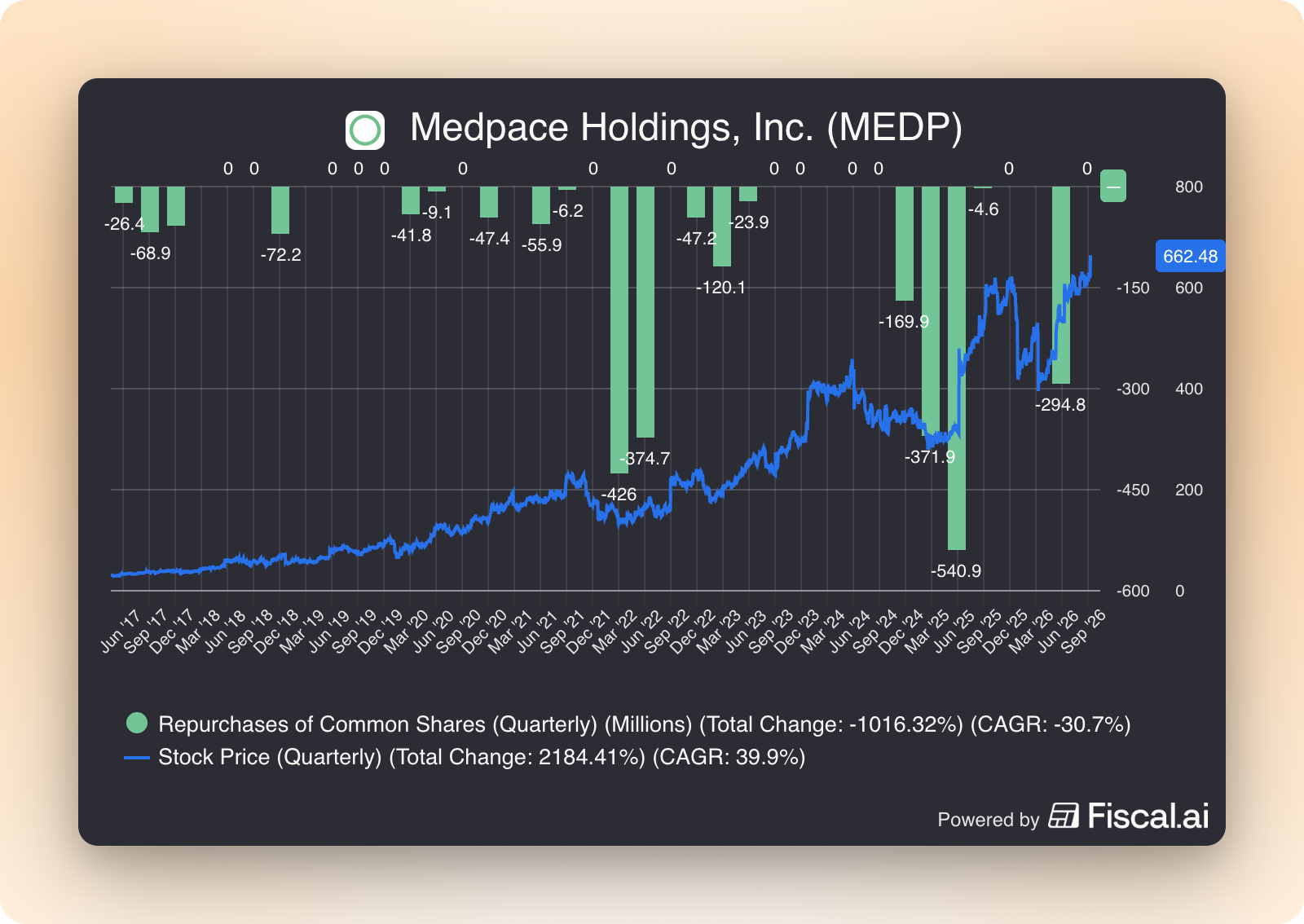
Now, I was slightly wrong with Medpace this quarter. Insider selling, a rising cash pile, and an elevated stock price made me think that management wanted to “create” a dip (i.e., that they would not be precisely optimistic during the call). This did not happen to the extent I thought I would, but they’ve nevertheless given themselves plenty of firepower for when it eventually comes.
Effective October 20th, the board terminated the old repurchase authorization ($527 million remaining and set to expire at the end of 2026) and approved a new one of up to $1 billion that runs through December 2028. That’s roughly 5–6% of the current market cap, and the cash on hand already covers about 70% of the authorization. Owning a cash generative business with a management team that deploys capital into buybacks opportunistically is an underrated advantage through drawdowns. Medpace’s stock might fall significantly, but you know that management will be “returning” cash to shareholders at the best possible time (evidently this assumes the business has not been impaired).
This pattern has held for Medpace for a long time: when there’s a sell-off, the buyback king strikes again. What made this quarter interesting is that it was somewhat the opposite of what we’ve been accustomed to. The leading indicators finally turned while the lagging indicators started to slow down, which means that the feared revenue cliff might have to wait a bit longer.
Let’s get on with it.
The numbers
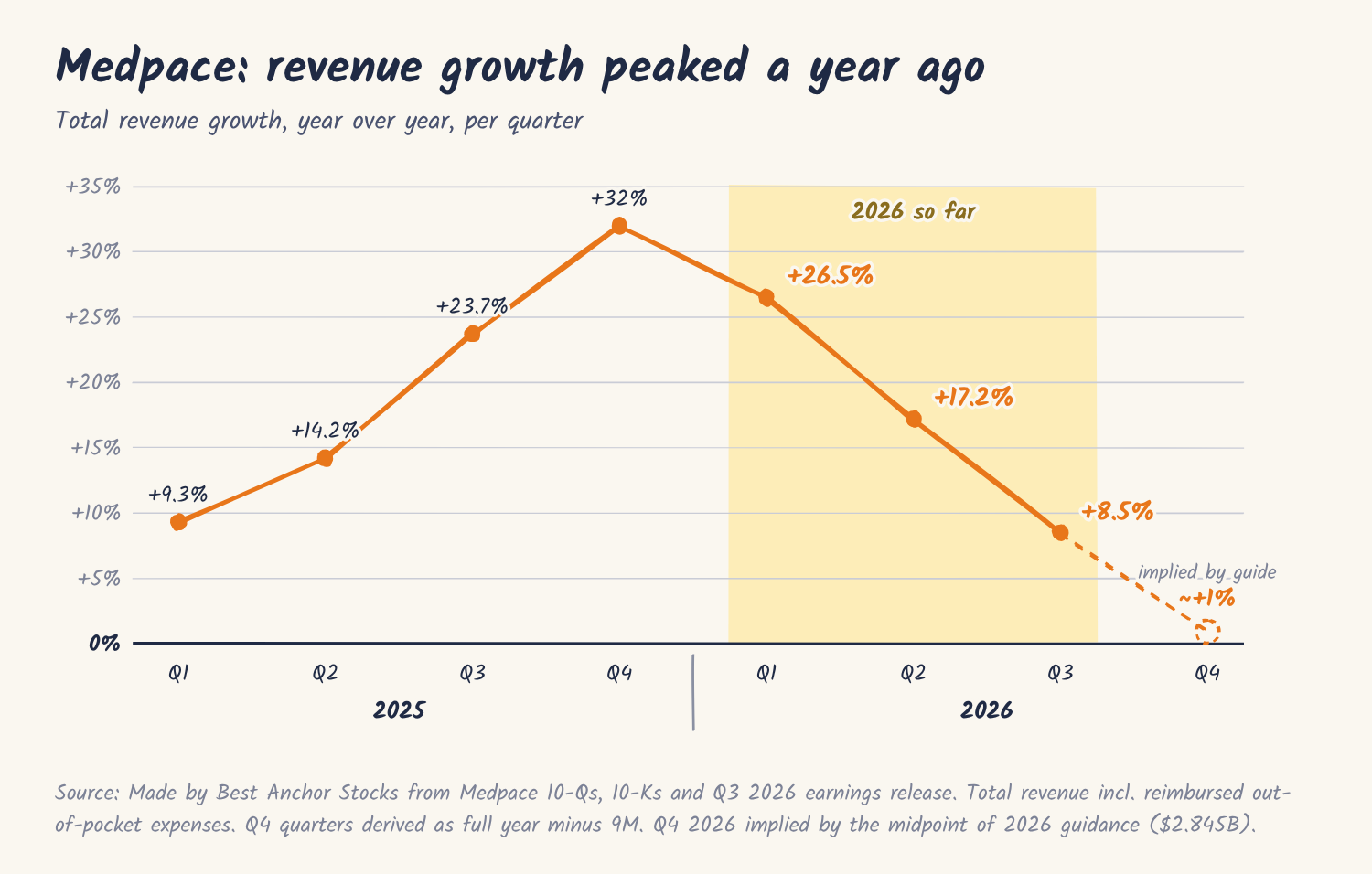
The headlines looked mixed on the surface, with a relatively “weak” top line and extremely strong margin performance. Revenue grew 8.5% to $716 million, the slowest growth in quite a while and minimally outpacing expectations. This shouldn’t have been a surprise, though, as management’s guide already implied a sharp slowdown in H2 which will supposedly continue in Q4 (comps have been getting tougher through the year):
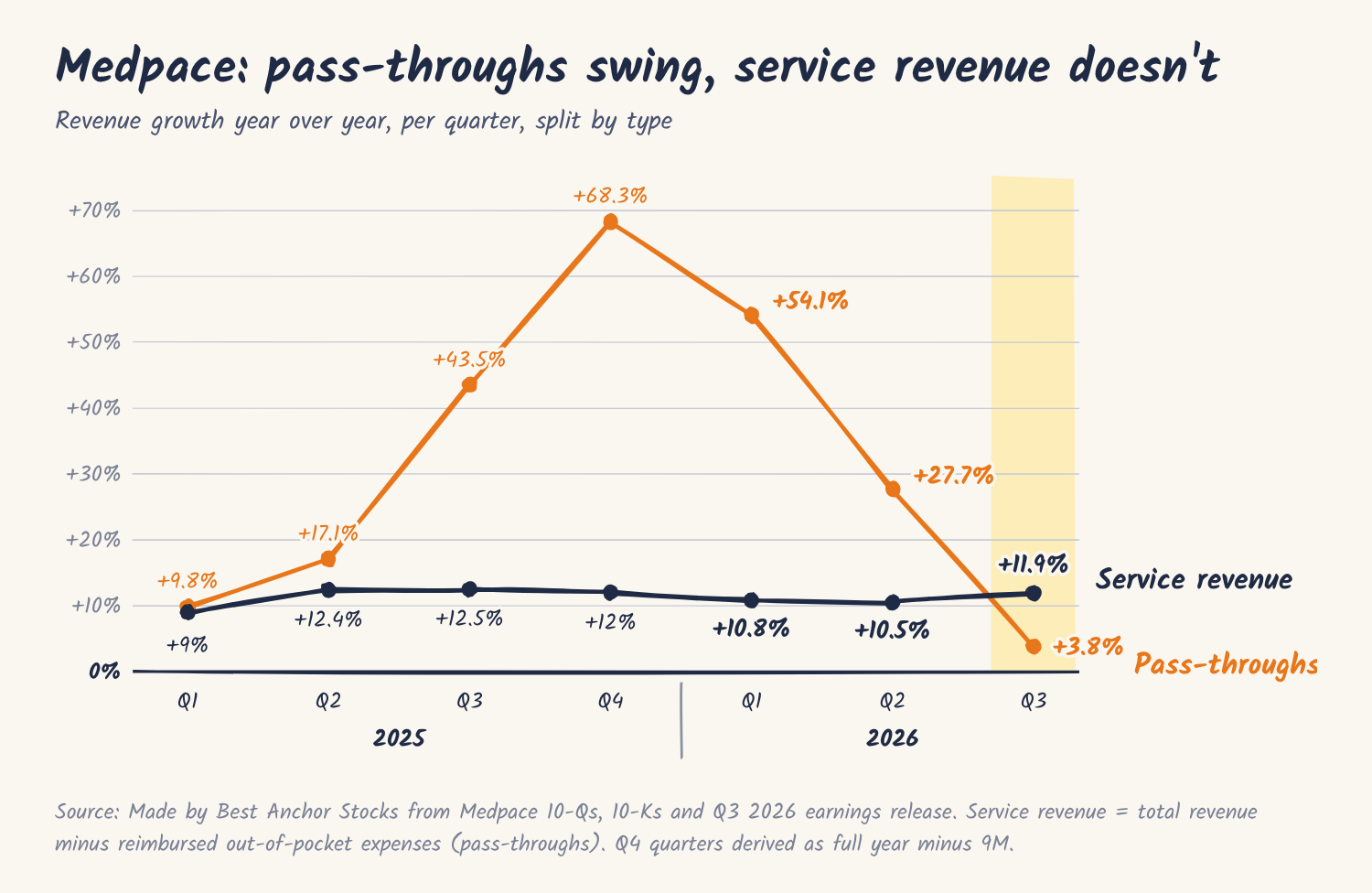
Part of the deceleration is “optical”, though. Reimbursed out-of-pocket expenses (pass-through costs) grew only 3.8%, but if we ignore them we can see that service revenue grew about 12%, the 6th consecutive quarter of double digit service revenue growth:
The question here is:
Why is there so much volatility in pass throughs?
Because they are significantly dependent on project phasing. These are costs that Medpace pays on the client’s behalf while a trial is running. As Medpace always bills them back at cost, they count as revenue but carry no margin (in any other business these would be stripped out with the resulting figure being called “net revenue”). The nature of these costs ties them to the patient-heavy phase of a trial, which means that they ramp when many sites are enrolling and treating patients, but fall away as these close out.
Medpace experienced in 2025 a wave of large, enrollment-heavy studies (many of them metabolic as a result of the GLP-1 boom) which hit the “books” at the same time, creating a significant ramp up in pass-throughs. Now that those studies are maturing and the mix is moving toward oncology (more on this later), pass-throughs are normalizing. The good news is that service revenue (Medpace’s actual work in which the company makes a margin) keeps growing steadily at around 11–12% per year. In short: service revenue is a better gauge of the underlying business.
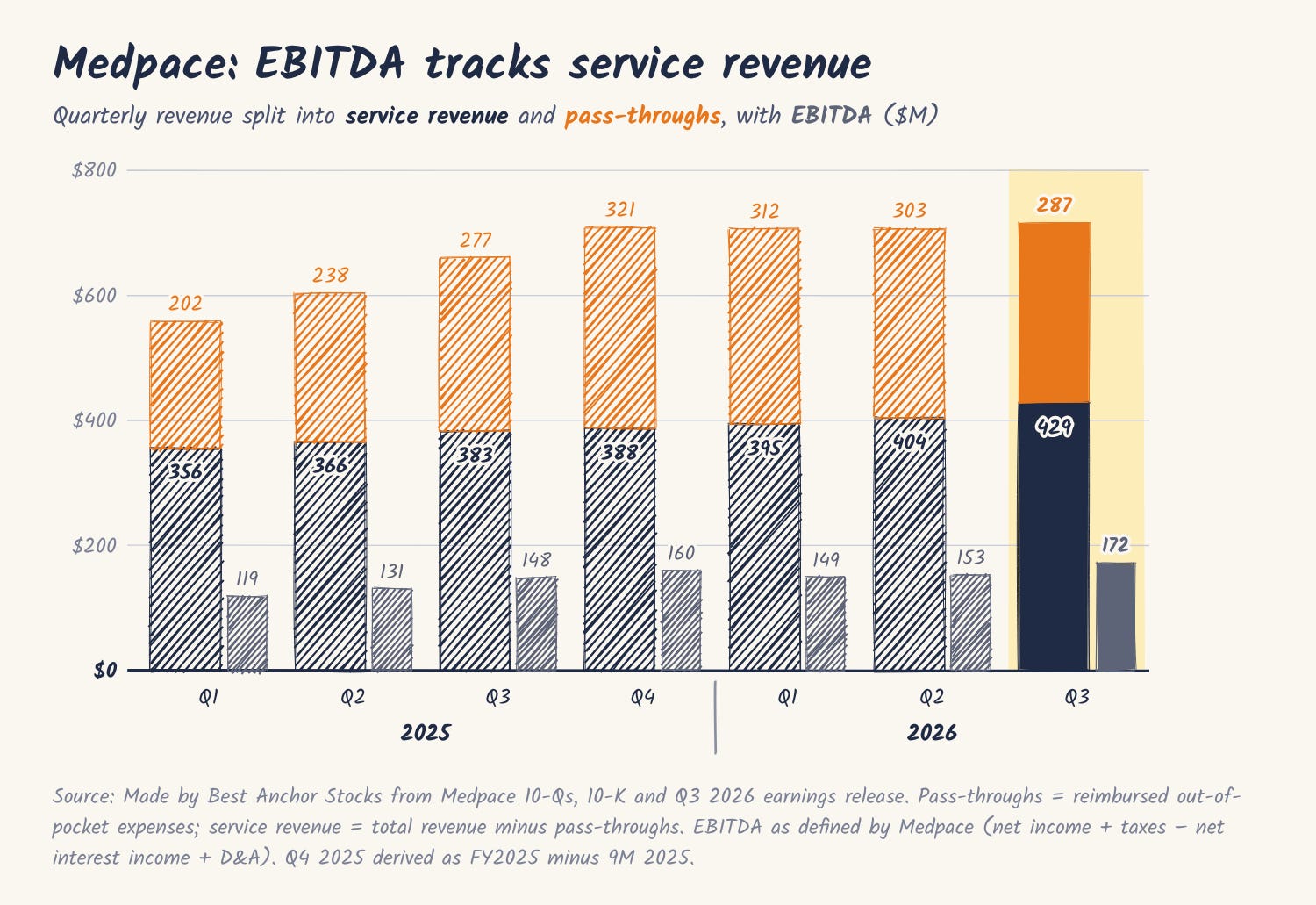
Does that mean EBITDA simply tracks service revenue? Yes to an extent, but it’s even better. Since pass-throughs carry no margin, EBITDA is ultimately earned on service revenue. This is why the reported EBITDA margin looks better when pass-throughs fall (24.0% this quarter). Now, the reality is that margins are expanding “organically” nonetheless. On a service-revenue basis the margin was about 40% in Q3, vs 39% a year ago and EBITDA has also grown faster than service revenue (+19.5% vs +11%) over the first nine months. That gap is operating leverage:
The caveat is accounting treatments. Medpace doesn’t book a contract’s fee as it bills it but rather books it in proportion to how far along the trial is. To measure the progress, the company uses the cost-to-cost method: costs incurred so far divided by total expected costs. The key detail is that those costs include investigator payments, which are pass-throughs.
Let’s take a look at this with a simple example. Say a trial is expected to cost $100 in total, of which $60 is investigator payments (i.e., pass throughs). If a big wave of patients enrolls in one quarter and Medpace pays $20 to sites, the trial suddenly looks 20% further along. This means Medpace books an extra 20% of its service fee that quarter, even if its own staff did no more work than usual. The bottom line is that pass-throughs earn no margin themselves, but they can shift when service revenue is recognized. They pull it forward when enrollment is heavy and slow it down when site activity fades on a contract by contract basis. The total fee over the life of the contract doesn’t change, but the quarter in which it lands does.
The CFO somewhat pointed at this during the call:
Quarter-to-quarter, there is certainly volatility that can occur in our numbers. I know that everybody uses pass-through as a proxy for what direct service fee revenue is. That is not exactly how 606 works.
So the bottom line is that, over a full year, EBITDA should broadly follow service revenue but there will be noise from quarter to quarter.

Profitability was a very pleasant highlight
Margins were one of the highlights of the quarter. Even though Medpace barely beat the consensus revenue figure, it significantly beat margin consensus.
EBITDA margin reached 24.0% (22.5% a year ago), the second-highest quarter ever since Medpace adopted ASC 606. This (together with a growing cash pile and higher interest rates), helped net income grow 23.7%, more than double the pace of revenue.
Management attributed the margin performance to good utilization, low attrition and revenue growing faster than headcount. The most critical aspect of all of this, though, is that they don’t see it as a one-off:
The business is performing very well on the direct service side. Attrition rates are in a very good spot. I do not expect there to be a major degradation in the fourth quarter.
This is “provable” with the guide The midpoint implies Q4 EBITDA of about $170 million on roughly $715 million of revenue or a margin near 24%. There’s one known headwind in 2027, though. The Cincinnati campus expansion adds about $20 million of operating costs (roughly 0.7 points of margin on ~$3 billion of revenue).
The leading indicators
The part that we should care more about is what’s coming, and it was an excellent quarter in terms of leading indicators (and forward-looking commentary). Let’s start with some highlights...
Net new awards hit an all-time high of $873.4 million, up 10.6% YoY. Trailing twelve-month awards reached $3.02 billion, up 23.9%.
Book-to-bill came in at 1.22x, the highest in at least seven quarters and up from 0.88x in Q1 and 1.12x in Q2. In Q2 I said the book-to-bill should go bananas. We are not quite at bananas levels yet, but we are getting there.
Backlog grew 5.6% to $3.17 billion, and growth has accelerated every quarter this year (2.9% in Q1, 4.9% in Q2). We did not get any quantitative comment about the pre-backlog which, if you have read my prior articles, should know why it’s quite relevant.
The slice of backlog expected to convert to revenue in the next twelve months is now about $1.99 billion, up roughly 8% YoY (from about $1.84 billion). This seems like a decent floor for 2027 revenue before any new award is considered.
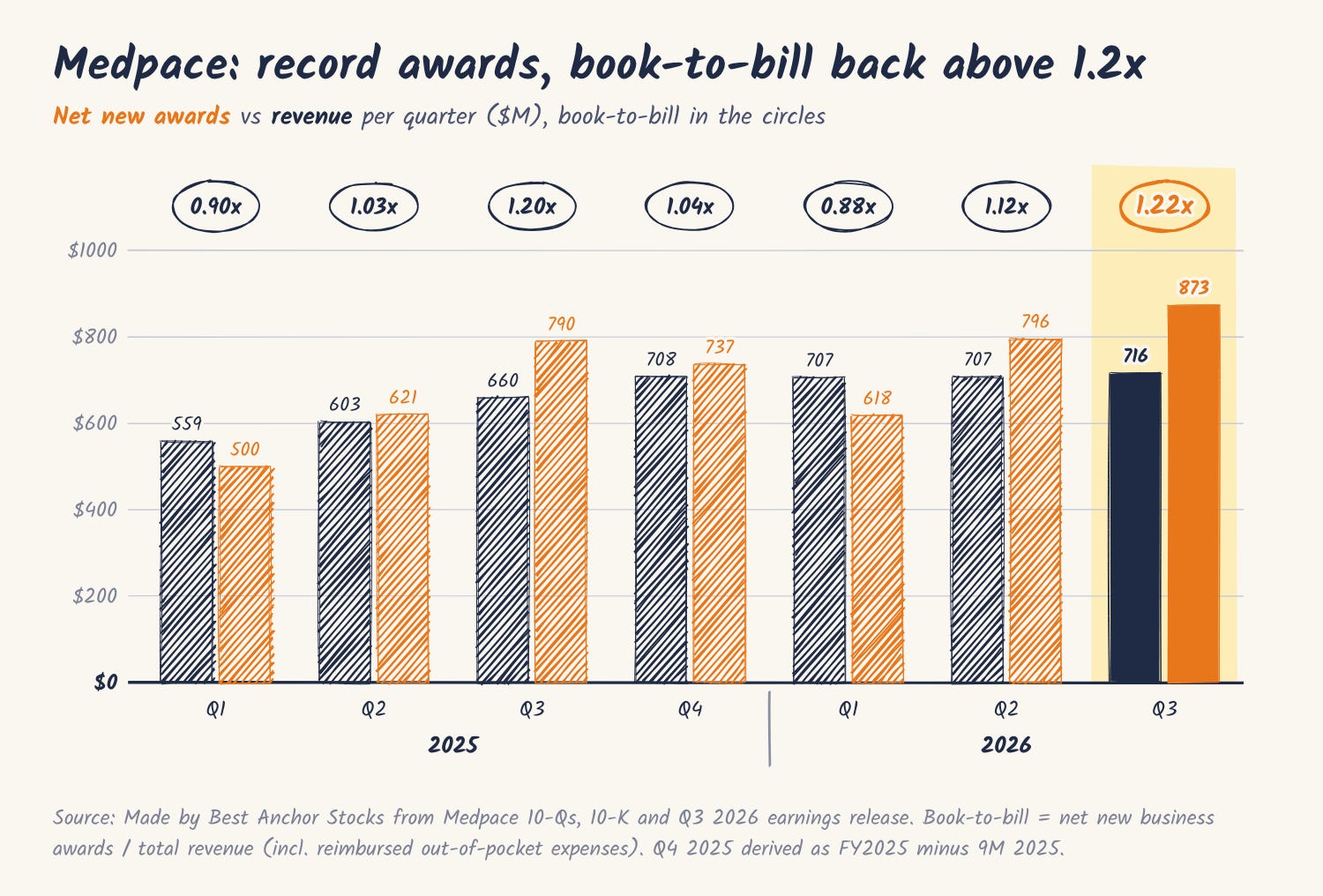
Now, we got even more (and more positive) forward-looking commentary during the call.
2027 and the pipeline
I’d say that the most important part of the call was August’s commentary on the pipeline:
The pending RFPs is up. Total dollar value of opportunities that we’re looking at is up nicely. RFP numbers are actually down some, but I guess I kind of ignore RFP. The quality and the total pending decisions by clients is very large. They’re not being held up. Things are actually going very well, but the total number of opportunities has increased and is at a very good high.
Simply put, August believes that the business is booming! Management added that decision timelines are faster than last year, and that clients want to start projects now, “not sometime in the future“.
Despite the very positive comments, an analyst noted that August sounded a bit less upbeat about Q4 than he did about H2 last quarter (these sell-siders just can’t get enough!). August answer actually was even more positive than anyone could’ve expected:
I think that Q4, if things go right, it is going to be another record awards. I hate to look at book-to-bill, I just think it’s a bad measure. I’d rather focus on award growth and trailing 12 awards, and I would expect another step up. Things look very good. We have a lot of stuff in the pipeline.
So, what does this imply? Plenty of things, and all of them positive:
“Another record“ means Q4 net awards above Q3’s $873 million. Implied Q4 revenue from the guide is only about $715 million, so book-to-bill will most likely increase beyond its current level (1.22x). August doesn’t like this metric, but I’d say the market does.
“Trailing twelve-month awards keep rising“. Q4 2025 awards were $737 million, so a record Q4 replaces it with something at least $135 million larger. TTM awards would end the year near $3.16 billion, up around 19% YoY.
“More awards moving into backlog”. He expects awards entering backlog to keep rising sequentially, which means backlog growth should keep accelerating into 2027.
August, however, made the same caveat he always makes: cancellations. Everything ultimately depends on this metric which is something management does not have much visibility on.
No cliff and a source of upside
Management will only guide “officially” for 2027 in February, but August opened the call with this:
We see no large disconnect between analyst consensus estimates and our current modeling of 2027.
Consensus is at around 6% revenue growth for 2027, which (you guessed it) would be a pretty significant deceleration compared to 2025. Now, there’s a pretty large caveat here because management ended up admitting that this view is supported by what they have today in the backlog (haha, classic). This ultimately means that if Q4 is strong and the current environment continues, then Medpace could experience significantly stronger growth in 2027 than what the market expects:
Our growth profile has dropped quite a bit over the last few years related primarily to pressure from cancellations. Q4 awards are still an important component of next year revenue. More importantly is kind of where we shake out in terms of cancellation pattern here in Q4 and going into next year. Things are improving month-to-month in terms of us increasing our revenue expectations for 2027, and hopefully that continues.
August continued:
Over the last quarter, our view on 2027 has moved, and we expect it to continue to move.
Given everything else on the call, I think it’s pretty reasonable to think that “moved“ in this context means “moved upward“.
So here’s what we know about 2027. Management’s internal numbers are roughly at consensus (~6%) BUT (seems like a pretty relevant “but”) rising month to month. The next-twelve-month backlog is already up ~8% YoY, so if Q4 is a record and cancellations behave, the bar looks low.
There’s also a decision that doesn’t fit with falling demand...management’s decision to expand the Cincinnati campus in 2027. This is maybe reading too much into it, but you don’t spend $20 million on more office space if you expect demand to drop. An analysts also noted that headcount grew high single digits. This is probably the best signal of what management expects in terms of demand in a labor-driven business.
There was this fear (probably still alive to an extent), that Medpace would suffer a revenue cliff in 2027. The fear stemmed from two places:
The not so great book to bill and backlog growth.
The fact that Medpace had benefitted from a huge wave of cardio-metabolic trials
I believe both were “put to rest” this quarter. I’ve already gone over the first one, but what about the second? Management claimed that the mix kept shifting towards oncology:
Things have changed a little bit in terms of the mix of what we’re seeing, and it’s a little bit more traditional oncology are generally our largest area, a little bit less metabolic demand at the current time point. But I think there’s a lot of good opportunities.
Even in metabolic, things seem to be far from over. Notifications and awards are down, but August said RFPs show “quite a bit of metabolic work again“, with a lot of pending metabolic opportunities.
Full service, with some flexibility
There was an interesting discussion around Medpace’s current full-service model. One analyst asked whether clients are increasingly carving out biometrics or asking for FSP (functional service provider) models. August claimed he hasn’t seen a meaningful change and that Medpace still prefers full-service work although will take a project as long as it adds real value:
We do prefer totally full-service opportunities, but as long as we’re able to add real value in terms of managing the recruitment, quality of the trial, execution overall. So if we have all of the front-end operations and they want to keep even data in-house as well as biometrics, as well as statistics and medical writing, that may be an opportunity that’s of interest to us, yes.
Pure FSP work is still a no-go for Medpace, but there’s some flexibility to cater to customer needs.
What about the valuation?
I’ve updated my three Medpace scenarios with a couple of changes.