On The Radar #9
A “boring” industrial, an interesting pharma, and a market share gainer

Before we jump into the ninth issue of “On The Radar”, a quick note: until midnight this Sunday, November 29 (Madrid time), you can get Premium+ for $359/year instead of $800. That’s $100 less than the normal price of Basic. You keep that price every year for as long as you stay subscribed.
As usual, one of today’s three companies is available to everyone. The other two are only available to Premium+ subscribers, and one of them is the company I’m most excited about in this issue. If you’ve been on the fence, this is probably the best moment to join.
You can read the free portion of today’s article here.
Welcome to the ninth issue of “On The Radar”,
If you want to know what this series is all about, I recommend reading the first issue. I’ll be kind enough to save you the click with a short summary: the goal is to share interesting companies that I’ve looked at but have not researched in-depth yet (at least not to the extent that allows me to gain sufficient conviction). Therefore, the “On The Radar” series should be understood as a well-curated list of companies that fit my investment philosophy and that might (in the future) make it into the portfolio (thus far 3/25 have made it). For you, it might be a great source of ideas!
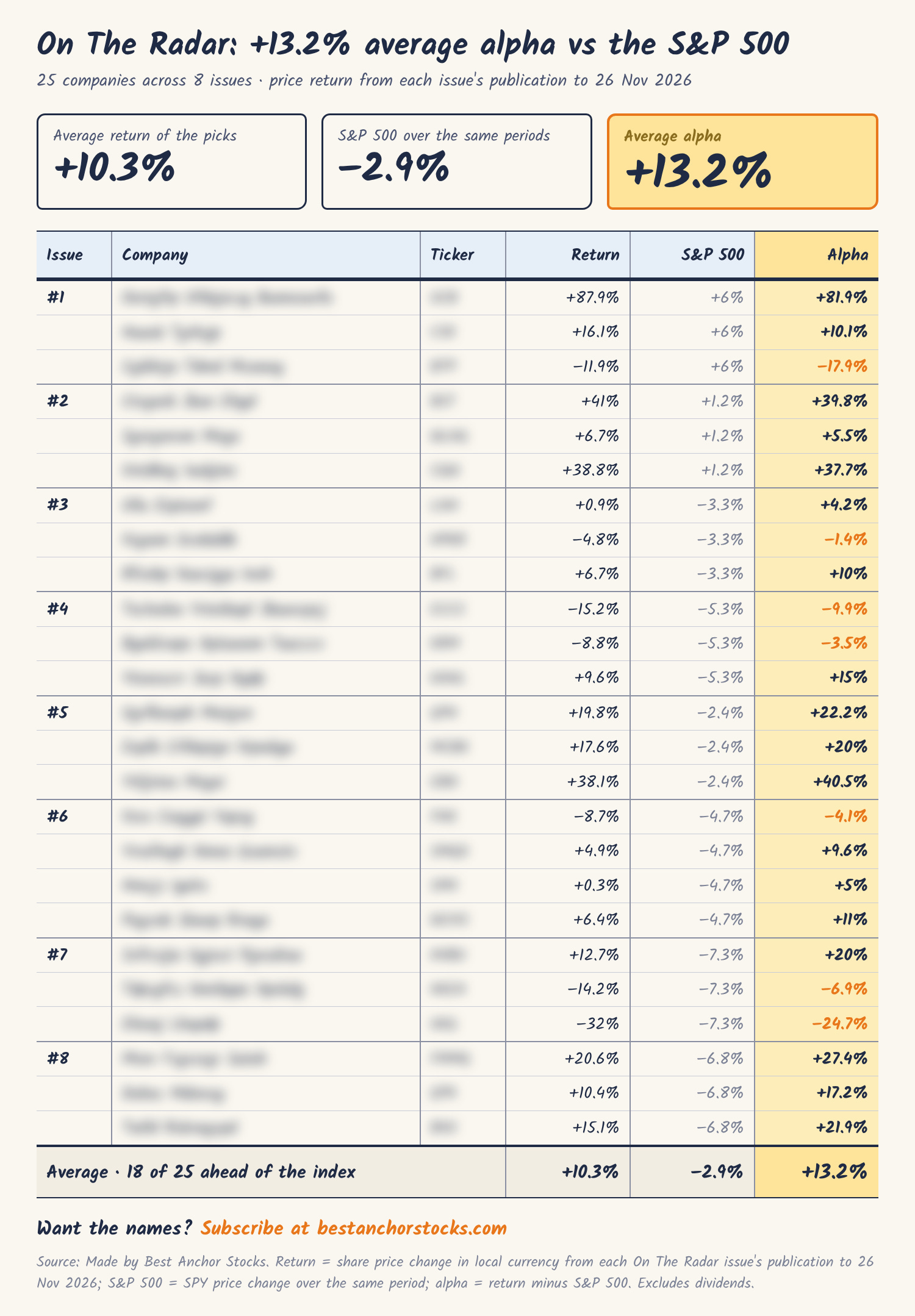
The “On The Radar” inclusions have done great thus far. 18/25 are ahead of the index and the’ve provided 13% alpha (against the S&P 500) on average. The three that made it into my portfolio have provided an average alpha of 20%:
Today’s issue brings yet another three companies (one for free and the remaining reserved for paid subscribers) that I’ve been looking into. Here’s a short summary:
A 124-year-old cable maker reinventing itself as an AI-era networking platform, with a balance sheet the market doesn’t like
A cheap, family-controlled pharma business with a great growth and operating leverage opportunity
A European used-car company with an outstanding market share gain opportunity. This one is currently 50% off highs and the opportunity seems “too good to be true“ which is what I’m looking into.
Note that all of these businesses get included in the “On The Radar” tab of the Portfolio Management Tool with their respective price evolution since the issue.
As this is the ninth issue, free subscribers have had access to 9 companies (one for free per issue) whereas paid subscribers have had access to 28.
So, without further ado, let’s jump into the first company.
Belden (NYSE:BDC)
Brief description of the business
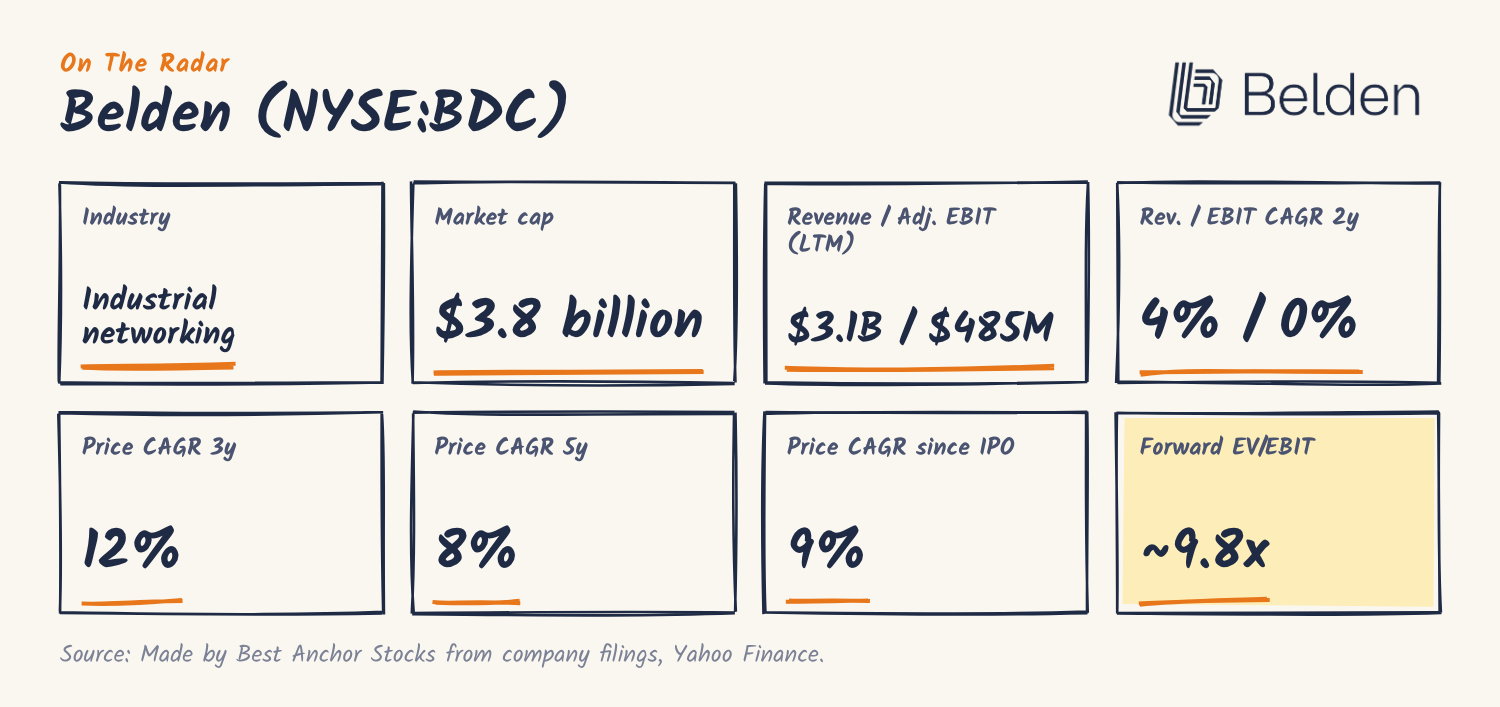
Belden is your “classic” industrial business. A company that has been around forever (founded in Chicago back in 1902) but that (1) most people have never heard of and (2) do something pretty different to what they did 100 years ago. The reality is that, if you have ever walked through a factory, a hospital, a stadium or a data center, you have most likely walked past its cables, connectors and switches without knowing it.
Belden ultimately makes the physical “plumbing” of networks (cable, connectivity, industrial Ethernet switches, routers, racks and cabinets), plus the software to manage it all (Belden Horizon). The company historically was mostly a cable company but the current management team has spent the last few years turning it into a solutions business, i.e., designing and delivering the whole network for a customer rather than shipping boxes of product. Solutions crossed 15% of revenue in 2025, up from roughly 10% when management set a 20% target for 2028 at the 2024 Investor Day.
The big unknown today is Ruckus. Belden closed the acquisition of Ruckus Networks (enterprise Wi-Fi and switching, 48,000 customers, $687 million of revenue in 2025 with 60%+ gross margins) on July this year for $1.87 billion and funded it with a $1.85 billion term loan which took leverage to close to 4x (this is despite management having said that leverage would stay around 1.5x).
With Ruckus in the mix, Q3 2026 revenue was a record $966 million (+38% YoY, +11% organic) and was split roughly as follows:
Automation (~46%): industrial networking for discrete manufacturing, energy, logistics.
Smart Buildings (~19%): hospitals, campuses and, increasingly, data centers.
Broadband (~18%): cable operators upgrading to DOCSIS 4.0 and fiber.
Wireless (~17%): Ruckus.
Management’s pitch is that Belden is now the only player that covers every layer of the network, from the connector to the cloud, both on the industrial (OT) and the enterprise (IT) side. Not a bad pitch considering where things are going.
Why it caught my attention
The set-up looks pretty straightforward. Belden is posting record numbers (also very decent on the organic side) while the share price is going the other way. Q3 2026 brought record revenue ($966 million), record orders (over $1 billion for the first time, +16% organically, 1.05x book-to-bill) and a new $100 million fiber assembly contract with a Tier-1 hyperscaler for 2027. Management now expects the data center business to reach ~$275 million in 2027, more than 50% above the $175 million run rate it announced only a quarter earlier but (importantly) will still only represent a minor fraction of the company’s revenue (i.e., there seems to be more upside than downside when it comes to datacenter).
Despite all of the above...Belden’s shares trade around 39% below the 52-week high of $159.99 and roughly 11% lower than a year ago. On a pro-forma basis (i.e., including a full year of Ruckus), Belden is currently trading at around 10x 2027 consensus adjusted EPS ($10.03 at ~$99 per share) while growing organically double digits. This seems cheap especially when considering that the company’s largest segment (automation) has a pretty interesting exposure to the robotics and physical AI theme.
The logic is pretty straightforward. Every robot, AGV (automated guided vehicle) or smart machine on a factory floor needs a pretty complex network (real-time, deterministic, millisecond latency) and (you guessed it) most legacy industrial networks weren’t built for the physical AI era. Belden sells pretty much every layer of the “renewal”: the hardened cables and connectors, the IO blocks, industrial switches and routers, and now (with Ruckus) the Wi-Fi 7 access points that let robots move around without a cable, plus the software to manage it all. Joint Belden + Ruckus pilots are already running in warehouse automation.
Management groups this opportunity under “physical AI”, which it presents (together with enterprise and hyperscale data centers) as one of Belden’s highest-priority growth vectors. This is how the CEO framed it in the Q2 2026 call:
“The third is physical AI. This is the opportunity I’m most excited about for the long term. As robots and autonomous systems scale across factories and distribution centers, they require a network that is real-time, deterministic, mobile, and mission-critical. [...] That is precisely what Belden and RUCKUS deliver together. [...] No other company delivers that full stack from a single source.”
Ashish Chand, President and CEO · Q2 2026 earnings call (30 July 2026)
It isn’t only hopes and dreams either! In that same quarter, Belden won a specification position with “a leading global retailer“ to network autonomous machines across its U.S. distribution centers (first orders already received), and it has worked hand-in-hand with Symbotic (the warehouse automation company that serves Walmart) on the network for its robots.
The way I see it is that Belden’s opportunity grows with the number of “things” that need to be connected. The more “nodes” a factory, warehouse or hospital has, the more Belden content it needs, and the more complex (and mission-critical) the network becomes. Note that this is a volume driver rather than a network effect because Belden doesn’t become more valuable to each customer as the world gets more connected, it simply sells more into each one!
The market seems to be worried about the Ruckus deal, and the reality is that things don’t look great at first glance. Net leverage jumped from 1.9x at year-end to 3.9x, Ruckus revenue fell 6% in its first quarter under Belden due to (supposedly) component shortages, and GAAP earnings turned negative in Q3 (adjusted EPS was $2.26, +15%). Shorts are feasting here, with short interest sitting at around 15% of the float.
My research into Belden is a quest to answer the following question:
Is Ruckus the deal that turns Belden into a higher-quality networking platform that benefits massively from Physical AI, or is it simply a leveraged bet that the market is right to discount?
What I like
I went over a bit of these above, but I like the following (among other things) about Belden:
Organic demand is strong across the board. Record orders of $1,017 million in Q3 2026, +46% YoY and +16% organically, with Automation and Smart Buildings orders both up ~30%.
The AI data center exposure seems to be positively skewed in Belden’s favor. The new $100 million fiber assembly agreement (fulfilled through Wesco) takes the data center business to ~$275 million expected in 2027. On the gray space side, industrial switch orders from a 2025 hyperscaler award are running ~50% above the initial estimate. Despite the commercial traction, data centers are still a small part of Belden (6%-7% of revenue). This means that there’s meaningful upside if the AI build-out continues, without much of the business at risk if it cools down.
Ruckus theoretically improves the mix and gives Belden something unique. Management expects the combination to run at ~43% gross and ~18% EBITDA margins and to give Belden something very unique: an E2E platform that nobody has.
The shift to solutions is very accretive. One of the things I like the most about Belden is that it’s a growth business that’s improving internally while “replacing” legacy revenue (pretty similar to Stevanato in this regard). Instead of selling boxes of cable and switches, Belden is increasingly designing and delivering the entire system. This translates into larger projects, stickier customers and better margins. Management said at the 2024 Investor Day that taking solutions from ~10% to 20% of revenue would lift gross margins from the high 30s to the mid 40s. Solutions crossed 15% in 2025 and, with Ruckus, it’s already above 20%.
Leverage is high, but they can deleverage fast. Management expects ~$300 million of Free Cash Flow in 2027, and this path takes net leverage from 3.9x to ~2.9x by Q4 2027 and ~1.5x by Q4 2029.
What gives me pause
There are evidently several things that I don’t particularly like:
Management alignment. I don’t love (in fact maybe I “hate”) how management is incentivized. The compensation structure rewards growth in absolute adjusted metrics, which means that a debt-funded acquisition like Ruckus is “accretive” to their bonuses almost by default. Combined with ~1.5% insider ownership, this is not the kind of alignment I tend to feel comfortable with.
A modest growth guide for a business exposed to so many growth markets. The long-term framework from the 2024 Investor Day calls for mid-single-digit organic growth over the cycle. This is not terrible (especially when trading at a low double digit multiple), but it’s hard to square with a pitch built around AI data centers, physical AI, Wi-Fi 7 and IT/OT convergence. This means that either the framework is conservative (which management has hinted at), or a good part of the portfolio is still growing slowly enough to dilute the exciting bits.
I don’t fully understand the business yet. Belden sells hundreds of products into many end markets through distributors, and it is in the middle of a transformation (and an integration). At this stage I can’t confidently say where its competitive advantage lies so I have not yet built enough conviction.
One evidently has to balance all of the concerns above with the multiple the company is trading at!
What I am watching
I’m basically looking forward to doing more work on Belden as it seems exciting at first glance. The only thing that’s stopping me right now is that I believe that the two other businesses profiled in this “On The Radar “issue seem even more exciting, especially one of them.