


My last Judges update began as follows:
Note that the first half of the year was okayish, with the “severe” problems beginning in H2. This ultimately means that the business will still suffer tough comps in H1 2026 (currently experiencing a 17% drop in orders), but that comps should start to moderate significantly as the year progresses.
It was a matter of math eventually mathing, so this is exactly how it played out. Judges’ H1 was pretty abysmal, but some green shoots have started to emerge in H2. If we think about Judges holistically, we can come up with two main growth levers:
Organic growth: has averaged around 7% annually over time
Inorganic growth: Judges can be considered a serial acquirer
Both have suffered significant “headwinds” lately, which has translated into an abysmal H1 performance:
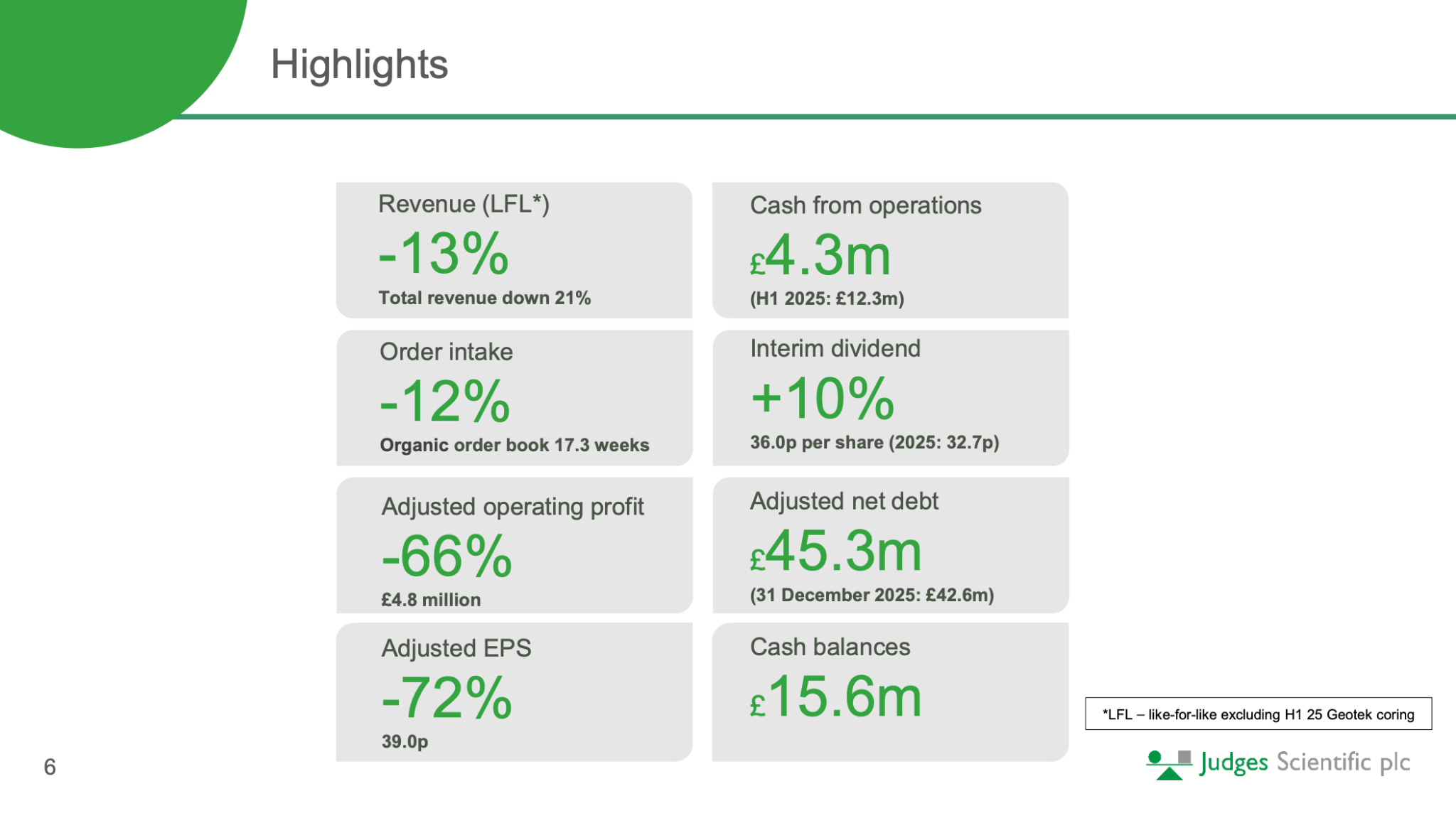
Judges has suffered many headwinds on the organic growth front. For example, the company is exposed to University funding in the US, which has virtually frozen during Trump’s mandate and his Government’s proposed cuts. Even though these cuts did not get implemented (at least not to the extent that the Government wanted), university Capex remained “frozen.” The Government is back at it for 2027, so the future doesn’t look rosier either.
Secondly, Judges is also suffering some headwinds in China. Orders had recovered strongly after a couple of weak periods, but order conversion to revenue is taking longer than anticipated. The reason is that China is finalising a new process for R&D tax exemptions (worth around 13%) on government-funded purchases of scientific equipment. This ultimately has translated to a Capex freeze, as many customers are waiting for this process to be effective to ultimately act on their orders. This also impacts order intake which has been delayed until this is resolved:
Because of the new five-year plan in China, several of those processes have been postponed. The way that we saw that was orders that were placed with customers then asking for those shipments to be postponed until the tax issues were sorted out, and then latterly orders not being placed for future business until those issues were resolved.
Thirdly, Judges has experienced something that could be considered organic/inorganic at the same time. After having acquired Geotek in 2022 with the expectation of enjoying one Coring contract per year or every one and a half years…the reality has been markedly different. Judges enjoyed a Coring contract in 2025, but is not going to enjoy one in 2026 nor 2027! This is a bummer and definitely portrays that Geotek might not have been the greatest investment, but the good news is that the market doesn’t seem to expect much from it either. The following commentary from management, however, seemed intriguing:
What we also highlight is that Geotek continues to follow- up some other opportunities. There are other opportunities out there. The field is very vibrant. There was a show or an event a few months ago in France. It was all about gas hydrate exploration and science. And the outcome of that is that we understand there are still plenty of opportunities out there.
Does this imply that there might be any given year with more than one Coring contract? I don’t know, but it does seem that the Coring contract is significantly lumpier than previously anticipated.
Lastly but no less important, M&A has been non-existent. After historically acquiring around 2-3 companies per year, Judges has not been active on the M&A front for more than 2 years (the company’s last acquisition was Teer Coatings in August 2024).
So, what does all the above mean? That Judges has suffered the perfect storm, some of which was self-induced and some of which was outside of the company’s control. This would be my interpretation:
Outside of the company’s control: US funding and China R&D freeze
Self-induced/outside of the company’s control: Coring contract
Self-induced: M&A
Not unexpectedly, the shares have fallen 70% from pretty inflated ATHs after the operational headwinds resulted in significant multiple compression:
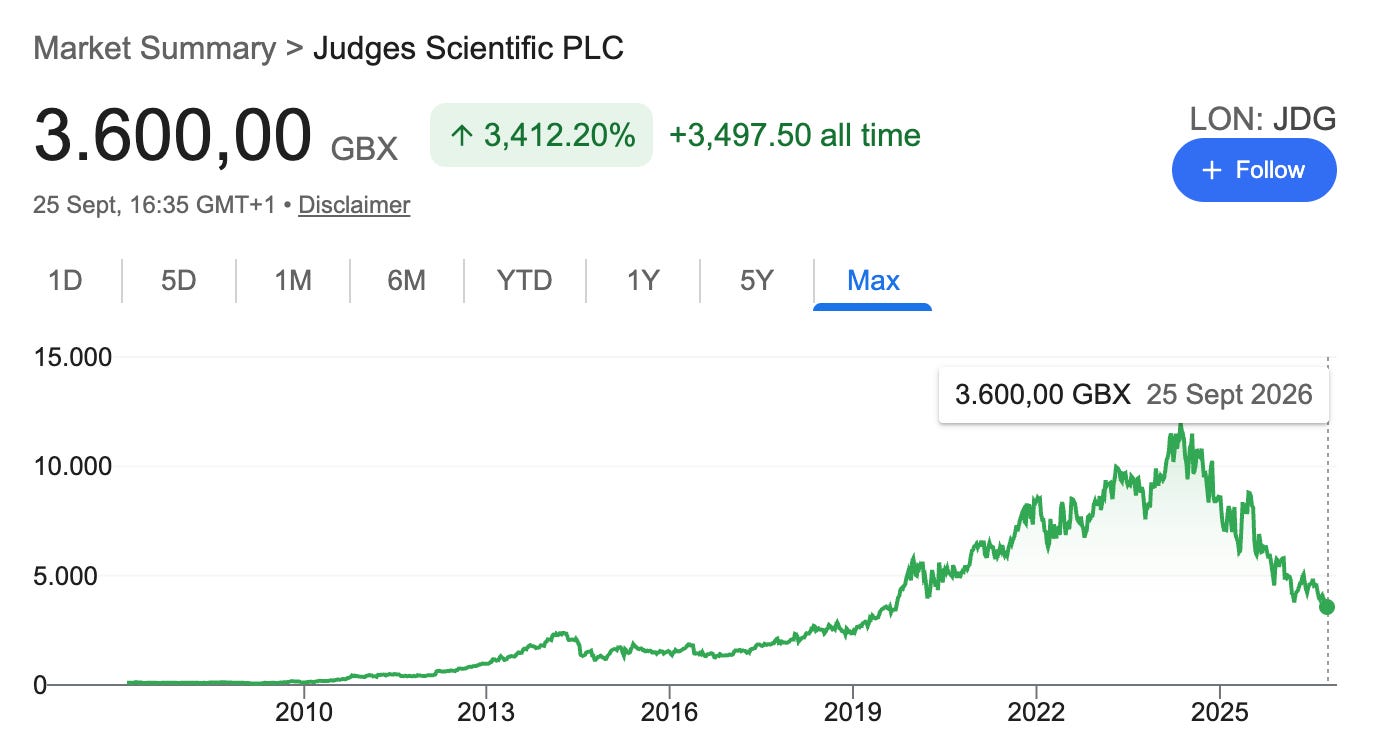
Judges has always been a cyclical company, but I don’t think it has ever suffered a cycle to the same extent to the one it’s suffering today.
The interesting question is not whether H1 was bad because it’s pretty evident that it was but whether 200 pence of Adjusted EPS in 2026 represents the company’s new earnings power or an unusually depressed point in the cycle. I increasingly believe it is the latter and I’ll explain why below.
The green shoots
With tough comps behind us, things seem to have started to change. Positive news could be found on both growth levers (organic and inorganic), but let’s start with the organic side.
Despite the abysmal H1 numbers, management shared a couple of encouraging things. The first and most obvious one was that they maintained the full year guide. This is definitely encouraging but it’s important to understand that the guide is not risk-free. Meeting it is going to require a significant production ramp in Q4, so any small delay might carry revenue into the next year. This is nothing extremely worrying if you are focused on the long term (the end of the year is an arbitrary checkpoint), but would definitely not be great for the market’s perception. The good news, though, is that orders to achieve the guide seem to be “locked in” and therefore the problem is one of execution rather than demand.
The second good news on the organic side pertains to orders. Management shared something that I don’t think people really understood well from the press release (myself included). After a mid-teens LFL (like for like) decrease in orders in H1, management shared that the YTD (year to date) number was now closer to -1%. This strong recovery ultimately means that Q3 must have been an incredibly strong quarter in terms of orders (also easier comps). This is something that management confirmed during the call, more or less confirming that orders have grown at a 20%+ clip for 4 consecutive months. There’s good and bad news here:
The bad news is that visibility in terms of how long order strength will last is very low
The good news is that the order strength is being achieved without the US funding returning in any meaningful way and despite the R&D exemption delays in China
So, the good news is that there’s even upside to these encouraging numbers, but the bad news is that we don’t know if we’ve reached the inflection point yet. I would add yet another “good” news: I don’t really think the market is pricing that a strong inflection in orders is about to take place, so the upside doesn’t seem priced in.
The order chart that Judges shares does seem at least a tad encouraging. The LTM order growth line (black line) starting to inflect upwards for the first time since 2024:
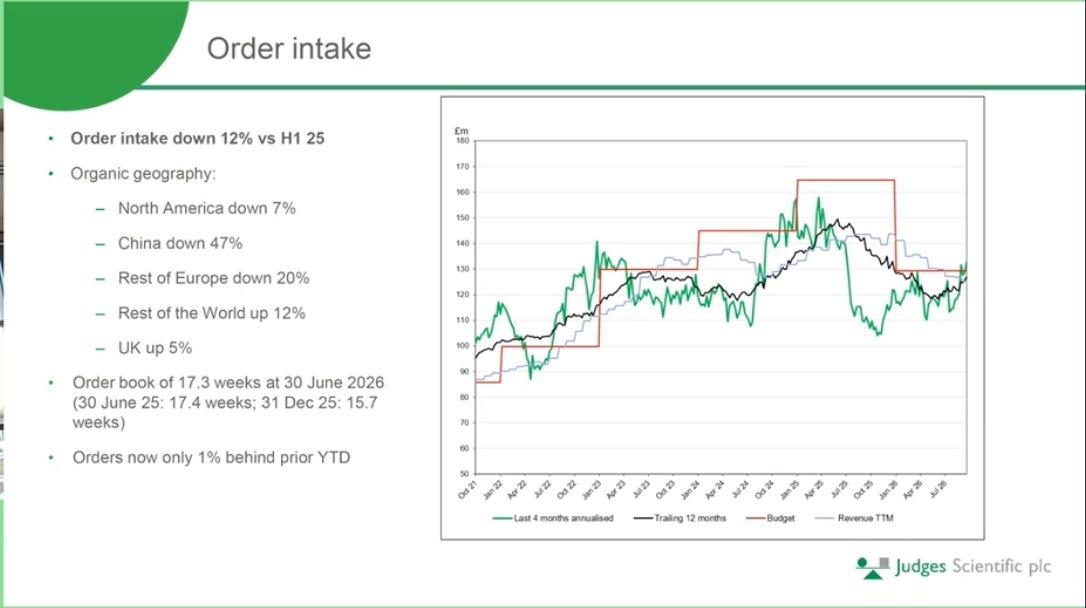
Management is not expecting incrementally good news in terms of US funding. The exposure is considerable (around 15% of total Judges revenue is exposed to US funding) but not unmanageable. As for China, the management team does believe that orders are mostly delayed but that they’ll end up flowing through the books:
Also, positively, early signs that the China’s tax exemption processes are being resolved. We are having customers who had ordered equipment but asked us to delay sending them until these things were resolved. They are now starting to ask for those things to be supplied.
The impact that we have seen is delays. We do not think we have seen orders being lost. Orders having been received, delays in shipping those orders, and then beyond that, delays in orders being placed until these processes have resolved. I do not think we anticipate any fundamental changes in the future as a result of those newly defined processes.
Now, there were also green shoots on the inorganic side. More than 2 years have passed since the company made the last acquisition, but Tim Prestige somewhat alluded to new acquisitions being closer:
We made no acquisitions in half one of this year, but we want to emphasize the group sees a healthy pipeline of opportunities, and we absolutely remain confident both in the depth and vitality of the potential deal pool and in our continued ability to attract and acquire businesses at the disciplined EBIT multiples that we refer to here. So we do not interpret the lack of an acquisition in the first half as either a lull in activity or that our acquisition strategy is ceasing to work in some way. We have absolute faith in the strategy that we followed. I would highlight as well that if compared to maybe 9 to 12 months ago, we do feel that there are some stronger opportunities out there.
I believe Judges’ management has always been conservative in terms of M&A, but they are maybe more conservative now after their Geotek experience. This is yet another potential source of upside but one that we shouldn’t really count on.
Some discussions around management
There were also certain things in the management team worth discussing. The first one is that Brad Ormsby announced his decision to step down as CFO of the company. I don’t think this is worrying because he has served for more than 11 years as CFO of the company. With Tim Prestige becoming CEO, a change of CFO makes perfect sense.
I believe Tim Prestige’s alignment also deserves a word or two. He has been granted two packages of 60,000 options each which, at the current share count and considering full vesting, would result in a 2% stake in the business. These options are based on a 5% adjusted EPS CAGR, and while this doesn’t seem like very demanding (it’s not), the adjusted EPS level they were issued at differs materially from where we are now:
The 2025 grant vests on January 2028 and would require 328.1p of adjusted EPS
The 2026 grant vests on January 2029 and would require 318.7p of adjusted EPS
The company expects around 200.5p of adjusted EPS in 2026 meaning that, for Tim’s options to vest, the company’s Adjusted EPS must grow 64% in 2027 (for the 2025 grant) or compound at a 26% CAGR over two years for the 2026 grant. Note that this includes M&A, so seeing Tim being very conservative in the multiples they want to pay is good news.
The 2025 grant seems tough to achieve BUT we must also not forget that Judges is a fixed cost business; earnings can go up and down quite materially with demand inflections and M&A can also do its part here, so I would say it’s not impossible. The bottom line is that Tim Prestige does seem aligned with shareholders as his base salary is relatively low and a good chunk of his compensation package is tied to these option packages.
Some thoughts on the valuation
Judges is currently trading at a P/E of 18x (on Adjusted EPS that strips out amortization of intangibles). This seems pretty low for a cyclical fixed-cost business that is starting to experience some green shoots. When it comes to cyclical but secular businesses, I always come back to Jerome Dodson’s quote which, at the risk of overusing, it I share once again below:
Many of our biggest winners have been companies that operate in cyclical industries with secular growth drivers. When their business cycle turns down, investors become overly pessimistic and extrapolate the current negative conditions. They forget the cycle will eventually turn, throw in the towel on the secular growth drivers, and engage in panic selling, pushing the stock to bargain-basement levels. But eventually the cycle turns, and the stock soars higher. It’s difficult to have the courage to buy when everyone else is selling, and this has been an important part of our success.
I believe Judges fits this mold but I’ve also been wrong thus far in terms of “timing” the inflection. The company has suffered far more headwinds than I previously anticipated and the thesis is definitely not free of risks yet. The good news is that the market seems to be increasingly discounting these risks, which is interestingly happening as green shoots emerge. Note that, despite the abysmal H1, Judges met the market’s expectations (which probably tells you how expectations have adjusted). I also decided to do a brief exercise to try to understand what has happened to Judges’ earnings power.
The market expects around 200.5 bps of Adjusted EPS in 2026. The last time the business generated similarAdjusted EPS was in 2019, or 7 years ago. In that year, Judges generated 19.8 million pounds of subsidiary EBIT, which ignores central costs. Since then, the company has acquired around 17-18 million pounds worth of EBIT. This means that subsidiary EBIT should result in around 37-38 million pounds (19.8M + 18M) assuming 0% organic growth in the existing 2019 companies and everything that was acquired after that.
Judges has, however, grown its central costs significantly (with no return to show thus far, which is not great). If we strip out around 6 million pounds of central costs from my calculations of subsidiary operating income, we get to around 31 million pounds in operating income “power” assuming no organic growth. Just to make it clear, this should be the operating income that Judges should be generating if organic growth would’ve been 0% over the past 7 years.
We then strip out 3-4 million pounds in interest costs and assume a 23% tax rate and we get to adjusted net income of 22 million pounds. Divide this by 6.66 million shares and we get to around 315 to 330 pence of adjusted EPS. So, what does all of this mean? Even when assuming that Judges has not grown at all organically since 2019, we get to an adjusted EPS level that’s 58% above the 2026 consensus estimate.
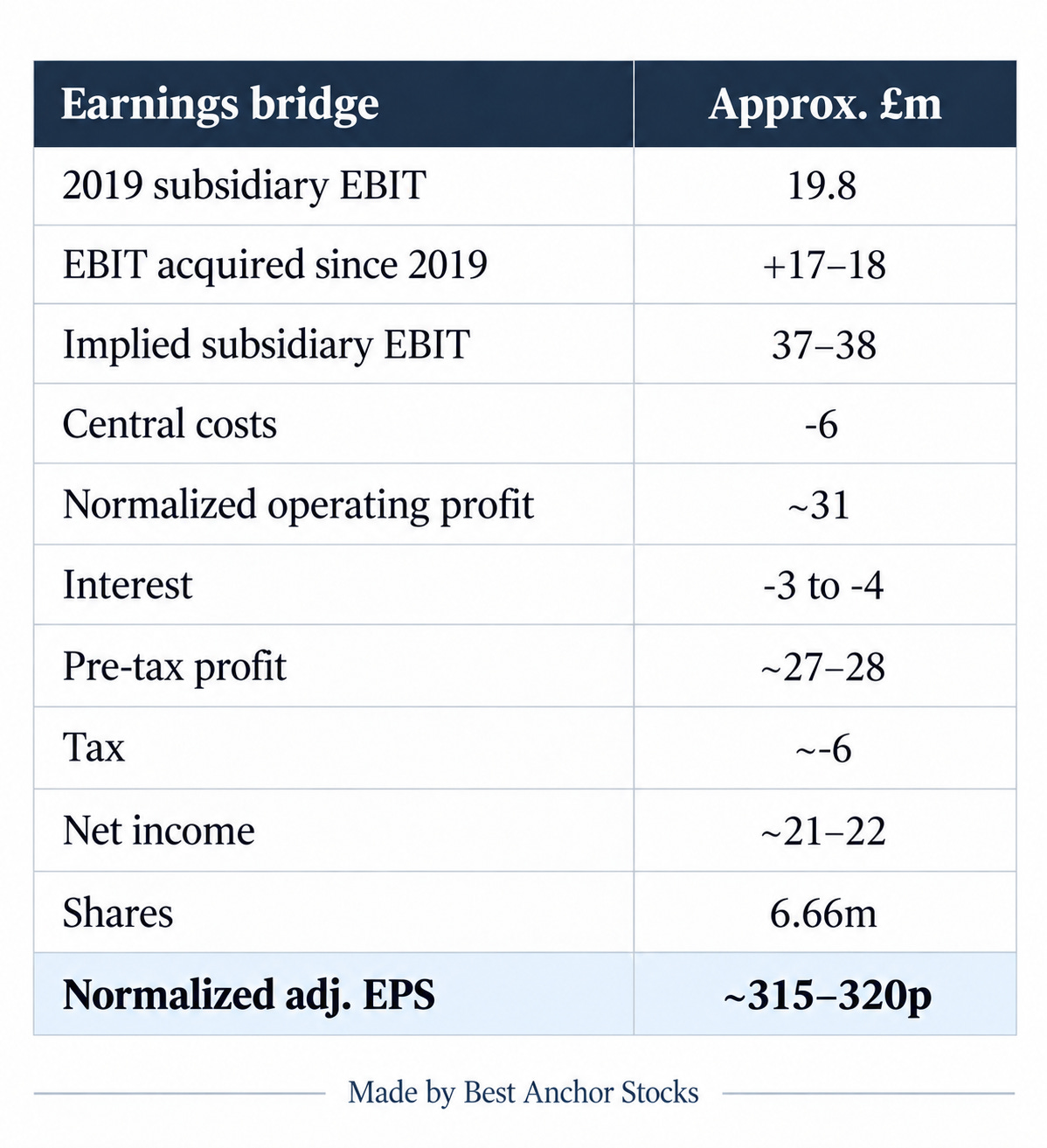
Judges has historically been a 7% organic grower but it’s fair to think that those organic growth rates are not here to stay after all that’s happened. Even so, it seems like current earnings are significantly depressed and still the company trades at 18x current earnings. Has something structural changed for Judges? Maybe when it comes to US funding, but it seems likely that the market is not assuming much in terms of a cyclical recovery.
The risk-reward seems appealing here, although if the market has demonstrated anything over the past few years is that risk-rewards can become more and more appealing over the short term (i.e., it can continue to go down).
For all of the above, I will add to my position.
Have a great day,
Leandro