


You can read this article in PDF format here.
Shift4 reported Q3 2026 earnings yesterday, with the stock dropping a whopping 16% before recovering some of it during the day (TBD if it holds). Q3 was another textbook Shift4 quarter...another guidance cut, another sell-off. What seemed obvious yesterday on X and based on the market’s reaction is that the market’s patience with the company is pretty much non-existent (and maybe for good reason).
Maybe this is an unpopular opinion (and the market clearly doesn’t agree with me), but I think the results were fine-ish. Not perfect or even good by any means, but fine-ish. Q3 in and of itself was clearly not the problem. The problems lie elsewhere and are probably more “disturbing” than a quarterly miss would’ve been, so I’ll focus the article on the following:
Growth is decelerating, and the question is whether it stabilises or keeps slowing down.
Management still hasn’t learned how to guide, and credibility is running out.
Leverage is not coming down as fast as the market would like.
Without further ado, let’s get on with it.
Q3 was an okay quarter
Let’s start with the good. Shift4 delivered pretty much exactly what it said it would deliver back in August across its main KPIs. The company achieved this despite a supposedly “worsening macro environment”:
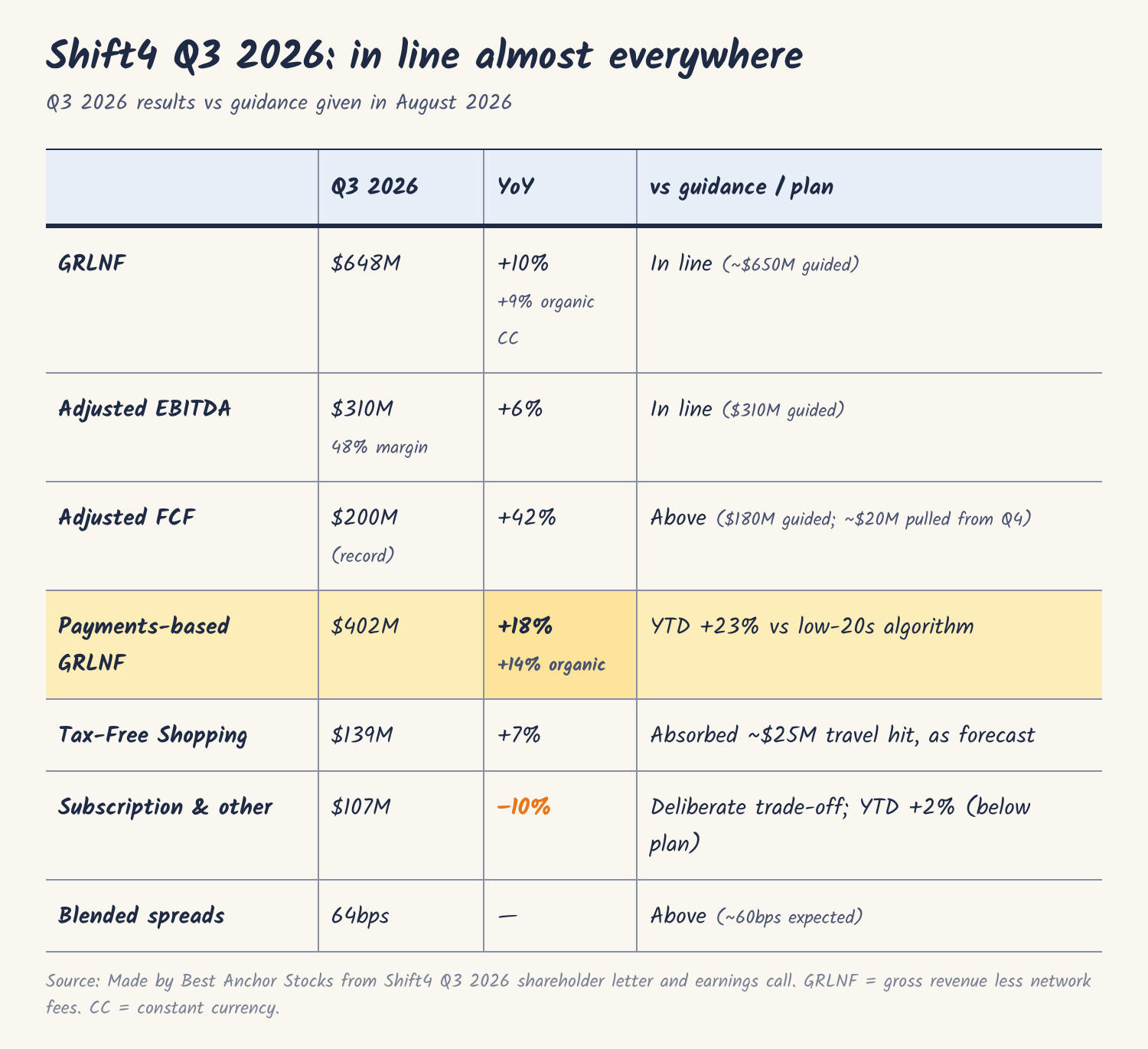
Gross revenue less network fees (GRLNF) grew 10% (9% organic at constant currency) and was roughly in line with the guide. Adjusted EBITDA was $310 million, right on guidance, and adjusted free cash flow hit a quarterly record of $200 million. This last point was likely the most positive note of the release and the guidance.
All that said, the true “meat” of the quarter sits underneath the headline numbers:
Payments-based revenue less network fees grew 18% (14% organic). This organic growth rhythm has been a constant over the past few quarters and is a good sign, but it must be contextualized alongside subscription revenue. Subscription revenue fell 10% in what is supposedly a “deliberate trade of non-core revenue for payments-based revenue“ (this will be relevant later).
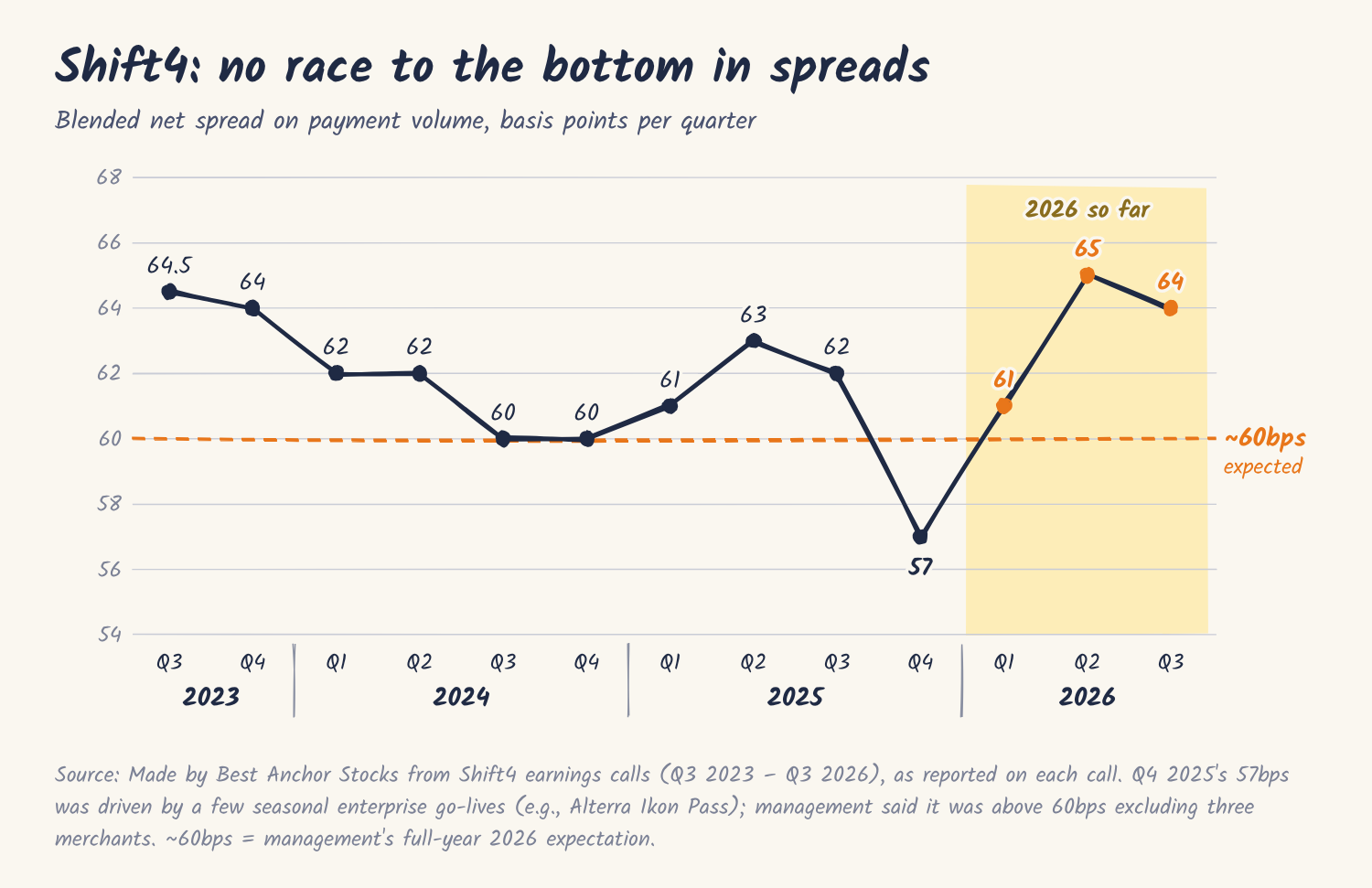
Shift4 continued to demonstrate that the “race to the bottom” thesis might have gone a bit too far. Blended spreads were 64bps in Q4 and have been stable for a while, which is great news to somewhat silence the historical payments bear case:
Tax-Free Shopping grew 7% organically despite absorbing the ~$25 million travel disruption headwind management had forecasted. 7% is likely far from what management underwrote when it acquired Global Blue, but nothing out of the ordinary, and I would say that it’s even acceptable if one follows the luxury segment and knows how much luxury is being impacted by the Middle East.
The bottom line is that, YTD, organic GRLNF growth is 10%. This is definitely not the pace of growth that Shift4 had hinted at in the past (mid-teens or even higher), but it’s also not catastrophic, especially when considering the current valuation. So, the quarter was okay, but there were a couple of “worrying” things.
Problem #1: decelerating growth
The first problem is the most obvious one. Shift4 grew organically 18% in Q3 2025 and a year later, that number is 9% (constant currency). The Q4 guide implies something in the low single digits, so yet another step down:
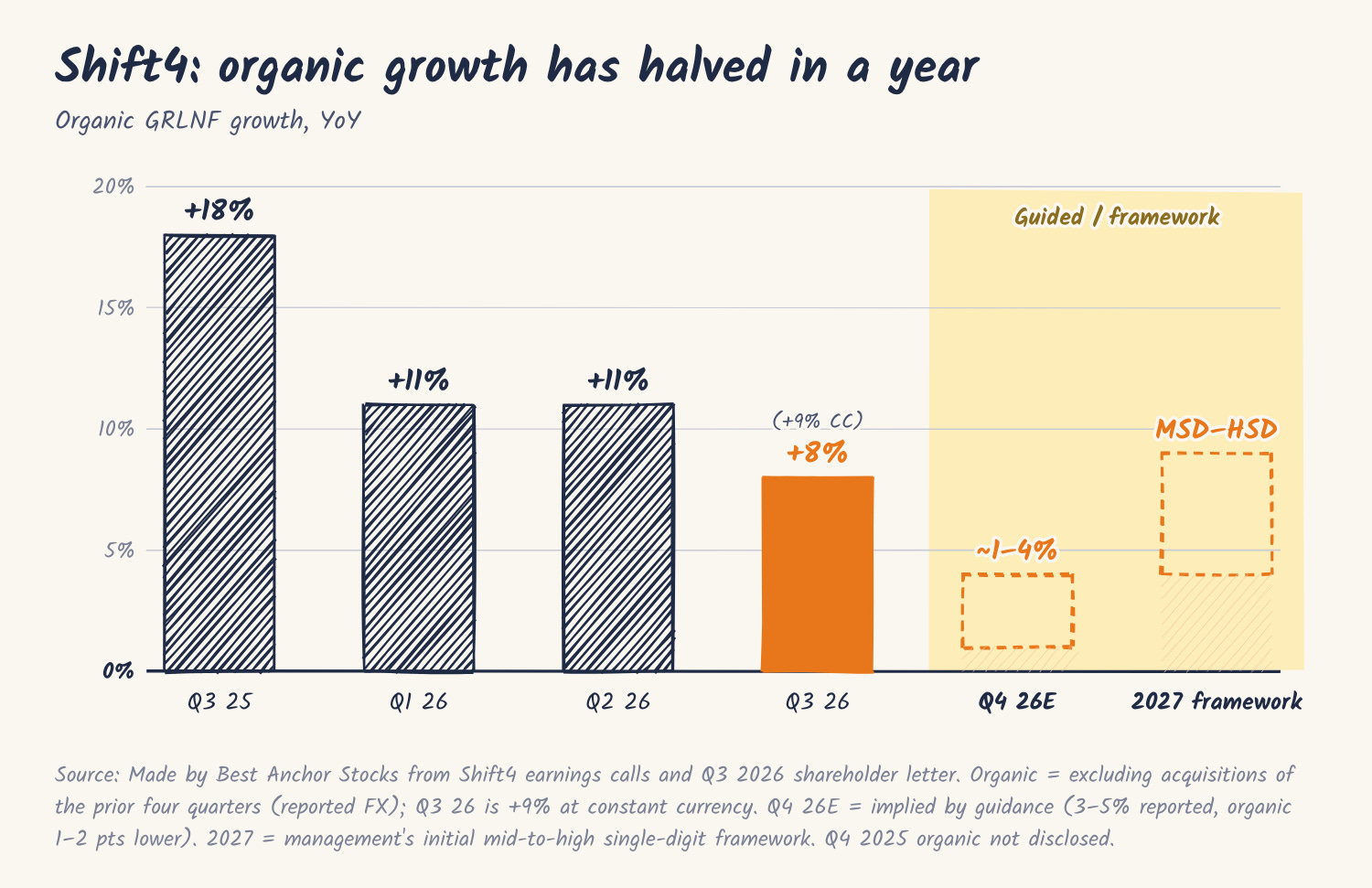
Management was quick to point out that the Q4 growth number is self-inflicted to an extent and that it’s not a base case:
“We just wanted to be very clear that this growth rate is being depressed by events and actions in Q4 that’ll be isolated and not recur. Namely, what we’re talking about there is that we have headwinds that have intensified in travel disruption. We’ve made some deliberate choices to deprecate non-core subscription and other revenue in exchange for our higher quality payments-based revenue. That’s always been part of our playbook. Then the deliberate choice to defer commercial initiatives on our European merchants experiencing the aforementioned challenges from travel disruption events.”
Christopher Cruz, CFO — Q3 2026 earnings call (November 5, 2026)
This supposedly temporary blip in Q4 is also why I believe that management introduced an initial 2027 framework. They are calling for mid-to-high single-digit organic GRLNF growth, which is yet again another deceleration compared to 2026. Even though this is evidently not great, I do believe there are some “positives” or at least some interesting building blocks.
The first one is that it seems to assume conservativeness. Management claimed that this framework assumes neutral same-store sales and, in their own words, leaves “appropriate room for volatility factors“ (i.e., it’s outright meant to be conservative). It also assumes the Middle East travel disruption continues, which is in stark contrast to how management has guided throughout 2026. When asked, Chris Cruz said Q1 2027 will still carry some of the effect because it isn’t fully anniversaried, and from then on the disruption simply laps itself at a neutral level. In other words, no recovery in travel is baked in, so a resolution/improvement of the conflict would (again, supposedly) be upside to the initial framework. This all will be an important point when discussing the next problem: “guidance and managing expectations”.
The reality is that this is a big growth step down for a company that until recently talked about mid-teens+ organic growth and is undoubtedly lower than what the market expected. So, is a mid-to-high single-digit grower exciting? Not really. However, the question that matters for us as investors is what the market is pricing in. At its current valuation, Shift4 is definitely not trading as if it were a double-digit grower and it doesn’t need that growth for the stock to work. Now, what the stock does need to work is better expectations management and execution, regardless of its current valuation.
Problem #2: guidance and managing expectations
The second problem is, in my view, the one that has done the most damage to the stock this year (and it’s pretty much entirely on management). Shift4 has now lowered its full-year guidance twice, and the guide it gave in February was already a disappointment for the market:
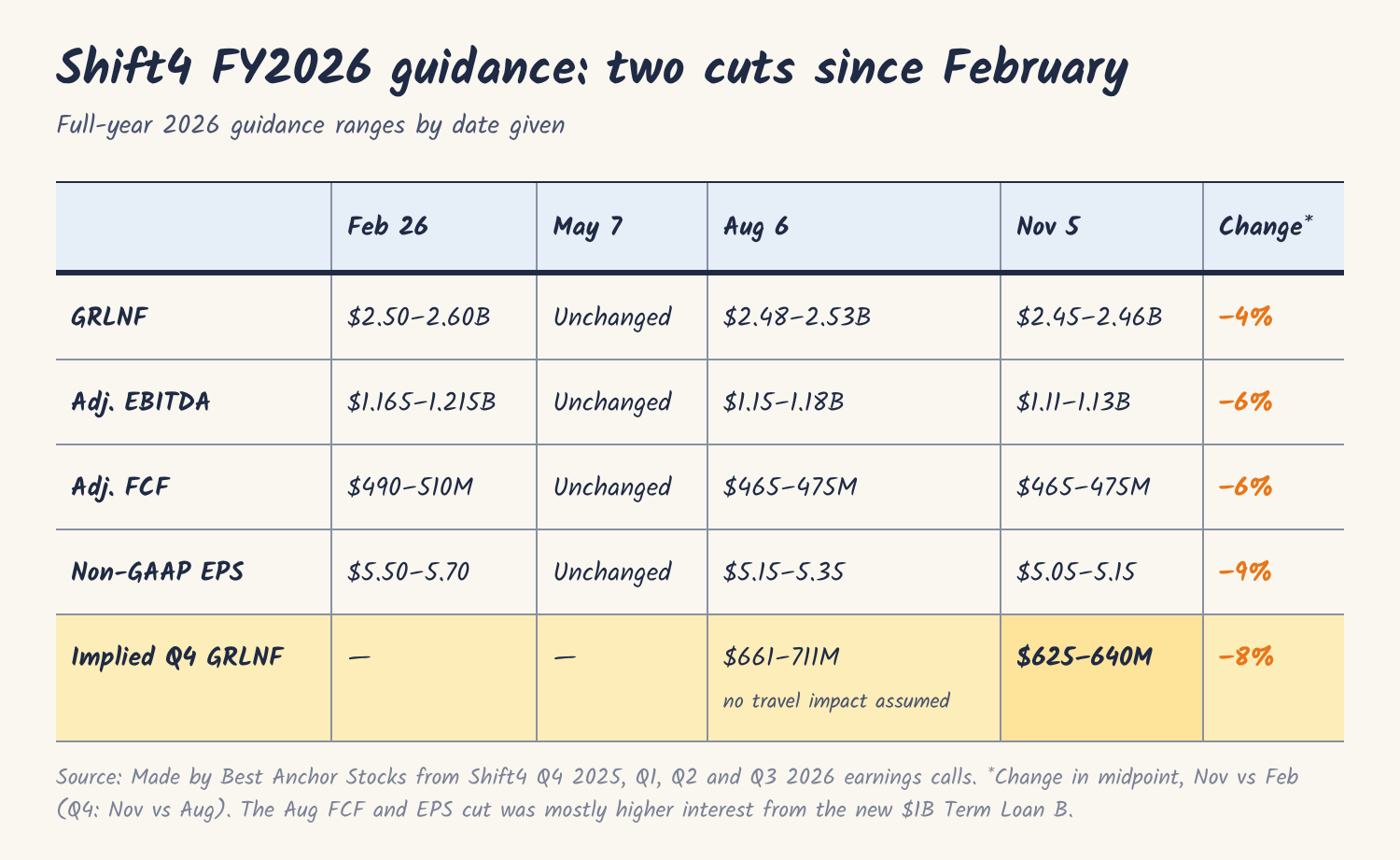
The expected FY2026 numbers are now ~4% lower on GRLNF and ~6% lower on adjusted EBITDA than the original guide. Free cash flow guidance, on the flipside, has held at $465–475 million since August, which is the best (maybe the only?) news about all of this.
I was a bit surprised to see so many people caught off guard by the Q4 cut, though. It shouldn’t have been a surprise to anyone who listened to the Q2 call in August. Management laid out back then that its implied Q4 guide did not yet assume any ME impact:
“Similar to last quarter, we are only forecasting potential travel disruption from the Middle East conflict for the next 60 days, and thus, our fourth quarter guidance does not assume any impact from this.”
Christopher Cruz, CFO — Q2 2026 earnings call (August 6, 2026)
In other words, Q3 was guided with a ~$25 million travel headwind and Q4 with zero. The war continued, so it was natural to think that the headwind did too. The same call also warned that subscription and other revenue would “moderate in the back half, resulting in a low single-digit growth for the year“. So the two largest pieces of the Q4 cut (travel disruption at $20–25 million of the midpoint variance and the non-core revenue trade-off at $25–30 million, with FX adding ~$6 million) were, to a large extent, telegraphed.
Let’s also be fair to management here. The first cut in August was not entirely their fault because they couldn’t have forecasted a conflict in the Middle East when they set the FY2026 guide in February. What I do hold against them is how they handled expectations through the disruption. The conflict had already hit Q1 and Q2 by August and was baked into the Q3 guide, yet they chose to assume it would “vanish” 60 days later. They should have ripped the band-aid off in August and assumed the disruption continued through year-end. Instead, investors got two consecutive step-downs, with the two cuts hurting credibility far more than one bigger cut would have.
Now, telegraphed or not, the core problem remains: expectations are not being managed like they should at Shift4. Shift4 seems to be guiding every quarter assuming the best case, only to then cut when the base case materialises. What does this result in? You guessed it, lost credibility. That’s, in my view, exactly what has happened here. Management has to learn to guide, or it will keep paying for it in the multiple, regardless of the company’s valuation.
The good news (albeit still TBD) is that they seem to have taken note. The 2027 framework was framed as explicitly conservative, and Taylor Lauber said the following:
“There’s a ton of potential inside the business, but we also need to look around at the market and say what’s getting rewarded and what’s not, and this doesn’t seem like a time to set ambitious expectations, I think for a lot of obvious reasons when you look at multiples.“
Taylor Lauber, CEO — Q3 2026 earnings call
That’s the right attitude, although now the market will be looking forward to seeing whether they can execute on the new framework. It seems non-trivial, but regaining credibility is likely the most important thing for the stock over the short to medium term.
Problem #3: leverage
The third problem is the balance sheet. Pro forma net leverage ended Q3 at 3.7x, with ~$5.5 billion of debt and $1.2 billion of cash (of which $633 million is earmarked for the August 2027 convertible notes). This is right below the 3.75x ceiling management says it won’t exceed on a sustained basis, and it’s ultimately where leverage has been sitting all year:
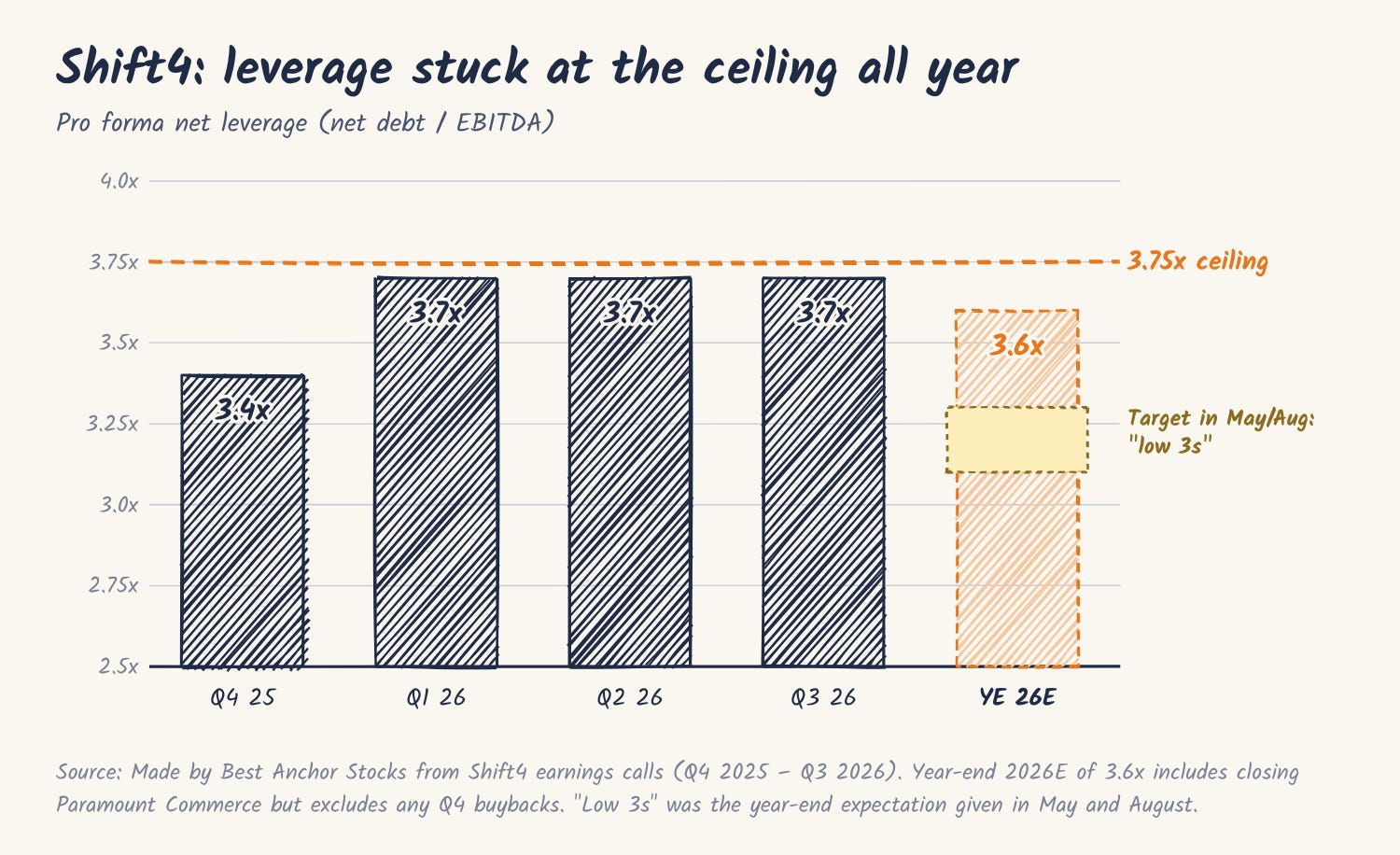
There was also terrible expectations management when it comes to leverage. In May, management said leverage would come down by roughly a quarter turn per quarter and end the year “in the low threes“. In August, the message was the same. Now the year-end expectation is ~3.6x (and that’s before any further buybacks in Q4). In other words, leverage is not coming down as fast as the market wants or as fast as management guided it would.
On top of the buybacks, management keeps doing M&A. After Global Blue last year and Bambora this year, Shift4 expects to close Paramount Commerce (account-to-account payments) in the coming weeks. Management says it’s paying less than 8x EBITDA upfront( with earnouts that would lower the multiple further) and that the closing is already baked into the 3.6x year-end leverage figure. I don’t doubt that the price is reasonable (tuck-ins like this have been part of the playbook since day one), but the issue is the signal. The market is asking for a balance sheet with less debt while management continues to find other uses for the cash.
To be fair, things have improved on the liquidity front compared to a few quarters ago. With the 2027 converts covered by cash, there are no relevant maturities until 2032, and the business is expected to convert ~60% of incremental EBITDA into free cash flow (i.e., there’s breathing room). The issue is not survival now, but rather how the market values the equity of a levered company.
Why deleveraging is so powerful for equity holders
This is something I believe many investors underestimate. The equity is a thin slice on top of the enterprise value when a company carries a lot of debt relative to its market cap. This means that every dollar of debt that is repaid moves from the debt holders’ slice to the equity holders’ slice, even if the business doesn’t grow at all and the multiple doesn’t move.
Shift4 is a great example of these dynamics. At about $36 per share, the market cap is roughly $3.2 billion while net debt is about $4.3 billion. Debt is ultimately larger than the equity at Shift4, so let’s take a look at what would happen if Shift4 simply used its free cash flow (about $470 million guided for this year) to repay debt, assuming EBITDA growth in line with this year’s guide (+15.5%), a flat multiple and a constant share count:
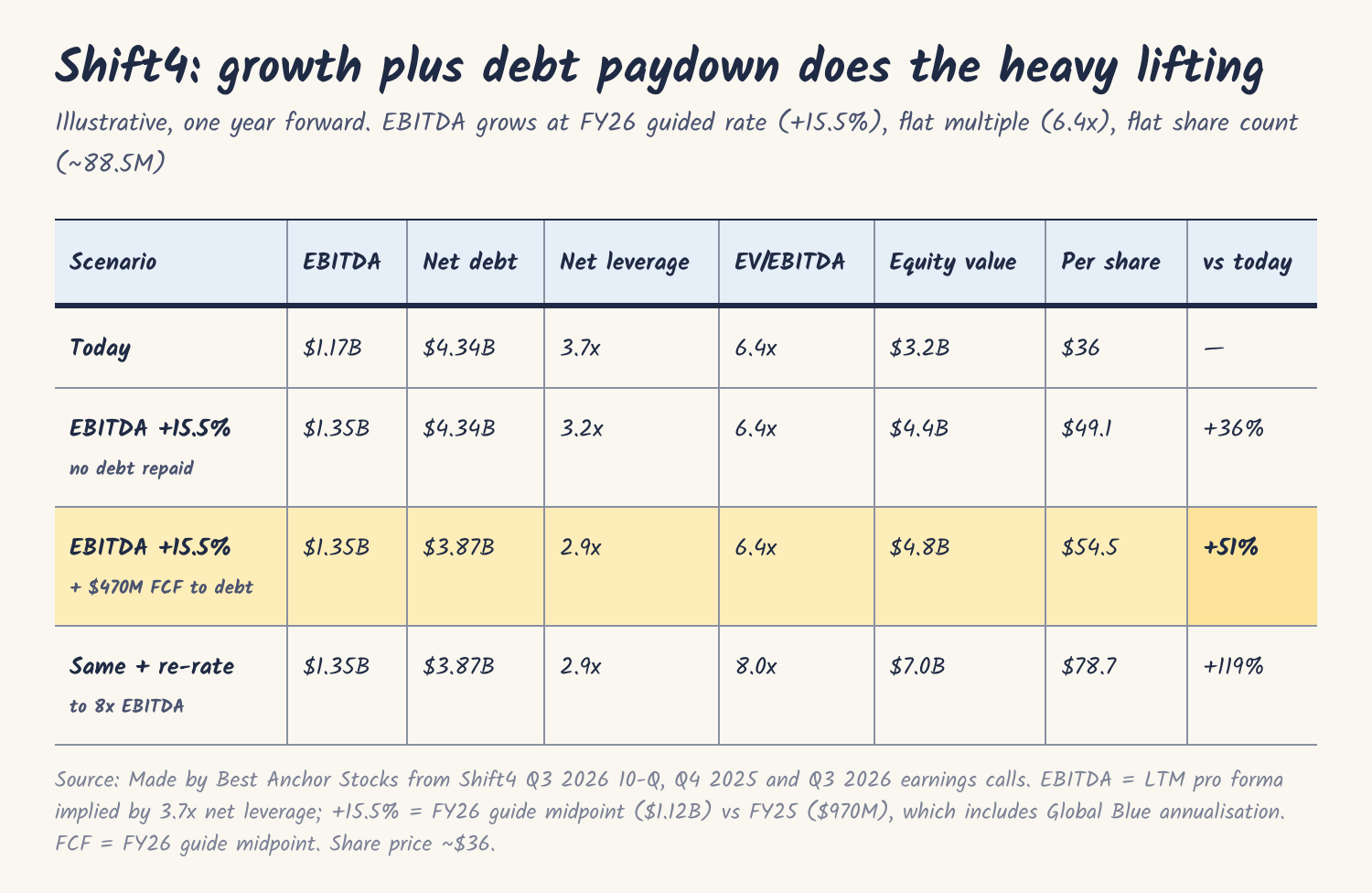
At a flat multiple, growth alone would add about 36% to the equity value in a year. Sending that year’s free cash flow to debt takes it to about 51%, with leverage falling below 3x. The bottom line is that those extra 15 points come purely from value moving from debt holders to equity holders.
Let’s compare this to a company with no debt and the same EV: the same $470 million would only add about 6%. Leverage cuts both ways here. It amplified the losses for equity holders as the multiple compressed, and it amplifies the gains as the debt comes down. And this doesn’t count the interest that Shift4 would save (about $30 million pre-tax on $470 million repaid at roughly 6.5%), which flows straight back to FCF.
On top of that, there’s the multiple and how the market views Shift4. Markets don’t like levered companies with decelerating growth, especially in this part of the cycle. A company at below 3x leverage is a different, less risky equity than one hovering at the ceiling. I believe it’s pretty obvious that the market might be telling management that lowering the debt today is the “best use” of capital for shareholders. I can also understand management’s POV. They own a pretty recurring business and are seeing better opportunities to deploy their capital in, but the market seems to be screaming one way while they go the other.
Buybacks are not “wrong” mathematically, and I do believe the stock is cheap. With the stock trading where it’s trading at and an after-tax cost of debt of ~5%, buying back stock is likely the more accretive option per share (if the multiple holds, that is). The problem is the “if”...with leverage at the ceiling and credibility damaged, the multiple is precisely what’s not holding.
Shift4 repurchased about 4.2 million Class A shares in Q3 for $190 million at an average price of $45.62, plus $10 million of the mandatory convertible preferred. That’s roughly 5% of the shares outstanding in a single quarter and about 16% over the last twelve months. Management also announced a new $1 billion authorisation starting January 1st, 2027.
What I find more interesting than the amount is the timing:
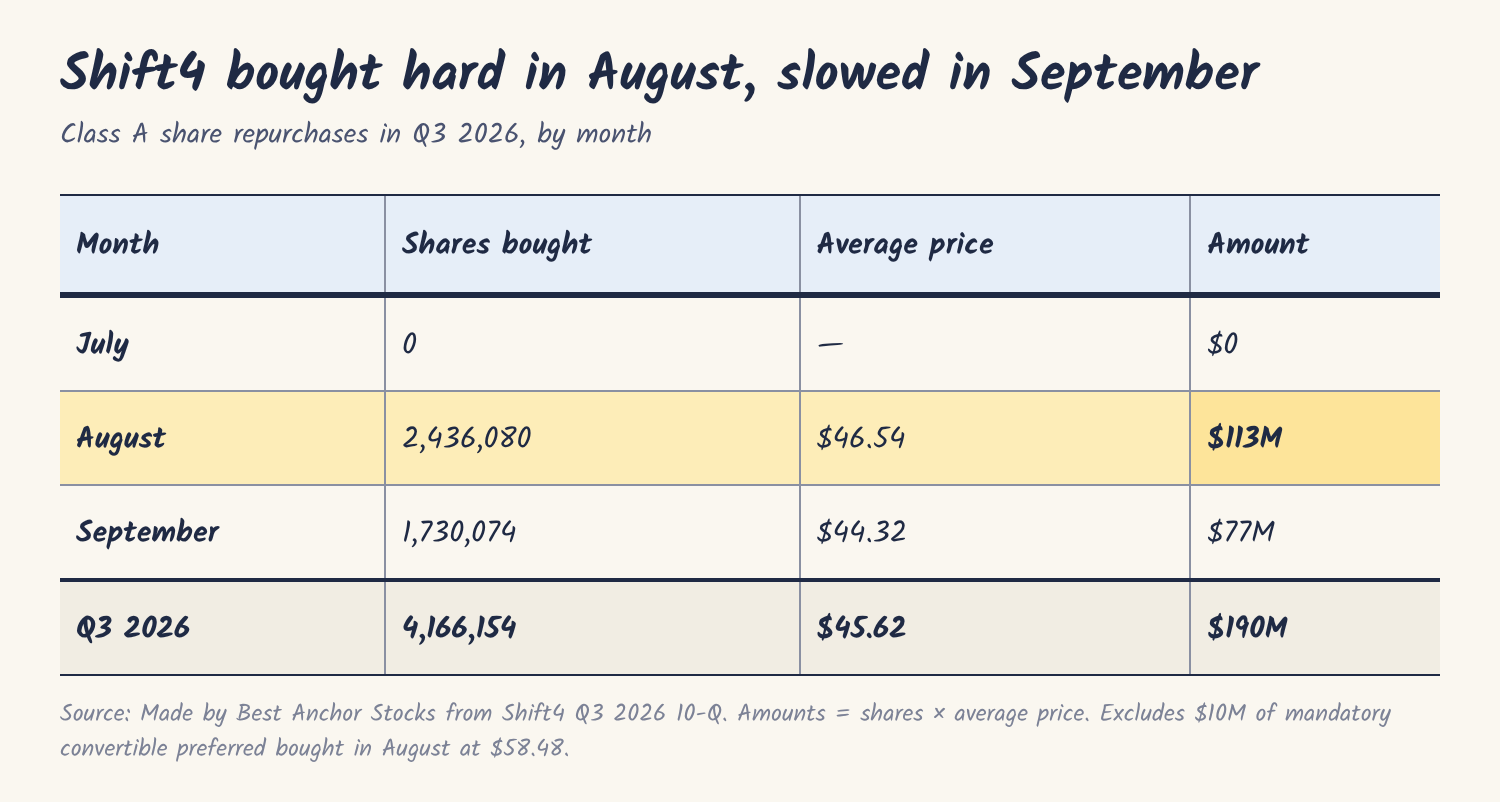
In Q2, management had been “intentionally conservative“ (only about 650,000 shares) because leverage was at 3.7x and it was a cash-consuming quarter. Then, right after the Q2 print in August, with the stock falling and the outlook still assuming no Q4 travel impact, they bought aggressively.
My read here is that management started seeing the deterioration during September and adjusted accordingly. Was it the right call? Hindsight is 20/20, and those shares were bought 20–30% above where the stock trades today, so waiting would have (obviously) been better. The problem is that nobody buys back stock with hindsight! Do you remember Meta? It spent tens of billions on buybacks in 2021, then dropped about 26% in a single day on its Q4 2021 earnings and more than 70% from its peak by late 2022. Today, those buybacks look brilliant! Why? Because everything can be judged in hindsight and we know what happened after.
My only concern is the one I raised above...at the leverage ceiling, every dollar spent on buybacks is a dollar that is not de-risking the equity!
Final thoughts
So, all in all, Q3 was an okay quarter. The numbers were in line, spreads were stable, payments-based revenue keeps growing in the mid-teens organically, free cash flow was a record and there are no relevant maturities until 2032. The Q4 cut was, to a large extent, telegraphed in August, but damaged management’s credibility even further.
We can’t ignore what’s not going well, though:
Growth has decelerated meaningfully, and I hope (maybe not the best to rely on “hope” as an equity investor) that the 2027 framework (mid-to-high single digits) is the floor and not another starting point for cuts.
Expectations management has ultimately cost management its credibility. They seem to have taken note, but February’s 2027 guide will tell us whether the guidance behavior/framework has changed or not.
The market seems to want leverage to come down faster. For a company whose debt is larger than its market cap, deleveraging is one of the most powerful (and least appreciated) sources of equity returns.
The good news is that the stock doesn’t need heroic assumptions to work. Will it start working soon? I have no clue, but I do believe it can if management re-establishes credibility and we get into a cadence of guiding up (not down). I have been pretty patient with Shift4, but I do feel that management has now realized that expectations management needs a lot of improvement. In the stock market, one is always better off underpromising (without obvious sandbagging) and overdelivering, and I’m willing to give the management team a couple more quarters to demonstrate whether they’ve finally changed.
I will continue holding my shares.
Have a great day,
Leandro