


Today I’ll venture into a new country and a new industry. Some will say that this is a dangerous thing to do, and while I do agree, I must say that today’s investment thesis has many parallels in other geographies (and even industries).
I don’t particularly like retail businesses, but I believe that the company I’ll profile today has sustainable (and widening) competitive advantages and a very long runway ahead.
The company…
Is founder-led, with the founder owning roughly 10% of the shares outstanding
Has grown its top line at a 37% CAGR over the past 3 years
Operates in an emerging country with significant growth potential
Is executing a model that has succeeded elsewhere by following the footsteps of another company (one where the founder had a stake)
Is attractively valued today
Without further ado, let’s jump right into it.
Just as an fyi, I’ll most likely host a webinar to solve any doubts/questions related to today’s report. The webinar will be held exclusively for paid subscribers.
Tiendas 3B (TBBB): Bueno, Bonito, Barato (?)
(If you prefer reading this report in PDF format, you can do so here)
This is the first time that I’ll venture into the great land of Mexico (might be the last one? Who knows!). The main character of today’s story, Anthony Hatoum, however, was born in the United States. After studying Civil Engineering at Columbia he realized that, despite being an engineer at heart, his professional career would be inevitably tied to the financial industry. His entry point into finance was not unconventional: investment banking. After several years working as an investment banker for JP Morgan, he accepted a job at Merrill Lynch as a managing director of Private Equity. Little did he know that this role would change his life.
Anthony Hatoum covered BIM while at Merrill Lynch, an extremely successful Turkish hard discounter. “Extremely successful” might be an understatement…BIM’s stock has compounded at a 39% CAGR since 2005. Even after accounting for the Turkish lira depreciation over that time frame, a US-based investor would’ve realized a pretty enticing USD 20-year total return CAGR of 22%! The model worked, at least in Turkey.
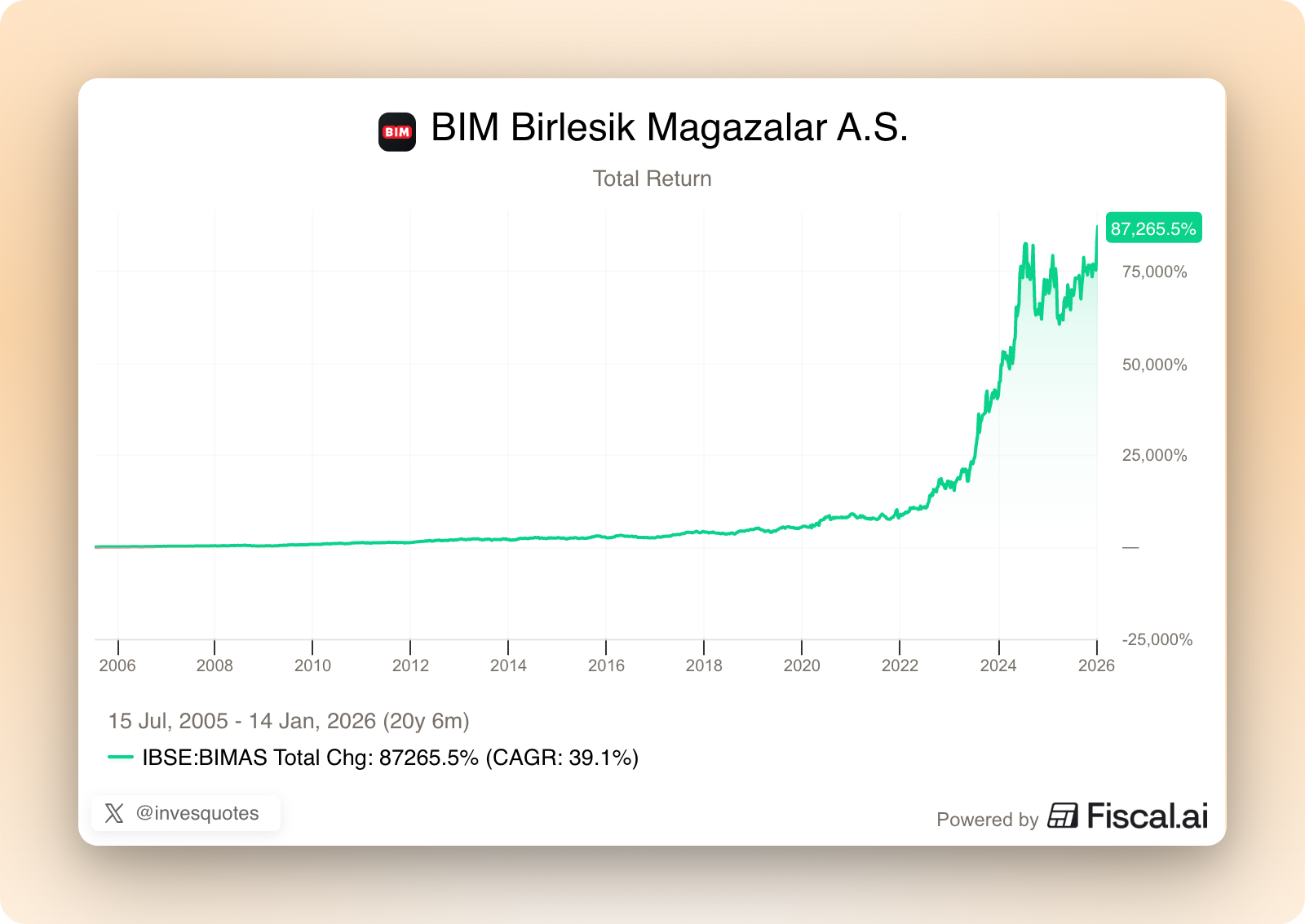
Understanding BIM’s model would be life-changing for Anthony Hatoum. Before giving BIM’s model a try, however, he founded two businesses in Turkey: Advantage Card and E-bebek. The outcome of both was phenomenal. Advantage Card was acquired by HSBC in 2002 for approximately $75 million after establishing a dominant model for loyalty and installment payments in the Turkish banking sector. E-bebek (a retailer of baby products) continued to thrive as a private company and IPOed in 2023, now worth around USD 200 million. Even though he had demonstrated his great doings as an entrepreneur, it would be BIM’s model that would give him the key to the largest treasure of them all: Tiendas 3B.
Mr. Hatoum became so attracted to BIM’s model that he began looking for a country to successfully replicate it. After a quick look here and there in Asia, he landed in Mexico in 2004. Without speaking a word of Spanish, he opened Tiendas 3B’s first store in Mexico DF in 2005. Since then, Tiendas 3B has grown from a mono-store retailer to a 3,000-store juggernaut. Revenue has gone from virtually $0 to $4 billion (and this is despite the Mexican Peso depreciating around 37% over that time frame!).
The management team decided to IPO with a US listing in 2024. The truth is that Tiendas 3B had no apparent financial reason to IPO. The “hard discount flywheel” was already spinning in full force and growth was already self-funded (more on this later), but they believed it was a good idea to IPO to facilitate the “cash-out” of long-time employees and to repay the company’s US-denominated debt. The key question for Tiendas 3B is whether Anthony Hatoum and his team will be able to replicate BIM’s success in Mexico and, therefore, become a highly successful investment for its shareholders. The objective of this in-depth report is to shed some light on this topic, and to do so I’ll go over the following topics:
Section 1: The hard discount model
Section 2: The Tiendas 3B model and the growth algorithm
Section 3: Store Economics and Financials
Section 4: The Opportunity
Section 5: The competitive landscape in Mexico
Section 6: Management & Incentives and Capital Allocation
Section 7: The Risks and the Valuation
As you’ll learn throughout the report, Tiendas 3B’s business is pretty straightforward. The reason is that the “magic” doesn’t lie in its complexity (like it does for companies like ASML), but rather in its simplicity. The fact that Tiendas 3B is mimicking almost on a 1:1 basis BIM’s footsteps in Turkey also helps because BIM provides a parallel to understand how things might evolve from here. We ultimately don’t know if Tiendas 3B will be successful in Mexico, but we do know that a similar model has been successful time and time again elsewhere. Is Mexico the next gold mine for a hard discounter? We will find out in due time.
Section 1: The hard discount model
Tiendas 3B’s investment thesis can’t be understood without an in-depth understanding of the hard discount model and why it’s such a durable and successful model. ALDI and Lidl are typically credited with the invention of the concept and have remained successful companies to this day, somewhat demonstrating that it has staying power. The hard discount model has disrupted incumbent retailers (and entire industries) in Germany, Spain, the UK, the Netherlands, Turkey…and the list goes on. This means that we could argue that, on top of being durable, it seems to be a global disruptive force.
Ultimately, a hard discounter is a very lean retailer (could be focused on grocery or something else, although I’ll focus on grocery) that combines scale, simplicity, and scale economies shared to become the lowest cost producer of a commoditized industry:
When a company is selling a product with commodity-like economic characteristics, being the low-cost producer is all-important.
Warren Buffett
Through strong operational cost control (frugality) and an extremely simplified business model, hard discounters can undercut incumbents (lower gross margins) while enjoying similar levels of bottom line profitability and significantly better cash conversion. Below you can see two hypothetical P&Ls; one belongs to a hard discounter and the other one belongs to a conventional retailer:
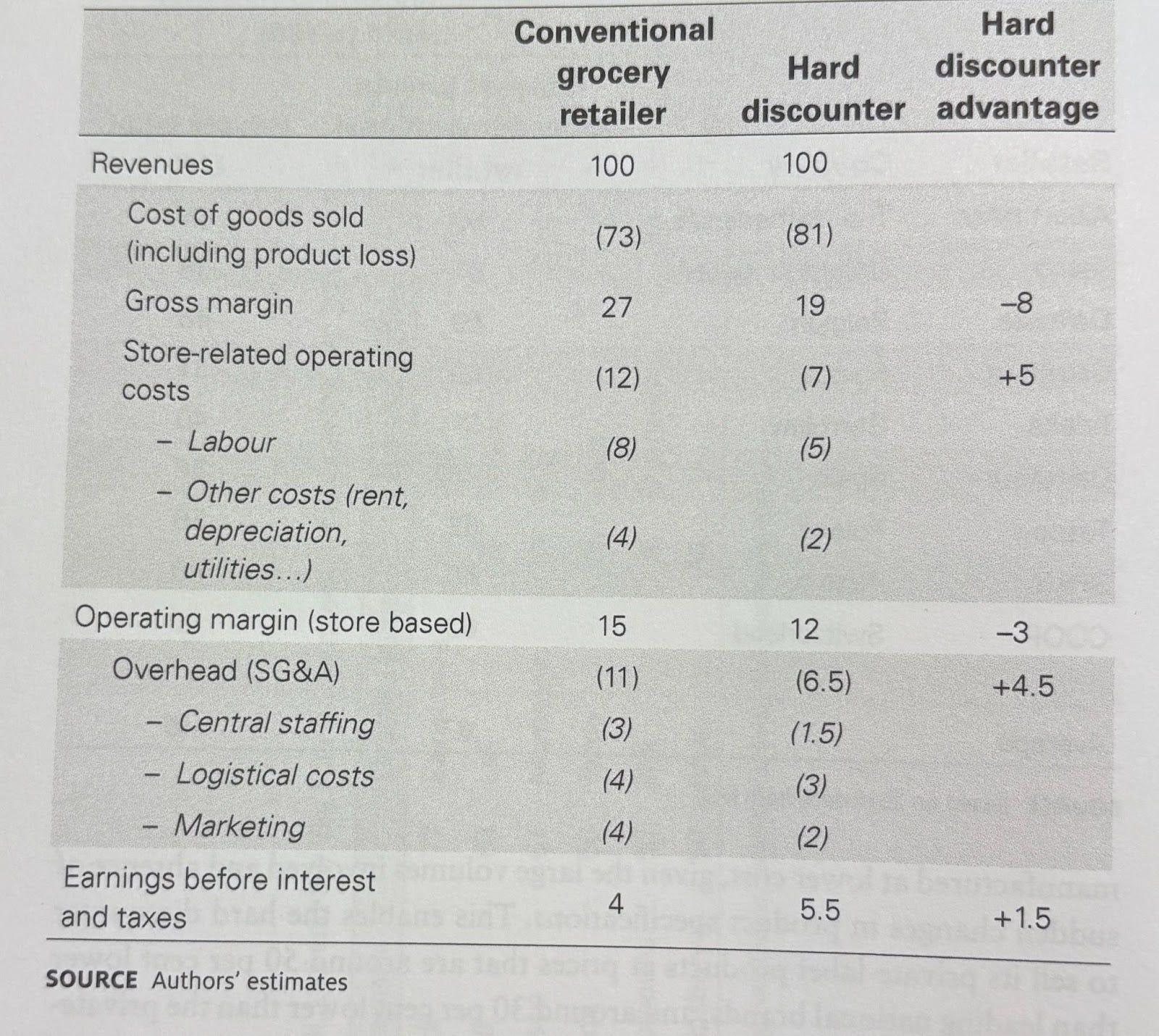
Even though the conventional retailer enjoys a significant gross margin advantage (i.e., it makes a higher margin selling groceries), the hard discounter enjoys a consolidated Opex advantage, driving a higher EBIT margin. Now, I must say that conventional retailers typically enjoy similar (or higher) EBIT margins to those of hard discounters (not inferior), but the key lies in the fact that, at that same profitability level, a conventional retailer’s value proposition is (theoretically) worse for customers. As you might have imagined, this better value proposition typically leads to structural share gains in markets dominated by conventional retailers.
So, two questions should arise from the above. The first one is: what characteristics make a hard discounter a hard discounter? The second one is: why don’t incumbents react to the threat? Let’s start with the first. Hard discounters are typically characterized by the following:
Austere stores where products are typically displayed with their original wrapper. This helps hard discounters save on Opex (labor) and Capex (both growth and maintenance)
A limited number of SKUs. Even though BIM and Tiendas 3B take this to the extreme by only carrying around 800 - 900 SKUs at any given time, the classic hard discounters like ALDI and Lidl carry significantly more SKUs, but also typically carry significantly fewer SKUs than a conventional retailer. Just for context here, a Walmart Supercenter in the US can carry up to 140,000 SKUs, whereas a typical ALDI store carries 1,500 or so. The goal of the limited product assortment is to increase the volume per SKU. This SKU scale advantage feeds into several advantages for the hard discounter (discussed later)
A high proportion of private labels. The objective with private labels is to bypass the brand “tax” and therefore to be able to offer a brand of comparable quality to the consumer that it’s significantly lower priced (typically at around a 20-30% discount), but that also carries higher gross margins for the hard discounter. When it comes to private labels, hard discounters follow two distinct strategies: (1) a single private label, or (2) one private label per SKU, giving the customer the “illusion” of choice. Tiendas 3B follows the latter. It’s also worth noting that, while private labels will make up a more significant proportion over time, ALDI’s development demonstrates that a hard discounter has to carry national brands in certain categories
These characteristics offer material advantages to the hard discounter and the consumer in what we could consider a win-win model. The consumer is able to fulfil his shopping needs at a significant discount, making this model initially well suited from low to medium income populations and resilient to economic downturns. On the other hand, the hard discounter…
Gains market share from conventional retailers due to offering a significantly better value proposition to the value-oriented consumer (while remaining profitable)
Turns its inventory faster due to its limited assortment and high volume per SKU. This results in significantly better cash conversion and, when a certain scale is achieved, a self-funding model
The second question one must answer here is:
Why don’t incumbents react to the threat and fiercely compete with hard discounters?
ALDI’s and Lidl’s experience shows that incumbents DO react to the threat, but that they typically do so when it’s already too late (i.e., when cost leadership has already been established). Industries get entirely reshaped with the entry of hard discounters. This is how it typically unfolds.
The incumbents start by ignoring the hard discounters: “they are too small to even worry us!”
While they are being ignored, hard discounters continue scaling until reaching a size with which they can retain cost leadership while remaining profitable. This results in gradual and continuous share loss by the incumbents, with no end in sight (remember that the model is self-funding once it reaches “escape velocity”).
Lastly, conventional retailers react, but this reaction comes with its own set of challenges.
The first response is to cannibalize their own gross margins to compete (i.e., try to match prices), but there’s two main limitations to this strategy. First, the management team has no incentive to do so if the stock is publicly traded. Lower margins mean the stock gets clobbered and a management team that is at the helm for 3-5 years simply doesn’t want to be held responsible for underperformance. The most rational short-term behavior is to ignore the threat and postpone it until the next management team is elected. In some ways this is the innovators dilemma; conventional retailers have no incentive whatsoever to disrupt themselves. Secondly (and probably most importantly), the business model of conventional retailers is simply not built to operate with significantly lower gross margins. National brands make up a high proportion of the assortment and store Opex is considerably higher. Changing the entire cost structure takes time and there’s no assurance that it will result in price leadership.
So, what choice do conventional retailers have? History shows that there’s only one way to survive competition against a scaled hard discounter: premiumizing by offering a significantly better customer experience. Pretty much any conventional retailer that lies in the middle of the market (neither premiumized or a hard discounter) is destined to be completely eliminated if it doesn’t manage to transition to the extremes. As I’ll explain in Section 5, the case of both BIM and Tiendas 3B is rather unique in terms of competitive intensity as they fight a different war to what ALDI and Lidl fought in other countries: instead of competing against conventional retailers, they are industrialising the traditional grocery industry.
Section 2: The Tiendas 3B model and the growth algorithm
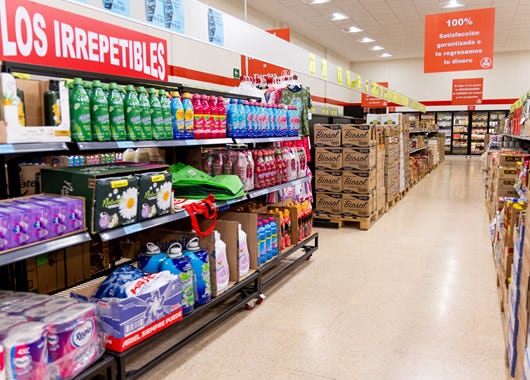
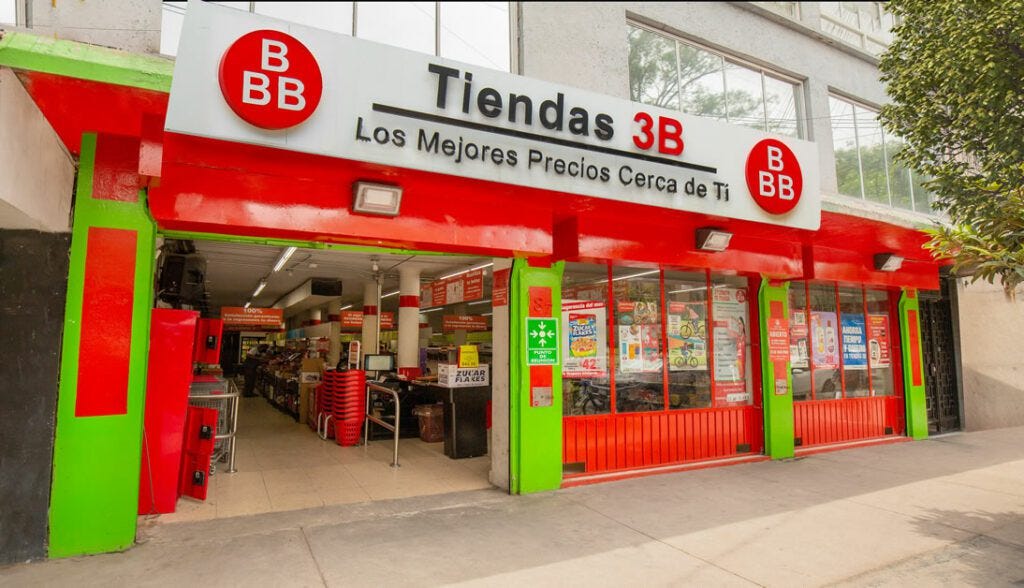
Tiendas 3B’s model doesn’t differ materially from that of a conventional hard discounter, but it has its particularities (especially when compared to ALDI and Lidl). For starters, Tiendas 3B’s stores are typically smaller (average of 400 square meters compared to Lidl’s average of 1,300 to 2,000) and located closer to customers, which also plays into the aspect of convenience. This allows for higher store density, thereby reducing logistics costs. This is how a store looks on the inside:
And this is how it looks on the outside:
Stores offer around 850-900 SKUs, of which around 450 are private label SKUs. Private label products currently account for 54% of sales and are typically 20-30% cheaper than national brands. This ultimately means that private sales volumes are considerably higher than the reported 54% of total sales. The store offers the most relevant grocery categories for customers but has two particularities. First, Tiendas 3B stores do not carry perishable goods yet, a key grocery category that its customers have to satisfy elsewhere. The management team is currently piloting these (with great results) and it’s a matter of time that they’ll be rolled out to the entire store base. The second particularity is that the store also carries a section called “Los Irrepetibles” in which they offer non-grocery products (like TVs) at great prices and for a limited time. This generates a treasure hunt experience.
So, what’s TBBB’s growth strategy? Simple: to open new stores and grow the sales of existing stores. Let’s start with the former: store openings. Management has opened stores at a pretty fast clip over time and is currently opening around 500 stores per year:
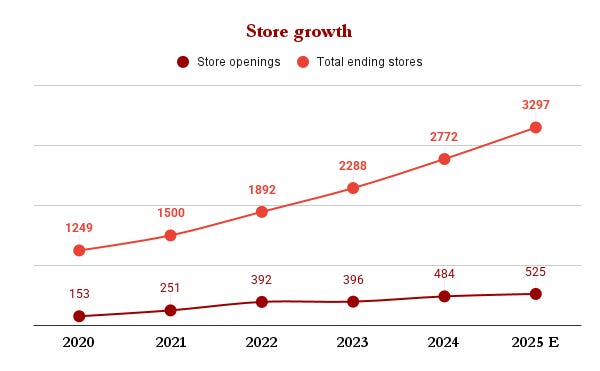
Two questions should arise from the chart above:
How can Tiendas 3B continue scaling store openings to maintain healthy growth?
What’s the store opportunity and how believable is it?
I’ll discuss #2 in section 4, but let’s focus on #1 here because it’s Tiendas 3B’s organizational structure that makes it possible. The first question that came to my mind after reading about management’s ambitions was how realistic scaling yearly store openings was (small note: management believes store openings can sustain a 15%+ CAGR over the coming years and the only way to achieve this is opening more stores per year). BIM, for context, currently opens around 1,000 stores per year, so doubling the yearly store openings seems to be a realistic feat, with the only question remaining being “how?.” Through decentralization.
Tiendas 3B’s operations are subdivided in regions. Every region (which is built around a distribution center) is responsible for around 150 stores in a 150 kilometre radius but can manage up to 200 stores and can reach beyond the radius if needed. Once a region is reaching its store limit and/or stores are too far out, Tiendas 3B opens a new adjacent region (with its corresponding distribution center). The new region is typically launched with 30-40 stores.
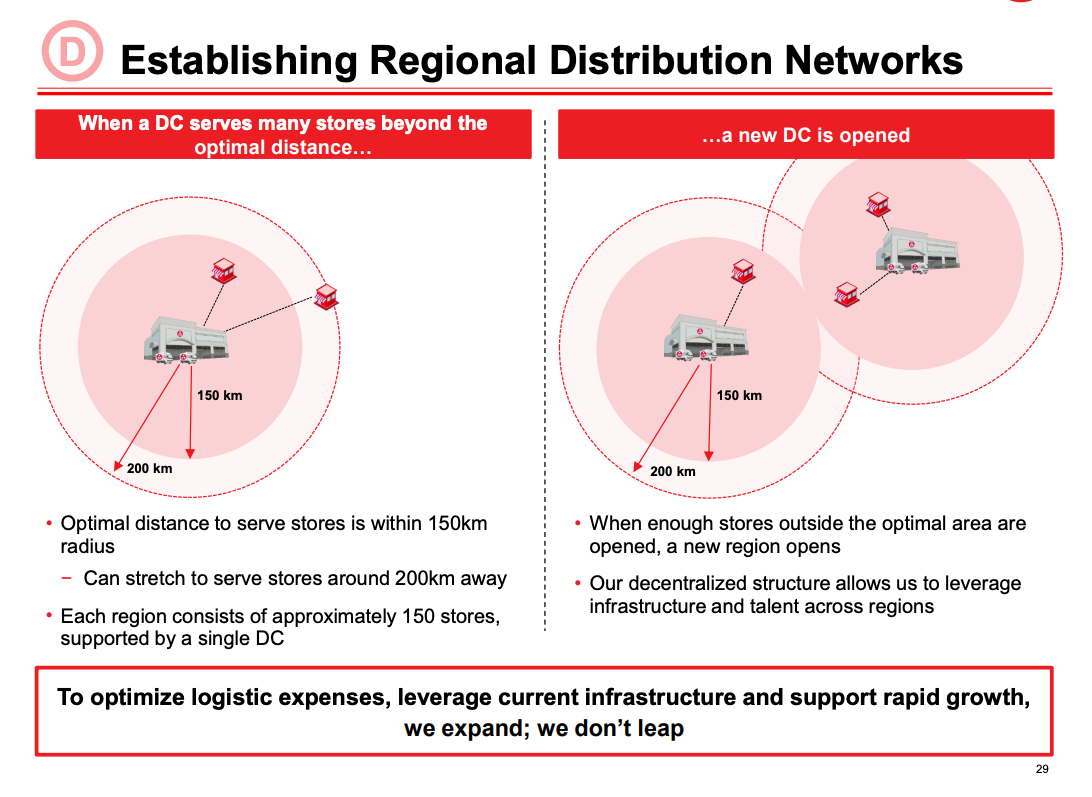
New regions are established with an entirely new team led by a regional leader. This team runs autonomously for the most part and is responsible for opening new stores in the region. Note that their responsibility is two-fold. First, increasing store density close to the distribution center, and second, looking further away from the distribution center to prepare the terrain for a new region:
And our strategy, as you know, in real estate is a very decentralized operation, and each regional CEO is in charge of doing their own search for stores where they are stretching distances a little bit from their distribution centers while at the same time backfilling and increasing density closer to this distribution center.
Source: Q4 2024 Earnings Call
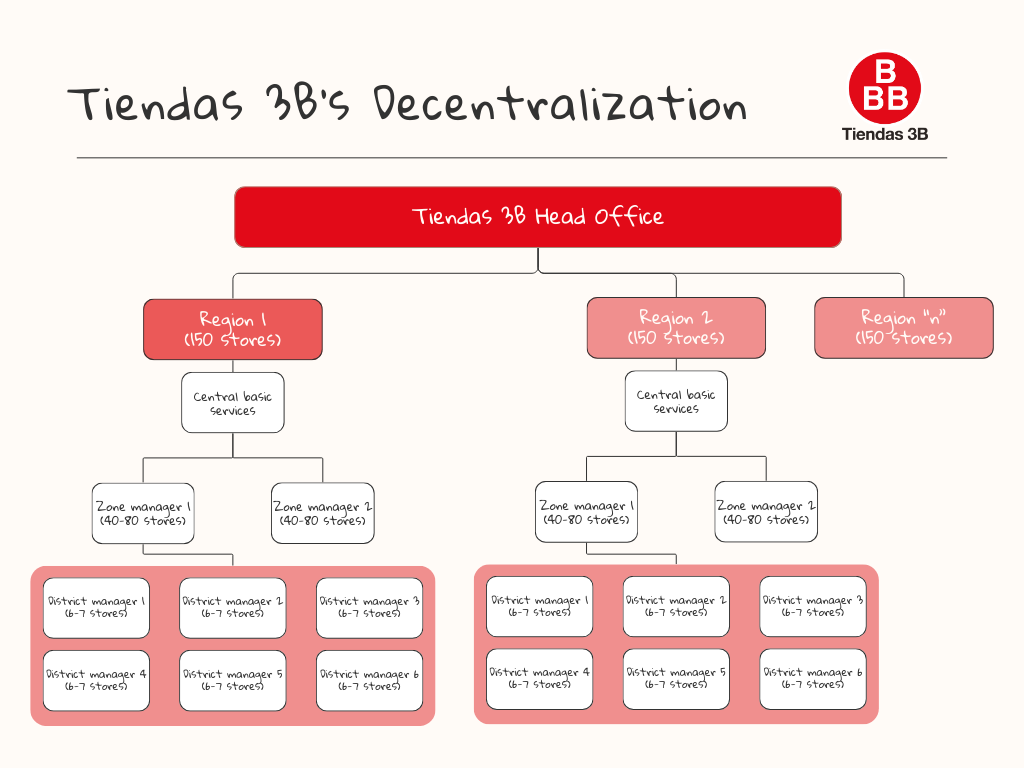
The only requisite to retain this autonomy is to adhere to Tiendas 3B’s real estate guidelines. Each regional leader oversees two zone managers that are responsible for around 40-80 stores each and have an obligation to visit each store at least once every two months. These zone managers are supported by 6/7 district managers, each responsible for 6-7 stores:
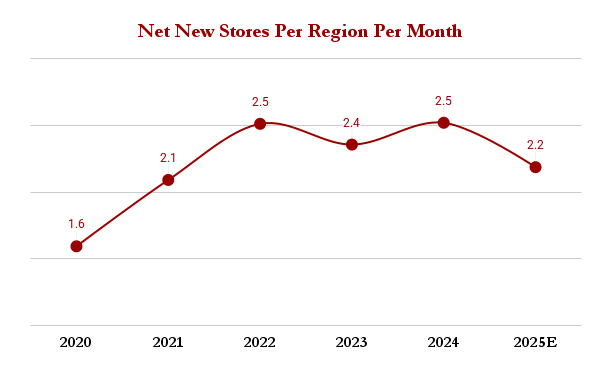
This decentralized model allows Tiendas 3B to continue scaling store openings without suffering bottlenecks at the consolidated level because every region is responsible for opening around 1-3 stores per month, a number that has remained fairly constant over time (COVID was evidently an exception):
Uncoincidentally, BIM “pioneered” this decentralized model to scale store openings to 1,000/year. BIM currently operates around 73 regions in Turkey (compared to Tiendas 3B’s 20 regions) and opens around 1,000 stores per year. This results in around 1.2 store openings per month/per region, which is understandable considering that BIM is significantly more penetrated than Tiendas 3B is. Tiendas 3B’s management has openly admitted that they require three things to continue the pace of store openings: capital, real estate, and labor. Labor is currently the sole “bottleneck.” With BIM being able to open 1,000 stores per year and TBBB following almost exactly the same model, I’d say it’s realistic to assume that the trajectory will be similar. JP Morgan indicated the following from a recent call with management:
Management indicated that with a 20-region footprint, the annual rate of store openings could significantly exceed the current 500-550 stores per year.
Source: JP Morgan
This would stretch the metric above closer to 3, which has been achieved in the past and demonstrates that the model can also scale within the regions (not only with additional regions).
The store openings lever already makes the model attractive because it’s…(a) a proven model that generates high returns (management often cites cash-on-cash returns above 60%, with consolidated ROICs significantly above the cost of capital), (b) replicable/simple, and (c) self-funding. Tiendas 3B currently opens a store every 10,000 people, but this number has been coming down over time without a significant impact on comparable sales growth. The most interesting thing about the model is that it’s also pretty resilient. First, it’s low-priced grocery so it tends to gain share during economic difficulties (people still have to eat, so it’s a non-discretionary expense). Secondly, once the flywheel is in motion, it’s tough for a competitor to regain cost leadership.
Comparable sales is the other growth lever and it’s an interesting and (slightly) misleading one. Tiendas 3B has grown comparable sales at an incredible pace for a grocery retailer (comparable sales growth accelerated again in 2025):
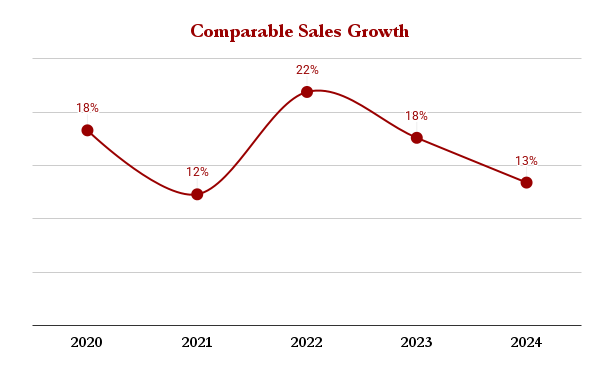
Despite being impressive, we must take these figures with a healthy dose of skepticism as this is what one would expect from a retailer during its high growth phase. The reason is that new stores take between 3-5 years to mature and, therefore, comparable sales experience a tailwind from this ramp up. Tiendas 3B has opened an incredible number of stores over the past few years, so its comparable sales include a good number of stores that are in the maturation phase (i.e., comparable sales are somewhat inflated). Management tries to somewhat control this by only including in comparable sales those stores that had been opened for at least 12 months before the beginning of the comparable period. This means that if Tiendas 3B opens a store in June 2024, that store will not make it into the comparable sales calculation until 2026.
We do know, however, that the underlying comparable sales growth is healthy and significantly higher than the industry average, which means that Tiendas 3B is gaining share at an accelerated pace. Management has shared that vintages that are 20 years old continue to grow comparable sales faster than inflation and that newer vintages are becoming more productive faster:
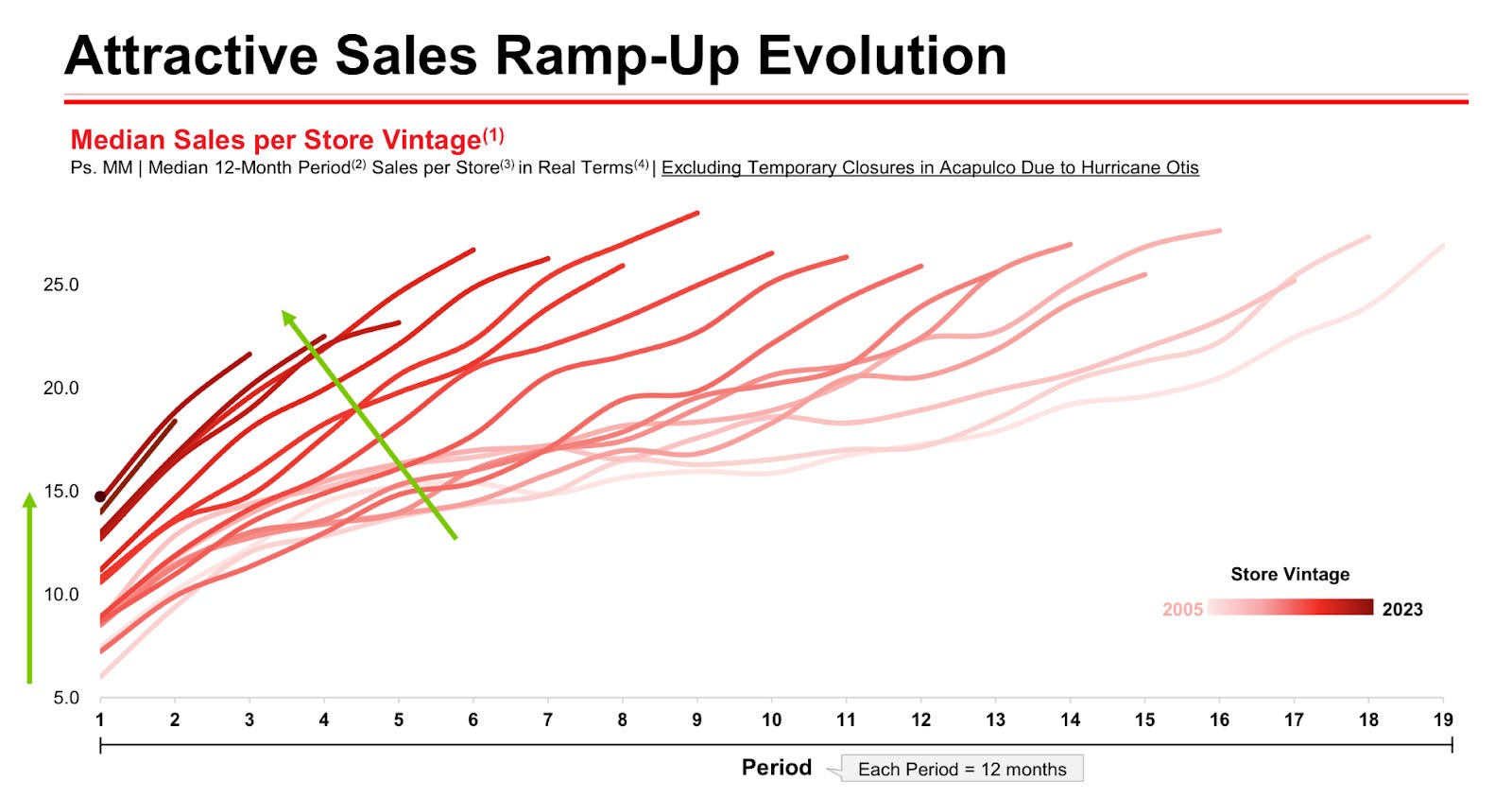
They attribute this faster ramp to two things. First, brand recognition. Secondly, the fact that the value proposition just keeps getting better and better:
We haven’t seen a slowdown in growth for older vintages. And we ask ourselves why the fundamental driver is a continued improvement in the value offered to customers.
Source: Q1 2024 Call
One might think that inflation is also another important consideration in the comparable sales growth analysis. While this is an apparently good caveat, it’s actually not as straightforward as it seems. Management has rightly pointed out that there are two offsets to said inflation narrative. The first one is that, as private labels grow, pricing actually becomes a headwind to comparable sales (i.e., they need to sell more volume to compensate for the lower price of the private label). The second one is that, as a hard discounter, the company actually suffers deflation in many periods. This makes the comparable sales growth more impressive than it already was in nominal terms! Despite these headwinds, both average ticket and number of transactions continue to grow at a good pace in mature stores:
For our stores with five or more years of operations, we saw a 4.6% increase in the number of transactions and a 3.6% increase in the average ticket size.
Section 3: Store Economics and Financials
Economics and financials for a retailer must be looked at from two POVs (points of view). The first one is the 4-wall (store) metrics. As discussed above, Tiendas 3B’s stores take on average around 3-5 years to reach maturation, have a payback period of roughly 2 years, and require “minimal” Capex investment:
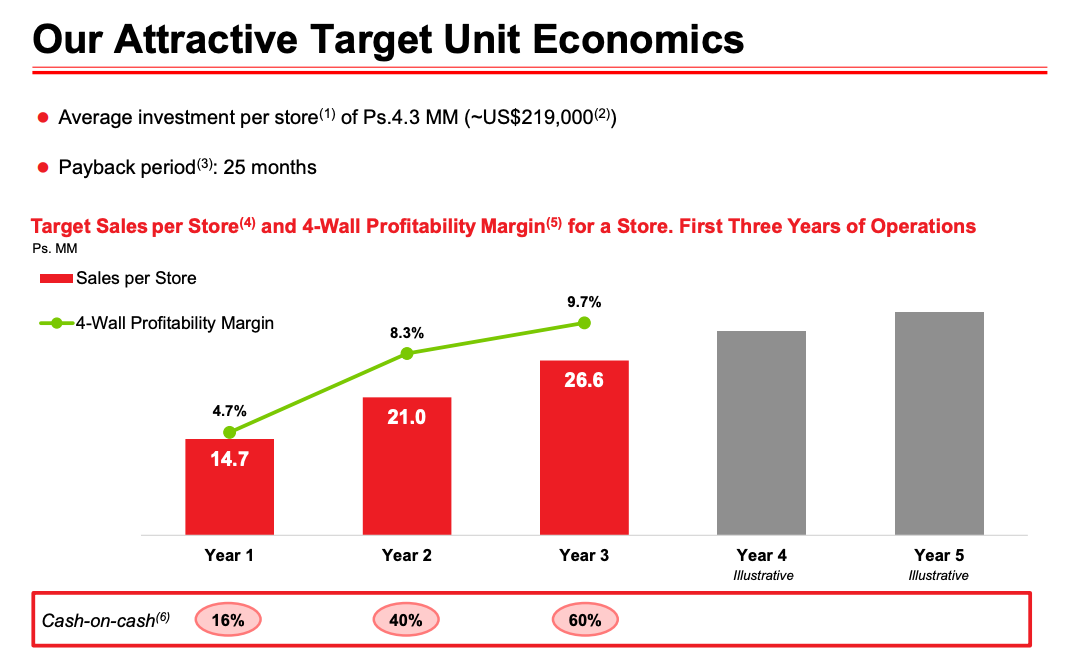
In year 3, a store that cost to build around $219,000 is generating $150,000 in EBITDA. This, together with favorable working capital dynamics, results in very appealing cash on cash returns. These great returns allow management to open new stores with the proceeds of existing stores, thereby enjoying a self-funding model. Now, the 4-wall returns don’t tell the full story here. One thing is the returns that Tiendas 3B generates on its stores, and a very different thing is the return the consolidated company generates on its investments. There is also good news on this front.
Tiendas 3B generates pretty appealing ROICs at the consolidated level:
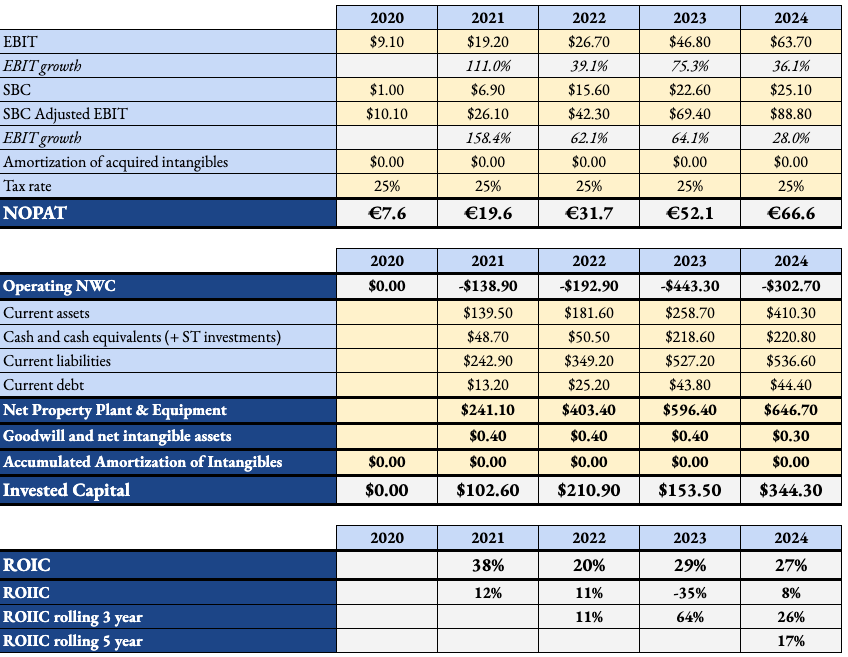
These high returns are possible thanks to a very attractive characteristic inherent to hard discounters: favorable working capital dynamics. Tiendas 3B turns its inventory roughly 3 times before paying suppliers, resulting in negative working capital of around 10% of sales. This benefit is higher when growth is high and diminishes when growth decelerates, but it also makes Tiendas 3B benefit from inflation because the debt it owes to its suppliers diminishes in real terms with inflation. I believe there are reasons to believe that returns will be better/worse going forward, but that’s a topic I will discuss in section 6!
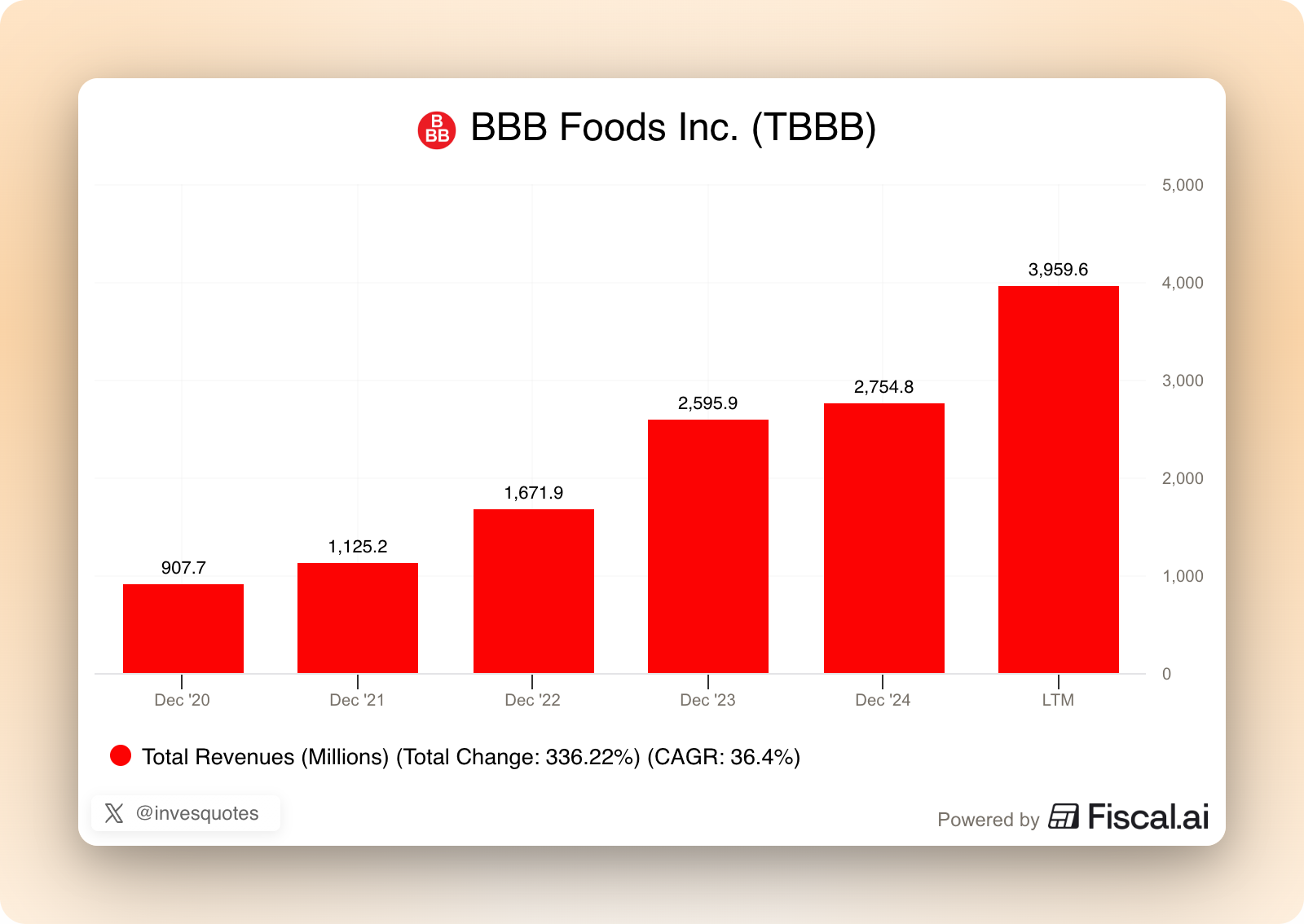
Briefly going over historical financials, we can see that Tiendas 3B has scaled pretty fast. Revenue has CAGRd at a 37% clip (in US dollars) since 2020:
Profitability, however, is not a straightforward topic for Tiendas 3B. The main reason is SBC (share-based compensation). As a result of its IPO, Tiendas 3B is currently experiencing high SBC expenses which are putting downward pressure on reported margins. Before you tell me that SBC is a real expense and shouldn’t be excluded (I know), let me tell you that the best way to take it into account for Tiendas 3B is through share dilution (as a large portion of it will be a one-off). Not only is this the most precise way to do it but it also lets the profitability of the underlying business shine through (as current dilution is not representative whatsoever of future dilution). Tiendas 3B is currently generating SBC-adjusted EBITDA margins close to 4%. They’ve been higher in past years but the company is currently frontloading DC openings:
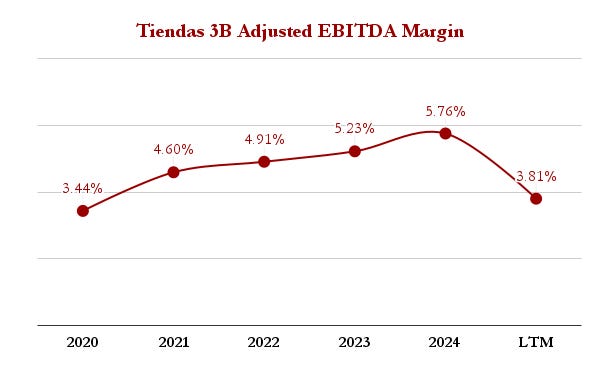
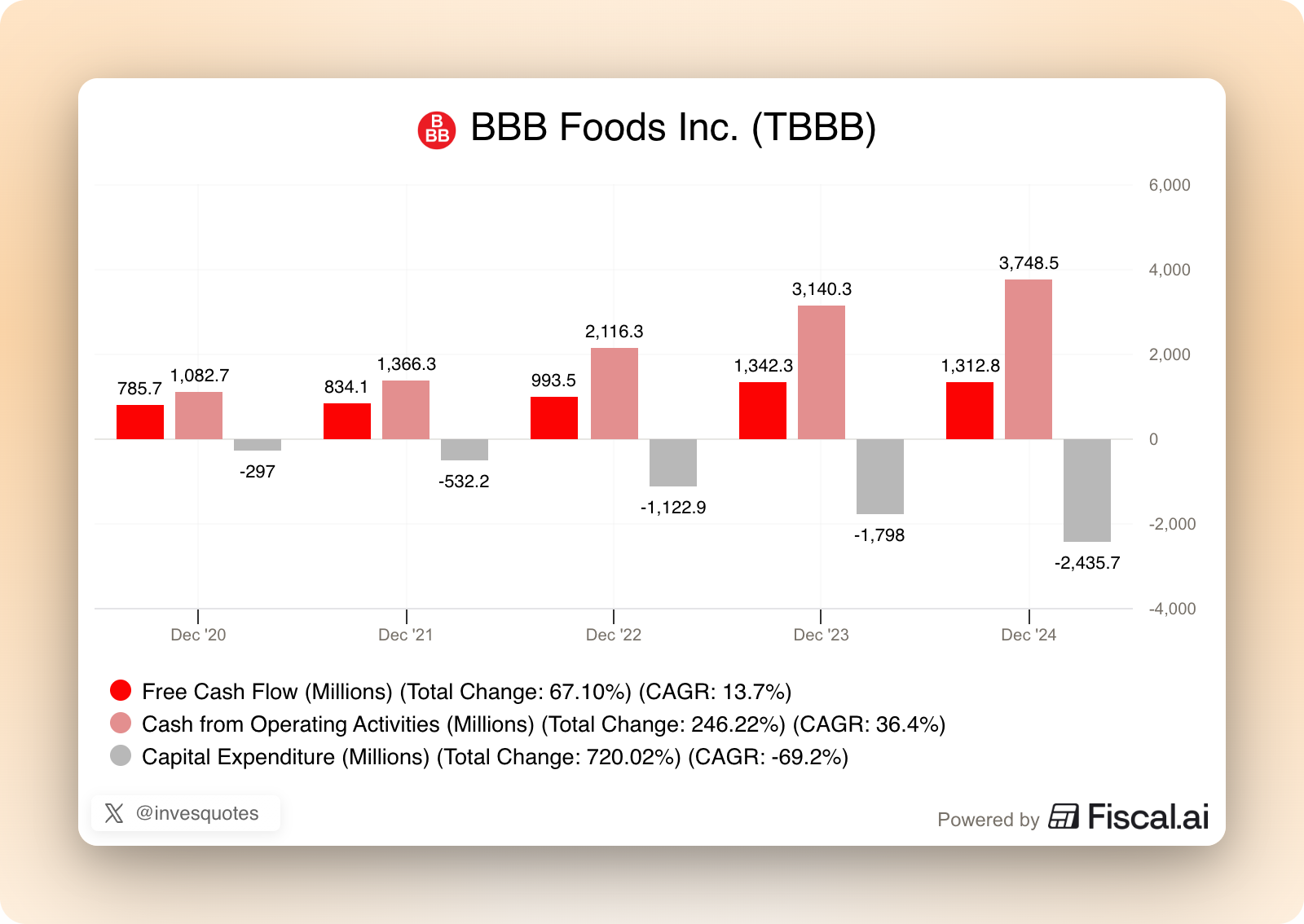
These margins are significantly lower than the EBITDA margins of comparable (albeit more mature) businesses like BIM which enjoy around 7-9% EBITDA margins, but the margin differential is a consequence of the hyper-growth phase the company is currently in. Regions and DCs are not rightsized and therefore margins are lower than they would should management decide to stop opening new stores. Despite profitability currently not being optimized, the beauty of the model lies in cash conversion: Tiendas 3B is already generating positive free cash flow despite being in a hyper-growth phase. This means that the model is self funding already and that Tiendas 3B will have significant cash to deploy (or return to shareholders) as it grows:
All in all, great economics, strong growth, slim margins (as you would expect from a hard discounter in the hyper growth phase), and very strong cash conversion. What’s important to understand for Tiendas 3B is that there’s a critical trade-off between profitability (gross margins) and growth. Tiendas 3B can share the additional margin achieved through scale with consumers (higher growth) or they can keep it for themselves (lower growth, but higher profitability). This trade-off is top-of-mind for management:
We are constantly trading off price versus sales versus peso margin gained. And we’re always optimizing for this peso margin gains and for volumes. So believe me, if you see a decrease in gross margin, we’ve only done it because we believe we’re better off on a volume basis and on a sales basis. We don’t have a gross margin target. In our models, we keep our gross margin flat forever. So if you put a lower gross margin, then you must change your sales curve and make it steeper and higher.
Source: Q3 2024 Call
Despite modelling for flat gross margins internally, management claims that some of the scale benefits will be reinvested into the customer, but that gross margins over time should trend up.
Section 4: The Opportunity
Now that we know that Tiendas 3B will probably be capable of ramping store openings to (at least) the 1,000/year mark, we must contextualize this within the store opportunity. Management believes that Mexico provides white space to open “no less than 14,000 stores.” Management recently raised their expectations from 12,000. The question here is: how do we know if it’s a “fair” metric? For starters, we can use BIM as a parallel.
Turkey has a population of around 85 million and, between BIM, A101, and SOK (the three most popular hard discounters), there are currently around 40,000 hard discount stores (and growing). This means that Turkey has been able to support one store per 2,125 people. BIM, specifically, has around 11,000 stores in Turkey, or what’s the same: one store per 7,200 people.
Mexico currently has a population of 130 million, but we must adjust this number somewhat. The number needs adjustment primarily because it doesn’t make sense for Tiendas 3B to open stores in unpopulated areas (those that have less than 10,000 inhabitants). This (according to questionable statistics) means that around 25% of the Mexican population can’t be addressed by Tiendas 3B (or at least not in a profitable way). If we combine Mexico’s population density map with Tiendas 3B’s store density map we can see what I am talking about here:
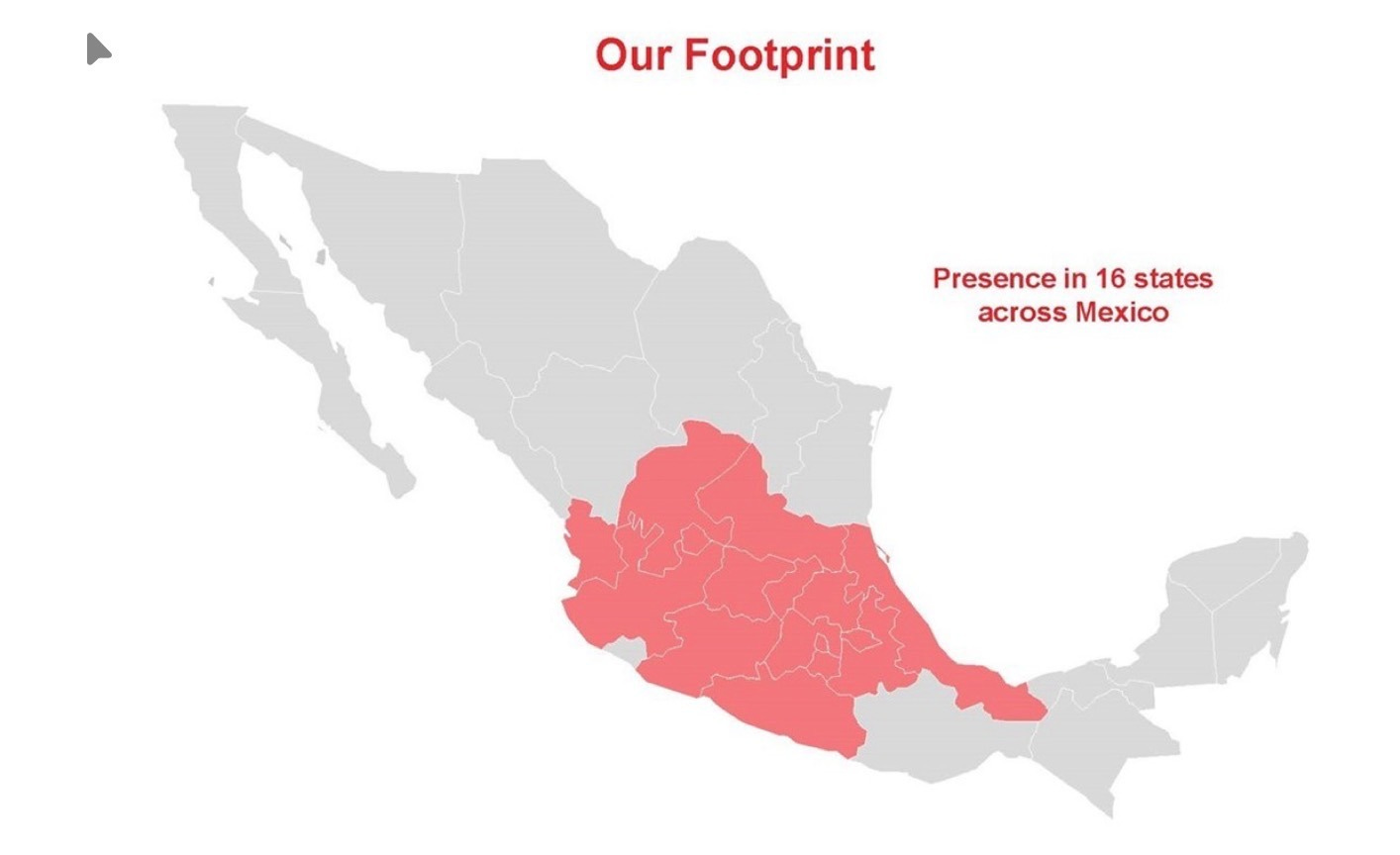
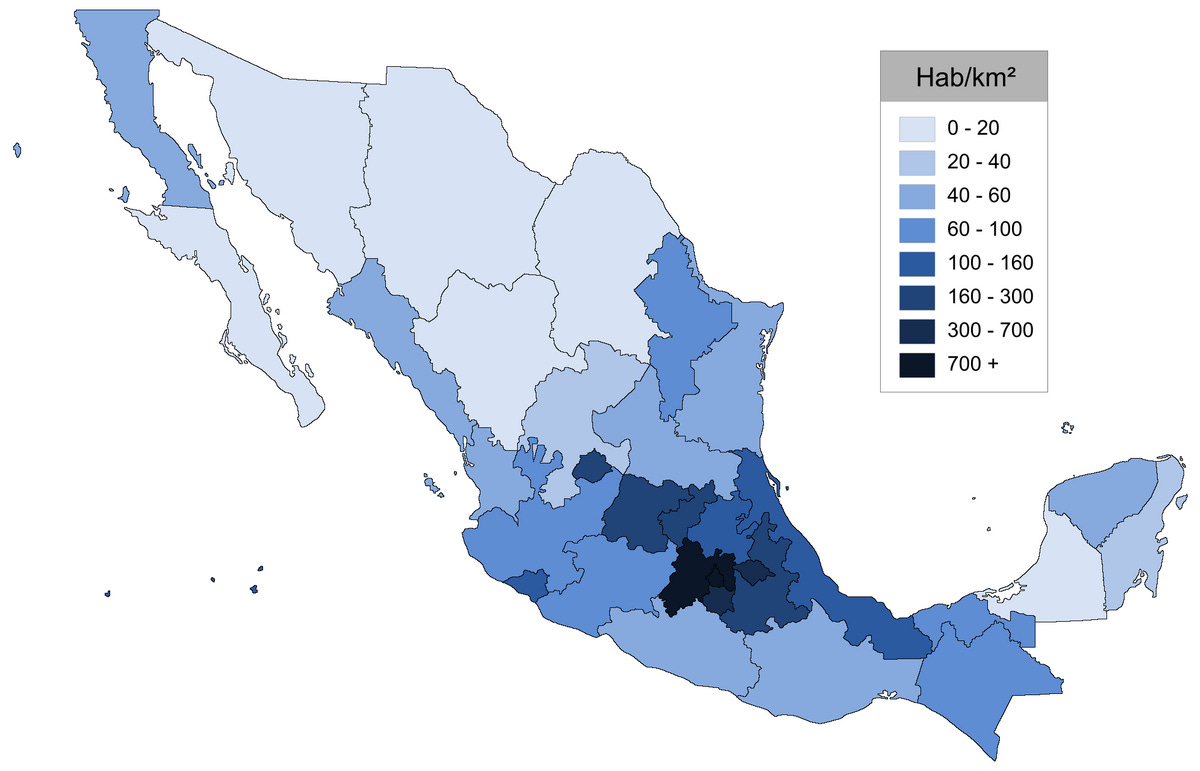
The above means that around 75% of the total mexican population is a potential customer of a Tiendas 3B store. This translates into a serviceable market of around 97.5 million. At 10,000 per store this results in around 9,750 stores, significantly lower than management’s estimates. However, at BIM’s 7,200 people per store, this lands almost right in management’s “guidance” of 14,000 stores. Note that BIM has 2 credible competitors, but Tiendas 3B only has one direct competitor which is lagging behind (more on this later). At the 2,125 people/store penetration of hard discounters in Turkey, Mexico can potentially host up to 46,000 hard discount stores. If 14,000 of these belong to Tiendas 3B, this results in a market share of around 30%, which definitely seems realistic/doable. One can ask themselves where this share gain will come from, right? At the end of the day, grocery needs are already being satisfied in Mexico, so why are hard discounters going to grow so much in a market that’s already being satisfied? This is a question I will answer in the next section.
Potential optionality
Despite having still a massive, untapped opportunity to continue opening stores, I thought it would be a good idea to go over several potential sources of optionality that BIM pursued once growth “slowed down” in Turkey (BIM continues to grow its top line at HSD to LDD real rates!):
Services: BIM started offering a myriad of services across its stores to take advantage of their high traffic. Tiendas 3B has been asked about potentially introducing services like remittances (remesas), something that management has not ruled out. Services increase the productivity of the store without the need for a larger footprint/Capex
International expansion? After densifying Turkey, BIM ended up expanding to Morocco and Egypt. Tiendas 3B could expand to other South American countries in the future. One thing I find interesting (albeit not necessarily a strong signal) is that Tiendas 3B’s Director of Retail Estate was involved in OXXO’s international expansion
Premiumization (a different store concept): BIM ended up launching FILE in Turkey, a more premiumized and independent concept so that it could coexist with its hard discount brand. Interestingly, Tiendas 3B acquired YEMA in 2023, a start-up specialized in organic, private label food. The YEMA brand is available at certain Tiendas 3B stores and runs 2 independent stores. Management believes the model will continue to expand (albeit at a slower pace than Tiendas 3B):
YEMA has been a very successful concept, and we will very likely roll it out. The pace of it would be at a different pace than when we roll out Tiendas 3B stores, but it will expand.
Source: Q1 2025 Earnings Call
All in all, the growth opportunity for Tiendas 3B seems both extremely large and believable.
Section 5: The Competitive Landscape in Mexico
The competitive landscape is one of the most interesting aspects of this investment thesis, not only because Tiendas 3B enjoys a pretty significant cost leadership against incumbents, but because it doesn’t theoretically need to win share from incumbents to do well. The Mexican grocery industry is bifurcated between the informal market and the formal market. The informal market is made up of three main players: tienditas (top left), mercados públicos (bottom), and tianguis (top right):
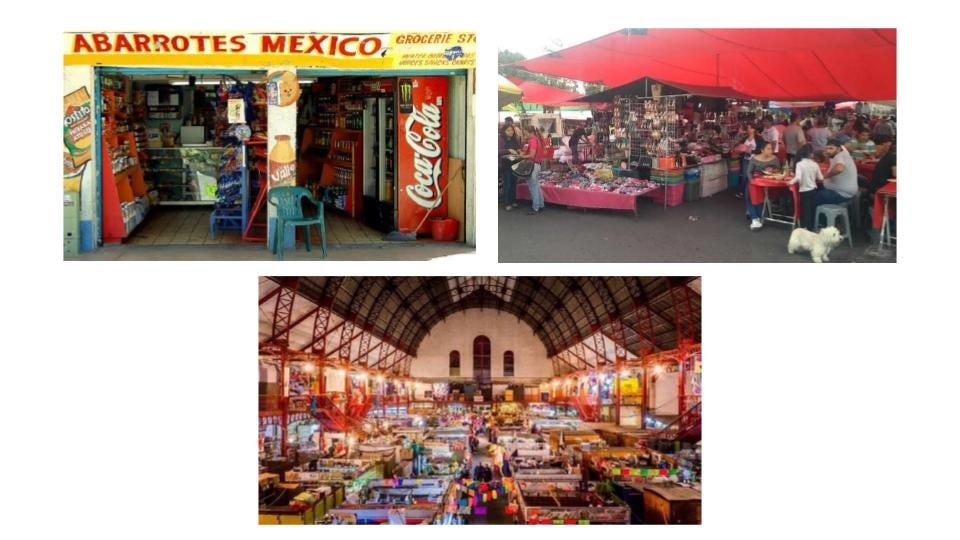
The formal market is made up of what we would consider conventional retail: hypermarkets, supermarkets, convenience stores, and hard discounters. Both the formal and the informal market satisfy the grocery needs of the population, so Tiendas 3B evidently competes against both. Under this scenario, why shouldn’t competition from incumbents be worrying? Because around 42%-56% of the grocery industry is still informal. This ultimately means there’s a lot of share to take from the “non-professionalized” players. It’s kind of ironic (but probably not a coincidence) that BIM’s success in Turkey came from competing in a somewhat similar market structure. The parallel to a Mexican Tiendita in Turkey is a Bakkal.
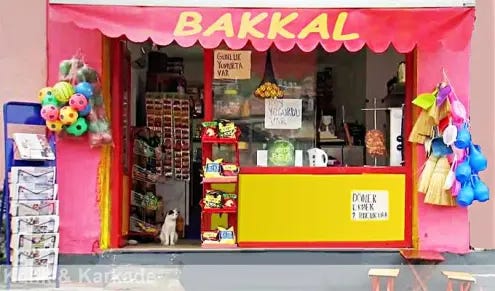
The rise of hard discounters in Turkey eroded the share of Bakkals from 65%-70% to around 20%-25% less than a decade later. This ultimately meant that BIM did not have to worry much about conventional retail (even though they also competed favorably), but that the only thing they had to do to be successful was to institutionalize the informal market. I expect something similar will happen in Tiendas 3B’s home country and I don’t believe it was a coincidence that Anthony Hatoum chose Mexico.
Now, evidently, Tiendas 3B is also going to compete against the formal market. The first section of this report should’ve been enough to explain why the only real competition is other hard discounters (and maybe not even!). Tiendas 3B’s closest peer is Tiendas Neto, which belongs to the Salinas family (a very powerful family in Mexico focused mainly on the financial industry). Tiendas 3B retains several advantages compared to Tiendas Neto. First, it enjoys cost (and, therefore, price) leadership, which is expected to widen as Tiendas 3B is scaling significantly faster (remember that scale benefits get reinvested into price leadership) than Tiendas Neto.
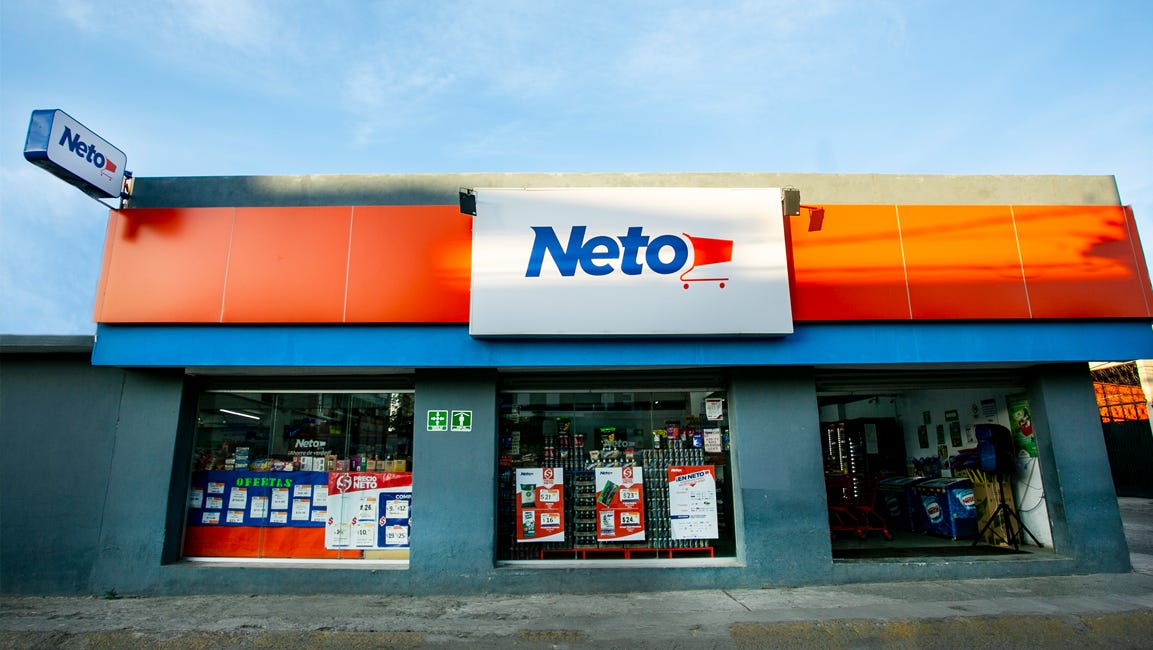
Secondly, Tiendas 3B has a better reputation among consumers (pretty evident in forums such as Reddit) and (importantly) suppliers. Tiendas Neto failed to pay its suppliers on time and some of them refused to continue selling to the company. This resulted in empty shelves and likely not the best customer perception. Tiendas 3B is not afraid at all to compete head to head with Tiendas Neto and their stores are typically close together:
With regards to Neto today, we have about 1500 Netos next to our existing stores. And what you are seeing is exactly that our current performance continues to be extremely strong. So we welcome all the competition and we’re very confident that our value proposition is stronger than most.
Source: Anthony Hatoum during the Q3 2024 Earnings Call
There are evidently other players in the formal industry. A notable one is Walmex (Walmart of Mexico). The concept of a hypermarket is entirely different to that of Tiendas 3B, but Walmex owns Bodegas Aurrerá, which somewhat mimics a hard discount concept:
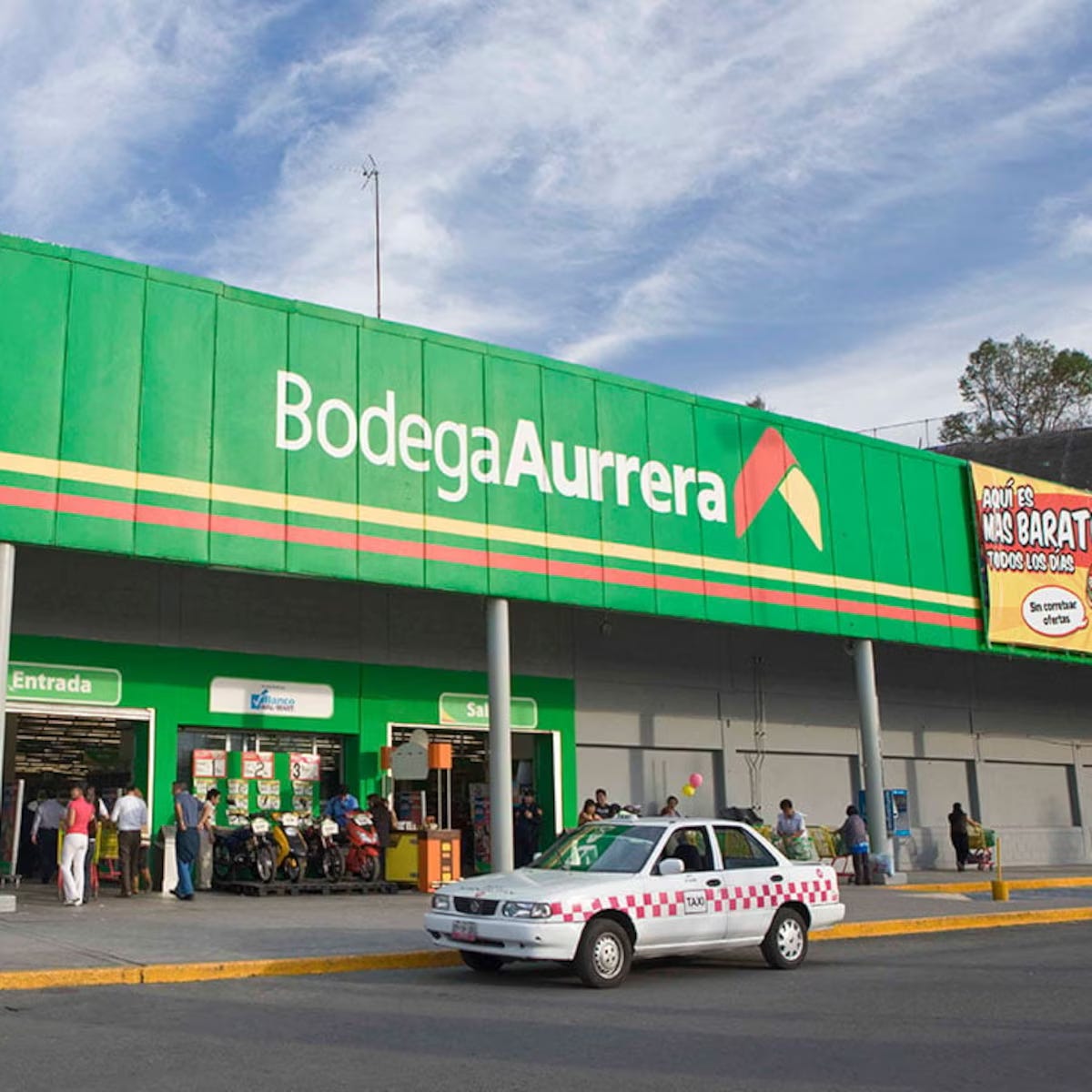
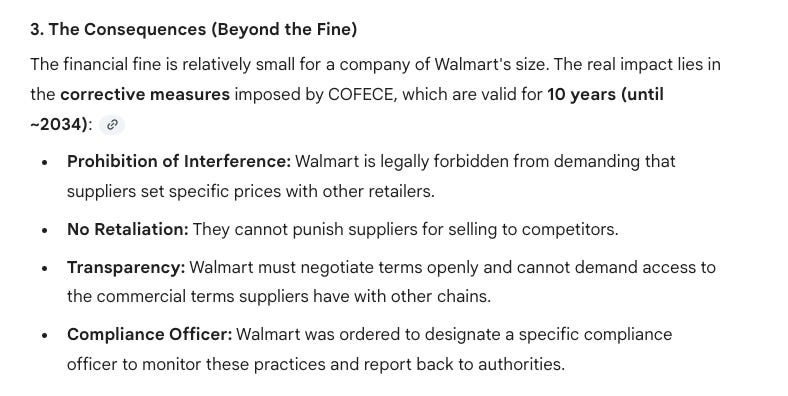
One would think that Bodegas Aurrerá (aided by Walmex’ expertise) should enjoy cost leadership due to Walmex’ scale, but Tiendas 3B actually retains price leadership with Bodegas Aurrerá. In fact, Walmart is starting to experience limits on how much they can push their scale in the context of their business model. COFECE (the Mexican regulator) has already fined Walmart for abusive practices with suppliers and has limited Walmex’s leverage:
So, where am I going with all this? If we look at history, the BIM parallel, and how incumbents have reacted to the hard discounter threat, we could argue that Tiendas 3B is in a pretty strong competitive position. We already know that incumbents have been slow to react to Tiendas 3B and that it now may be too late to do so.
If Bodega Aurrerá and Walmex wanted to eliminate us, they could have done it within weeks or months by reducing prices. However, they weren’t interested in doing so, which was fortunate for us. After reaching 300 to 500 stores, you gain purchasing power and can grow faster. At that point, you’re big enough no one can easily eliminate you.
Source: Expert Call, Former Tiendas 3B Employee
Tiendas 3B has cost leadership and it’s unlikely that it’ll give it away. If anything, I expect the gap to widen as the company scales (i.e., the moat is getting larger, not thinner). Incumbents have to completely reshape their business models, and they are already following the footsteps of conventional retailers in other countries: not competing directly with the hard discounter but premiumizing. One of the most successful concepts in Mexico (besides Tiendas 3B) is La COMER, which sits on the opposite side of the spectrum (I wonder why!):
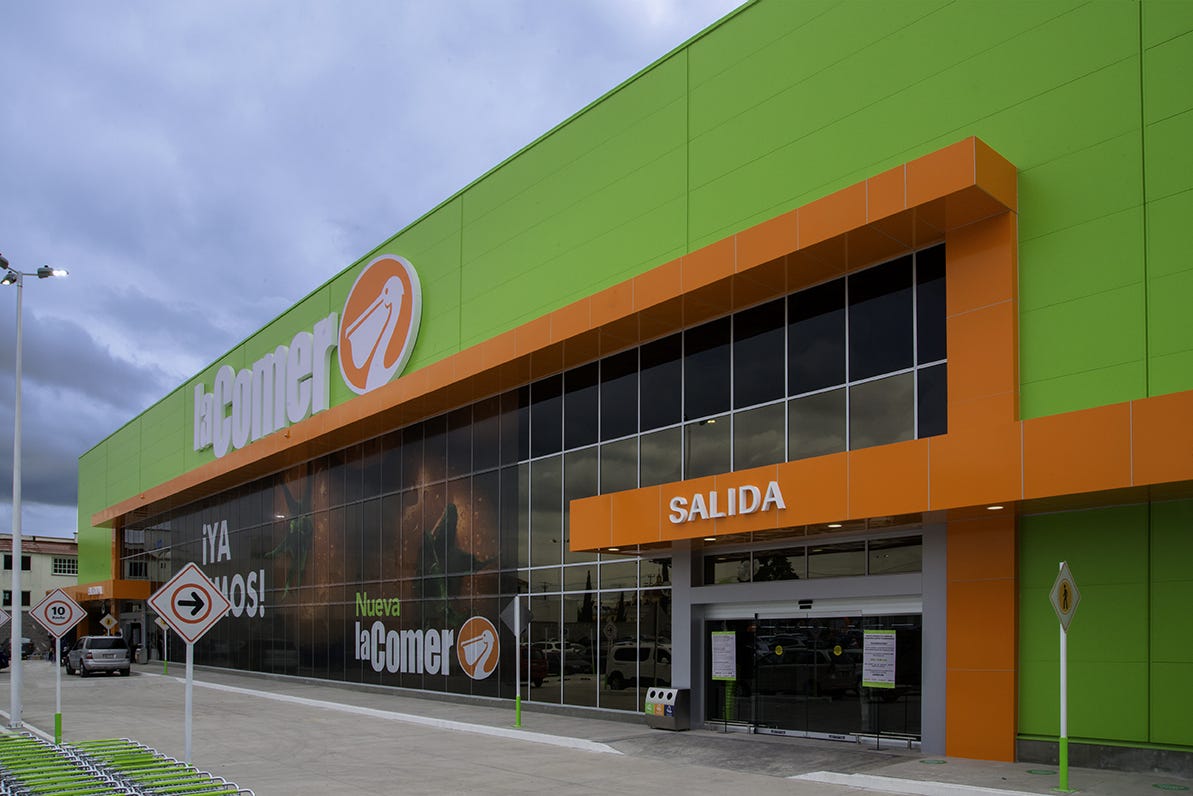
To this, we must add that Tiendas 3B can be very successful simply by industrializing the informal market. It’s great to know that it also competes favorably against the formal market, but what should really matter is that the writing is on the wall. If one needs certainty that the hard discount model competes favorably against the formal market, one only has to look at what Lidl and ALDI achieved in the UK. The UK’s grocery market was dominated by the formal market when ALDI and Lidl decided to compete. The German hard discounters managed to quickly gain share from the incumbents and forced them to premiumize or die. Notably, this resulted in one of Warren Buffett’s and Terry Smith’s historical mistakes: Tesco.
One could argue that Tiendas del Bienestar also constitutes some kind of competition. Tiendas del Bienestar (formerly known as Tiendas Diconsa) are government-owned and are supposed to offer affordable grocery for the low-income population:
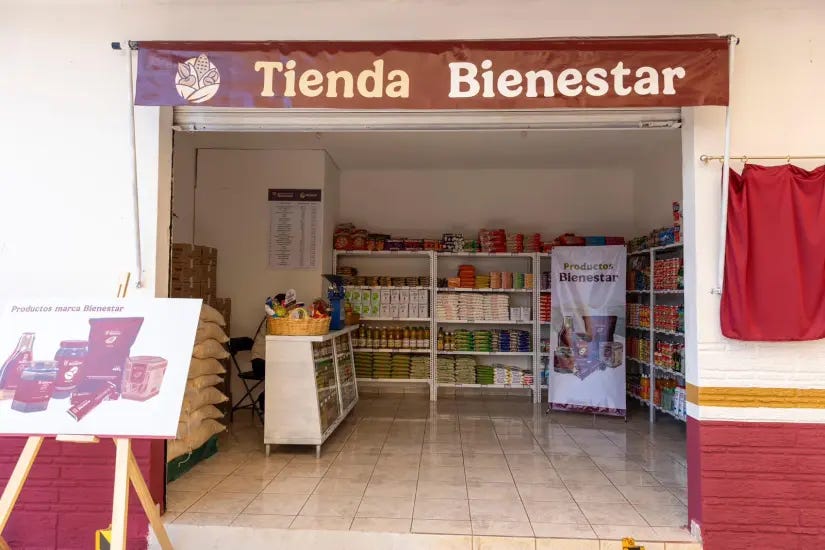
It’s a concept with 24,000 points of sales, but the focus is somewhat different. While Tiendas 3B pursues high population density, Tiendas del Bienestar was born specifically to target the portion of the population that lives in low-density areas. To this, we must add that Tiendas 3B has even managed to retain price leadership over a publicly-sponsored initiative! (watch this video).
The bottom line from this section is two-fold. First, the hard discount model is significantly underpenetrated in Mexico, and nothing stops it from achieving a similar success than it has elsewhere:
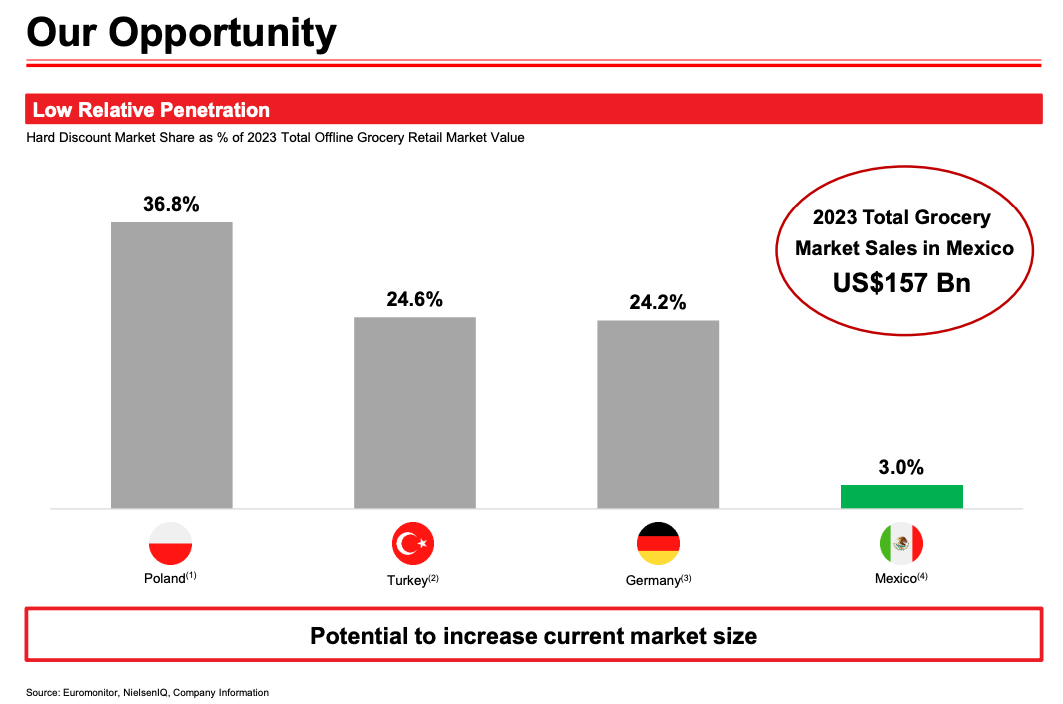
Secondly, the share donor will be an unprofessionalized market that has absolutely no chance of surviving against an industrialized player like Tiendas 3B.
Section 6: Management & Incentives & Capital Allocation
Right out of the bat we can see several interesting things about Tiendas 3B’s management (and other not so good things). Let’s start with what’s good. For starters, the company continues to be founder-led, with Anthony Hatoum serving his 21st year at the helm. As discussed in the introduction, he has a great CV and Tiendas 3B is not his first successful venture, so it’s likely that he knows a thing or two about successfully scaling a business. He also continues to hold a significant stake. Through Bolton Partners, Anthony Hatoum holds around 10% of the total shares outstanding. TBBB has a multi-share class structure, meaning that he actually holds a more significant voting stake: 45%. Shareholders should be cognizant that pretty much whatever happens at the company will be “decided” by Anthony. The second thing that (positively) stands out is management tenure. Tiendas 3B’s management is pretty experienced and one can tell there is a predisposition to hire from within.
On the flipside, I would say there are two lowlights in the management team, one of which one can consider a lowlight or a highlight (depends how one decides to look at it). The main lowlight in my opinion is that, as a foreign issuer, TBBB is not required to disclose what management’s compensation is tied to. This means that, as investors, we are flying blind. The good news is that the founder has a +$300 million stake, so alignment is most likely created through his ownership rather than his compensation. The other lowlight (which is honestly subjective) is the high proportion of SBC, albeit it needs context. In the last quarter, Tiendas 3B shared a detailed discussion of dilution. As you can see in the table below, dilution is expected to be significant over the coming years:
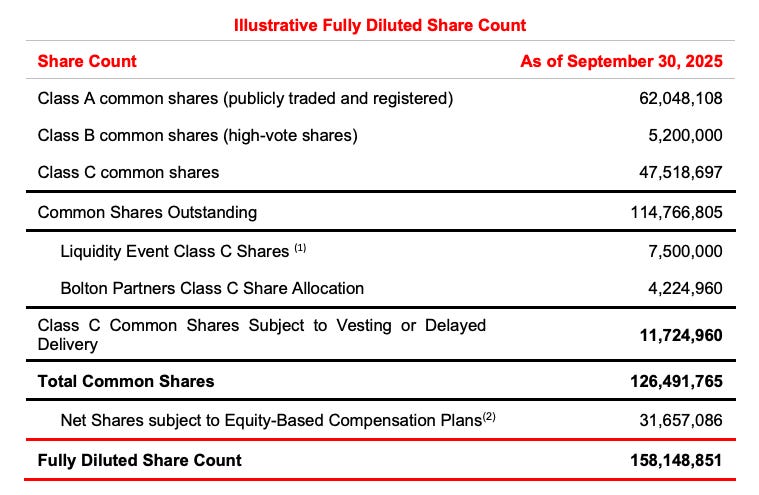
There are several components of this dilution. The most relevant one is the 2004 option plan. A good portion of said plan remained unvested until the company IPOed in 2024 so the IPO evidently resulted in a one-time large expense. The reality, however, is more nuanced: the 2004 option plan has created an annual dilution of 1.4%:
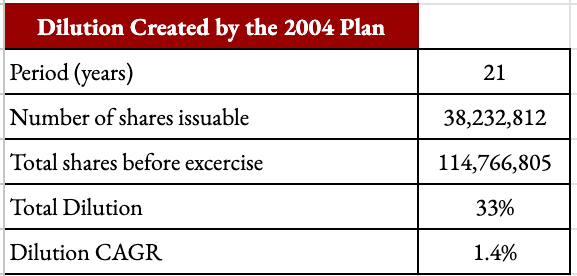
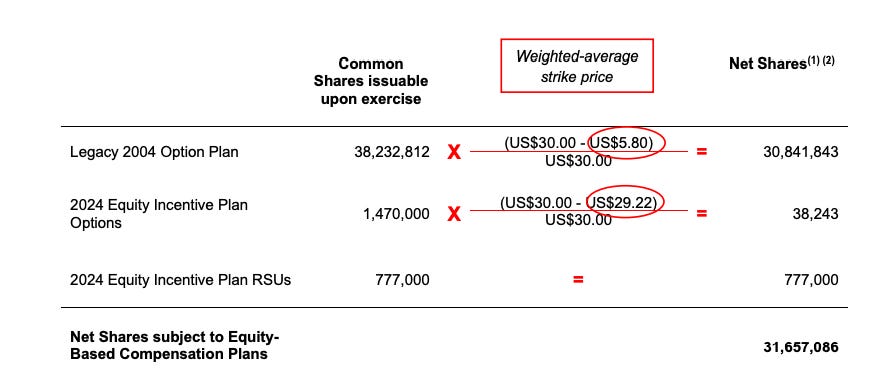
Once annualized it doesn’t seem like a big deal, but the truth is that 1.4% per year is pretty significant for a company with the EBITDA margins in the mid to high single digits. Now, this shouldn’t be a problem so long as we take it into account in our valuation model (more on this later). The company has revealed a new option plan called the “2024 employee option plan.” Even though we don’t know what dilution this will result in, we do know that…
Management has claimed that it shouldn’t necessarily result in a different annual dilution to the 2004 option plan
Dilution increases if (and only if) the share price is materially above $30 in the future
Management has discussed several times that they believe that the return on share-based compensation is great, more so considering the employee turnover inherent to TBBB’s industry. Returns is precisely something where management has their eyes on:
Anything that we look at is always looked at through the lens of what’s the return on invested capital, what’s the return on time invested.
Source: Anthony Hatoum, Tiendas 3B’s CEO
I’d say this is evident in two places. First, on historical returns. Tiendas 3B has historically achieved pretty decent ROICs, and this is despite being currently in a high growth phase where a lot of investment is front-loaded and the benefits are only generated over time (recall that stores take 3-5 years to mature):
I discussed one of the secrets behind these exciting returns in section 3: negative net operating working capital. Thanks to scale and the hard discount business model, Tiendas 3B manages to turn inventory three times before having to pay suppliers. This ultimately means that suppliers are the ones financing the store growth. While this is a great benefit of the model, we shouldn’t forget that it diminishes over time as growth slows.
I believe there are reasons to believe that incremental returns will be higher going forward, but also some reasons to believe they might be pressured. Let’s start with the reasons why they might be higher. The first reason is that Tiendas 3B is not currently optimized for margins. This means that, should store openings growth slow, the reinvestment rate (which is today close to 100%) would likely decrease, but returns would increase considerably due to improving margins. This is something that management has discussed in the past:
If we reduced our store opening rate to zero, you will immediately see a pop in margin and in EBITDA.
Source: Q3 2025 Earnings Call
Another reason to believe that future returns will be higher lies in the continuously improving value proposition of the stores. Management is piloting around 50-60 SKUs at any given time, but the number of total SKUs doesn’t tend to increase. The reason is that “unproductive” SKUs are replaced by more productive SKU’s, thereby continuously increasing store productivity and returns. Every new vintage ramps up faster than its predecessor so stores become more productive faster, but at a similar level of Capex (i.e., new vintages should generate significantly higher returns):
Unless you see a significant change in Capex costs due to whatever reason, the tendency is for an improvement on returns because what we’re seeing is every new vintage of stores performing better than previous vintages.
Source: Q1 2024 Earnings Call
There’s a lot of scrutiny in terms of SKU replacement because management is focused on efficiency and not on growth at all costs:
It’s so easy to increase sales by just adding more SKUs, but you have to look at the whole picture, we want to maintain efficiency across the board.
Source: Anthony Hatoum, Tiendas 3B’s CEO
On the flipside, I can also think about a couple of reasons why returns might be pressured going forward. The first one is inflation. Note that, as discussed above, inflation is not really a tailwind for TBBB due to the hard discount model, but it can potentially become a headwind through construction costs. Prior to 2024, management spent around 3.9 million pesos in building each store, but this has already gone up to 4.3 million pesos, and I’d say it’s logical to think that it grows from here. The other reason why returns might be pressured (albeit still far away) is cannibalization. As Tiendas 3B opens more stores, it’s also logical to think that some sort of cannibalization will end up happening, lowering store productivity. Now, this said, I expect incremental returns to look great here. Note that management is, to an extent, in control of their profitability through gross margins. The reason is that they are the price leaders and can decide when to share gross margins with customers and when to keep them for themselves.
Section 7: The Risks and the Valuation
Before jumping directly into the valuation and the model, I thought it would be a good idea to discuss the risks. Inherent in any investment thesis, but maybe more so in one of a high growth company operating in an emerging market with unstable politics (this description might actually fit any country nowadays), TBBB is not free of risks. Let’s start with the most straightforward of them all.
Mexico (and the peso depreciation)
Mexico is a country that’s not really politically stable and is run by a questionable government. This evidently introduces risk into the investment. Part of this risk feeds through the exchange rate, with the peso having depreciated quite considerably over time with the US dollar. Since 2005 (the year Tiendas 3B started operations), the Mexican Peso has depreciated 36% (compared to the US dollar). The landscape over the last couple of years has even been favorable to the Mexican Peso (slight appreciation), but Tiendas 3B has gone through several Peso deprecations throughout history.
So, what would happen if the peso depreciates again? I already shared at the beginning of the report what happened in the case of BIM: US investors still made a pretty good return despite the significant depreciation of the Lira, but significantly lower than those of Turkish investors (albeit these suffered hyperinflation all throughout). Tiendas 3B is more insulated from this risk for the sole reason that COGS are, to a great extent, dollarized in Mexico. This means that when the dollar depreciates, COGS rise. This would be worrying, but it’s a phenomenon that happens across the industry and results in pretty much everyone passing these increased costs to end consumers. This is good for investors because, even though a peso depreciation lowers USD returns, absolute mexican pesos end up higher (through higher prices) and therefore the impact is somewhat reduced. Management, however, has shared that the price increases typically lag the depreciation by a “few months:”
When we get a peso depreciation, what happens is that this is mostly a pass through, which takes a few months for that to happen.
Source: Eduardo Pizzuto, Tiendas 3B’s CFO
Now, even though I am not extremely worried about a potential peso depreciation, it’s undeniable that investing in Mexico can carry more risks than investing in what we call “developed economies.” This is something to consider when weighing Tiendas 3B in any portfolio, and it’s something that I will also consider.
The end of the lockout period
I was also going to discuss SBC and dilution as a risk, but as I discussed above, I don’t see this as a risk so long as it is correctly accounted for in our valuation model (more on this later). One thing that I do consider a risk for the stock (not the business per se) is the end of the lockout period. As part of the IPO, a lot of the Private Equity guys and employees faced a lockout period through which they couldn’t sell their shares. This lockout period ends in August this year and it could put considerable downward pressure on the stock (yet another reason why one shouldn’t weigh TBBB too high in a portfolio, at least not yet). The impact can potentially be pretty large, considering that Private Equity backers hold more than 25% of the shares outstanding:
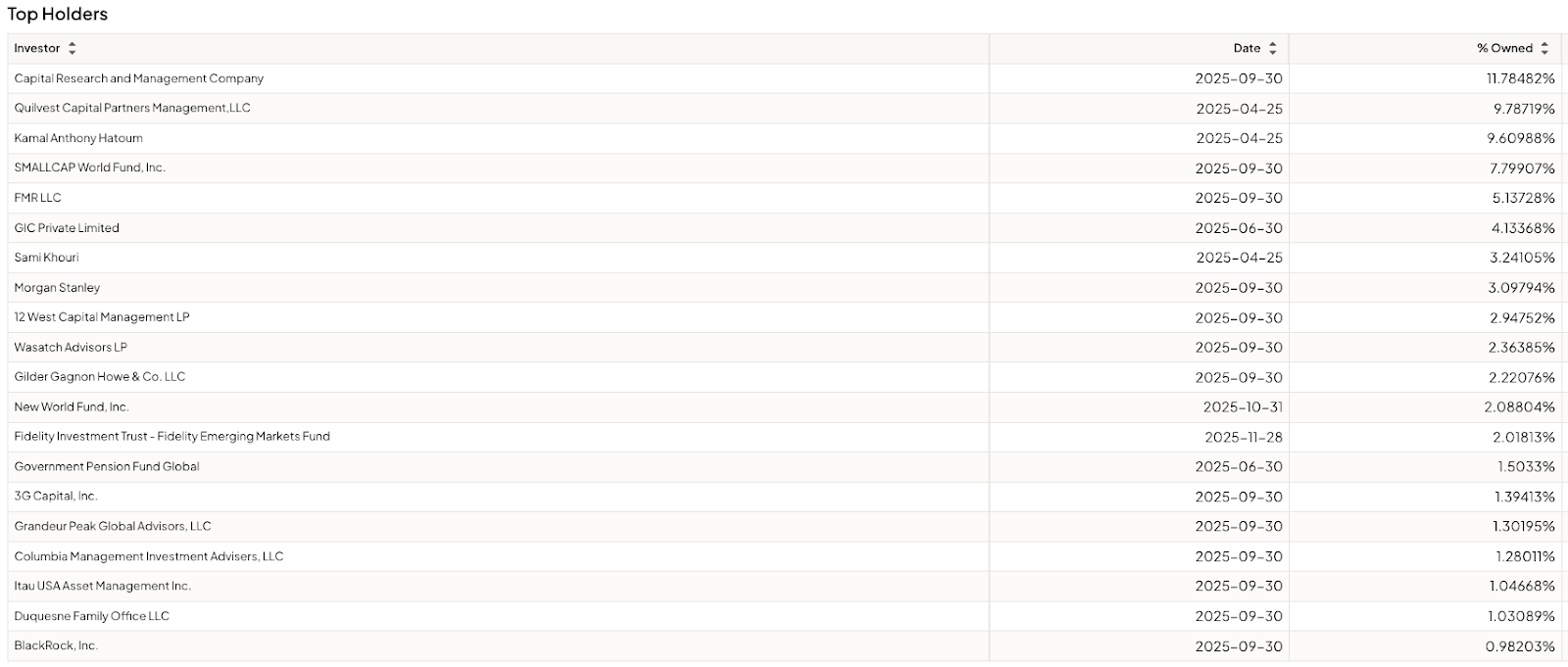
This selling pressure is likely to weigh on the stock price, but we never know for sure by how much. What seems sensible is to take it into account when building a position in the company.
The sensitiveness of the valuation model
This is a risk you’ll understand in the following section, but in short: hard discounters tend to have monstrous scale and relatively thin operating margins. This ultimately means that the valuation model is very sensitive to the exit EBITDA margin and the multiple (this applies to pretty much any company). I’ll discuss why the margin I have chosen makes sense and also why there’s somewhat of a protection in the model against this.
The valuation
Management tends to point to BIM when discussing how the future financial statements will look like, so I’ve also looked into what BIM has achieved to understand whether my forecast makes sense. Note that the entire model is available here, but I’ll go over the highlights in this article. Let’s start with the top line.
Revenue
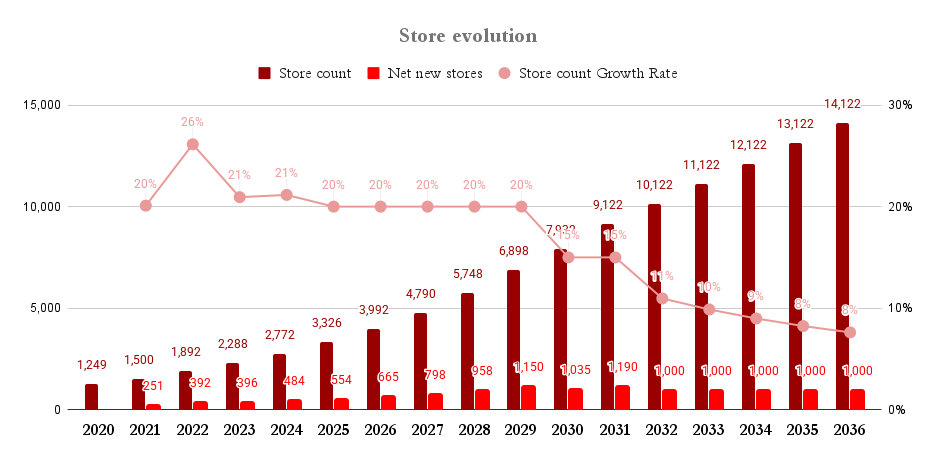
As discussed throughout the report, Tiendas 3B has two growth levers at its disposal: store openings and comparable sales growth. Forecasting comparable sales growth is pretty much impossible because we don’t really have a clean number, but I believe that forecasting store openings is easier (because we have the BIM parallel and we know more or less how much yearly store openings can scale). I assumed the following cadence of store openings. As you can see, store openings flatline once they get to 1,000 stores per year, and therefore store openings growth eventually slows down. Note that the ending store count by 2036 ends up more or less where management sees the total opportunity to be (although they’ve raised the target once and it might not be the last time). From that moment on, the company would theoretically grow mostly organically (assuming there’s no international expansion):
For the top line, I assumed the following growth rates (in the chart you can also see how they compare to the store count growth rate). Note that (obviously) the total revenue growth rate for the company decreases as the rate of store openings decreases:
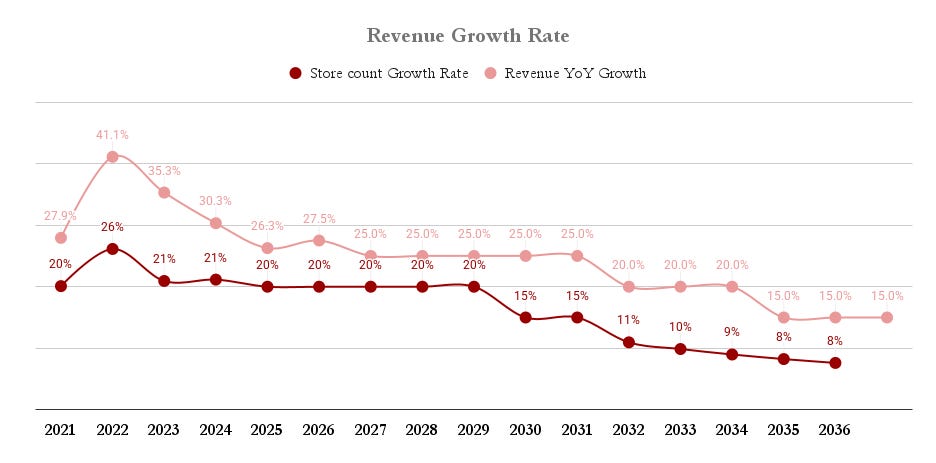
Growth rates are hefty, but doable. I mean, forecasting a 10-year CAGR of 20% should definitely raise some eyebrows, but we have a couple of ways of understanding whether this is believable. The first one is looking at BIM. If we take BIM’s 10-year reported growth rate, it’s significantly higher than the 20% CAGR we are forecasting here, but Turkey is a market that has suffered hyperinflation. Now, we can’t get the real growth rate either (reported - CPI inflation) because the hard discount model lends itself towards deflation (or let’s say less inflation). This means that BIM’s last 10-year real CAGR is likely somewhere between the reported revenue CAGR (40%) and what we could consider a real growth CAGR (of low double digits).
The other reason why this is doable is because Tiendas 3B has a blue ocean in front of it. As I shared before, hard discounter penetration has gone up considerably over time in other countries, but the format remains underpenetrated in Mexico. With a lot of share resting in the informal market, Tiendas 3B has the opportunity to gain significant market share over the coming years with virtually anything to stop it.
Profitability
For profitability we need to model two things: gross margins and SG&A as a percentage of total sales (i.e., opex). I assumed that gross margins would reach 18% by the end of the 10-year period (currently around 16.5%). I believe this is pretty doable. For context, Walmex’s gross margins stand at 24%, meaning that even at 18% it’s highly likely that Tiendas 3B’s price advantage compared to conventional retailers would still be wide. Secondly, BIM’s gross margins (which management has historically used as a parallel for Tiendas 3B’s financials) currently stand at 19%. I might have been a bit conservative with gross margins, but I have not been conservative with growth and remember there’s a trade-off between both.
As for Opex, I assumed that SG&A as a percentage of sales (excluding SBC) grows over the coming years as the company scales but that operating leverage is found as soon as store openings slow down. SG&A over total sales ends the period at 12.5%:
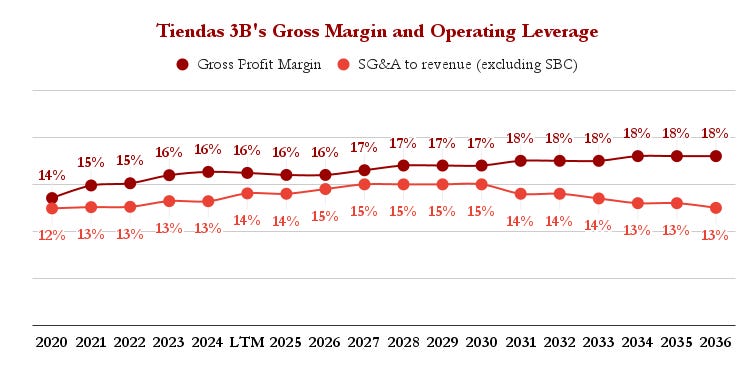
A good friend of mine told me that one can look at the ratio of SG&A to gross profit to make efficiency comparisons across companies in the same industry. With SG&A as a percentage of total sales being 12.5% at the end of the decade and gross margin being 18%, this ratio would be around 70% for Tiendas 3B. Walmex’s ratio is right around this one today and I struggle to see why Tiendas 3B should not be more efficient from an Opex perspective than Walmex considering its hard discounter advantage.
All of the above results in a 2036 EBITDA margin (excluding SBC) of 7.8%. This is considerably lower than Walmex’s EBITDA margin (around 9%) and consistent with BIM’s Adjusted EBITDA margins (excluding IAS 29 hyperinflationary adjustments) of around 7.5% - 8%. One thing I like about Tiendas 3B’s model is that margins are ultimately to an extent under their control because the cost gap is wide with conventional retailers. This means management can choose to take more gross margins to defend bottom line margins should this be necessary.
Shares outstanding and the exit multiple
I already shared the rationale for my shares outstanding calculation above. In short, I assume the same thing for the 2024 employee stock option plan that happened for the 2004 employee stock option plan: 1.4% annual dilution (over the fully diluted share count, of course). Note that management has claimed that the 2004 option plan should be a good proxy for the new one. Should dilution be higher than anticipated (from the 2024 option plan that is), then that would be good news because it would mean that the stock price is significantly higher. Assuming a 1.4% dilution over the diluted share count results in around 184 million shares outstanding by 2036:
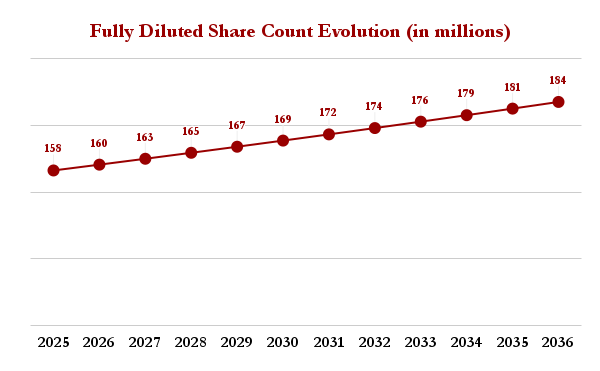
This means that EBITDA per share ends up at 249 Mexican pesos, or what’s the same at current exchange rates, around USD $14 in EBITDA per fully diluted share in 2036. The only thing missing here is a multiple. I assumed an exit EBITDA multiple of 12x. Note that “peers” like Walmex are currently trading similar EBITDA multiples despite growing significantly slower than what I expect Tiendas 3B to be growing by then. This results in a stock price of $171 in 2036 for a 16% CAGR. Important caveat: this return is in Mexican pesos and any devaluation of the peso should subtract from it, but I already explained above why this, despite being a risk, doesn’t worry me much.
Now, there’s a missing piece in all of this puzzle: the cash build!
The best thing about the model lies in its cash flows! (the BIM parallel)
In the exercise above I have focused on EBITDA, but I have ignored how much cash flows Tiendas 3B will generate over the next decade. I tried to build a Capex model (assuming stable OCF/EBITDA cash conversion) to understand how much Free Cash Flow Tiendas 3B might generate over the next decade…and the results are incredible (and most importantly, seem realistic!). According to my calculations, Tiendas 3B will generate around $8 billion in Free Cash Flow over the coming decade. For context, the current market cap is under $4 billion. This means that Tiendas 3B will potentially generate 2x its current market cap in Free Cash Flow over the next decade:

This sounds unbelievable, but BIM generated 3x its 2016 market cap in Free Cash Flow over the following decade. Evidently, that money has not stayed still in the balance sheet and BIM has returned it to shareholders through dividends and buybacks, being additive to stock price returns:
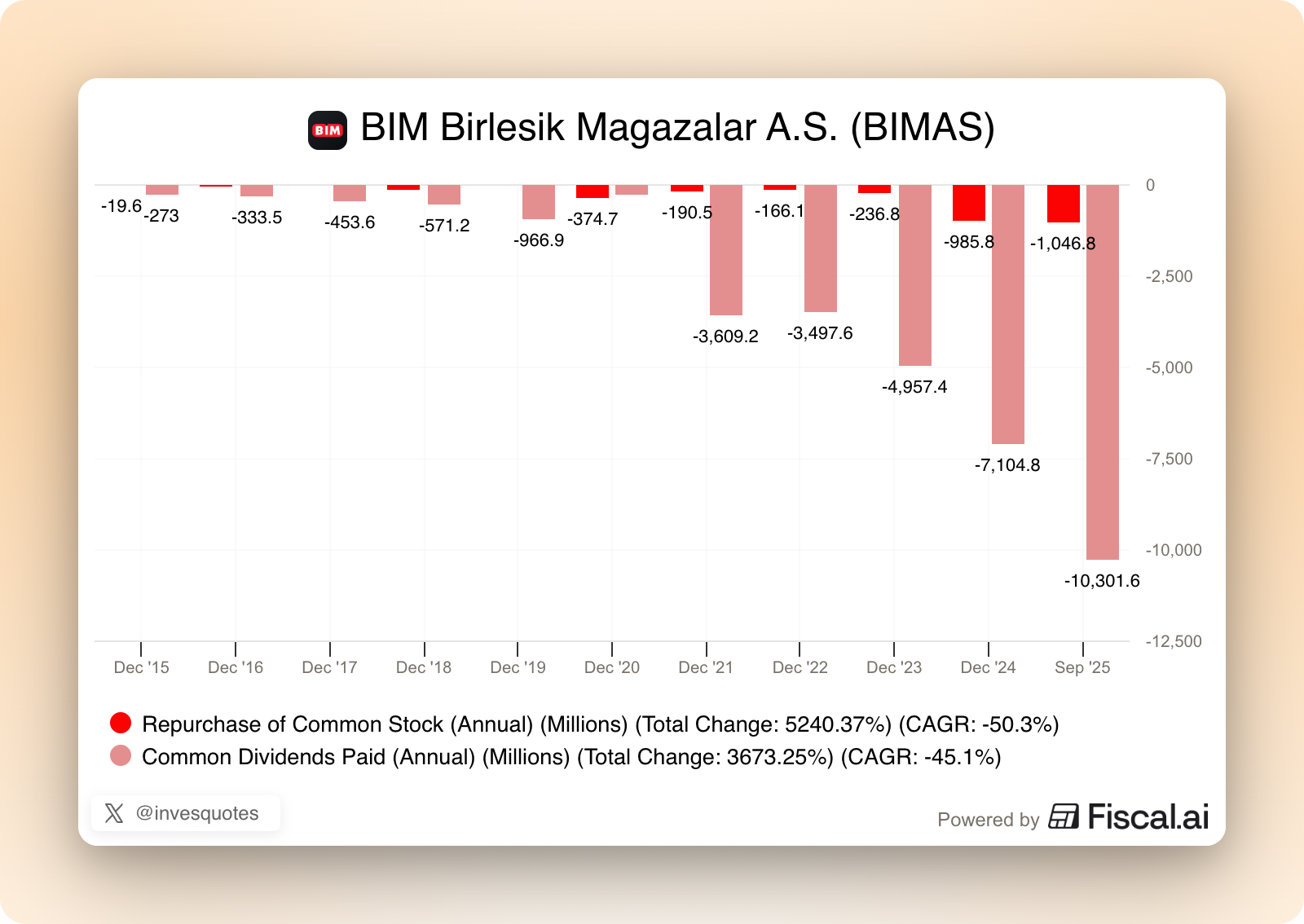
I expect something similar to happen with Tiendas 3B, although I did not take it into account in my estimate of a 16% CAGR. One thing to stress here is that there are risks inherent to the investment, regardless of how good of an opportunity it looks like. In fact, I believe the end of the lockout period could result in significant selling pressure at some point this year (or more dilution to avoid it), which is why I will start a 2%-3% position in the company and will scale it from there should there be future opportunities.
Have a great day,
Leandro
—--------------------
Disclaimer: Nothing in this document should be taken as investment advice as it has been shared with informational purposes only. Do your own due diligence.
Hola Leandro, gracias por hacer público el análisis, ha sido un gusto leerlo.
Tengo una duda que me ha surgido justo al final de la lectura. Cuando dices que "Tiendas 3B is more insulated from this risk for the sole reason that COGS are, to a great extent, dollarized in Mexico. This means that when the dollar depreciates, COGS rise.", esta relación es al contrario y entiendo que hay una errata en el texto? Me refiero, si el dolar se deprecia, los costes bajan también. Si no fuese así, te agradecería que me lo pudieras aclarar
Gracias de nuevo por tu trabajo!
Great analysis of the business.
I come up with very similar numbers as yours.
However, I have a different speed for ramping up stores openings so your 2032 numbers aligns with my 2035 (ish)
Seeing management is guiding for 590-620 store openings in 2026 (+6% vs the 574 stores in 2025), do you think it's realistic to forecast 1,000+ per year ?